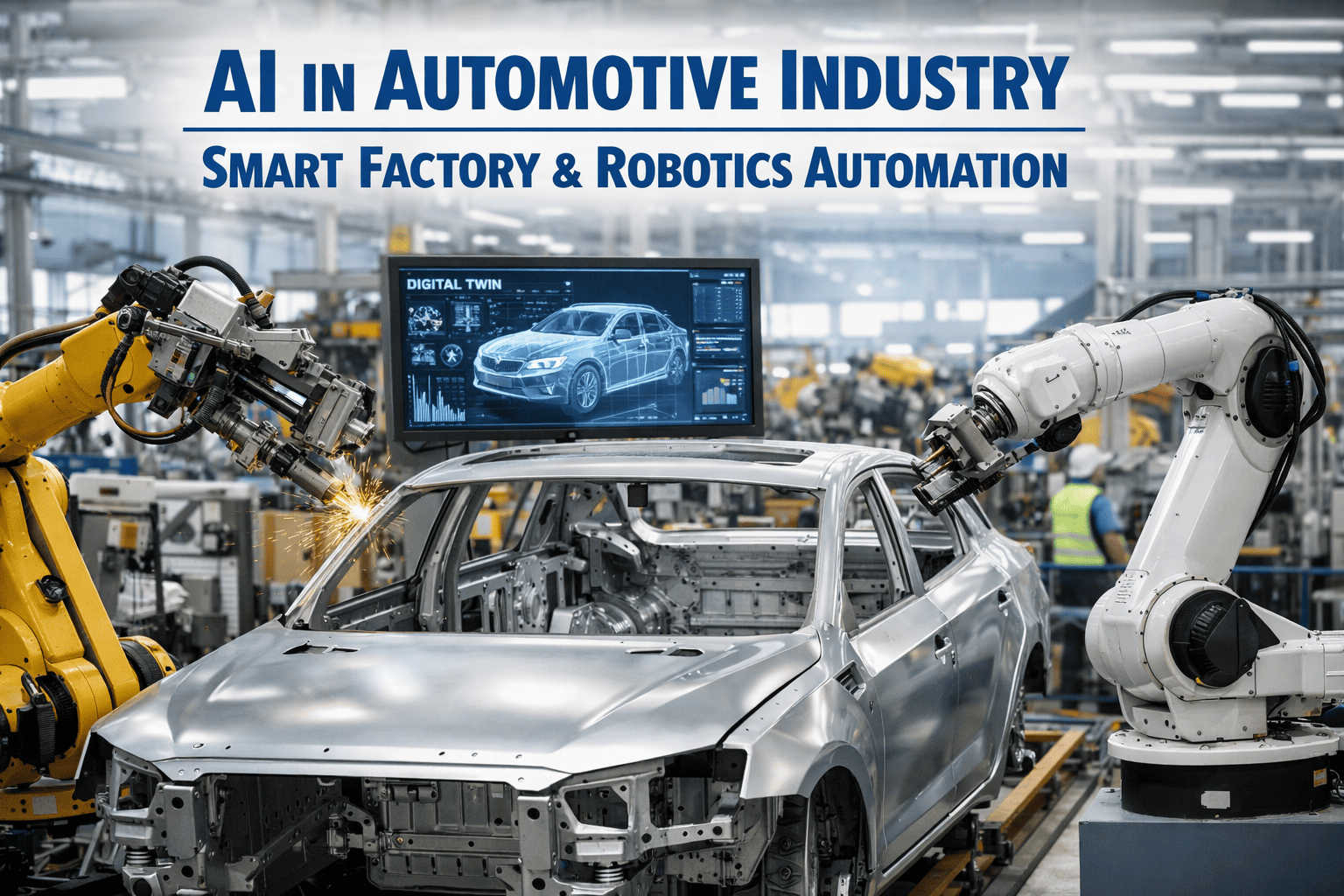
Most traditional industrial businesses were built to last — and that is exactly the problem. The systems, workflows, and decision-making habits that made them strong in 1995 are the same ones holding them back in 2026. Global spending on digital transformation is forecast to reach $3.4 trillion in 2026. The businesses that act now will pull ahead. The ones that wait will find the gap impossible to close.
iFactory Strategic Guide · Industry 4.0 · Modernization Roadmap
Step-by-Step Guide to Modernizing Traditional Industrial Businesses
Legacy systems, paper-based workflows, and disconnected operations are not just inefficient — they are existential risks. This guide gives you the exact steps to modernize, without disrupting what already works.
$3.4T
Global digital transformation spend in 2026
49%
Industrial manufacturers with active AI delivering business value
16.3%
5-year CAGR of digital transformation investment
2.5×
More likely to embed transformation as a core business pillar
Sources: IDC Digital Transformation Forecast 2026 · KPMG Global Tech Report 2026 · TEKsystems State of Digital Transformation 2026 · McKinsey Industry 4.0 · Tervene Digital Manufacturing Guide · Plataine Digital Trends 2026
The Gap Between Traditional and Modern Industrial Operations
Industry 4.0 is no longer a futuristic vision — it is the baseline of leading organizations. Manufacturers running on paper, spreadsheets, and disconnected systems are not just behind on technology. They are operating with a structural cost disadvantage that compounds every quarter. The question is no longer whether to modernize. It is how to do it without breaking what already works.
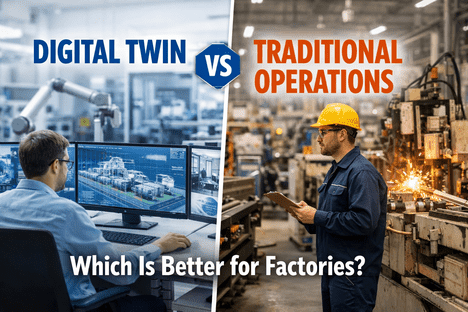
Traditional vs. Modern Industrial Operations
The operational gap that digital transformation closes · 2026 benchmark data
Traditional Business
Paper-based reporting · decisions made days late
Siloed departments with no shared data view
Reactive maintenance — fix it when it breaks
Manual quality checks prone to human error
Inventory managed by gut feeling and experience
Production KPIs reviewed monthly in spreadsheets
New equipment = new learning curve from scratch
Modern Digital Operation
Real-time dashboards · decisions made in minutes
Connected platform with one version of the truth
Predictive maintenance — fix it before it breaks
AI-assisted quality detection at line speed
Demand-driven inventory with automated reorder signals
Live OEE, throughput, and defect rate on every shift
Digital twin simulation before any production change
The 4 Pillars of Industrial Modernization
Digital transformation in manufacturing breaks down into four interconnected pillars. Process automation alone is not enough — and most businesses that fail at modernization focus only on the first pillar while ignoring the other three. All four must move together for transformation to stick.
01
Process Transformation
Using IoT, ERP, and daily management systems to cut operational waste and smooth out workflows. The foundation layer — nothing else works without it.
02
Business Model Transformation
Shifting how value is delivered — moving from pure product sales to service-driven models, predictive maintenance contracts, and data-enabled offerings.
03
Domain Transformation
Branching into new markets made possible by digital capability — digital twins, remote monitoring, connected customer portals, and cross-industry data services.
04
Cultural Transformation
The hardest and most important pillar. Changing how people think and work. A data-driven, collaborative culture is what makes everything else sustainable.
The 8-Step Modernization Roadmap
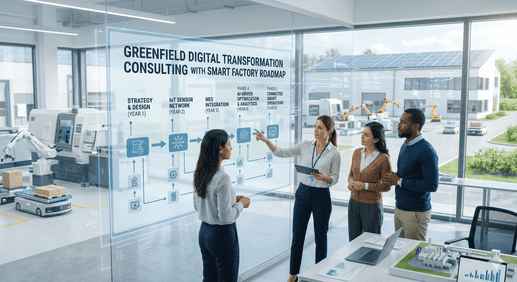
This is not a technology project. It is a business transformation with technology as the enabler. Each step builds on the previous one — skipping ahead creates integration debt and wasted investment. Follow this sequence and the results compound. Shortcut it and the same problems resurface under new software labels.
Diagnostic Phase
Audit Your Current State — Honestly
What to doMap every major operational workflow. Identify where decisions rely on paper, memory, or spreadsheets. Document where data lives — and in how many disconnected places.
Why it mattersA lot of digital projects fail because nobody stops to ask the most basic questions: what are we actually trying to fix? Most factories have the same core issues — lead times slipping, defect rates too high, and output that jumps around when supply pressure hits.
OutputA prioritized list of 5–8 operational pain points ranked by business impact and cost. This list drives every subsequent decision.
Key Question to Answer
Where are we losing money every hour that nobody is measuring?
Foundation Phase
Define Goals with Measurable Outcomes
What to doConvert every pain point into a specific, measurable goal. Not "improve efficiency" — but "reduce unplanned downtime by 30% within 12 months." Assign ownership and a deadline to each goal.
Why it mattersA KPI without a target is just data. Digital leaders are 2.5 times more likely to embed transformation as a core business pillar with explicit goals tied to every initiative. This is what separates transformations that stick from pilot projects that die quietly.
OutputA one-page modernization scorecard with 5–7 KPIs, baselines, targets, owners, and review cadence.
Key Question to Answer
What does success look like in 12 months — and how will we measure it?
Data Foundation Phase
Digitize Your Data Before You Automate Anything
What to doBefore sensors, before AI, before dashboards — get your data off paper and out of silos. Implement a single source of truth for production records, quality logs, maintenance history, and inventory levels.
Why it mattersAI and IoT can only work if the underlying data is digitalized in the first place. Manufacturers who skip this step find their advanced tools running on incomplete, inconsistent inputs — producing unreliable outputs that erode trust in the whole system.
OutputA centralized data environment where production, quality, maintenance, and inventory data flows into one accessible platform.
Key Question to Answer
If we needed yesterday's defect data right now — could we get it in under 60 seconds?
Connectivity Phase
Connect Your Machines with IIoT Sensors
What to doStart with your most expensive or most failure-prone asset. Install sensors for temperature, vibration, power draw, cycle count, and output. Connect sensor data to your central platform. Verify the signal before expanding.
Why it mattersYou are losing money every hour that your machines are not communicating. Connected equipment enables predictive maintenance — shifting from "fix it when it breaks" to "fix it before it breaks." Most factories recover this investment within 12 to 24 months.
OutputYour highest-cost asset generating live operational data — visibility into uptime, cycle efficiency, and early fault signals before failure occurs.
Key Metric to Track
OEE — Availability × Performance × Quality. World-class target: 85%+
Visibility Phase
Build Real-Time Dashboards for Every Level
What to doCreate three layers of visibility: a floor-level display showing live shift performance, a supervisor view showing team and line KPIs, and a leadership dashboard showing plant-wide OEE, quality, and throughput trends.
Why it mattersNearly half of organizations are prioritizing digital tools that break down data silos and enable seamless access across the enterprise. When every level of your organization can see the same real-time picture, decisions happen in minutes instead of days.
OutputA three-tier dashboard architecture visible on the floor, in the office, and on mobile — showing the same live data to every decision-maker simultaneously.
Key Question to Answer
Can your shift supervisor see last hour's defect rate without opening a spreadsheet?
Automation Phase
Automate Repetitive Workflows and Reporting
What to doIdentify every workflow where a human is manually moving data from one place to another — shift reports, quality logs, maintenance tickets, inventory alerts. Automate these first. Then move to process automation: automated reorder triggers, escalation alerts, and compliance documentation.
Why it mattersHyperautomation focuses on end-to-end workflows rather than isolated tasks. In 2026 this means finance operations, supply chains, and compliance functions all running with automated data flows — freeing every skilled person for problem-solving instead of data entry.
OutputZero manual shift reports. Automated quality escalations. Inventory reorder triggers. Compliance documentation that writes itself from live production data.
Key Metric to Track
Hours per week spent on manual reporting — target: reduce by 70%+ within 90 days
Intelligence Phase
Deploy AI and Predictive Analytics
What to doWith clean, connected, real-time data now flowing from steps 3–6, layer in predictive models. Predictive maintenance alerts, demand forecasting, quality deviation detection, and energy optimization are the highest-ROI starting points for most industrial operations.
Why it mattersNearly half of industrial manufacturing executives now report active AI use cases already delivering business value — significantly above the cross-sector average. The ones who built their data foundation first are the ones reaping the rewards. AI on bad data produces bad decisions at machine speed.
OutputPredictive maintenance reducing unplanned downtime. Demand forecasts improving inventory efficiency. Quality models catching deviations before they reach the customer.
Key Metric to Track
Unplanned downtime hours per month — predictive maintenance target: reduce by 40–60%
Scale Phase
Scale Across the Organization and Upskill Your Team
What to doReplicate what worked on the first asset or line across all operations. Run structured onboarding for frontline teams — not just managers. Celebrate early wins publicly: faster problem resolution, fewer breakdowns, cleaner reports. These moments build the cultural momentum that sustains transformation.
Why it mattersThe most successful digital transformations treat workforce capability as a strategic asset, not an afterthought. Technology enhances human performance — it does not replace it. Organizations investing in digital literacy and AI training now are building a structural competitive advantage that cannot be copied by buying the same software.
OutputA digitally fluent workforce. Transformation embedded into daily routines — not as a project, but as the standard way the business operates.
Key Question to Answer
Does every frontline operator understand one KPI they personally influence every shift?
Expected Results by Phase
Based on published industry benchmarks from McKinsey, WEF Global Lighthouse Network, KPMG, and TEKsystems, these are the performance improvements organizations typically achieve at each phase of a structured industrial modernization program.
Modernization ROI Timeline
Expected performance improvements by phase · Based on WEF Lighthouse Network, McKinsey, and KPMG 2026 data
Phase 1–2 · Months 1–3
Audit & Foundation
70%
Reduction in manual reporting hours
1 view
Single source of truth established
Phase 3–5 · Months 3–9
Connect & Visualize
+53%
Labor productivity lift
−26%
Conversion cost reduction
Phase 6–7 · Months 9–18
Automate & Predict
−40%
Unplanned downtime reduction
50%
Faster development and scale-up cycles
Phase 8 · Month 18+
Scale & Compound
85%+
OEE world-class threshold achievable
12–24mo
Typical full investment payback period
The 5 Most Common Modernization Mistakes
Most industrial modernization programs do not fail because the technology does not work. They fail because of predictable, avoidable organizational mistakes. These are the five we see most often — and how to avoid them.
01
Automating a broken process
Digitizing a bad workflow makes the bad workflow faster — and more expensive. Fix the process first, then automate it. Mapping the current state in Step 1 exists for exactly this reason.
02
Skipping the data foundation
Buying AI tools before your data is clean and connected is like buying a GPS before you have roads. The tool works. The inputs are wrong. The outputs are wrong. Trust in the system collapses within months.
03
Treating transformation as an IT project
Digital transformation is a business strategy that uses technology. When it lives in the IT department and not in the C-suite and on the factory floor simultaneously, adoption fails and the technology sits unused.
04
Adding tools without retiring old ones
Tool overload is one of the biggest failure modes in enterprise transformation. Every new system added without removing an old one increases the data fragmentation problem. Platform consolidation must be part of the plan from day one.
05
Ignoring the people side
Technology adoption alone is not enough — people must evolve with it. Frontline operators who do not understand the new system will work around it. Transformation that lives only at the top dies at the middle. Training, communication, and celebration of wins are not soft extras. They are the deployment strategy.
Wondering where your business sits on the modernization curve? Book a 30-minute iFactory assessment walkthrough — we will map your current state and show you the fastest path to Phase 4.
Frequently Asked Questions
How long does industrial modernization actually take?
A full 8-phase modernization takes 18 to 36 months for most industrial operations of significant scale. However, the first visible results — reduced manual reporting, live dashboards, and connected asset data — typically arrive within 60 to 90 days of starting. The key is sequencing correctly: early wins in months 1–3 build organizational confidence for the harder phases that follow. Most factories recover their full modernization investment within 12 to 24 months based on WEF and McKinsey benchmark data.
Do we need to replace our existing systems entirely?
Almost never. The best modernization approaches layer new digital capability on top of existing assets — connecting legacy machines with IIoT sensors, integrating existing ERP data into a modern analytics layer, and building dashboards that pull from systems already in place. A full rip-and-replace is rarely necessary and usually introduces more risk than it solves. Start by connecting and making visible what already exists, then upgrade selectively where genuine gaps exist.
Contact iFactory to discuss your existing systems setup.
What is Industry 4.0 and is it only for large enterprises?
Industry 4.0 refers to the fourth industrial revolution — the integration of IoT sensors, AI, real-time data analytics, cloud computing, and automation into industrial operations. It is no longer only for large enterprises. SaaS-based platforms and pay-as-you-grow sensor models have made Industry 4.0 tools accessible to mid-market and SME manufacturers. The operational principles — connected data, predictive operations, real-time visibility — apply at any scale. Starting with one machine and expanding from there is a completely viable and proven approach.
Where is the best place to start for a traditional manufacturer with no digital tools?
Start with Step 1 of this guide — the honest operational audit. Before any technology is selected or purchased, you need a clear map of where your biggest operational costs and inefficiencies live. The second move is always data digitization: get your core operational records off paper and into a centralized system. From there, connecting your highest-cost asset with IIoT sensors delivers the fastest return on the smallest initial investment. Build from there — do not try to do everything at once.
Book a free iFactory demo to see how this starting sequence works in practice.
How do we get our workforce to adopt new digital tools?
Three things work consistently: involve frontline operators in the tool selection process before purchase, not after deployment. Celebrate the first wins publicly — faster problem resolution, fewer breakdown surprises, cleaner end-of-shift reports. And make the tools make individual jobs easier, not more complicated. Digital transformation that makes a supervisor's morning meeting take 10 minutes instead of 45 spreads by word of mouth faster than any training program. The tools that fail are the ones that add steps to existing workflows instead of removing them.
Your Modernization Starts with One Conversation · iFactory Platform
See the 8-Step Roadmap Applied to Your Operation — Live
iFactory's AI analytics platform is built for exactly this journey — connecting your machines, centralizing your data, automating your reporting, and giving every level of your organization real-time visibility from day one. Book a 30-minute session with an iFactory modernization specialist and see the path from where you are to where you need to be.
8 Steps
Proven sequenced roadmap from audit to autonomous operations
12–24mo
Typical full investment payback on modernization programs
+53%
Labor productivity lift documented by WEF Lighthouse Network
Day 1
First live dashboard visibility after iFactory deployment begins