The automotive industry has always been the proving ground for manufacturing excellence — and today, that excellence is being redefined by AI. Vehicle architectures are more complex than ever, EV production demands battery assembly precision that human hands cannot consistently deliver, and just-in-time supply chains tolerate zero downtime. Traditional automation can run a fixed process with reliability. But it cannot adapt when a new model enters the line, self-correct when a weld deviates by microns, predict the exact hour an asset will fail, or simulate an entire factory changeover before a single bolt is turned. AI-powered smart factories can do all of this — simultaneously, continuously, and with a compounding accuracy that improves with every production cycle. The automotive robotics market is already at $16.32 billion in 2025, growing at 14.18% CAGR, and the manufacturers deploying AI now are building a production advantage that late movers will struggle to close.
AI-Powered Automotive Manufacturing
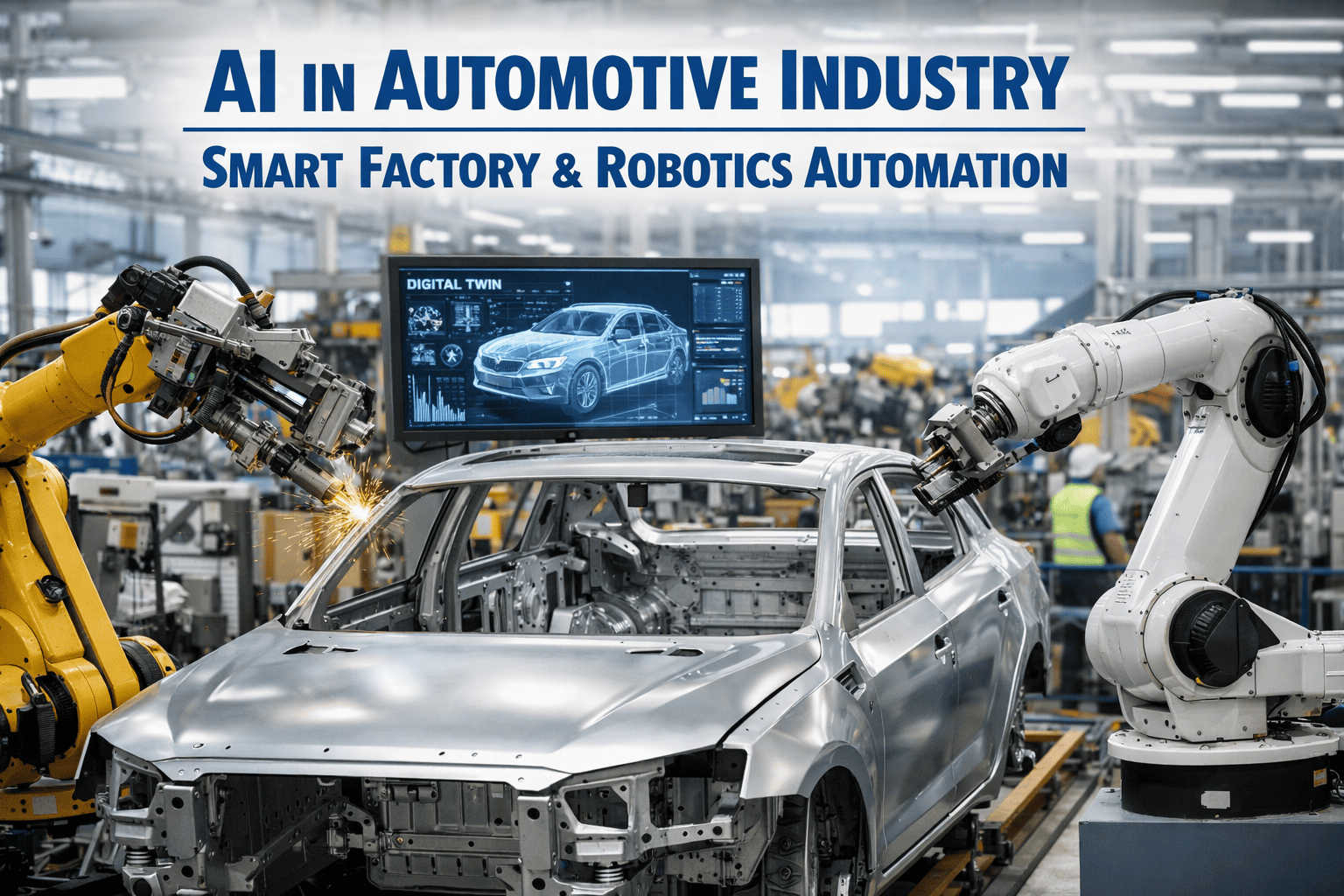
AI in Automotive Industry for Smart Factory and Robotics Automation
Deploy intelligent robots, build self-optimizing production lines, and run a factory that simulates every decision before it is made — all from your existing infrastructure.
$31.67B
Automotive robotics market projected by 2030 at 14.18% CAGR
20–40%
Equipment lifespan extension with AI-powered predictive maintenance
50%
Reduction in development time with digital twin simulation
470
Robots per 10,000 workers — automotive leads all industries globally
Sources: Mordor Intelligence · ABI Research · Persistence Market Research · McKinsey · Frontiers in AI · iFactory 2025
Why Conventional Automation Is No Longer Enough
Automotive manufacturing was the first industry to embrace industrial robots — and for decades, that advantage held. Fixed automation ran repetitive tasks with speed and consistency that human labor could not match. But the factory floor has fundamentally changed. EV production introduced battery pack assembly requiring sub-millimeter precision at scale. Multi-model flexible lines must switch configurations without extended downtime. Customers demand mass customization that breaks the economics of rigid automation. And global just-in-time supply chains mean a single unplanned stoppage cascades into production losses within hours. The answer is not more robots — it is smarter robots. AI transforms conventional automation into adaptive, self-learning production intelligence that continuously optimizes, predicts failures before they happen, and simulates every change before it is physically made.
Precision
Is every weld, seal and joint perfect?
Common Losses
Weld spatter, porosity, and micro-cracks invisible to manual inspection
Paint booth defects causing costly rework at end-of-line
EV battery cell assembly errors missed until electrical testing
What AI Does
Computer vision and sensor fusion inspect every weld, seal, and battery cell in real time — detecting micro-defects with 88–97% accuracy before they become warranty claims or safety risks downstream.
Flexibility
Can the line switch models without long changeovers?
Common Losses
Fixed automation requires hours of reprogramming between model variants
Cobots idle during transitions because sequencing is manually planned
New EV platforms require months of re-commissioning physical lines
What AI Does
AI-powered cobots adapt to part variation and model changes autonomously. Digital twin simulation validates new configurations in minutes — reducing commissioning time by 30–50% before physical changes begin.
Uptime
Is the line running when it should be?
Common Losses
Unplanned breakdowns costing $22,000 per minute on high-volume lines
Preventive maintenance replacing components that had years of life remaining
Cascading line stoppages from a single upstream equipment failure
What AI Does
Predictive maintenance models fuse vibration, thermal, and electrical sensor data to predict Remaining Useful Life with 88–97% accuracy — scheduling repairs during planned windows, not emergency shutdowns.
Speed
Is every second of capacity being used?
Common Losses
Cycle time drift after model changeovers never recalibrated to peak
Bottleneck stations identified weeks after they reduce throughput
Material flow inefficiencies on AGV routes consuming line takt time
What AI Does
AI continuously monitors cycle times, identifies bottlenecks in real time, and dynamically reschedules AGV routes and robotic sequences — compounding throughput improvements with every production shift.
Six AI Capabilities Transforming Automotive Smart Factories
Automotive plants are among the most complex manufacturing environments on earth — combining hundreds of robots, thousands of sensors, multi-model assembly, and just-in-time logistics into a system where every second of downtime has a measurable cost. Here are the six AI capabilities iFactory deploys to optimize every layer of that complexity simultaneously.
01
AI-Powered Robotics and Cobot Optimization
AI transforms conventional robots into adaptive production assets. Machine learning models continuously optimize welding parameters, torque settings, paint application profiles, and stamping press cycles — adjusting in real time as part dimensions and material properties vary across batches. Collaborative robots equipped with AI vision work alongside operators without safety fencing, flexibly handling mixed-model assembly tasks that rigid automation cannot accommodate at economic cycle times.
Typical result: 10–20% improvement in production output from existing robot assets
02
Predictive Maintenance and Asset Health Monitoring
AI fuses vibration sensors, thermal imaging, electrical signature analysis, and acoustic emission data from every critical asset — spindles, presses, welding guns, conveyor drives — to build Remaining Useful Life predictions with 88–97% accuracy. Maintenance is scheduled during planned downtime windows, eliminating emergency stoppages and removing unnecessary preventive replacement of components that have years of service remaining in them.
Typical result: 25–40% lower maintenance costs, 35–55% unplanned downtime reduction
03
Computer Vision Quality Inspection
Deep learning vision systems perform 100% inline inspection at full production speed — detecting weld defects, paint surface anomalies, dimensional deviations, assembly errors, and EV battery cell irregularities that manual or rule-based inspection consistently misses. Every defect decision is logged with captured image and confidence score, creating per-unit traceability for warranty management and regulatory compliance without manual data entry or batch sampling.
Typical result: 90% quality improvement — IoT and AI combined outperform conventional approaches
04
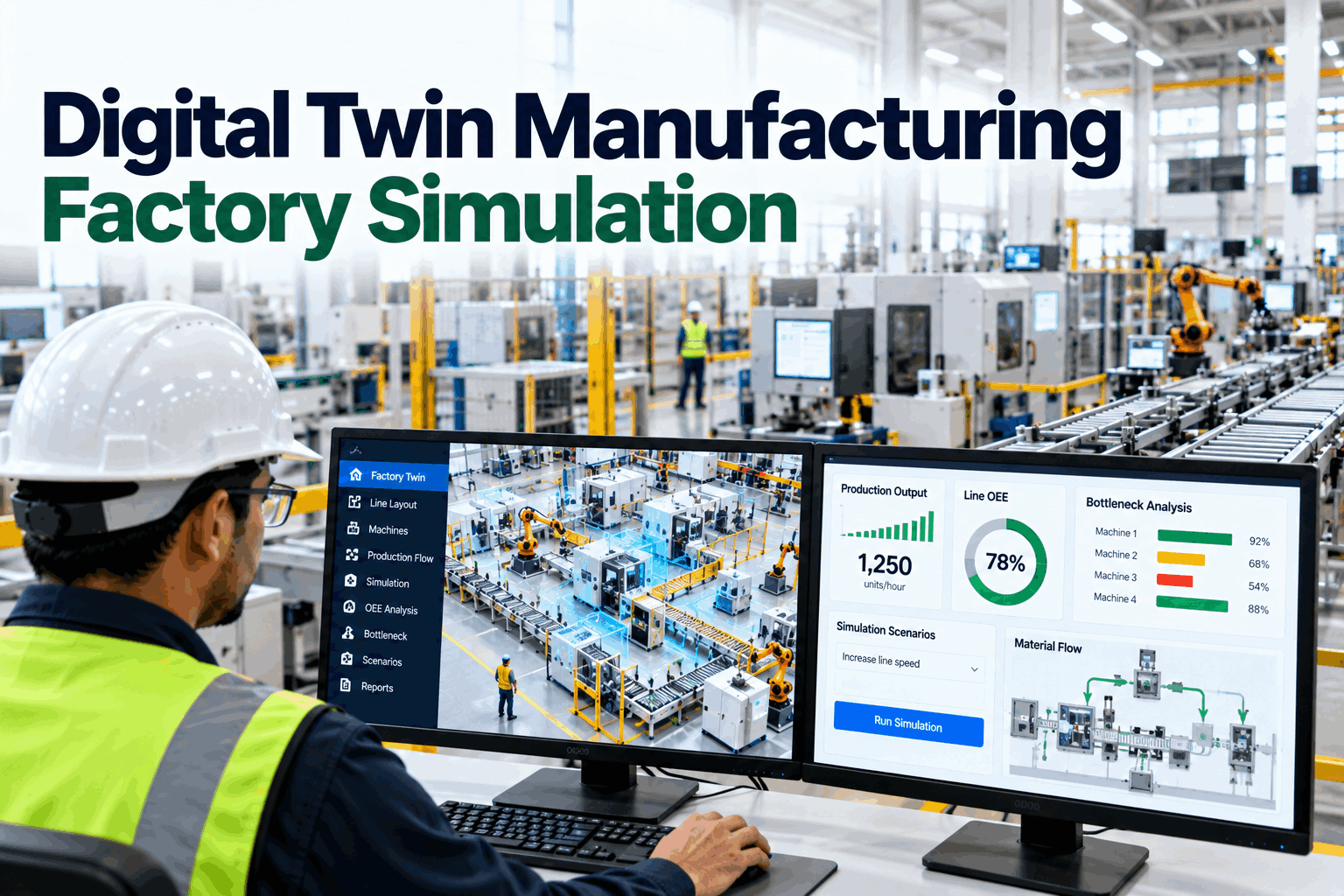
Digital Twin Factory Simulation
iFactory builds a continuously-updated virtual replica of your production environment — integrating live sensor data, robot telemetry, and production scheduling into a simulation that mirrors plant behavior in real time. Before making physical changes, engineers test new model introductions, equipment relocations, capacity expansions, and process modifications in the digital twin — validating throughput projections and eliminating costly on-floor trial-and-error. Development times cut by up to 50%.
Typical result: 30–50% reduction in commissioning time for new model introductions
05
Intelligent Production Scheduling and AGV Optimization
AI optimizes production schedules by factoring in machine availability, model sequence, material supply, workforce allocation, and takt time requirements simultaneously — dynamically adjusting when disruptions occur to maintain throughput targets. Autonomous Mobile Robot routes are continuously recalculated to minimize material travel time and eliminate wait states that silently steal line capacity shift after shift without appearing in any traditional OEE report.
Typical result: 7–20% improvement in employee and equipment productivity
06
EV Battery Assembly and Smart Production Intelligence
Electric vehicle production introduces quality tolerances that conventional automation was not designed to meet at scale — battery cell alignment, busbar welding integrity, thermal management component sealing, and high-voltage connector torque verification. AI integrates vision, torque telemetry, and thermal sensing to inspect every battery assembly step inline, flagging deviations in real time and generating ISO 26262-compliant safety documentation automatically for every unit produced.
Typical result: 40% cost savings and 85% efficiency in EV assembly operations
Want to identify which AI capabilities deliver the fastest ROI for your automotive production operations? Book a free smart factory assessment.
Before vs. After: What AI Changes in Automotive Manufacturing
The shift from conventional automotive automation to AI-powered smart factory operations is not a software upgrade — it is a structural transformation in how production decisions are made, how fast they execute, and how reliably they compound over time.
Quality Inspection
Statistical sampling, manual final checks, end-of-line only
100% inline AI vision inspection at full line speed — every unit, every shift
Maintenance Strategy
Calendar-based schedules with emergency reactive repairs
Condition-based AI predictions scheduling repairs to planned windows only
Model Changeovers
Manual reprogramming taking hours — significant production losses
Digital twin-validated configurations cutting commissioning time by 30–50%
Robot Optimization
Fixed parameters set at commissioning, drift uncorrected between campaigns
Continuous AI parameter tuning adapting to material and condition changes in real time
Production Decisions
Shift supervisors reacting to downtime and quality escapes after the fact
AI predicts and prevents disruptions hours before they impact output
Improvement Curve
Periodic engineering reviews — improvements quarterly at best
Self-learning models improve accuracy and efficiency every production cycle
Measurable Results from AI Smart Factory Deployments
These are documented outcomes from real AI deployments at major automotive manufacturers, academic research, and industry operational data from 2024 and 2025. Every figure below is sourced and auditable — not modeled projections.
50%
Development Time Reduction
Digital twin simulation cuts new model development and production validation time by up to 50% — Ford, BMW, Toyota, and Tesla all deploy digital twins to test and validate before physical build begins
40%
Cost Savings in Assembly
IoT and AI-powered smart manufacturing systems deliver 40% cost savings and 85% operational efficiency in automotive component assembly — outperforming all conventional approaches across comparative studies
25–40%
Maintenance Cost Reduction
AI predictive maintenance replacing calendar-based schedules delivers 25–40% lower maintenance costs while reducing unplanned downtime by 35–55% — protecting throughput commitments and delivery schedules
20%
Unexpected Stoppage Reduction
Digital twins integrated with predictive AI achieve up to 20% reduction in unexpected work stoppages — McKinsey data confirms the direct link between predictive asset management and production stability
10–20%
Production Output Improvement
Smart manufacturing implementation delivers 10–20% production output improvements — 2025 Smart Manufacturing and Operations Survey across manufacturers deploying Industry 4.0 AI frameworks
$21B
Hyundai AI Investment 2025–28
Hyundai Motor Group committed $21B in US investment for 2025–2028, allocating $6B specifically to autonomous driving, robotics, and AI partnerships with Boston Dynamics and NVIDIA — signaling the scale of the shift
Sources: McKinsey · Persistence Market Research · Mordor Intelligence · Springer Nature · Smart Manufacturing Survey 2025 · S&P Global Mobility
Industry Applications: Where AI Delivers the Biggest Wins in Automotive
AI smart factory capabilities apply across the full automotive production system — but certain segments and operations deliver outsized returns because of the precision requirements involved, the cost of failure, or the complexity of the transition they are currently managing.
Body in White and Stamping
Welding and stamping operations generate the highest robot density and the most failure-critical quality requirements in any automotive plant. AI continuously optimizes welding parameters — current, voltage, electrode force, cycle time — based on real-time material property feedback. Computer vision detects spatter, porosity, and dimensional deviations at inline inspection speeds, eliminating quality escapes that reach the paint shop and require costly rework or scrap decisions.
Paint and Surface Treatment
Paint booth conditions — temperature, humidity, airflow velocity, and atomization parameters — interact in non-linear ways that static recipes cannot compensate for. AI monitors environmental and process variables continuously, adjusting spray parameters in real time to maintain film thickness consistency and surface quality. Computer vision performs final paint inspection detecting orange peel, dirt inclusions, and color deviation at resolution and speed impossible for human inspectors on high-volume lines.
EV Battery Pack Assembly
Battery module assembly demands a precision level that conventional automation was not architected for. Cell alignment tolerances of fractions of a millimeter, busbar weld integrity verified by thermal imaging, electrolyte fill accuracy monitored in real time, and high-voltage connector torque logging for ISO 26262 compliance — all require AI integration of vision, thermal, and mechanical sensing to deliver the quality and traceability that EV safety standards require at production volumes.
Final Assembly and Trim Lines
Mixed-model final assembly is the most complex production environment in automotive manufacturing — sequencing hundreds of part variations across multi-model lines where a single mis-sequence triggers significant rework. AI-powered vision systems verify torque compliance, part fitment, and connector engagement at every station. Cobots handle flexible assembly tasks alongside operators, adapting to model-specific requirements without extended line stops or manual tooling changeovers.
Powertrain and Engine Machining
Machining centers for engine blocks, cylinder heads, and transmission housings require continuous tool wear monitoring to maintain dimensional tolerances across production campaigns. AI analyzes spindle vibration signatures, cutting force data, and acoustic emission in real time — predicting tool change requirements before tolerances drift outside specification, eliminating both premature tool replacement and quality escapes caused by worn tooling that was not detected in time.
Tier 1 and Tier 2 Suppliers
Automotive suppliers face OEM quality expectations that require process capability levels unachievable with manual inspection. AI quality systems deliver the 100% inline inspection, per-unit traceability, and PPAP-compliant documentation that OEM approval processes demand. Digital twin simulation enables suppliers to validate new component designs against OEM specifications virtually — reducing prototype build cycles and accelerating the engineering change approval process that governs supplier competitiveness.
The Smart Factory Race Is Already Underway
The global automotive robotics market stands at $16.32 billion in 2025 and will reach $31.67 billion by 2030 at 14.18% CAGR. The global digital twin market is racing from $21.14 billion in 2025 toward $149.81 billion by 2030 at 47.9% CAGR. Over 63% of automotive companies are already using digital twin technology to support sustainability goals. Mercedes-Benz took a strategic stake in Apptronik in March 2025 and began testing humanoid robots at its Digital Factory Campus in Berlin. Hyundai committed $6 billion specifically to AI and robotics partnerships. NVIDIA, ABB, Siemens, and Fanuc are all building closed-loop AI frameworks for automotive production. The manufacturers who deploy AI now lock in an operational lead that compounds year over year as their models improve on their own production data.
13M
Robots in global circulation by 2030 — ABI Research
72%
Of manufacturers already implementing Industry 4.0 smart factory initiatives
How iFactory Deploys AI in Automotive Smart Factories
iFactory connects to your existing PLC, SCADA, MES, and robot controller infrastructure — no replacement of production equipment required. Our AI layer ingests the operational data your plant already produces and transforms it into real-time optimization intelligence, predictive maintenance foresight, and quality automation that compounds shift after shift.
Week 1–2
Connect and Integrate
Integrate with your existing PLCs, robot controllers, SCADA, MES, and sensor networks via OPC-UA, REST API, or MQTT. Deploy computer vision hardware at quality inspection points. Begin streaming production parameters, robot telemetry, and asset health data into iFactory's analytics engine — with zero disruption to running production operations throughout the integration process.
AI vision models train on your specific vehicle components and quality standards. Predictive maintenance models establish baseline degradation signatures for every critical asset. The digital twin is constructed from live plant data — building a continuously-updated virtual replica that mirrors real production behavior across all operating conditions, model variants, and shift patterns.
Week 5–6
Optimize and Alert
Activate real-time quality inspection at full production speed. Predictive maintenance alerts go live — flagging asset health risks before they become production stoppages. Robot optimization recommendations deploy via operator dashboard or closed-loop automated adjustment. Digital twin simulation becomes available for new model planning and changeover validation. Production scheduling AI activates across all lines.
Week 7–8
Measure and Scale
Quantify OEE improvement, quality defect reduction, maintenance cost savings, and throughput gains against your pre-deployment baseline. Present board-ready ROI analysis with full audit trail. Expand AI capabilities to additional production lines, new model programs, and Tier 1 supplier integration based on demonstrated results from the initial deployment.
Ready to build a smart factory that improves with every production cycle? Schedule your free automotive AI assessment.
Frequently Asked Questions
What is an AI-powered automotive smart factory?
An AI-powered automotive smart factory uses machine learning, computer vision, digital twins, and predictive analytics to continuously optimize production in real time — adapting robot parameters, predicting equipment failures before they occur, inspecting every unit at full line speed, and simulating every change before it is physically made. Unlike conventional automation, which runs fixed programs, AI learns from production data and improves accuracy and efficiency with every operating cycle.
Book a demo to see iFactory's automotive AI in action.
How does AI predictive maintenance work in automotive plants?
AI predictive maintenance fuses vibration, thermal, electrical, and acoustic sensor data from critical assets — welding guns, stamping presses, conveyor drives, robot joints — to build Remaining Useful Life predictions with 88–97% accuracy. The system identifies degradation signatures weeks before failure, scheduling maintenance during planned production windows. This eliminates both emergency stoppages and the waste of preventive replacement for components that had years of service remaining in them.
What is a digital twin and how is it used in automotive manufacturing?
A digital twin is a continuously-updated virtual replica of your production environment that mirrors real-time equipment behavior and line dynamics. In automotive manufacturing, digital twins are used to simulate new model introductions before physical commissioning, validate equipment moves and capacity changes, predict bottlenecks before they affect throughput, and test process changes without risking production disruption. Ford, BMW, Toyota, and Tesla all use digital twins for vehicle development and factory optimization — reducing development times by up to 50%.
Does iFactory's AI work with existing robot systems and PLCs?
Yes. iFactory connects to your existing robot controllers, PLCs, SCADA, and MES systems without requiring replacement of any production equipment. The AI layer ingests data from ABB, FANUC, KUKA, Yaskawa, and other major robot platforms via OPC-UA, REST API, and MQTT protocols. If your equipment generates digital data — which all modern automotive production systems do — iFactory can analyze and optimize from it within two weeks of integration with no production disruption.
What ROI can automotive manufacturers expect from AI deployment?
Automotive manufacturers typically see 10–20% production output improvements, 25–40% lower maintenance costs, 35–55% unplanned downtime reduction, and 30–50% commissioning time cuts for new model introductions. Digital twin simulation delivers 15–30% ROI within the first few years, with payback periods often under 24 months for targeted deployments. Quality AI drives 40% cost savings and 85% efficiency in assembly operations. iFactory deployments deliver measurable gains within 8 weeks, with full ROI documented within 6 to 12 months.
Schedule a demo to model your specific savings.
Your Factory Is Already Generating the Data
Let AI Turn Your Production Data Into a Self-Optimizing Smart Factory.
iFactory connects to your existing PLCs, robot controllers, SCADA, and MES to deliver real-time quality inspection, predictive maintenance, digital twin simulation, and production optimization — all running within 8 weeks, with zero disruption to live operations.
8 Weeks
From data connection to live AI optimization
Zero
Production disruption during deployment
50%
Development time reduction with digital twin
14.18%
Annual growth rate of automotive robotics market