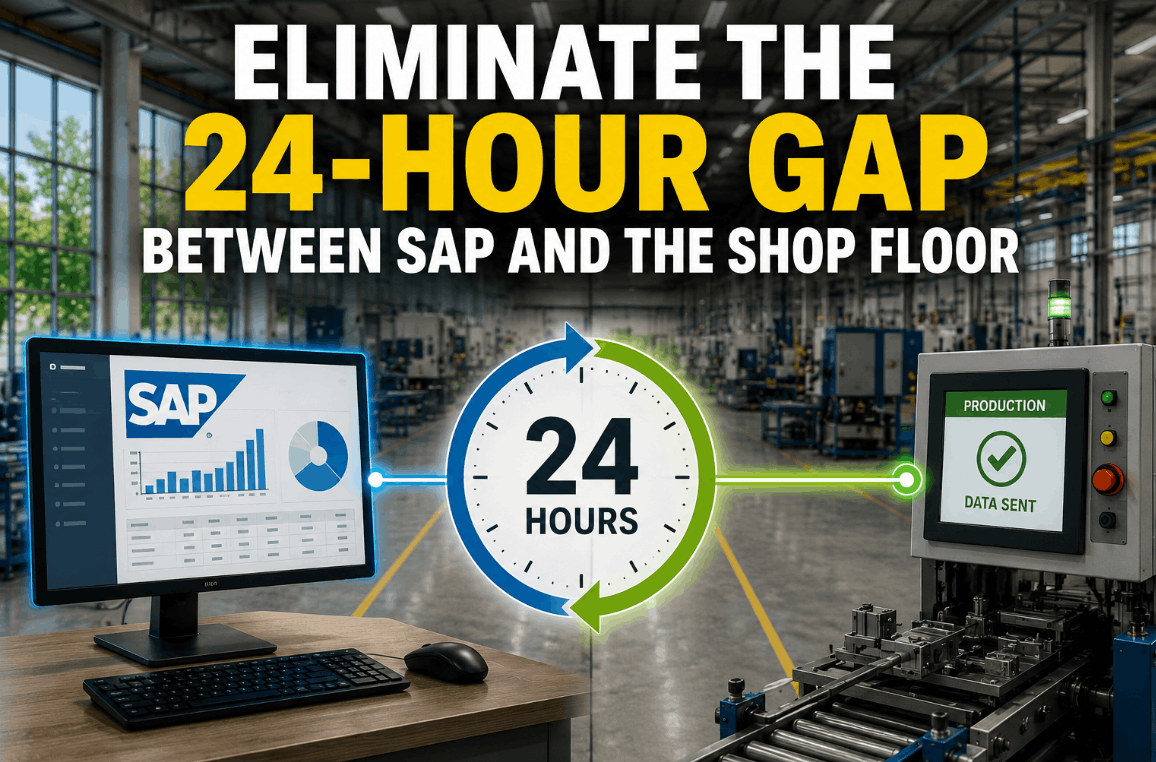
Every plant running SAP knows the end-of-shift upload ritual: production operators key in quantities, scrap, and downtime from paper logs or spreadsheets; the data sits in a staging table until the shift supervisor approves the batch; and sometime in the next shift, SAP MM and PP receive an update on what happened 12 to 24 hours earlier. This workflow is so embedded in manufacturing operations that most plants treat the latency as an unchangeable fact of life — but it is not a fact of life, it is an architecture choice, and it is a costly one. When SAP shows an order as "in process" for three days after the line has already finished it, inventory positions are wrong, procurement releases are mistimed, and every production confirmation carries a timestamp that does not match the actual event. iFactory closes this gap by polling the shop floor at 2-second intervals via MSMQ, transforming production events into live SAP updates through a REST and webhook bridge, and maintaining a live tick counter that confirms every transaction reached SAP — verified in sub-minute time, every time, without batch uploads or end-of-shift reconciliation.
The Real Cost of the 24-Hour Data Gap
Why End-of-Shift Batch Uploads Create a False Picture of Production
The 24-hour gap between production events and SAP updates does not just create a delay — it creates a structural data inconsistency that propagates into every SAP module that depends on accurate, timely inventory and production confirmation data. SAP MM plans replenishment based on inventory positions that are 12 to 36 hours stale. SAP PP confirms production orders with quantities and scrap percentages that are aggregated rather than event-based. SAP CO accrues variances against standard costs using data that has already been averaged and smoothed by the shift-end reconciliation process. The result is an ERP system that is nominally "real-time" in its technical architecture but operates on manufacturing data that is perpetually out of date.
The operational cost of this latency is concentrated in three areas. First, inventory inaccuracy — when consumption and production posting are delayed, cycle count adjustments become the primary correction mechanism, and every adjustment represents a period during which procurement and planning systems were operating on incorrect inventory positions. Second, production order closure — when orders cannot be closed because confirmation data has not been posted, WIP valuations remain open longer, and the costing team spends the first week of every month reconciling order variances that would not exist if the data had been posted at the time of the event. Third, production visibility — when operations managers and shift supervisors cannot see real-time order status in SAP, they make scheduling and resource allocation decisions based on whiteboard updates and verbal reports rather than actual production system data.
- Production data posted 12–24 hours after events occur
- Inventory positions stale — procurement releasing against outdated stock levels
- Production order closure delayed 2–5 days per order
- Shift-end batch reconciliation consuming 3–6 operator-hours per shift
- Costing team spends 4–6 days per month on variance reconciliation
- Scheduling decisions based on whiteboard status, not live SAP data
- Production data posted in SAP within 2–10 seconds of the event
- Inventory positions updated live — procurement sees actual stock in real time
- Production orders closed within minutes of the last confirmation
- Zero manual batch uploads — all posting is automated via MSMQ and REST
- Costing data accurate at month-end — no manual variance reconciliation needed
- Operations decisions based on live SAP data, not verbal reports
How Sub-Minute SAP-Shop Floor Synchronization Works
From MSMQ Poll to Live SAP Update in Seconds
iFactory's SAP synchronization architecture is built on three core components: a high-frequency MSMQ poll that checks the shop floor message queue every 2 seconds; a REST and webhook bridge that transforms production events into the IDoc or API format SAP expects; and a live tick counter that confirms every transaction reached SAP and is visible in the target module. The architecture requires no changes to SAP's standard interfaces — it connects through the same IDoc, RFC, and OData endpoints that SAP supports natively, using the security and authentication protocols already configured in your SAP landscape.
The entire cycle — from MSMQ poll to SAP confirmation tick — completes in under 10 seconds under normal operating conditions. For plants running SAP ECC, the connection uses standard RFC and IDoc interfaces. For S/4HANA environments, iFactory supports both the traditional IDoc path and the newer OData API endpoints. The architecture is independent of the specific MES or SCADA platform on the shop floor — any system that can write a message to MSMQ or expose a REST endpoint can be integrated without custom development. To see this architecture applied to your specific SAP and shop floor environment, Book a Demo with iFactory's SAP integration engineering team.
Measurable Impact of Real-Time SAP Integration
What Sub-Minute Data Freshness Delivers to Production Operations
The financial impact of eliminating the 24-hour data gap is measurable in the first month of live operation. Inventory accuracy improves from typical end-of-shift levels of 85–92% to over 98% sustained, because every material movement is posted at the moment it occurs rather than waiting for batch reconciliation. Production order closure cycles shorten from 2–5 days to under 30 minutes, freeing working capital that was trapped in open WIP valuations. The operations team recovers 3–6 operator-hours per shift that were previously consumed by end-of-shift data transcription and validation. And the costing team closes each month without the 4-to-6-day variance reconciliation exercise that had become an accepted cost of running SAP with delayed manufacturing data. Book a Demo to see a live tick counter demonstration with your own SAP instance.
We had accepted the 24-hour SAP latency as an operational constraint for eight years. Our production operators spent the last 45 minutes of every shift keying quantities and scrap codes into an SAP transaction screen from handwritten batch tickets. The data was always wrong — not maliciously, just inevitably — because transcription errors, forgotten events, and estimation of quantities when the physical count did not match the production log meant that every shift-end upload was a negotiation between what the line produced and what the operator could reconstruct from memory and paper. iFactory connected our MES message queue to SAP through their MSMQ poll and REST bridge. The first week of live operation, we identified 14% more scrap than our manual process had been capturing — because the PLC-level event detection was catching short stops and material losses that the operators were not recording. That scrap had been invisible in our SAP data for years. The live tick counter gives us confirmed visibility into every transaction. We have not done a single end-of-shift manual upload since go-live.
Architecture for Live Plant-to-SAP Connectivity
The Components That Deliver Sub-Minute Data Freshness
A production-grade live SAP integration requires four architectural layers: a polling engine that checks for new production events at sub-minute intervals; a transformation layer that converts shop floor message formats into SAP-compatible payloads; a secure transmission bridge that handles delivery confirmation, retry logic, and error handling; and a monitoring layer that verifies every transaction reached SAP and alerts on any failure. iFactory delivers all four layers in a single platform that integrates with any shop floor system capable of writing structured messages.
| Architecture Component | iFactory Implementation | Supported SAP Interfaces | Latency |
|---|---|---|---|
| Message Queue Poll | MSMQ poll at configurable 1–60 second intervals with priority queuing | N/A — shop floor side | 2 sec |
| Data Transformation | Payload mapping engine — converts shop floor messages to IDoc, OData, or RFC format | IDoc, OData V2/V4, RFC FM | < 1 sec |
| Transmission Bridge | REST endpoints and configurable webhooks with TLS 1.3 and automatic retry | SAP ECC, S/4HANA, S/4HANA Cloud | 1–5 sec |
| Confirmation Monitor | Live tick counter — SAP response recorded per transaction with timeout alerting | All SAP targets | < 2 sec |
Closing the Data Freshness Gap
Why Sub-Minute SAP Sync Is an Operational Necessity
The gap between when production happens and when SAP knows about it is not a technical constraint — it is a design flaw that has been accepted as normal because the tools to fix it were either too expensive, too complex, or too risky to deploy in a production environment. iFactory's live SAP integration architecture changes that calculation by delivering sub-minute synchronization through standard SAP interfaces, without custom development, without middleware procurement, and without changes to the shop floor systems that are already generating the data. The result is an ERP system that reflects the actual state of the plant — not the state of the plant as it was at the end of the last shift. If your SAP instance is still operating on yesterday's data, you are making today's decisions with yesterday's information. Book a Demo to see how iFactory's live sync bridge connects your shop floor to SAP in under 10 seconds.
Frequently Asked Questions
The gap is caused by end-of-shift batch upload workflows where production data is manually transcribed from paper logs or spreadsheets and posted to SAP in a single consolidated transaction hours after events occur.
iFactory polls the shop floor MSMQ queue every 2 seconds and transmits transformed events to SAP via standard REST, webhook, or IDoc interfaces — all within SAP's native security and authentication framework.
A live tick counter records every transaction's SAP confirmation response with timestamps, providing verified visibility that data reached SAP — eliminating the uncertainty of unconfirmed message delivery.
No — iFactory connects to SAP through standard RFC, IDoc, and OData interfaces and ingests shop floor data through MSMQ or REST without modifications to either system.
Most plants close production orders within minutes of the last confirmation event instead of 2–5 days, because the final confirmation is posted live rather than waiting for end-of-shift batch processing.