In-Spec Coil & Lot Tracking — Real-Time With Recipe Version Stamping
By Henry Green on June 4, 2026
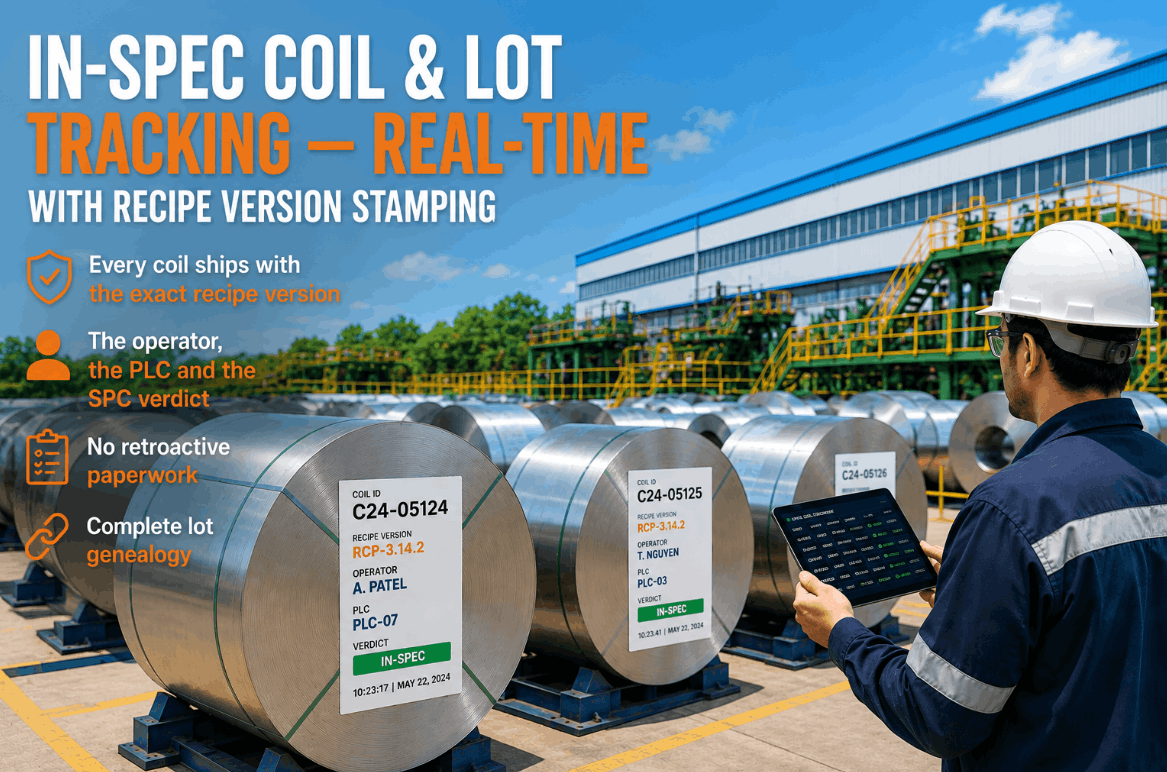
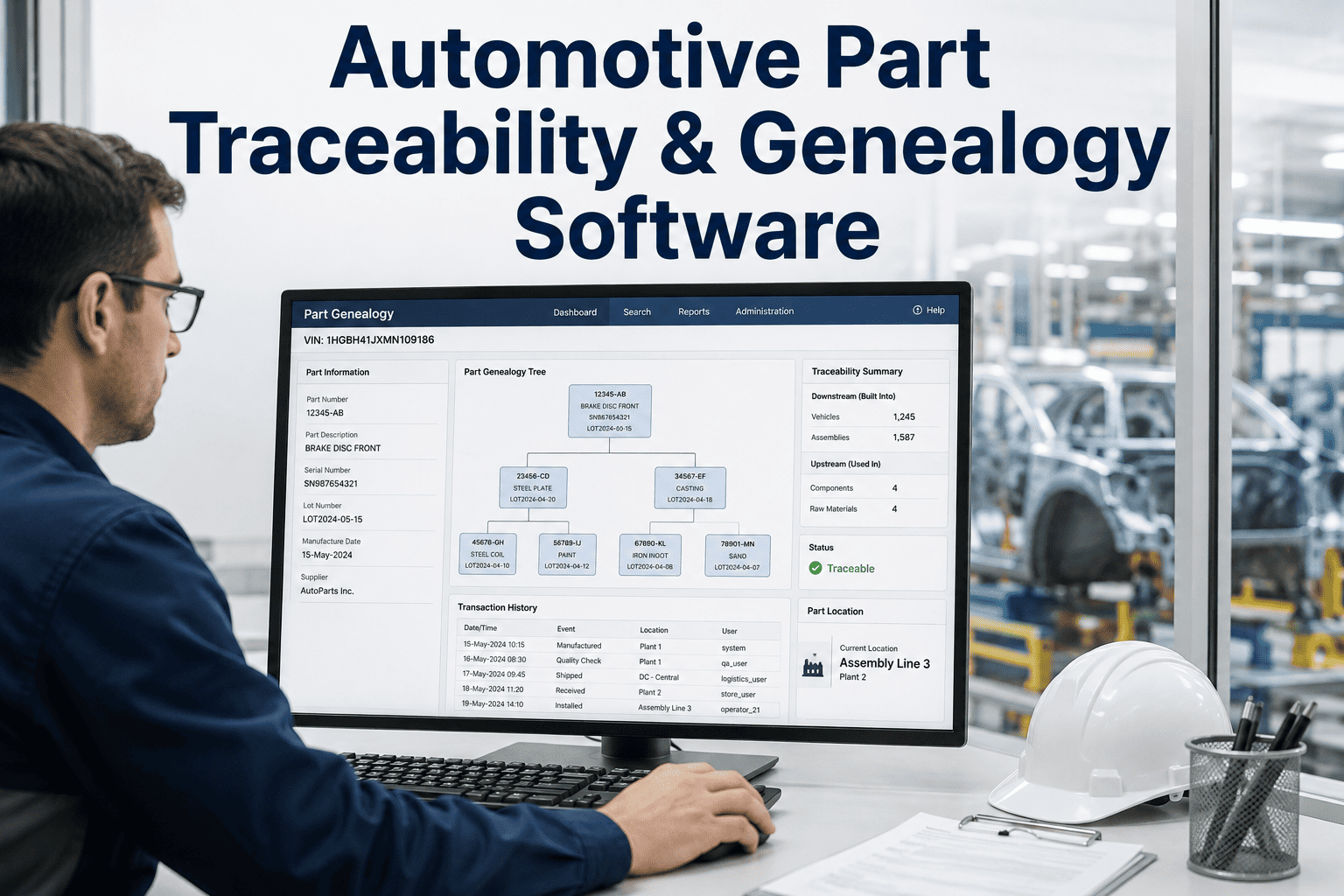
In steel service centers, rolling mills, and coil processing lines across the United States, the question that production quality leads face after every coil completion is not whether the material met spec — it is whether that determination can be proven, traced to the exact recipe version, operator, and PLC state at time of production, and delivered to the customer without a day of retroactive paperwork. Real-time in-spec coil and lot tracking closes this gap at the event level. iFactory's live coil-completion stream captures coil ID, weight, recipe version, operator identity, PLC parameter snapshot, and in-spec verdict the moment a coil exits the line — creating a complete, recipe-bound genealogy record with no manual assembly required. For a conversation about how iFactory's traceability platform applies to your coil production environment, Book a Demo with our quality engineering team.
Live Coil Stream · Recipe Version Stamping · In-Spec Verdict · Real-Time
In-Spec Coil & Lot Tracking — Real-Time With Recipe Version Stamping
iFactory's live coil-completion stream stamps every coil with the exact recipe version, operator, PLC state, weight, and SPC verdict at the moment of production — so every lot ships with a complete genealogy record and no retroactive paperwork.
Real-TimeIn-spec verdict captured at coil-completion event — not reconstructed after the shift
100%Coil-level recipe version stamping — every lot linked to the exact PLC recipe active at production
<15 minFull lot genealogy trace assembly vs. 4–8 hours of manual record retrieval
ZeroRetroactive paperwork required — every data element captured automatically at production time
Why Coil Traceability Breaks Down — and What It Costs
The traceability gap in coil and lot production is not a data problem — it is a timing problem. Most U.S. mills and service centers generate the necessary data: SPC readings, PLC recipe parameters, operator records, and weight measurements all exist somewhere in the production infrastructure. The failure is that these data elements are captured in disconnected systems, at different times, by different people, and are only assembled into a coherent lot record after the fact — often hours or days after the coil has already moved to packaging, inventory, or shipment staging.
When a customer submits a material nonconformance, or a distributor requires a material test report with recipe documentation, or an internal quality review demands traceability to the PLC version active during a suspect heat — the quality lead is assembling records from the historian, the operator log, the gauge system export, and the manual weight entry sheet, hoping that shift-change gaps and transcription errors did not introduce discrepancies. The cost of this process is not just the hours it consumes. It is the warranty exposure created when records cannot be produced, and the customer confidence lost when documentation arrives days after the quality inquiry. Book a Demo to see how iFactory eliminates this gap at the coil-completion event level.
Recipe Version Ambiguity at Time of Production
When a recipe parameter is adjusted mid-shift, coils produced before and after the change share the same lot identifier but were processed under different PLC versions. Without event-level recipe stamping, it is impossible to determine retroactively which coils ran on which recipe — exposing the plant to mixed-lot quality risk.
60%+ of lot quality inquiries involve recipe version ambiguity in plants without live stamping
Operator Record Gaps at Shift Changes
Manual operator logging introduces inherent gaps during shift transitions — the outgoing operator does not complete the record, the incoming operator lacks context, and the coil completion entry is made retrospectively from memory. These gaps are precisely the windows where quality events occur.
4–8 hrs average time to reconstruct a complete lot record from disconnected manual sources
SPC Verdict Not Linked to the Physical Coil
SPC control charts run in the quality system. Coil IDs are tracked in the ERP. Weight data lives in the gauge system. When these are not joined at the coil-completion event, the in-spec verdict exists as a chart entry — not as an attribute stamped to the specific coil and lot that will appear on the customer's material test report.
3× more likely to face customer documentation requests when SPC and lot data are disconnected
Retroactive Paperwork Is Not an Audit-Ready Record
A lot genealogy record assembled after the fact from memory, exports, and manual cross-referencing is not the same as a real-time stamped event record. Customers, certification auditors, and regulatory reviewers increasingly distinguish between contemporaneous traceability data and retrospectively assembled documentation — and the distinction matters in nonconformance proceedings.
Hours saved per customer inquiry when live stamped records replace manual assembly
iFactory's Live Coil-Completion Stream: What Gets Stamped and When
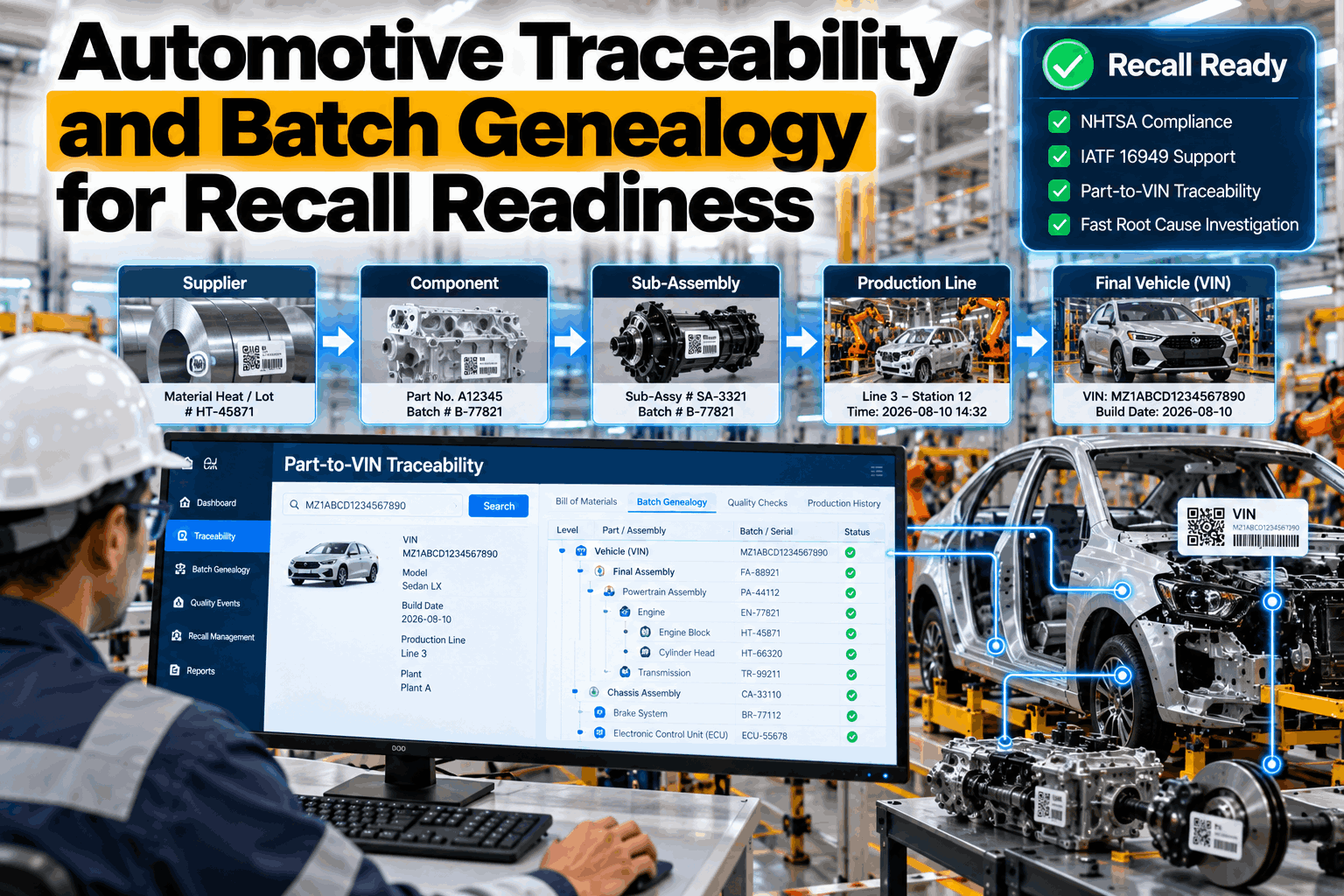
iFactory's coil traceability module operates at the production event level — not at the shift level, the lot level, or the batch summary level. When a coil completes the line, a coil-completion event fires automatically, pulling every relevant data element from its source system and stamping them together into a single, timestamped genealogy record. The record is immutable, immediately queryable, and never requires retroactive assembly.
Data Elements Stamped at Every Coil-Completion Event
Coil ID
Unique coil identifier from the production tracking system — linked to the physical label, customer order, and internal lot record simultaneously at event time.
Coil Weight
Actual finished weight from the coil scale, captured at completion — eliminating the manual weight-entry step that introduces transcription discrepancies into material test reports.
Recipe Version
The exact PLC recipe version active during this coil's production — not the current recipe, not the nominal recipe for the order, but the version that was running when this specific coil was processed.
Operator Identity
The logged-in operator at the time of coil completion — captured from the production terminal authentication, not from a retrospective log entry, providing a defensible chain of personnel accountability.
PLC Parameter Snapshot
Key process parameters from the PLC at time of completion — exit temperature, tension, speed, and other critical values — creating a process fingerprint tied to this coil that supports root-cause analysis if a quality issue emerges downstream.
In-Spec SPC Verdict
The pass/fail determination from the SPC engine at time of coil completion — based on the actual process data for this coil against the spec band in effect under the active recipe version, not a summary assessment applied after the run.
Every Coil Ships With a Complete Genealogy Record — No Assembly Required
iFactory's live coil-completion stream means the lot genealogy record is complete the moment the coil leaves the line. When a customer requests documentation, the quality lead queries by coil ID and exports a record that includes the recipe version, operator, PLC snapshot, weight, and SPC verdict — in under two minutes, from any device, without contacting the shift team or pulling historian exports.
Real-Time Traceability vs. Retroactive Record Assembly: A Direct Comparison
The operational difference between real-time coil stamping and retroactive lot record assembly is not a matter of convenience — it is a matter of data integrity. The table below compares the two approaches across the dimensions that matter most when a production quality lead needs to respond to a customer inquiry, close a nonconformance, or prepare for a third-party audit.
Scroll to compare
Traceability Dimension
Retroactive Record Assembly
iFactory Live Coil-Completion Stream
Recipe Version at Time of Production
Inferred from shift log — may not reflect mid-shift parameter changes
Exact PLC recipe version stamped at coil-completion event
Operator Identity
Retroactive entry — subject to shift-change memory gaps
Authenticated terminal user captured at event time
In-Spec SPC Verdict
Applied retrospectively from chart exports — not linked to the coil record
Live SPC verdict stamped per coil at completion
Coil Weight
Manual entry from scale printout — transcription errors possible
Automated capture from coil scale at event trigger
PLC Parameter Record
Historian export required — manual correlation to coil ID
PLC snapshot embedded in coil-completion event record
Requires preparation — records assembled on request
Always audit-ready — complete record exists from production time
Platform Capabilities: What iFactory Delivers for Production Quality Leads
iFactory's coil traceability and recipe version stamping module is one component of a broader quality and production intelligence platform — but it is the component that production quality leads rely on most directly when traceability is required on short notice. The capabilities below are designed specifically for coil, strip, and lot-based production environments in U.S. mills and service centers.
Live Coil-Completion Stream
Event-driven data capture at every coil completion — pulling coil ID, weight, recipe version, operator, PLC parameters, and SPC verdict simultaneously into a single immutable event record with no manual trigger required.
Core Traceability
Recipe Version Stamping
Every coil record includes the exact recipe version number active in the PLC at time of production — supporting mid-shift recipe change traceability and eliminating version ambiguity when coils produced under different recipes share a lot identifier.
Recipe Management
In-Spec Verdict Per Coil
SPC pass/fail verdict bound to each coil completion event — not a batch summary, not a shift-level determination, but a coil-level quality stamp generated from the actual process data running against the active spec band at time of production.
SPC Integration
Lot Genealogy Query
Single-query lot genealogy trace by coil ID, order number, or lot number — returning the complete record including all stamped data elements, production timeline, and downstream disposition status in under 15 minutes.
Genealogy Trace
Real-Time Production Dashboard
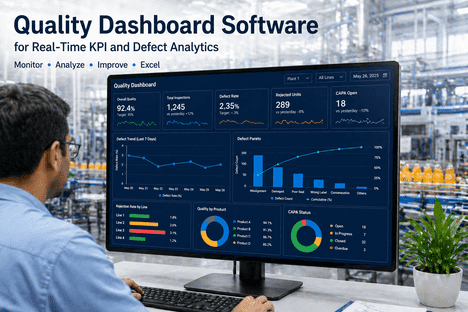
Live view of the coil-completion stream — in-spec rate by line, recipe version distribution across active production, operator-level quality performance, and shift-level coil count with weight totals — updated continuously without manual refresh.
Operations Intelligence
Customer Documentation Export
Coil-level material test report generation with all stamped data elements — formatted for customer submission or third-party audit, exportable in PDF or structured data format, available for any coil from the moment it completes the line.
Audit Readiness
Ready to see iFactory's live coil-completion stream configured for your production environment? Book a Demo with our quality engineering team — we demonstrate the recipe version stamping and SPC verdict workflow on live coil data.
Expert Perspective
The traceability question in coil production has always been the same: can you prove, for this specific coil, what recipe it ran on, who was operating the line, and whether it met spec — not for the lot, not for the shift, but for this coil? In most mills I have worked with over the past fifteen years, the honest answer is no — not without two to four hours of record assembly, and not without material uncertainty about mid-shift parameter changes that may have affected part of the lot. The operational impact of that uncertainty is larger than most quality leaders realize. It is not just the hours spent assembling records — it is the customer relationships eroded when documentation arrives late, the nonconformance investigations that drag on because the PLC version cannot be definitively established, and the product held in inventory because the in-spec determination cannot be confirmed without pulling the shift supervisor. Plants that have deployed real-time coil-completion stamping consistently report that the first customer inquiry they handle with the new system changes the conversation with that customer permanently. When you can respond to a nonconformance request by querying the coil ID and sending a complete record with recipe version, operator, PLC snapshot, and SPC verdict within ten minutes, your customer's perception of your quality system maturity shifts. That perception has real commercial value — in retained business, in reduced escrow holds, and in faster payment on documentation-dependent invoices.
— Quality Systems Director, Flat-Rolled Steel Service Center · 18 Years Coil Processing Quality Experience · ASQ Certified Quality Manager · Former Quality Lead at U.S. Tier-1 Automotive Stamping Supplier
What U.S. Coil Producers Achieve with iFactory Traceability
<15 min
Lot Genealogy Trace Time
Single-query coil trace with all stamped data elements — replacing 4–8 hours of manual record retrieval from disconnected historian, ERP, and gauge system exports
100%
Coil-Level Recipe Documentation
Every coil produced after deployment carries a recipe version stamp — no gaps, no retroactive inference, no ambiguity when mid-shift parameter changes create mixed-recipe lot conditions
Zero
Retroactive Paperwork Required
All data elements captured at the coil-completion event — quality leads respond to customer documentation requests from a complete record, not from an assembly process that must be initiated when the inquiry arrives
Real-Time
In-Spec Status Visibility
Live coil-completion stream gives production quality leads a continuous view of in-spec rate, out-of-spec events, and recipe version distribution — across all active lines simultaneously, without waiting for shift-end reports
Conclusion: Coil Traceability Is Only as Good as the Moment It Was Captured
The most important characteristic of a lot genealogy record is not completeness — it is timing. A record assembled after the fact from disconnected sources may contain the same data fields as a real-time stamped event record, but it does not have the same evidentiary value, the same audit defensibility, or the same response speed when a customer or regulatory reviewer requires documentation on short notice. The difference between a coil record that was stamped at production time and one that was reconstructed the following day is the difference between traceability and an approximation of traceability.
iFactory's live coil-completion stream delivers real traceability — coil ID, weight, recipe version, operator, PLC snapshot, and in-spec SPC verdict, captured at the moment of production, immutable, and immediately queryable. For production quality leads managing customer documentation obligations, nonconformance investigations, and internal quality reviews, that timing difference is the entire value proposition. The retroactive paperwork problem does not need to be managed more efficiently — it needs to be eliminated at the source.
iFactory for In-Spec Coil & Lot Tracking — Built for U.S. Coil Production
Live coil-completion stamping. Recipe version traceability. Real-time in-spec verdicts. Complete lot genealogy in under 15 minutes. iFactory delivers the coil traceability platform that production quality leads require — so every coil ships with a complete record and no retroactive paperwork.
How does iFactory capture the recipe version at coil completion — does it require changes to the PLC program?
iFactory reads the active recipe version from the PLC via OPC-UA or direct historian connection — no PLC program modifications are required. The recipe version tag is polled at the coil-completion event trigger and embedded in the event record automatically.
What happens when a recipe parameter is changed mid-coil — does iFactory capture both versions?
Yes — iFactory logs the recipe version active at coil start and at coil completion, and flags the coil record when a recipe change occurred during production, giving quality leads a clear indicator that this coil may span two parameter states requiring separate evaluation.
Can the in-spec SPC verdict be configured for different spec bands per customer or per order?
Yes — iFactory supports customer-specific and order-specific spec band configuration, so the in-spec verdict stamped at coil completion is evaluated against the tolerance applicable to the specific order being produced, not a generic plant-level standard.
What ERP and MES systems does iFactory integrate with for coil ID and order linkage?
iFactory supports pre-built integration with SAP, Oracle JD Edwards, Infor CloudSuite Industrial, and Microsoft Dynamics 365 — coil IDs and order references are linked at the event level so lot genealogy records are queryable from both the iFactory traceability module and your existing ERP.
How quickly can iFactory's coil-completion stamping be operational on an existing production line?
Most coil and strip processing facilities reach full production deployment — PLC integration, coil-completion event configuration, SPC verdict linkage, and operator dashboard — within 4 to 8 weeks, with the first stamped coil records generated in the initial commissioning week. Book a Demo to discuss the specific timeline for your line configuration.