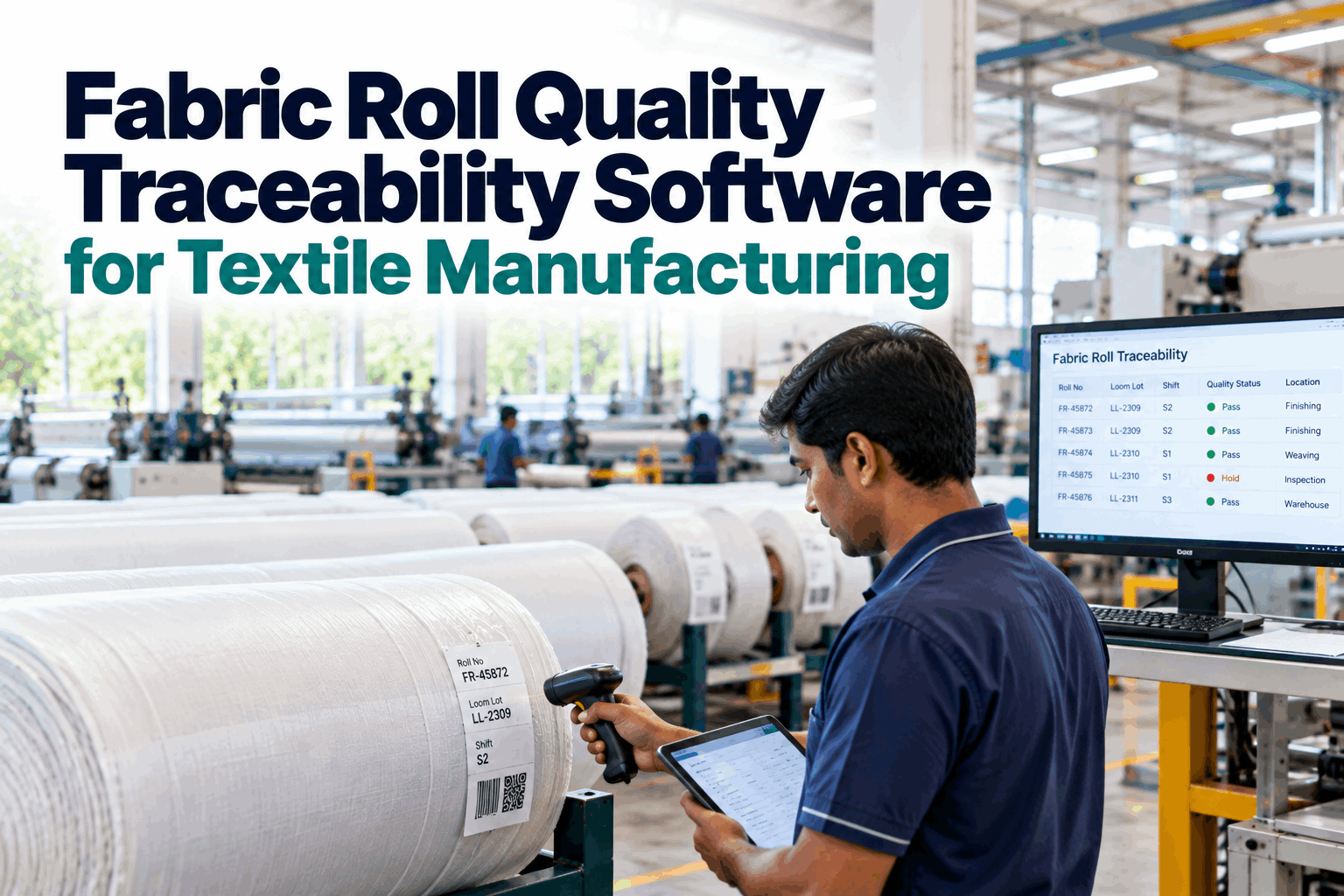
When a garment maker reports a defect, the first question is always the same: where did this fabric come from? In many mills, answering it means hours of digging through handwritten labels, loom logs and dyehouse sheets, and sometimes the trail simply ends. Roll-level traceability links every finished roll back to its yarn lot, warp beam, loom, shift and dye lot, and forward to the cut orders it fed. This article explains what to record, how to connect it, and why buyer and regulatory pressure is turning traceability from a nice-to-have into a requirement. To see a complaint traced end to end, book a short walkthrough.
Fabric Roll Quality Traceability: Link Every Defect to Its Loom, Lot and Shift
Roll IDs, defect maps and production records joined into one chain, so a complaint becomes a root cause in minutes instead of a week of searching.
Why a Single Complaint Can Take a Week to Trace
A mill might produce thousands of rolls a month. Each one passes through several departments, each with its own records: yarn receiving, warping, weaving or knitting, greige inspection, dyeing and finishing, final inspection and dispatch. When the records live on paper or in separate spreadsheets, and roll IDs change between departments, the chain breaks at every hand-off.
The cost shows up when a complaint arrives. The customer reports holes in shirts cut from a particular delivery. To find the cause, someone has to map finished roll numbers back to dye lots, dye lots to greige rolls, and greige rolls to looms and shifts. If the greige roll number was written by hand and re-labelled after dyeing, the trail may end there. Without the source, the fix is a guess, and the same defect keeps coming back.
The good news is that most of the data already exists. It just needs a common roll identity and a place where the links are kept. We can review your current records in a short call.
From Yarn Lot to Cut Order: The Links That Matter
A useful traceability chain has seven links. Each one is a hand-off where an ID must be carried forward or mapped to the next. Miss one and every link after it becomes guesswork.
Received lots logged with spinner, count and lot ID.
Beam built from named yarn lots, given its own ID.
Greige roll woven on a known loom, shift and date.
Inspected and scored with a defect map.
Greige rolls batched into a dye lot and recipe.
Final inspection, grade and shade band.
Rolls issued to cutting against a garment order.
For knitted fabrics the chain is similar, with the knitting machine and yarn feeders in place of the warp beam and loom. For printed fabrics, add the printing machine, the rotary screen set and the print batch.
The hardest links are usually greige roll to dye lot, because rolls are often sewn together for dyeing, and finished roll to cut order, because that record sits with the garment maker. Both can be solved with scanning and shared roll IDs. Ask our engineers how other mills handle them.
The Minimum Data Set for Every Roll
Traceability fails when the record is either too thin to be useful or too heavy for the floor to keep up with. The minimum data set below covers what a root cause investigation actually needs.
| Field | Captured at | Example | Used for |
|---|---|---|---|
| Roll ID | Doffing or roll off | GR-24-11873 | The key every other record links to |
| Yarn lot IDs | Warping or knitting set-up | Spinner lot 5520, 30s combed | Barre, yarn faults, count issues |
| Beam or machine ID | Warping, loom or knitter | Beam B-318, loom 42 | Sister rolls and machine patterns |
| Shift and time | Weaving or knitting | Night shift, 02:10 | Shift and operator team patterns |
| Defect map | Greige and final inspection | 14 defects, yard positions | Cutting plans, root cause |
| Four-point score | Greige and final inspection | 22 points per 100 sq yd | Grade and buyer acceptance |
| Dye lot and recipe | Dyehouse batching | D-551, reactive navy | Shade grouping, lot risk |
| Shade band | Final inspection | Band B | Keeping garments to one shade |
| Dispatch and order | Packing and dispatch | PO 7702, delivery 3 | Linking complaints to rolls |
Most fields are captured by a scan rather than typed. A roll label with a barcode or QR code at doffing, scanned again at each stage, carries the identity forward without anyone rewriting numbers. That is where most trace gaps disappear.
Keep the record honest about what it does not know. If a greige roll was re-labelled by hand before the scanners were in place, mark the link as unverified rather than guessing. An investigation that knows where the chain is weak is far more useful than one built on confident but wrong links.
Loom, Lot and Shift: What the Data Reveals
Once rolls carry their history, quality data can be sliced by any link in the chain. Patterns that were invisible on paper become obvious.
A worn reed or a loose harness shows up as the same defect type repeating on every roll from one loom.
Rolls from the same warp beam share yarn and tension history, so a beam problem appears across all of them.
Yarn-driven defects cluster by lot, not by loom, which points the fix at the spinner rather than weaving.
A defect that rises on one shift often points to set-up, maintenance timing or training rather than machines.
Stains and shade issues grouped by dye lot direct attention to the dyehouse batch and recipe.
Some constructions are simply harder to weave; the data shows which articles need tighter process control.
Illustrative data. Two looms account for more than half of the week’s defect points, which tells the weaving room exactly where to start.
None of this needs new theory. It needs every roll to carry its source. See this analysis on your own data in a demo.
Why Buyers and Regulators Now Ask for Traceability
Traceability used to be an internal quality tool. It is now also a condition of doing business in several markets.
The same roll genealogy that speeds up complaint handling also supplies the evidence these requirements call for. Building it once serves quality, compliance and customer reporting together.
Requirements differ by market and are still evolving, so treat this as orientation rather than legal advice. Our team can show how the records map to buyer requests.
From Complaint to Root Cause, Step by Step
With a connected chain, a complaint follows a short, repeatable path.
Scan or enter the garment order and delivery. The system lists the finished rolls issued to it.
Compare the complaint with each roll’s inspection record. Was the defect seen and scored, or missed?
Follow the roll to its dye lot, greige roll, loom, shift and yarn lots.
List every roll that shares the suspect beam, loom period or dye lot, and check stock.
Act on the source, then watch the next rolls from that loom or lot to confirm the fix held.
What used to take a week of searching becomes a short, documented investigation, with a report you can share with the customer. That report template is part of the rollout.
How iFactory Delivers Roll-Level Traceability
Barcode or QR labels scanned at every stage, no retyping.
Four-point scores and defect maps attached to each roll.
Loom, beam, shift and yarn lots pulled from machine and ERP data.
Greige rolls mapped to dye lots, recipes and shade bands.
Defects sliced by loom, lot, shift and article.
Complaint investigations exported with the full chain.
It connects to your ERP and machine data rather than replacing them. Share a recent complaint and we will trace it live in a session.
Trace a Real Complaint on Your Own Data
Start with one product line. We connect roll labels, inspection results and production records, then trace a recent complaint from the finished roll back to its loom and lot.
Traced to finished roll 3316, dye lot D-551, greige from loom 42 on night shift. Two sister rolls from the same beam are still in stock.
A Complaint Traced in Minutes
This is how a quality manager might work through a customer complaint with iFactory.
iFactory ships as a pre-configured NVIDIA AI server, racked and ready with the roll traceability and defect analytics models loaded. Rack it, plug in power and Ethernet, and the AI is live on your network. Our scope covers cameras and lighting on inspection frames and scan points, PLC/SCADA and ERP integration, cabling and network setup, operator and QC team training, and 24×7 remote monitoring.
Server installed, cameras and lighting mounted, historical inspection and defect records loaded.
Models trained on your own fabrics and styles, then piloted on one line with your QC team reviewing every call.
Rollout to the agreed lines, inspector and supervisor training, ERP hand-off and 24×7 remote monitoring in place.
Hardware, software, labels and integration come as one package. For a scoped quote, contact our sales team.
Frequently Asked Questions
It is the ability to link each finished roll to the materials, machines, shifts and processes that made it, and forward to the orders it supplied. A complete chain runs from yarn lot through warp beam, loom, greige roll and dye lot to the finished roll and cut order.
At minimum: a unique roll ID, yarn lots, beam or machine ID, shift and time, inspection score and defect map, dye lot and recipe, shade band, and the order and delivery it was shipped against.
Greige rolls are scanned when they are batched into a dye lot, and the finished rolls are scanned when they come off finishing. The software keeps the mapping, so the link survives even when rolls are sewn together or re-cut.
It supplies much of the underlying data, such as origin and the economic operators involved. The textile delegated act is planned for adoption in Q4 2027, and the exact data requirements will be set there.
No. Smaller mills often gain the most, because each complaint costs them proportionally more. Starting with roll labels, scanning at key stages and digital inspection records is enough to close most gaps.
Most rollouts take 6–12 weeks, starting with labels, scan points and data links, then a pilot on one product line, then full rollout. Plan the scope with our engineers.
Know Where Every Roll Came From
iFactory joins roll IDs, inspection results and production records into one chain, so every defect has a source and every complaint has an answer.
The weakest link shows where labels or scans are being skipped.