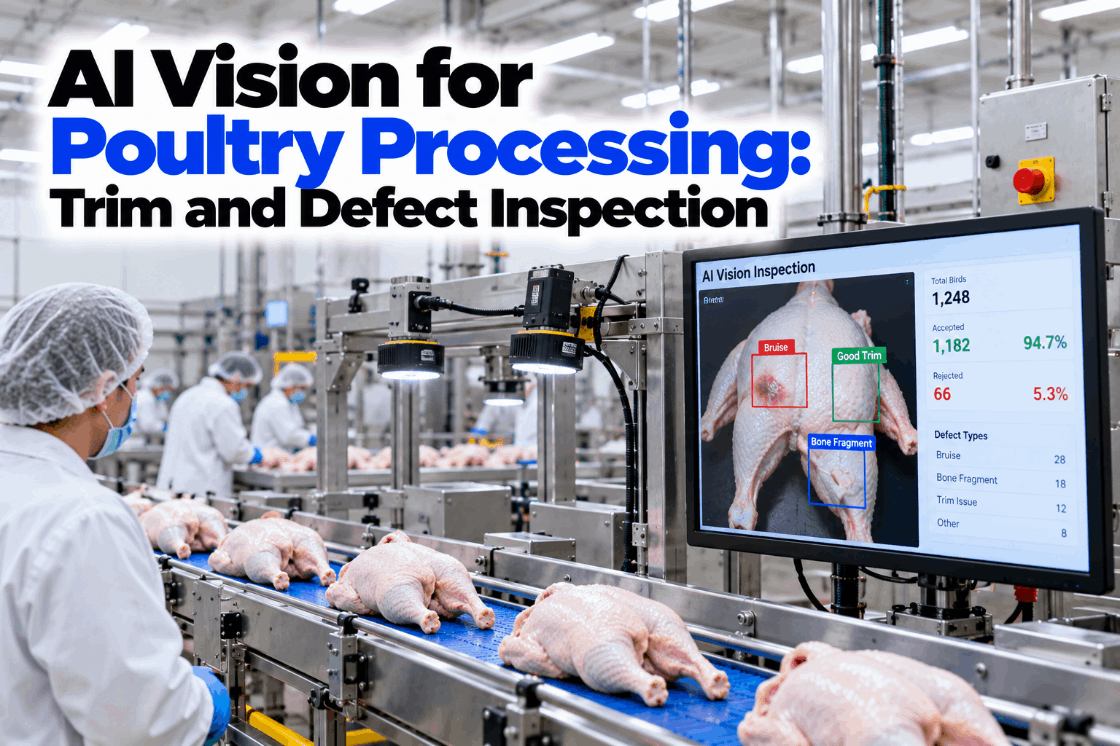
A broiler line can run at 140 birds a minute or more, and every bird and fillet still needs a quality call. Sorters and trimmers do their best, but calls drift across a long shift, and downgrades are often counted only at the end. AI vision checks every piece the same way, routes rejects to the right station and tracks where trim loss comes from. See it grade real poultry images in a short poultry vision demo.
Grade Every Bird and Fillet the Same Way, Shift After Shift
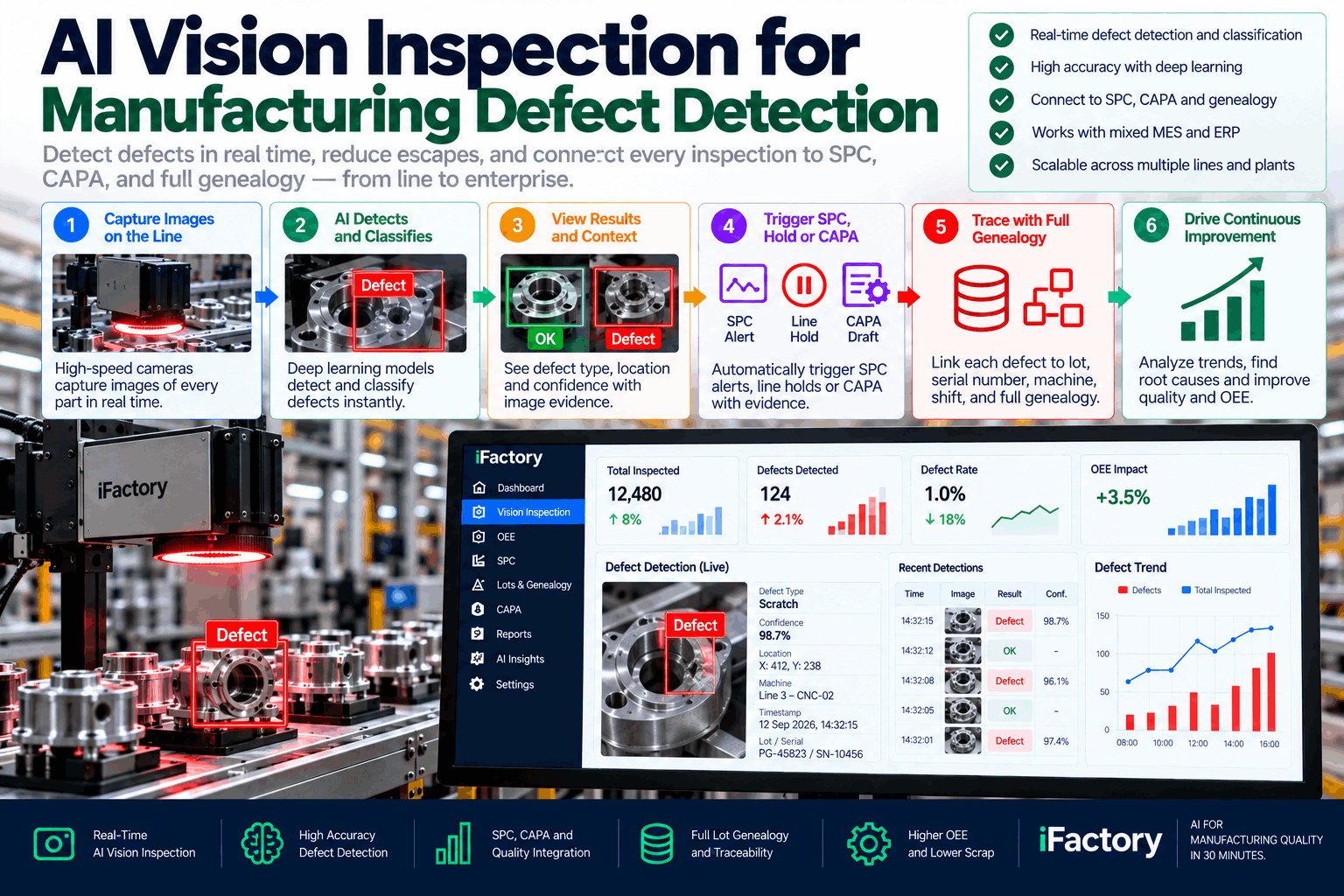
iFactory AI Vision QC runs on a turnkey server at the line. It gives per-bird defect classification, reject routing and yield tracking, with shift reports for QA and USDA inspection records.
Line Speed Sets the Time Budget for Every Bird
Under the 2014 New Poultry Inspection System rule, young chicken lines run at up to 140 birds per minute and turkey lines at up to 55. FSIS has granted waivers to run chicken at up to 175, and in 2024, 44 establishments operated under them. In February 2026 FSIS proposed raising the limits to 175 and 60. Comments closed on April 20, 2026, so check the rule's current status before planning. Size your inspection point with our vision engineers.
FSIS Inspection and AMS Grading Are Different Jobs
Two USDA agencies look at the same bird for different reasons. FSIS inspection is mandatory and decides whether product is wholesome and fit to carry the mark of inspection. AMS grading is a voluntary, paid service that judges quality against the US grade standards. AI vision helps the plant do its own sorting and quality grading better. It does not replace the FSIS inspector or the AMS grader. Walk through where vision fits on your line in a line review.
- Question asked: is it wholesome and safe?
- FSIS inspector checks carcasses online
- Under NPIS, plant staff sort, trim and reprocess first
- No visible fecal contamination may enter the chiller
- Question asked: what quality grade is it?
- Grades A, B and C under US standards
- Paid for by the plant, done by or under USDA graders
- Where vision helps most: consistent plant-side sorting
What Grade A Asks of a Carcass and a Part
The AMS standards set Grade A limits for each quality factor. Some are firm counts, such as no broken bones on a whole carcass. Others depend on carcass weight or on whether a blemish detracts from appearance, which is where human calls vary most. The model applies your written interpretation of each rule the same way on every piece. Check the AMS standards and your customer specs with our quality team.
Cameras See the Surface. X-Ray Finds the Bone Inside.
A camera sees what light can reach: colour, shape, skin and anything breaking the surface. A bone fragment buried in a fillet is invisible to it. Finding embedded bone needs X-ray, which sees density. X-ray has its own limits, because uneven fillet thickness changes the image, and USDA-funded research has worked on thickness correction for that reason. Plan the two together in a bone detection review.
If bone is a hazard you control in boneless product, name the control that actually finds it. A camera can support that control, but it should not be listed as the bone detection step.
Ask Why the Rejects Rose, Get the Flock and the Cause
Because every call is tied to a piece, a time and a flock, QA can ask a plain question and get the pattern behind it. Instructions are confirmed back before anything is logged.
Where Each Bird or Piece Goes After the Camera
Classification only matters if the piece ends up in the right place. The system ties each call to a shackle position or belt position and triggers the diverter or kick-off at the right moment. Carcasses with visible contamination follow your written procedures, whether that means offline trimming and washing or an approved online reprocessing step with an antimicrobial. Map your routing with our support team.
Trim Loss and Downgrades, Counted by Shift and Flock
Each downgrade costs yield, and its cause usually starts somewhere specific. Bruises often begin during catching and transport, while broken wings often point to hanging or picker settings. Linking each defect to a flock and a line turns end-of-shift totals into actions for live haul, the picker crew or deboning. The example is illustrative. See a sample yield report in a yield walkthrough.
The Records QA and FSIS Will Want to See
Poultry slaughter plants must have written procedures to keep visibly fecal-contaminated carcasses out of the chiller and to prevent contamination through the process, plus daily records of monitoring and sampling under 9 CFR 381.65. HACCP records sit under 9 CFR 417.5. Vision adds its own evidence: what it saw, what it decided and where each piece went. Keep those records with the same care as any other plant record, because an FSIS reviewer may ask how a reject decision was made. Ask our support team for a sample record set.
A Simple Way to Size the Yield Value
The clearest value is fewer pieces lost to downgrades because causes are found earlier. Size it with your own figures, not a vendor's. The example below uses assumed inputs to show the arithmetic only, so replace each one with data from your plant. Build the full case in a value session.
Multiply by your price gap between Grade A and downgraded product, then add time saved on manual grade counts and on yield reports. Leave out labour cuts unless your own trial supports them.
Five Best Practices for the First Line
Start with one inspection point where defects are frequent and costly, often post-chill carcasses or a fillet belt. Prove the calls match your best graders before any piece is routed by the system. Then add routing, and only then yield reporting. Each step below has a clear check before the next one starts, so the line never depends on a model nobody has tested against your own graders. Plan your first point with our support team.
Washdown Cameras, Grading Models and AI Server in One Package
iFactory delivers AI Vision QC as a turnkey bundle. Washdown-rated cameras and lighting are installed at the inspection point, and a pre-configured NVIDIA AI server ships racked and ready with the grading models pre-loaded, so every bird is classified on site at line speed. You rack it, plug in power and Ethernet, and the AI is live. To scope it for your plant, request a turnkey quote.
- Pre-configured NVIDIA AI edge server, racked and ready
- Washdown-rated cameras, housings and lighting
- Grading models trained on your birds and parts
- Links to diverters, kick-offs and shackle counters
- X-ray and checkweigher results joined per piece
- Shift grading reports, yield views and image log
- 24×7 remote monitoring of models and hardware
Cameras, lighting and server installed, grade rules written, images collected across flocks.
Models trained and run silently, calls compared with plant graders on the same pieces.
Diverters switched on, shift and yield reports started, QA and line leads trained.
Poultry Vision That Grades, Routes and Explains
iFactory is built for wet, cold, fast poultry lines where every call must be quick and traceable. Our support team can walk you through a pilot plan.
What Poultry Plant Managers Ask About AI Vision
Consistent Grades at Line Speed, With the Reason for Every Reject
Classify every bird and piece, route rejects automatically and see where yield goes by flock and shift. The full system is delivered turnkey and goes live in 6 to 12 weeks.