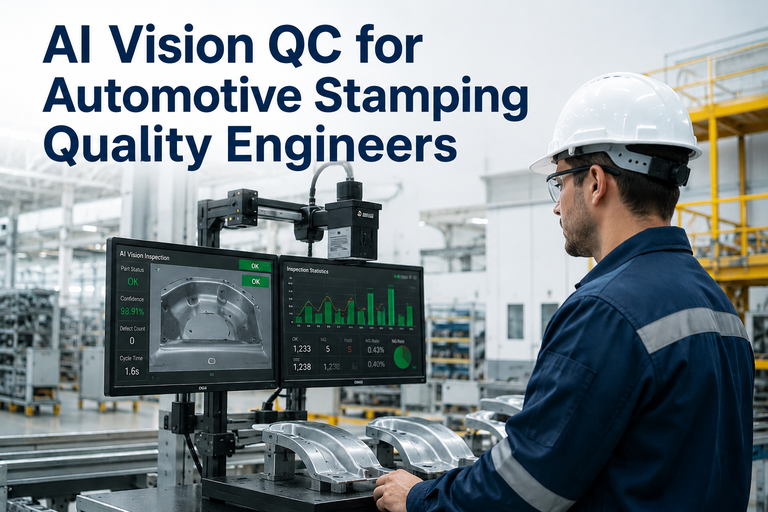
At 2:14 AM on a Tier-1 stamping floor in Pune, the third-shift inspector signed off a tote of fender reinforcements as conforming. By 6:00 AM the OEM customer rejected the entire shipment — a hairline split along the draw radius, 0.4 mm wide, visible only under raking light. The line had already produced 2,800 more parts off the same die. The cost of that one missed defect, by the time warranty exposure, sort-and-rework, and OEM penalty deductions cleared the ledger, was just over ₹38 lakh. The supervisor knew exactly what happened. Inspector fatigue at hour six of an eight-hour shift drops detection rates to under 60% on micro-defects in painted Class-A surfaces — a number every quality engineer in stamping has read but cannot fix with more SOPs. This is the gap AI vision inspection closes. Not by replacing your SPC discipline, but by feeding it ground-truth defect data from every part, every stroke, every shift, with detection accuracy that does not degrade at 2 AM. Book a 30-minute audit and we will show you what your last 7 days of stamping data looks like under AI eyes.
iFactory AI Vision QC
AI Vision Inspection for Automotive Stamping — Built for Quality Engineers Who Live and Die by Cpk
Catch splits, wrinkles, springback drift, burrs, and surface defects at press-stroke speed. Feed real-time SPC. Raise First Pass Yield 5–15 points in 90 days. Audit-ready for IATF 16949, with Cpk ≥ 1.67 evidence built into every shift.
99.5%+
AI vision detection accuracy at line speed
5–15 pts
First Pass Yield lift in 90 days
80%
Fewer customer escapes documented
6–10 mo
Typical ROI payback on AI vision deployments
Why Stamping FPY Has a Hard Ceiling Without AI Vision
Every stamping quality engineer eventually hits the same wall. You implement SPC. You harden your PFMEA. You GR&R every gauge. FPY climbs to 92%, maybe 94% on a good die. And then it stops. The reason is mathematical: human inspection caps out at 70–85% defect catch under optimal conditions, falling to 55–60% under fatigue. Inter-inspector agreement on defect severity sits at 55–70% — meaning the same panel that passes Shift A can fail Shift B. You are not running a quality system. You are running three different quality systems on rotation. The chart below shows where the loss is hiding.
70–85%
Human inspector catch rate
Under optimal lighting, rested operators, daytime shift
55–60%
After 4+ hours of inspection
Attention degrades 30–40% after first two focused hours
55–70%
Inter-inspector agreement
Same defect, three inspectors, three verdicts
99.5%+
AI vision, 24/7, no drift
Identical verdict every shift, every part, fully logged
The Five Stamping Defects AI Vision Catches That Humans Miss
Splits, wrinkles, and springback are the three most common defects encountered during sheet metal stamping — but they are not the only ones killing your FPY. AI vision systems trained on stamping-specific defect taxonomies catch the full set, including the micro-scale issues that human inspectors physically cannot resolve at line speed.
Root cause: Material exceeding forming limit, low elongation lots, small die fillet radius, inconsistent blank thickness
AI detection: Sub-pixel edge analysis along draw radii, hairline splits down to 0.2 mm width, including paint-hidden subsurface tears
FPY impact: Single largest source of late-stage scrap on AHSS and UHSS panels
Root cause: Insufficient blank holder force, improper draw bead geometry, thin material under compressive strain
AI detection: Surface topology mapping under structured darkfield lighting, catches edge wrinkles invisible from above
FPY impact: Drives most rework hours; often hidden under flanges and missed in visual pass-through
Root cause: Elastic recovery in high-strength steel, die wear, temperature variation, lot-to-lot yield strength shift
AI detection: Dimensional deviation from CAD nominal across full panel, trended shift-over-shift to predict die service
FPY impact: Quiet killer of downstream assembly fit — caught at the customer, not the press
Root cause: Punch and die clearance drift, tool edge wear, inadequate sharpening intervals
AI detection: Edge-profile analysis at trim and pierce stations, automated burr-height classification against spec
FPY impact: Predictive signal — rising burr height is the first warning of tool service need
D5
Surface Defects (Class A)
Root cause: Die contamination, debris in stock, lubricant non-uniformity, galling on draw radii
AI detection: Multi-angle lighting reveals scratches, dents, micro-deformations on visible-surface panels
FPY impact: Most expensive escapes — visible to end customer, drives RMA and warranty claims
How AI Vision Plugs Into Your Existing SPC Loop
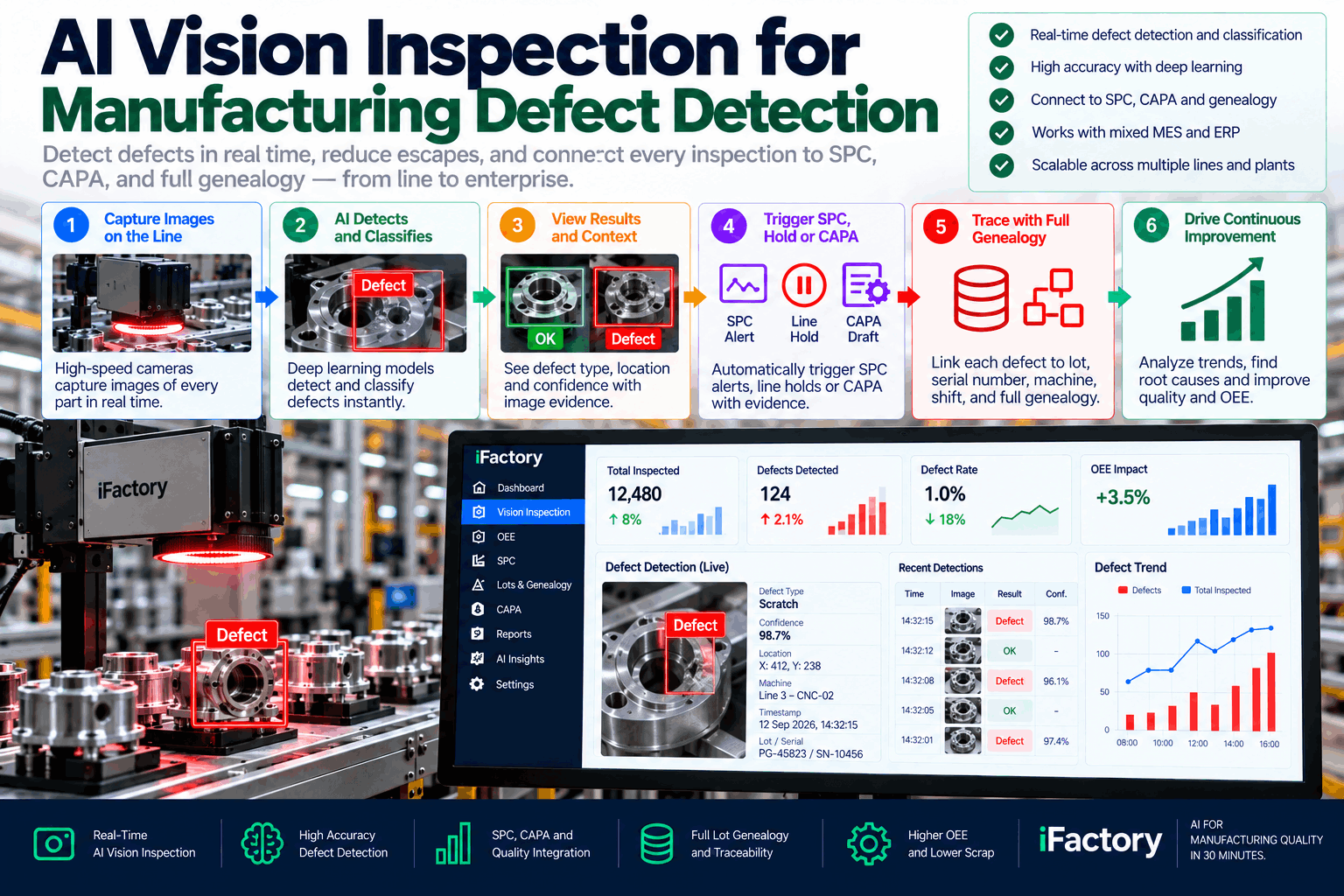
This is the part most quality engineers want to see before anything else. AI vision is not a replacement for SPC — it is the inspection layer that finally gives SPC the sample size and consistency it has always needed. Below is the data flow from press stroke to control chart, with no manual entry between them.
1
Press Stroke & Image Capture
High-resolution cameras with structured lighting capture every part as it exits the die. 4–8 cameras per station depending on geometry. Sub-100 ms inference per image on edge GPU.
2
AI Classification & Measurement
Deep learning models trained on stamping-specific defect taxonomy classify defect type, severity, and location. Dimensional features extracted against CAD nominal with sub-millimeter accuracy.
3
Real-Time SPC Update
Every measured characteristic streams into your SPC engine. X-bar and R charts update live. Cpk recalculated per shift, per die, per characteristic. Western Electric rules fire instantly on drift.
4
Operator & Engineer Alerts
Andon stack lights at the press. Mobile alert to the quality engineer. Suspect parts diverted to quarantine. Defect image and location pushed into the NCR draft before the operator finishes the next stroke.
5
IATF Audit Record
Every image, classification, timestamp, and disposition logged with full traceability. Audit pack auto-generates on demand — PPAP elements, capability studies, control plan adherence, all timestamped to the press stroke.
What the Numbers Look Like — Before vs After
This is a representative outcome profile from automotive stamping deployments in 2025–2026 across Tier-1 panel, structural, and BIW suppliers. The shape of the curve is consistent. The magnitude varies with starting baseline.
Metric
Before AI Vision
After AI Vision (90 days)
Δ
First Pass Yield
88–92%
96–99%
+5–15 pts
Defect Escape Rate
0.8%
0.06%
−92%
Customer Complaints
Baseline
−60% to −80%
−80%
Scrap & Rework Cost
Baseline
−45%
−45%
Inspection Cycle Time
60+ sec/unit
< 5 sec/unit
−92%
Cpk on Critical Dim.
1.20–1.40
1.67+ sustained
IATF passing
Audit Prep Time
2–4 weeks
2 hours
98% faster
Curious where your line falls on this chart? Send us 7 days of stamping defect data and we will benchmark it against this curve on the call.
What a Quality Engineer Actually Does Differently
The technology is interesting. The change in your day-to-day job is more interesting. Here is the practical shift across the four tasks that eat the most of your week today.
Daily Floor Walks
Today: Walk the press shop. Spot-check parts. Argue with shift leads about whether that mark is a defect or a witness line. Lose two hours.
With AI vision: Read the dashboard in 90 seconds. Spend the time on the one die showing Cpk drift. Walk the floor with data in your hand.
Root Cause Analysis
Today: Defect found at customer. Pull production records. Try to match part serial to operator, shift, lot, die counter. Three days of detective work.
With AI vision: Click the defect. See the image, timestamp, die stroke count, material lot, blank holder force, and shift in one record. RCA in 30 minutes.
PPAP & Capability Studies
Today: Pull 125 parts. Measure on CMM. Build the Cpk study in Excel. Pray the sample was representative. Repeat for every CTQ.
With AI vision: Every part is measured. Cpk computed continuously across the full population, not a 125-piece sample. Customer-grade evidence on demand.
Customer Audits
Today: Two weeks of audit prep. Print binders. Stage parts. Hope no one asks about the part that escaped in March.
With AI vision: Pull up the timestamped record for any part shipped in the last 12 months. Defect image, disposition, CAPA, signature. Done.
The IATF 16949 Evidence Pack — Built Automatically
IATF 16949 requires Cpk ≥ 1.67 at initial production approval and ≥ 1.33 in ongoing production for special characteristics. A Cpk below threshold triggers a mandatory reaction plan — regardless of whether individual parts conform. The system that catches the defects must also produce the evidence. Here is what gets generated, by default, without anyone touching a spreadsheet.
PPAP Element
Dimensional Results
Full-panel dimensional report against CAD nominal, every part measured, statistical summary auto-generated.
PPAP Element
Initial Process Studies
Cpk ≥ 1.67 evidence on every special characteristic, from a production-rate run, not a simulated batch.
Core Tool
SPC Control Charts
Live X-bar, R, and p-charts per shift, per die, per characteristic. Western Electric rule violations time-stamped.
Core Tool
MSA Records
Vision system GR&R studies, repeatability validation, drift monitoring against gauge masters.
Traceability
Part-Level History
Every part: image, defect classification, disposition, operator, lot, die stroke count — retained per customer spec.
CAPA
Reaction Plan Logs
Automatic CAPA draft whenever Cpk drifts below threshold. Closure verified by data, not memo.
The Honest ROI Math
The case is straightforward enough that most CFOs sign off in one meeting. We will lay out the actual variables a Tier-1 stamping plant uses to model the investment. Replace the numbers with yours.
Daily parts produced (stamping line)
4,200 parts/shift
Current defect escape rate
1.8% to customer
Average rework / sort cost per escape
₹3,800–4,500 per incident
OEM penalty for escape (typical)
₹45,000+ per truckload
Expected defect escape after AI vision
< 0.2%
Documented annual savings per line
≈ ₹1.0–1.1 Cr
Typical payback period
6–10 months
How Deployment Actually Runs — The 12-Week Path
iFactory deployments are turnkey. We supply the pre-configured NVIDIA AI vision servers — racked, networked, software-loaded — handle the cabling, integrate with your existing MES and SPC platforms, train your operators, and stay on remote 24×7 monitoring. You rack it, plug power and Ethernet, and the AI is live. No NVIDIA hardware to buy separately. No model training capacity to staff. No system integrator on your payroll.
Weeks 1–4
Ship, Network & Data
Pre-configured AI servers shipped and installed. Cameras and lighting commissioned on the line. MES, SPC, and ERP integration validated. Defect taxonomy locked to your control plan.
Weeks 5–8
Model Train & Pilot
Models trained on your specific dies, panels, and defect modes. Parallel run with existing inspection. Cpk baseline established. Operator and engineer training completed.
Weeks 9–12
Go-Live & Handover
Production cutover. Live SPC integration. PPAP-grade Cpk evidence flowing. Customer audit pack ready. 24×7 remote monitoring active.
On the floor, in plain language
Press Operator
Why did Line 2 stop on stroke 8,142?
iFactory AI
Edge wrinkle detected on left flange — third occurrence in the last 40 strokes. Pattern suggests blank holder force on the left rear pad is drifting. Recommended action: verify pad pressure setting, check for debris on the binder surface, run 5 sample parts before resuming. Image and stroke history saved to NCR-2347.
Frequently Asked Questions
Will this work on our existing press line, or do we need to retrofit?
Standard deployments are non-invasive retrofits. Cameras and lighting mount on existing frames or in egress conveyors after the last die station. No press modifications, no die changes, no production downtime beyond the commissioning window. We have deployed on tandem lines, transfer presses, and progressive die lines without altering the press itself.
How much data do we need to train the AI models?
Less than most quality engineers expect. We start with the defect images you already collect during routine inspection — typically a few hundred per defect class. Models continue learning during the parallel-run pilot weeks. By week 8, the system is performing at production-grade accuracy on your specific dies, panels, and defect modes. Customers without a defect image library are no problem — we collect during pilot.
Do I buy NVIDIA servers separately?
No. iFactory supplies fully-loaded AI vision servers as part of the turnkey deployment — pre-configured NVIDIA edge GPU hardware, racked and ready, software pre-loaded. We handle installation, cabling, network, MES integration, operator training, and 24×7 remote monitoring. Rack it, plug power and Ethernet, the AI is live.
How does this integrate with our existing SPC and MES systems?
Standard protocols on day one: OPC-UA, REST, MQTT, Q-DAS, DMIS, ODBC. We integrate with the SPC engines and MES platforms in common use across automotive Tier-1s — Q-DAS qs-STAT, Northwest Analytics InfinityQS, Hexagon, SAP ME, Plex, Tulip, and custom MES. Your control plan, characteristic IDs, and Cpk targets flow in. Live measurements flow out.
What about false positives — won't we be drowning in alerts?
A high false-positive rate is the failure mode of legacy AOI, not modern AI vision. Properly-tuned systems run below 3% false-call rate in production. We tune to your specific quality engineer tolerance during the pilot — false-positive rate, defect severity thresholds, and alert routing are all calibrated against your real workflow before go-live.
Is the system audit-ready for IATF 16949 and customer-specific requirements?
Every deployment ships audit-ready for IATF 16949 with documented evidence packs for PPAP, APQP, FMEA, MSA, SPC, and Control Plan elements. Customer-specific requirements from major OEMs are pre-mapped — including GM, Ford, Stellantis, Renault Group, Mercedes-Benz, Tata, Mahindra, Maruti Suzuki, and Hyundai-Kia. Cpk ≥ 1.67 evidence is generated automatically on every special characteristic.
Stop Losing FPY to Inspection Variance
See Your Stamping Line Under AI Eyes — In 30 Minutes
Bring 7 days of defect data and the part numbers giving you the most trouble. We will run them against our stamping-trained models on the call, show you the Cpk you would be reporting today, and walk through the 12-week path to IATF-grade evidence on every shift.
12 wk
Turnkey deployment, line-live
1.67+
Cpk sustained on critical dims
1000+
Manufacturing clients on iFactory
99.9%
Platform uptime SLA