AI Paint Defect Detection for Automotive Paint Shops
By Larry Eilson on May 21, 2026
A 0.6 mm dust nib trapped under the clearcoat on the C-pillar of a metallic black SUV is one of the most expensive 0.6 millimeters of contamination in industrial manufacturing. Caught at paint booth exit, the repair costs about $280 in polish, materials, and one operator's time. Missed at booth exit and caught later at final assembly — after the trim has been installed, the glass has been sealed, the wiring loom has been routed — the same defect costs roughly $3,200 to fix. That is the entire economic case for AI paint defect detection in one number. The reason this matters is not that human inspectors are bad at their jobs. It is that human visual inspection accuracy drops from 85% in the first hour of a shift to 62% by hour eight, and the typical paint shop runs 850 bodies through one inspector per shift. By body 600, the inspector is no longer the limiting factor — fatigue is. iFactory's paint defect AI inspects every square centimeter of every body, at line speed, with detection accuracy that does not change at 3 AM. Book a paint shop walkthrough and we will run your last week of escape data against our defect taxonomy.
iFactory Paint Surface AI
AI Paint Defect Detection for Automotive Paint Shops — Every Body, Every Defect, Every Shift
Detect orange peel, runs, sags, dust nibs, fish-eye, solvent pop, color drift, and clearcoat anomalies on every painted body. Live DOI, gloss, ΔE, and wave-scan-equivalent metrics. On-premise edge AI — zero cloud, IATF 16949 ready, live in 6 to 12 weeks.
The Defect Library — Twelve Categories, One AI Model
Every paint defect ever cataloged in an OEM control plan falls into one of these twelve classes. The AI is trained on the specific visual signature of each, on your specific paint codes, under your specific booth lighting. Severity tiers route the body automatically: critical bodies reject, major bodies divert to rework, minor bodies proceed with documentation.
Runs & Sags
Critical
Excess film build, vertical paint flow. Visible drips and tear-shaped pools on vertical panels.
Fish-Eye Craters
Critical
Coating retracts from contaminant. Small craters with material in the center. Always respray.
Solvent Pop
Critical
Sub-surface bubbles burst during bake. Sub-surface pops require strip-to-metal repaint.
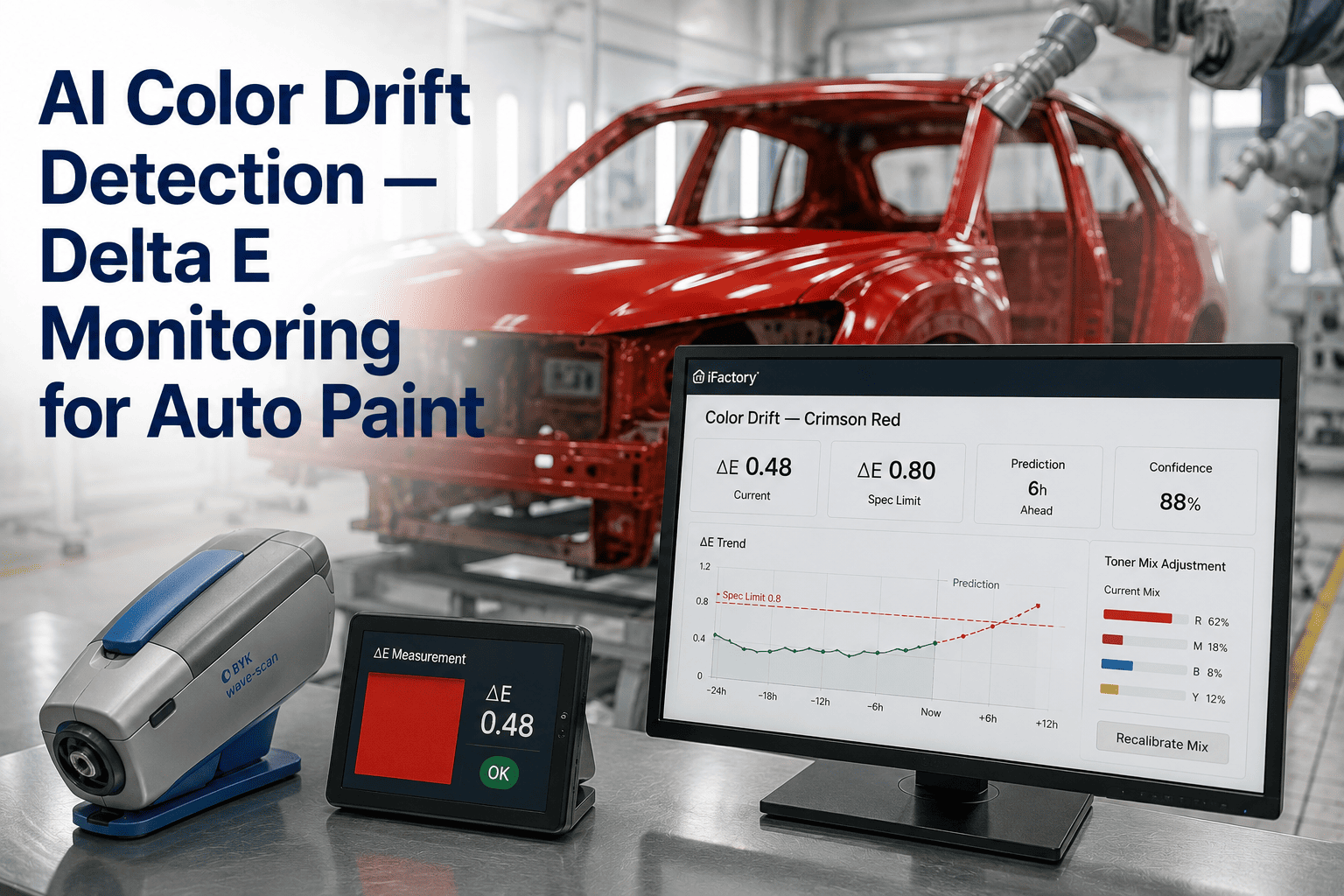
Color Drift (ΔE)
Critical
Color deviation beyond OEM ΔE tolerance, typically < 1.0. Adjacent-panel mismatch most visible.
Orange Peel (excess)
Major
Excess waviness on long-wave or short-wave scale. Wet sand and clear respray.
Dust Nibs
Major
Airborne particles trapped in clearcoat. Denib and polish, no respray on minor cases.
Flow Marks
Major
Visible spray pattern, lap marks, gun-stroke trails. Rework and re-blend.
Thickness Variation
Major
Film build outside ±5 µm of spec. Coverage gaps, thin zones at edges and creases.
Surface Scratches
Minor
Linear marks > 0.5 mm. Buff and polish, document by body ID.
Gloss Variance
Minor
Gloss reading at 20° outside tolerance band. Adjacent-panel harmony check.
Overspray Boundary
Minor
Mist beyond masked area. Light buff, often acceptable per panel zone.
DOI Drop
Minor
Distinctness of image below threshold. Sign of micro-orange-peel or texture drift.
The Appearance Dashboard — Live Numbers Every Quality Engineer Knows
iFactory replaces the BYK-Gardner wave-scan walk-around with continuous, full-body appearance measurement. Every body gets the four numbers your quality control plan was written around: DOI, Gloss, Orange Peel structure, and ΔE color. Live, per panel, against your spec bands.
DOI
Distinctness of Image
94.2
Spec: > 90.0
Sharpness of a reflected edge. Drops when texture or micro-waviness intrudes on the mirror finish.
G
Gloss (20° & 60°)
87 / 91
Spec: 85–92 GU
Specular reflection at standard angles. Two readings catch issues that single-angle misses.
OP
Orange Peel (SW & LW)
12 / 8
Spec: SW < 18, LW < 12
Short-wave and long-wave structure on the 0.1–30 mm band. The wave-scan standard, automated.
ΔE
Color Match
0.6
Spec: < 1.0
CIE Lab color difference vs master standard. Critical for body-to-bumper-cover harmony.
The Body Defect Map — Every Square Centimeter, Every Body
This is what the operator sees when a body exits the topcoat booth. A full-body schematic, every defect plotted to its exact panel coordinate, severity color-coded, click-through to the source image. Quality engineers stop chasing defects by memo and start working from the actual map.
Body #B-44210 — Metallic Black — Topcoat Exit
3 defects detected · Routed: Rework
1
Driver-side rear door, mid-panel
Run · 3.2 mm length
Reject to rework cell
2
Roof, mid-section
Dust nib · 0.8 mm
Denib station
3
Tailgate, lower-right
Gloss low: 83 GU (spec 85+)
Document, proceed
The Severity Routing — From Detection to Disposition in Seconds
Detection without disposition is just an interesting picture. Every defect classification triggers an automated routing decision on the conveyor. Critical bodies divert before reaching assembly. Major bodies are physically routed to rework. Minor bodies proceed with documentation against the body ID for trend analysis.
Critical
~3% of bodies
Auto-reject
Conveyor diverts body to reject station. Quality engineer pinged with image and panel coordinates. CAPA draft auto-generated. Re-inspection mandatory before re-entry.
Major
~8% of bodies
Auto-route to rework
Body diverted to specific rework cell based on defect type — denib, polish, sand-and-clear, full respray. Work instruction pre-loaded with defect images and panel marks.
Minor
~12% of bodies
Document & proceed
Body proceeds to assembly. Defect logged against body ID with image and severity. Feeds drift detection — trending minor defects predict major defects.
Pass
~77% of bodies
Pass to assembly
All four appearance metrics in spec, zero defects above minor threshold. Body proceeds with audit-ready inspection record archived.
What the Hardware Looks Like — Booth-Exit Inspection Tunnel
The capture system is a booth-exit tunnel: high-resolution cameras under structured darkfield lighting, positioned around the body envelope, capturing 4K to 8K imagery at line speed. AI inference runs on the on-prem edge GPU server in under 100 ms per panel. No cloud round-trip, no internet dependency, no IT exposure of proprietary paint formulations.
1
Camera Array
12–24 cameras around the body envelope, 4K–8K resolution, GigE Vision, hardware-synced shutters
2
Structured Lighting
Deflectometry-grade LED panels, darkfield and brightfield channels, color-temp matched to your booth
3
Edge GPU Server
Pre-configured NVIDIA AI server. On-prem, behind your firewall. Sub-100 ms inference per panel
4
Conveyor Interface
PLC link to your existing conveyor controls. Routing decision asserted within the body's exit cycle
5
Operator HMI
Body defect map, drillable images, severity routing, override controls — on the booth-exit station
Why On-Premise — Three Reasons Your IT & Quality Teams Will Agree On
Every cloud-based vision vendor will tell you on-prem is old-fashioned. Every automotive OEM and Tier-1 quality leader will tell you it is non-negotiable for paint shops. Here is why.
IP Protection
Paint formulations, color matching tolerances, and defect taxonomies are trade-secret IP. Every cloud-bound image is a potential leak vector. On-prem keeps every byte of inspection data inside your firewall, accessible only to your engineers.
Latency
A 200 ms cloud round-trip is two-and-a-half bodies of latency on a 75-second cycle. Conveyor routing has to happen inside the body's exit window. Sub-100 ms edge inference makes that automatic, every cycle.
Uptime
Internet outage cannot stop the paint line. On-prem inference runs through link failures, cloud-provider incidents, and regional outages with zero degradation in inspection rate or accuracy.
The First 90 Days — What Actually Gets Measured
Representative outcome profile from automotive paint shop deployments. Numbers vary with baseline; the shape of the curve is consistent.
Metric
Before AI
After 90 Days
Defect catch rate
62–85%
95–99%
False rejection rate
15–22%
< 2.5%
Late-stage rework escapes
Baseline
−70 to −80%
Cost per escape
$3,200
$280
Audit-pack prep
Days
Minutes, on demand
Inspection coverage
Sampling, fatigue-limited
100% of bodies, every shift
Frequently Asked Questions
How is this different from a wave-scan or BYK-Gardner appearance robot?
A wave-scan instrument gives you four numbers on a sample area, typically once per body or once per shift. iFactory gives you the same four numbers — DOI, gloss, orange-peel SW/LW, ΔE color — continuously, on every panel of every body. Plus defect classification, severity routing, full traceability, and conveyor automation that a single-point instrument cannot do.
Can the system handle metallic and pearl finishes?
Yes. Multi-angle imaging with structured lighting plus models trained specifically on metallic and pearl finishes handle effect-flake orientation, sparkle distribution, and angle-dependent color shift. We measure flop index and BC behavior alongside the standard appearance metrics for these paint codes.
What if our defect taxonomy is non-standard or proprietary?
Standard. Every plant we deploy at has its own defect codes from its OEM control plans. We map your taxonomy into the AI model during pilot, including any OEM-specific naming or severity rules. The output labels match your existing NCR codes and quality system terminology day one.
Do I buy NVIDIA servers separately?
No. iFactory supplies fully-loaded AI servers as part of the turnkey deployment — pre-configured NVIDIA edge GPU hardware, racked and ready, software pre-loaded. Cabling, network, conveyor integration, operator training, and 24×7 remote monitoring are included. Rack it, plug power and Ethernet, the AI is live.
Is the system IATF 16949 audit-ready?
Every deployment ships audit-ready for IATF 16949. Every detection event is logged with body ID, panel coordinates, defect image, severity, classification confidence, routing decision, and operator override if any. Audit packs include the appearance metric history per body, the closed-loop CAPA trail, and the control-plan reference for every measured characteristic.
How long does deployment take and what is the scope?
Weeks 1–4: ship and rack the on-prem AI server, install the booth-exit camera tunnel and structured lighting, network the OT and IT connections, integrate with the conveyor PLC. Weeks 5–8: train models on your paint codes, defect taxonomy, and lighting, parallel-run with existing manual inspection. Weeks 9–12: cut over to live routing, operator training, audit pack handover, 24×7 remote monitoring active.
Catch It at the Booth, Not at Final Assembly
See Your Bodies on a Live Defect Map — In 30 Minutes
Bring your last 7 days of paint shop escape data, your top 5 paint codes, and a recent appearance audit report. We will overlay your numbers on the body defect map, identify the panels driving your rework, and walk through the 12-week deployment path.