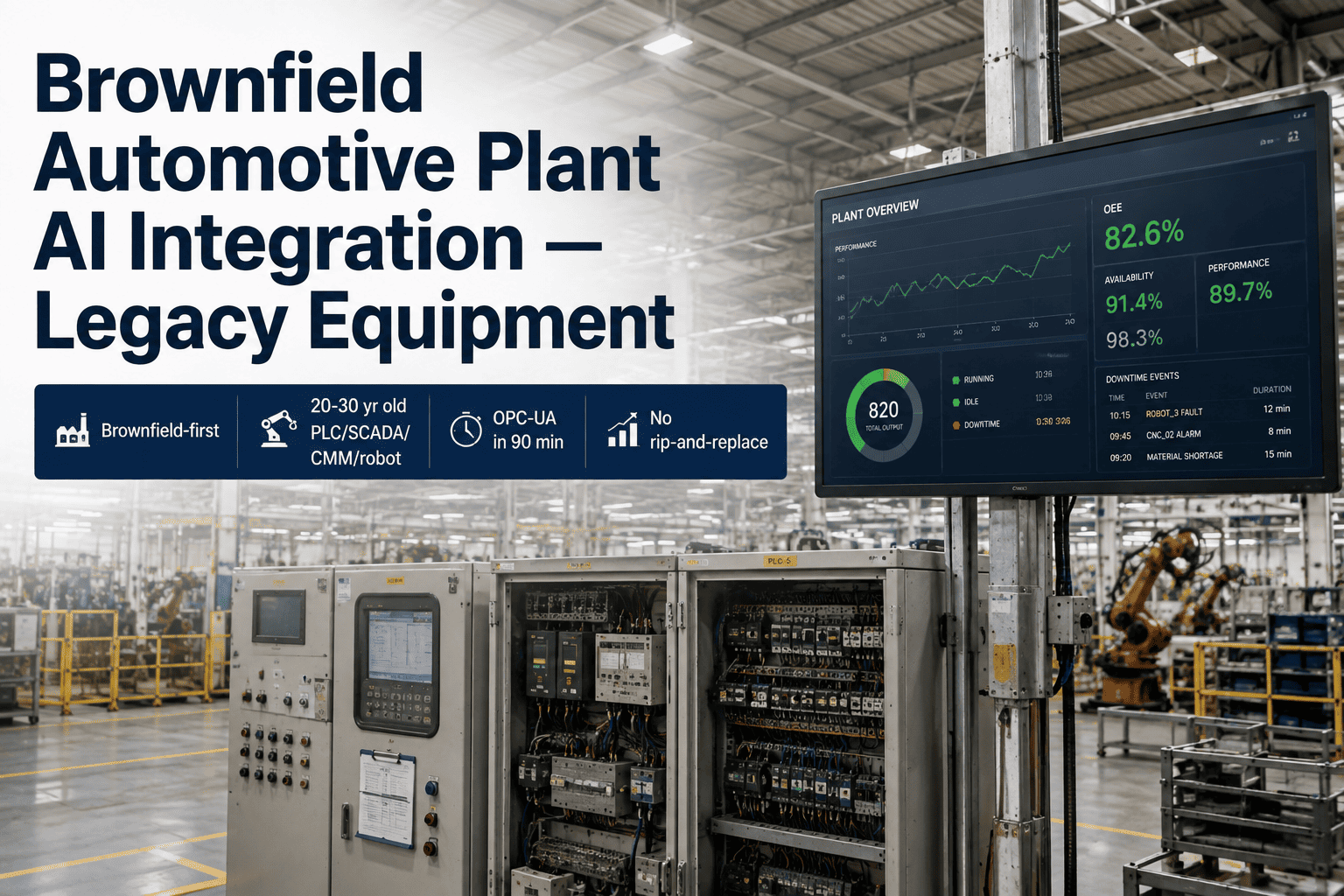
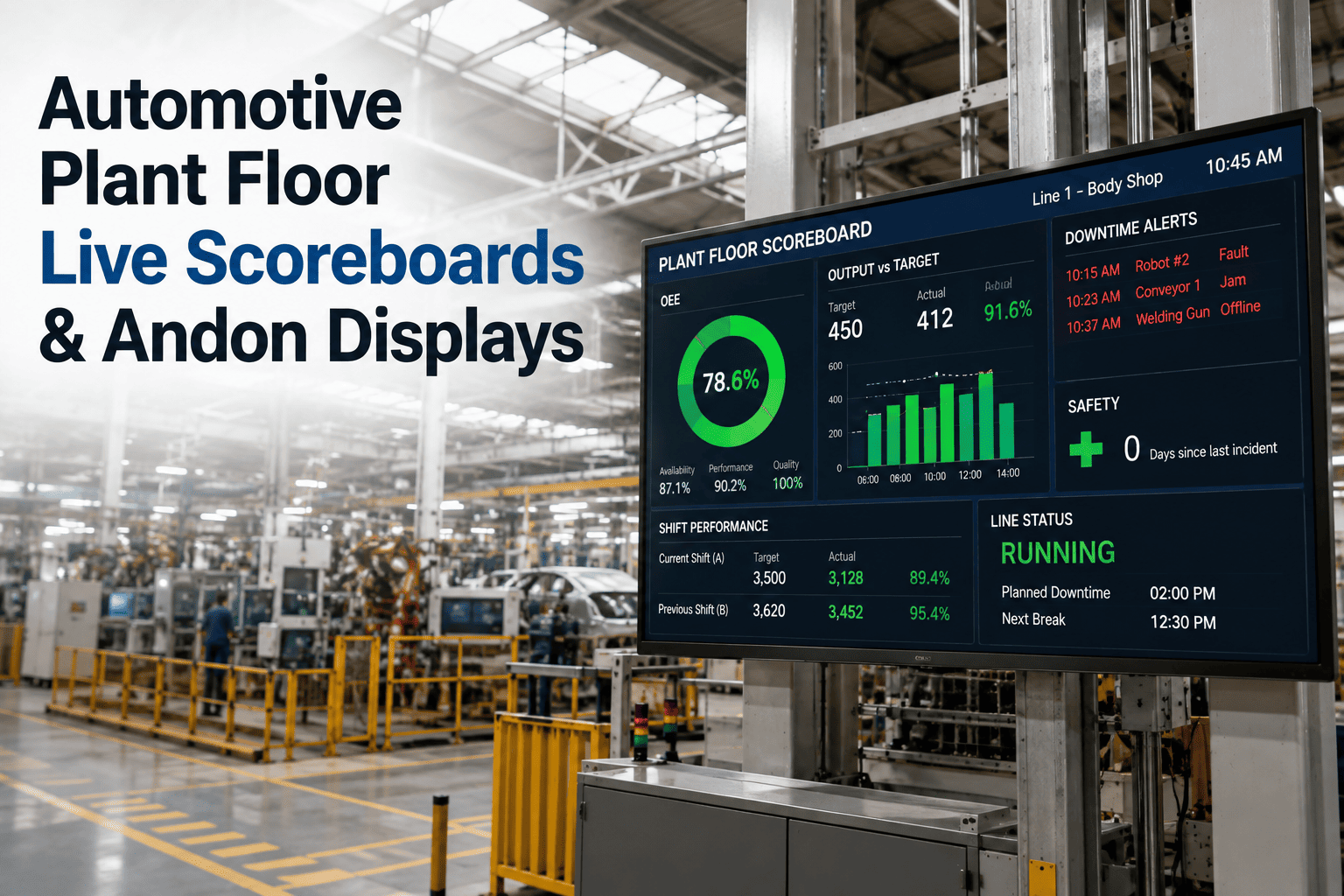
The plant manager at a Tier-1 powertrain supplier in Pune did the math one evening and could not unsee it. They had 312 connected assets across three buildings. Of those, 47 were Siemens S7-300s installed between 2008 and 2013, 89 were Allen-Bradley ControlLogix on EtherNet/IP, 22 were Mitsubishi PLCs running CC-Link, 14 were Schneider Modicons still on serial Modbus RTU, 28 were Yaskawa drives, and the remaining inventory ran a mix of Profibus, DeviceNet, and one proprietary protocol from a Japanese press supplier whose engineer last visited the plant in 2017. Every previous integration vendor had quoted a 14-to-18-month rip-and-replace. The plant could not afford to lose that production window. They needed something else: a way to leave every PLC exactly where it was and still get a single live data stream into their AI layer. That is what brownfield-first integration means, and that is what iFactory was built to do. Live PLC connection in 90 minutes, full plant integration in 6 to 12 weeks, no rip-and-replace. Book a connectivity audit and we will list every protocol on your floor and tell you exactly what gets connected first.
iFactory Plant Connectivity
OPC-UA, MQTT, Modbus & PLC/SCADA Integration for Automotive Plants — Brownfield First, Always
Connect every PLC, SCADA, sensor, and proprietary controller on your floor without touching a line. OPC-UA + MQTT + Modbus + 40 native drivers + custom protocol support. Live PLC link in 90 minutes. Full plant integration in 6 to 12 weeks. On-prem AI servers included.
90 min
From kickoff to first live PLC data stream
40+
Native protocols and PLC drivers
6–12 wk
Full plant integration, on-prem AI live
$2.3M/hr
Average cost of automotive plant downtime
The Brownfield Reality Nobody Wants to Quote
The brochures show clean greenfield drawings. Modern PLCs, native OPC-UA, one MQTT broker, one beautiful Sparkplug B topic tree. Your actual plant has equipment from four decades, three OEMs, two SCADA platforms that never talked, and a press from 2003 whose vendor went bankrupt in 2019. The integrator who walks in and says "we will replace all of this" is selling you an 18-month outage, not a solution. The brownfield-first principle is the opposite: keep every controller running, wrap it in a protocol gateway, normalize the data, and let the AI layer not care whether the source is OPC-UA, EtherNet/IP, or RS-485 Modbus on a 19.2k baud line.
Rip & Replace
14–18 month timeline
Full production stop required
$3–8 M capex per plant
Vendor lock-in by design
Re-train every engineer
OEM PPAP re-submission risk
Brownfield-First
6–12 week deployment
Zero production downtime
Fraction of rip & replace cost
Protocol-agnostic, vendor-neutral
Operators keep their HMIs
PPAP and IATF unaffected
What's Actually on Your Floor — And How We Talk to It
This is the protocol matrix every automotive plant we walk into has in some combination. iFactory connects all of them natively. No third-party brokers in your critical path, no hand-off to a SCADA layer you do not own, no extra license stack.
OPC-UA
Modern controllers, MES interface
Native client + server. Pub/Sub (Part 14). Certificate management. Companion specs for ISA-95, AutomationML, PackML.
Siemens S7-1500/1200, Beckhoff TwinCAT, B&R, modern Rockwell, Mitsubishi MELSEC iQ-R
MQTT + Sparkplug B
Telemetry, edge-to-cloud, low bandwidth
Built-in broker. Sparkplug B topic standardization. TLS 1.3. Birth/death certificates. Store-and-forward on link loss.
Edge gateways, sensors, energy meters, vibration nodes, AGVs, cloud bridges
Modbus TCP & RTU
Universal fallback, legacy field
Master and slave. Extended addressing to 65,535 registers. Serial over RS-232/RS-485. Wireless radio modem support.
Schneider Modicon, drives, energy meters, legacy sensors, third-party gateways
EtherNet/IP & CIP
Allen-Bradley ecosystems
Native to ControlLogix and CompactLogix tag space. Producer-consumer messaging. Implicit and explicit messaging supported.
Rockwell ControlLogix, CompactLogix, MicroLogix, FactoryTalk, Stratix
PROFINET & PROFIBUS
Siemens floors, European OEMs
PROFINET IO via Siemens S7 protocol. PROFIBUS DP via gateway. DP/PA Link compatible. Direct tag read/write supported.
Siemens S7-300/400/1500, ET200, Sinamics, Sinumerik CNCs
Legacy Serial & DF1
Equipment older than 15 years
DF1 to PLC-5 and SLC-500. ASCII over RS-232. SECS/GEM for semiconductor-class equipment.
Allen-Bradley PLC-5, SLC-500, Siemens S5, GE Series 90, legacy presses
Mitsubishi MC, FX, CC-Link
Japanese OEM stamping & assembly
MELSEC protocol (MC) over Ethernet. FX series serial link. CC-Link IE Field Basic supported.
Mitsubishi Q, L, FX, iQ-F, iQ-R; CC-Link fieldbus devices
Custom & Proprietary
The one machine nobody planned for
Custom driver development included in deployment. Reverse-engineered protocols, vendor-supplied DLLs, proprietary serial framing.
Japanese presses, Korean injection moulders, European robot dialects, OEM-specific paint cells
The 4-Layer Stack — Where iFactory Sits, Where Your Floor Sits
Most integration vendors blur the architecture on purpose, because their value depends on you not seeing the layers clearly. Here is the honest diagram. Your equipment never moves. Your AI sits where it should: on-prem, on your network, behind your firewall. The integration layer is where iFactory does the work.
Layer 4 — Intelligence
iFactory AI & Decisions
Predictive maintenance, quality models, OEE engines, energy optimization. On-prem NVIDIA AI servers. Models trained on your data, owned by you.
Layer 3 — Integration
Protocol Drivers & Normalization
40+ native drivers. Tag normalization, timestamp alignment, engineering unit conversion, asset-context enrichment. ISA-95 information model.
Layer 2 — Supervision
SCADA, MES, HMI
Your existing FactoryTalk, WinCC, Citect, Ignition, Wonderware, custom HMI. iFactory reads alongside, never disrupts the control loop.
Layer 1 — Floor
PLCs, Drives, Sensors
Every controller on your floor, exactly where it is. Siemens, Rockwell, Mitsubishi, Schneider, Yaskawa, Beckhoff. Untouched.
The First 90 Minutes — What Actually Happens
You will read claims like this from every vendor. Here is what we mean by it, step by step, on a real automotive plant kickoff. The clock starts when our engineer joins your IT/OT team on the call.
0–15 min
Network Discovery & Tag Map
We scan your OT network for active controllers. Auto-discovery returns the PLC model, firmware, IP, and exposed tag namespace. You confirm which 5–10 critical assets to connect first.
15–35 min
Driver Selection & Connection
Native driver loaded for each PLC. OPC-UA for modern controllers, EtherNet/IP for Rockwell, S7 for Siemens, Modbus for serial fallback. Read-only first, always.
35–60 min
Tag Normalization
Raw tags mapped to your ISA-95 asset hierarchy. Engineering units applied. Timestamps aligned. Quality codes preserved. Asset context (line, station, OEE state) attached.
60–90 min
Live Stream & First Insight
Data flowing into iFactory edge. Live tag values visible on your dashboard. First baseline anomaly detected on at least one asset, typically within the first hour of streaming.
Want this run on your plant? Book the 90-minute connectivity session — bring your PLC inventory and we will return with a live data stream and a phased rollout plan.
Security & IT/OT Posture — The Five Questions Your Security Team Will Ask
The conversation always shifts here once IT joins. We have answered these questions at every major OEM and Tier-1 audit we have been put through. Here are the answers, in plain English.
Will this open my OT network to the internet?
No. iFactory runs on-prem on NVIDIA AI servers behind your firewall. The OT-to-iFactory connection is read-only by default, on your isolated OT VLAN. No outbound internet required for AI inference. Remote monitoring is opt-in through a one-way reverse tunnel you control.
What about Purdue Model and DMZ separation?
iFactory deploys cleanly into a Level 3.5 DMZ between OT and IT. Optionally we support one-way data diodes for high-security plants. The connection to PLCs follows least-privilege read access, scoped to specific tag namespaces only.
How are credentials and certificates handled?
OPC-UA mutual certificate authentication on every controller connection. MQTT mutual TLS with topic-level ACLs. PLC credentials stored in a hardware-backed key vault. Rotation policies aligned to your existing IT standard.
Can you push data back to the PLC?
By default, no. Read-only is the deployment posture. Write-back capability exists for closed-loop optimization use cases but requires explicit dual-approval workflow, signed change records, and is scoped to specific tags agreed with your controls engineer.
What logs and audit trails do you produce?
Every connection attempt, tag read, write event, certificate event, and admin action is logged with timestamp, user, source IP, and outcome. Logs export to your SIEM via syslog or native connectors for Splunk, ELK, Microsoft Sentinel, and IBM QRadar.
What Comes Online Once the Data Is Flowing
Plant connectivity is not the prize. It is the prerequisite for everything you actually want — the AI use cases that depend on live floor data. Here is what typically goes live in the first 90 days after connectivity, and what plants document by month six.
Live OEE Engine
Real-time availability, performance, and quality calculated from raw PLC tags. Per machine, per line, per shift.
+10–20% OEE in 90 days
Predictive Maintenance
Vibration, current, temperature, and cycle data feed models that predict failures 7–21 days out on bad-actor assets.
−20–40% unplanned downtime
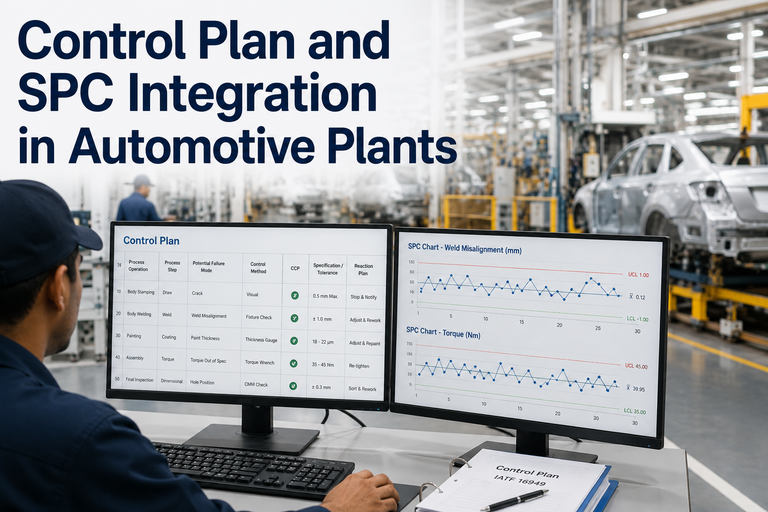
Live SPC & Cpk
Process tags flow into real-time control charts. Cpk computed continuously on critical-to-quality dimensions, IATF audit-ready.
Cpk ≥ 1.67 sustained
Energy Optimization
Compressed air, HVAC, and motor power data correlated with production rate. Idle waste flagged, optimization recommendations served to ops.
−8–15% energy per part
Genealogy & Traceability
Part-level genealogy across stations: who, when, which die, which material lot, which torque profile. Recall scope reduction in minutes, not days.
Hours, not weeks for recalls
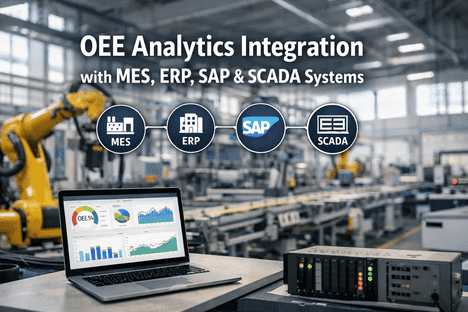
MES & ERP Sync
Live counts, downtime reasons, and quality flow to your SAP, Oracle, or custom ERP. Manual entry eliminated end-to-end.
Zero manual data entry
The Honest ROI — What Tier-1s Document in 12 Months
Automotive plant downtime costs roughly $2.3M per hour. That is the number Siemens publishes and the number every Tier-1 finance team uses to model integration ROI. Here is what manufacturers documented after 12 months of IT/OT integration in 2025–2026 industry studies.
20–40%
Reduction in unplanned downtime
Driven by predictive maintenance on connected assets
15–25%
Lower maintenance cost
Right-time service vs fixed PM intervals
10–20%
OEE improvement
From bottleneck visibility and faster reaction
25%
Faster supply chain response
Live counts flowing to ERP and OEM portals
Three Plant Profiles — Which One Looks Like Yours
We have run this conversation enough times to know there are three honest starting points. Find yours below. The integration path is different for each — but all three end up in the same place.
Profile A
The Pure Brownfield
25-year-old plant. Two SCADAs that do not talk. PLCs from Siemens S5 era to current S7-1500. One press line still on serial Modbus.
Path: Gateway-led. Modbus and DF1 first. OPC-UA wrapped on legacy via converters. AI value visible in week 6.
Profile B
The Mixed Estate
10–15 year plant. Mostly Rockwell on EtherNet/IP. Some Siemens PROFINET. SCADA exists but only covers 60% of assets.
Path: Native EtherNet/IP and S7 drivers first. Fill SCADA gaps via direct tag read. AI value in week 4.
Profile C
The Modern Tier-1
New plant. Greenfield OPC-UA on every controller. Sparkplug B MQTT. MES already integrated. Looking for the AI layer.
Path: OPC-UA Pub/Sub subscription. ISA-95 model import. Day-one AI feature engineering. Live in week 2.
Frequently Asked Questions
Do we need to replace our existing SCADA to deploy iFactory?
No. SCADA stays exactly where it is. iFactory reads alongside your SCADA — either by direct PLC connection or by reading the SCADA's OPC-UA server if one exists. Operators continue using the same HMIs and procedures they use today. No disruption to the existing control loop or alarm handling.
What if a PLC does not have native OPC-UA support?
Most PLCs older than 10–15 years do not have native OPC-UA. We handle this with native protocol drivers — DF1 for older Allen-Bradley, S7 for Siemens S7-300/400, MELSEC for Mitsubishi, Modbus RTU/TCP for everything else. For unusual legacy controllers, we develop a custom driver as part of the deployment scope.
Do I buy NVIDIA servers separately?
No. iFactory ships fully-loaded AI servers as part of the turnkey deployment — pre-configured NVIDIA edge GPU hardware, racked and ready, all software pre-loaded. Cabling, network, PLC integration, operator training, and 24×7 remote monitoring are included. Rack it, plug power and Ethernet, the AI is live.
How does iFactory differ from a traditional OPC-UA gateway vendor?
An OPC-UA gateway gives you data access. iFactory gives you the data access layer plus the normalization, asset modeling, AI engine, dashboards, alerts, and CMMS workflow on top. You do not buy four products and try to glue them together. You buy one platform that absorbs the integration complexity and delivers production-ready AI use cases out of the box.
Will this slow down our PLCs or interfere with the control loop?
No. We connect read-only by default and poll at intervals appropriate for each tag — fast tags (e.g. cycle counters) at 100 ms, slow tags (e.g. temperatures) at 1–5 s. PLC CPU impact stays under 3% on every controller we have measured. Critical control loops are never touched.
What does the 6–12 week full deployment actually cover?
Weeks 1–4: ship and install the on-prem AI servers, network the OT and IT zones, validate every PLC connection, lock the ISA-95 asset model. Weeks 5–8: train AI models on your plant's data, parallel-run with existing systems, baseline OEE and Cpk. Weeks 9–12: go-live, operator and engineer training, audit pack handover, 24×7 remote monitoring active.
Brownfield Is Not a Limitation — It's the Starting Line
See Your Plant Connected in 90 Minutes — Live
Bring your PLC inventory, your protocol list, and the three assets giving you the most downtime. We will connect them on the call, show you live data flowing into iFactory, and lay out the 6–12 week path to full plant integration with on-prem AI.
90 min
First live PLC stream
40+
Protocols supported natively
On-prem
AI behind your firewall
1000+
Manufacturing clients live