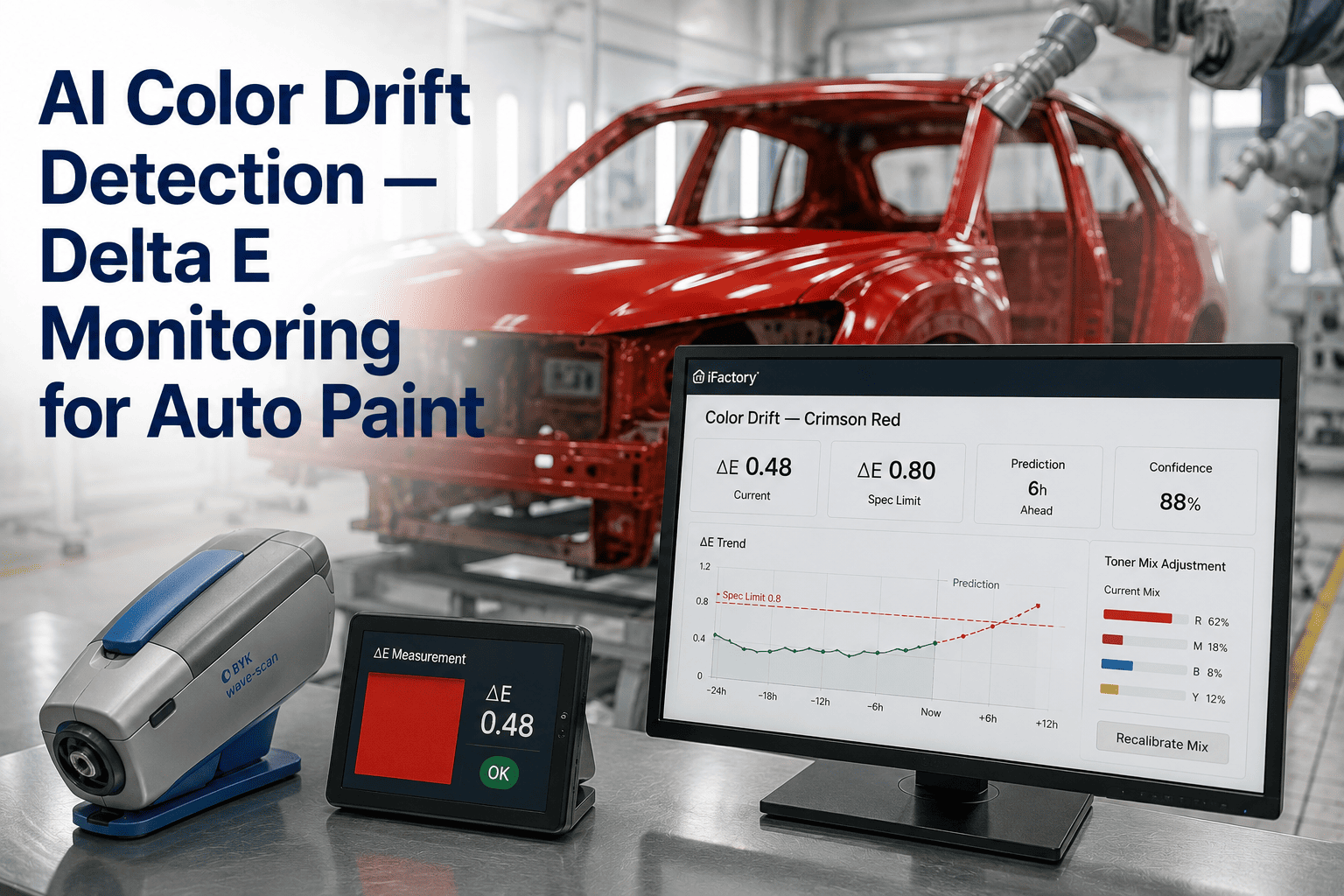
The booth supervisor at a Tier-1 BIW paint shop in Chennai keeps a small notebook in his pocket. Every defect he catches, he writes down with the RH reading from the booth display next to it. After fourteen months, his notebook had a pattern nobody had charted before: 78% of the dirt inclusions on the night shift showed up between 2:00 and 4:30 AM, and 91% of those nights had RH readings above 68% in Booth #2. The HVAC was reactive — it adjusted the dehumidifier only after the sensor crossed the alarm threshold, by which point the booth had already been spraying for 22 minutes in a degraded environment. Twenty-two minutes is 11 bodies on a typical cycle time. Eleven bodies into the rework loop, every night, because the control system was looking at the present instead of the next 30 minutes. This is the gap predictive RH control closes. iFactory forecasts the humidity excursion before it forms, writes the corrected setpoint back to the HVAC, and the booth never crosses the line. Booth #2 humidity dropped from 72% to 62% sustained with 88% prediction confidence. Dirt and inclusion defects down 18%. Payback in four months. Book a paint shop audit and we will show you your own booths against this curve.
iFactory Paint Shop AI
AI Paint Booth Humidity & RH Control — Predict the Excursion Before the Defect Forms
Forecast RH drift 15–30 minutes ahead. Auto-pilot-ready setpoint writes back to your HVAC. Cut dirt nibs, blushing, fish-eye, and solvent pop. $28,000 documented savings per booth per year. On-prem AI, live in 6 to 12 weeks.
72 to 62%
RH stabilized on Booth #2, sustained
−18%
Dirt & inclusion defects in 90 days
$28K/yr
Savings documented per booth
4 mo
Average payback period
The RH Window — Why the Math Is So Unforgiving
Automotive paint booths operate inside a relative humidity window between roughly 40% and 60%. Below 40%, solvent flashes off too fast and the paint film cannot level — orange peel, static-attracted dirt, and dry spray dominate. Above 65%, evaporation slows, surface moisture forms, and the booth starts producing blushing, fish-eye, and adhesion failures. The danger band on either side is narrow. The cost of being outside it is loud. Every defect that escapes the line is a body in the rework loop, eating polish, primer, clear, and one of the most expensive process steps in the entire plant.
< 40%
Too Dry
Orange peel · Static dust · Dry spray · Overspray
40–60%
Optimal Window
Smooth flow · Predictable cure · Minimum defects
60–65%
Caution
Slowing cure · Surface moisture risk rising
> 65%
Defect Zone
Blushing · Fish-eye · Solvent pop · Adhesion failure
AI-controlled band: 48–58% sustained
Reactive vs Predictive — The Twenty-Two Minute Gap
This is the single most important diagram on this page, because it explains why every paint shop with a working PID controller still produces defects. The PID waits for the sensor to cross a threshold. Then the dehumidifier ramps. Then the air mixes. Then the new RH settles. By the time the booth is back inside the band, you have already painted 8 to 12 bodies in degraded conditions. Predictive control fires the setpoint change before the excursion ever crosses the threshold.
Reactive (PID)
1
0 min — RH starts climbing toward 68%
2
+6 min — Threshold crossed, alarm fires
3
+11 min — Dehumidifier ramps to full
4
+22 min — Booth returns to band
Cost: 8–12 bodies painted in defect zone
Predictive (iFactory AI)
1
−18 min — Outdoor dew point shift detected
2
−12 min — Model forecasts 67% in 18 min, 88% conf.
3
−10 min — Setpoint written to HVAC, pre-conditioning starts
4
0 min — Booth stays at 58%, never crosses
Result: Zero bodies in defect zone
The Six Paint Defects RH Excursions Cause — And What They Cost
Every one of these defects has a humidity signature. Quality engineers have known this for decades. The problem was never knowing the cause. The problem was catching the excursion in time to do anything about it.
Blushing & Cloudiness
RH > 65%, solvent-based topcoat
Milky haze in dried film. Surface moisture trapped during cure. Often hidden until polish.
Fish-Eye Craters
RH spike + surface tension disruption
Small craters with material in the center. Coating retreats from the substrate. Sanded and respray required.
Solvent Pop
Slow flash-off in high RH
Trapped solvent blows through the film during bake. Sub-surface pops mean strip and full repaint.
Orange Peel
RH < 40%, premature solvent loss
Pebbled texture from poor levelling. Drying outpaces flow. Wet sand and clear respray.
Dirt & Static Inclusion
Low RH + static buildup
Airborne particles attracted to wet film by electrostatic charge. Number-one rework driver in dry seasons.
Adhesion Failure
Sustained high RH on primer
Moisture between substrate and coat. Peeling and flaking in service. Worst-case warranty exposure.
How the Model Actually Works — In Five Inputs
No black-box. The prediction model is a multi-variable forecaster trained on your specific booth, your specific HVAC, and your specific climate. Five input streams. One output: the RH value 15 to 30 minutes from now, with a confidence interval the operator can read.
The Auto-Pilot Decision — Three Modes, Operator Always in Control
Three deployment modes. Most plants run all three at once, one per booth, based on operator comfort and audit posture. The system never forces auto-pilot — it earns it.
Mode 1
Advisory
The model predicts. The operator decides.
RH forecast and recommended setpoint shown on the booth HMI. Operator adjusts the AHU manually. Used during the first 4–6 weeks of pilot.
Trust building
Mode 2
Confirm-to-Write
The model proposes. The operator approves with one tap.
Setpoint change appears on HMI with confidence score. Operator confirms; system writes to HVAC. Audit trail captures every decision.
Most common
Mode 3
Auto-Pilot
The model writes directly. Operator monitors.
Setpoint adjustments written automatically when confidence exceeds threshold (typically 85%). Below threshold, falls back to Mode 2. All actions logged.
After 90-day track record
The Booth #2 Story — What 90 Days Looked Like
This is a representative 90-day deployment trajectory from a Tier-1 paint shop running three topcoat booths on water-based color, solvent-based clear. Booth #2 was the worst performer of the three on monsoon-season RH excursions. Numbers below are sustained results from the deployment, not peak weeks.
Pre-deployment
Avg booth RH72%
RH std dev±9.4%
Dirt/inclusion rate3.8%
Rework cost/month$11,400
Weeks 1–4 (Advisory)
Avg booth RH68%
RH std dev±6.2%
Dirt/inclusion rate3.4%
Rework cost/month$9,800
Weeks 5–12 (Confirm + Auto)
Avg booth RH62%
RH std dev±2.8%
Dirt/inclusion rate3.1%
Rework cost/month$9,070
90-day net result
−18% dirt/inclusion
−70% RH std dev
$28K/yr savings/booth
4 mo payback
Run this on your booths. Share 30 days of booth RH and defect logs and we will return with the predicted savings curve for each booth.
What Connects — Standard Protocols, No Rip-and-Replace
Every paint shop has a different HVAC vendor, a different BMS, a different sensor stack. iFactory's paint shop AI is built to absorb that variation. We pull from what is already on your network and write to the controllers you already trust.
Read From
BMS: Siemens Desigo, Honeywell Niagara, Johnson Metasys, Schneider EcoStruxure
Protocols: BACnet/IP, Modbus TCP, OPC-UA, MQTT, KNX
Sensors: Vaisala, E+E Elektronik, Rotronic, Sensirion, generic 4–20 mA
Weather: Local met feed, rooftop station, on-prem dew-point probe
Write To
AHU setpoints: RH target, supply air temp, OA damper position
Dehumidifier: Desiccant wheel speed, regen heater stage, bypass valve
Reheat: Coil valve position, electric stage selection
Audit log: Every write captured with timestamp, value, confidence, operator
The Honest Energy Story
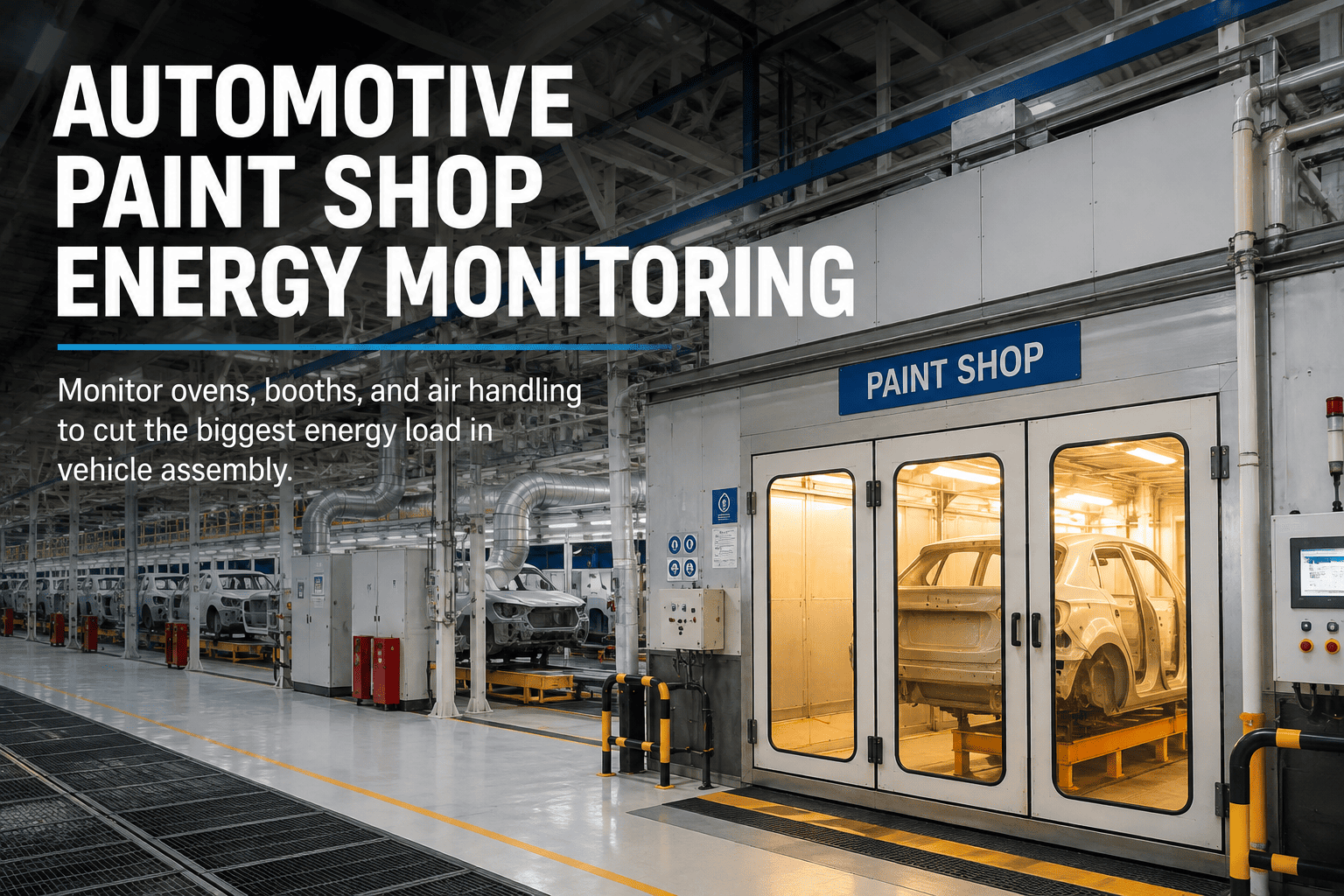
The paint shop is the most energy-intensive process in an automotive plant. Air management for booths consumes the largest share of that. Predictive humidity control cuts both defects and energy because the AHU stops chasing — no overshoots, no compensating reheat, no spike-and-recover cycles. Documented studies put paint-shop HVAC energy savings between 20% and 46% when predictive control replaces standard PID.
20–46%
HVAC energy saved
Range from peer-reviewed paint-shop studies, depending on climate
−70%
RH standard deviation
Tighter band = less overshoot = less compensating energy
Zero
Spike-and-recover cycles
Pre-conditioning replaces reactive ramps
Frequently Asked Questions
Will this work with our existing HVAC vendor and BMS?
Yes. We connect to every major BMS and HVAC controls platform via BACnet/IP, Modbus TCP, OPC-UA, or direct vendor protocol. No HVAC replacement. No new desiccant wheels. The existing equipment stays — the AI only changes when and what setpoints get written.
Can we run advisory mode first before writing to the HVAC?
That is the recommended path. Most plants spend the first 4–6 weeks in advisory mode — the AI predicts, the operator decides. Only after the team has seen the prediction accuracy on their own booths do we move to confirm-to-write, and only after a 90-day track record do we enable auto-pilot. Operator trust is earned, never assumed.
Do I buy NVIDIA servers separately?
No. iFactory supplies fully-loaded AI servers as part of the turnkey deployment — pre-configured NVIDIA edge GPU hardware, racked and ready, all software pre-loaded. Cabling, network, BMS integration, operator training, and 24×7 remote monitoring are included. Rack it, plug power and Ethernet, the AI is live.
What if our outdoor weather data is unreliable?
We deploy a rooftop or air-intake weather station as part of the standard scope where local met data is poor — dry-bulb, dew point, barometric pressure. Sensor cost is small, and the prediction accuracy lift is substantial. Most plants discover during pilot that their existing OA sensors were drifted or poorly positioned.
Is this compliant with IATF 16949 environmental controls?
Yes. IATF 16949 requires controlled environments for processes that affect quality, including humidity. iFactory generates timestamped logs of every RH reading, every setpoint change, every operator override, and every excursion. Audit-ready evidence packs include the control plan reference, the reaction plan trail, and the closed-loop CAPA record for any out-of-band event.
How long does deployment take and what does it cover?
Weeks 1–4: ship and rack the on-prem AI server, network the BMS/OT connections, install any supplemental sensors, validate data flow from every booth. Weeks 5–8: model training on your specific booths, advisory-mode pilot, baseline accuracy measurement. Weeks 9–12: confirm-to-write rollout, operator training, audit pack handover, 24×7 remote monitoring active.
Stop Painting Bodies in Degraded Conditions
See Predictive RH Control on Your Booths — In 30 Minutes
Bring 30 days of booth RH logs and a recent defect Pareto. We will overlay the two on the call, point to the excursions that drove your last month of rework, and walk through the path to 4-month payback on Booth #1.
88%
Prediction confidence on excursions
15–30 min
Forecast lead time
$28K
Annual savings per booth
6–12 wk
Live on your floor, on-prem