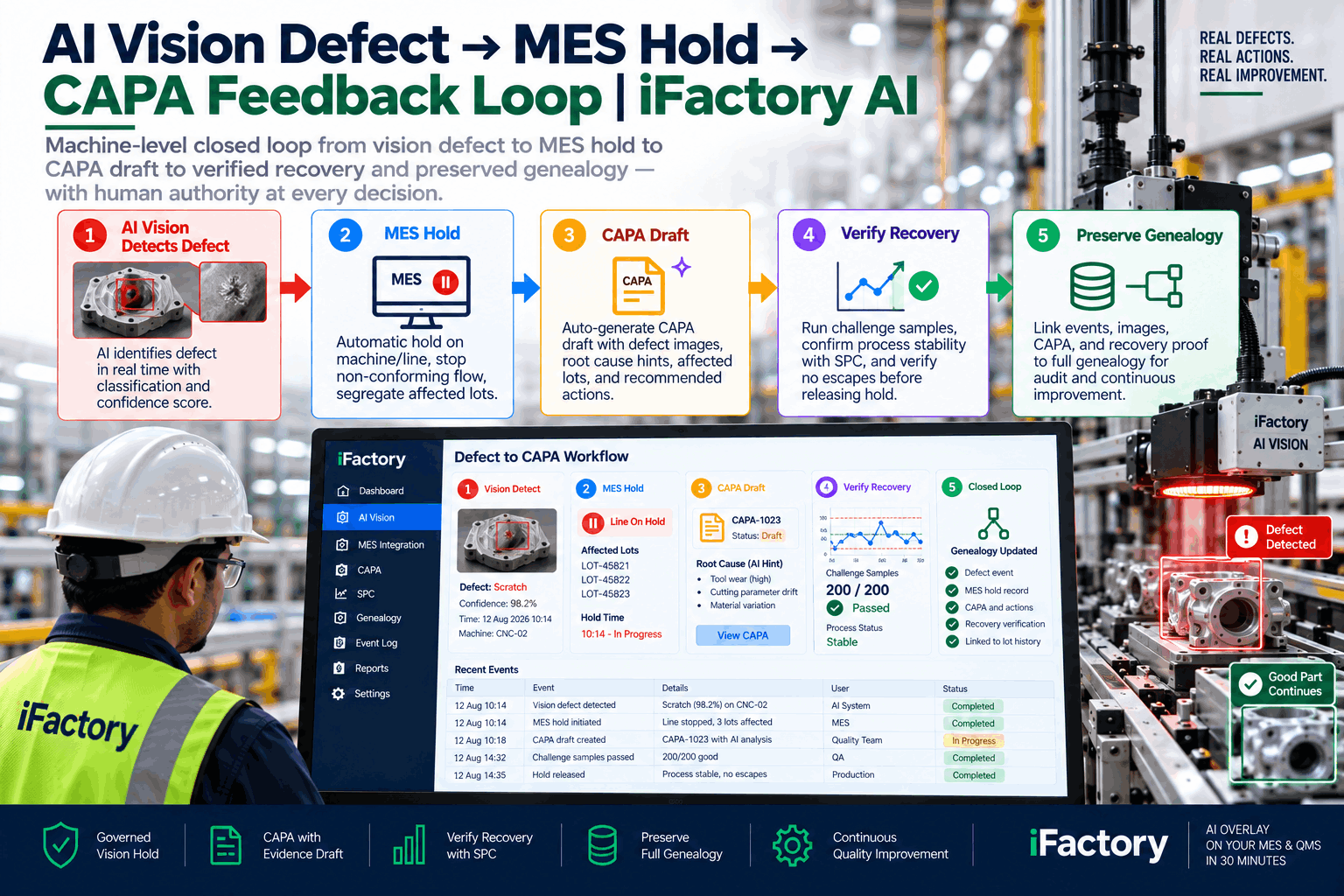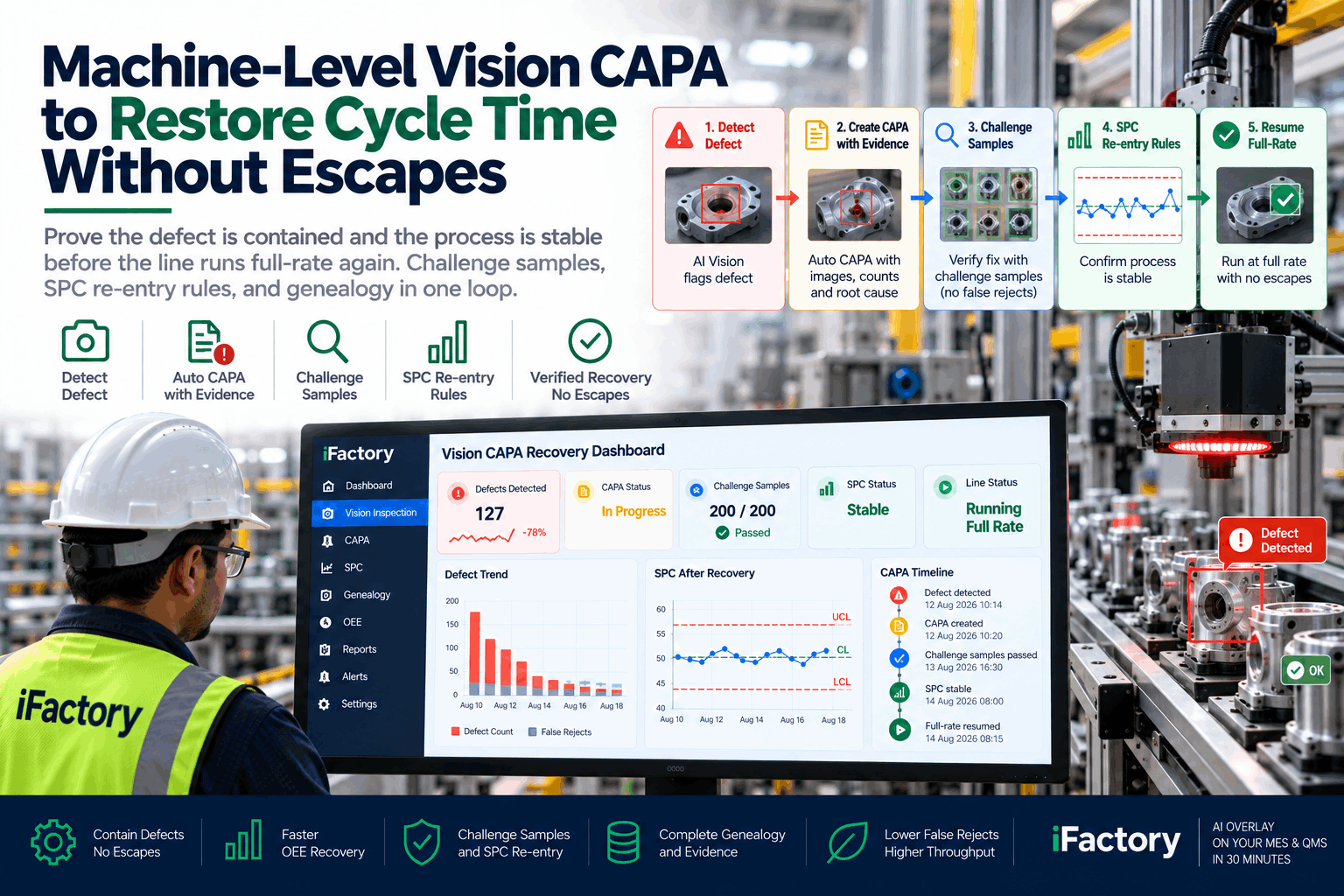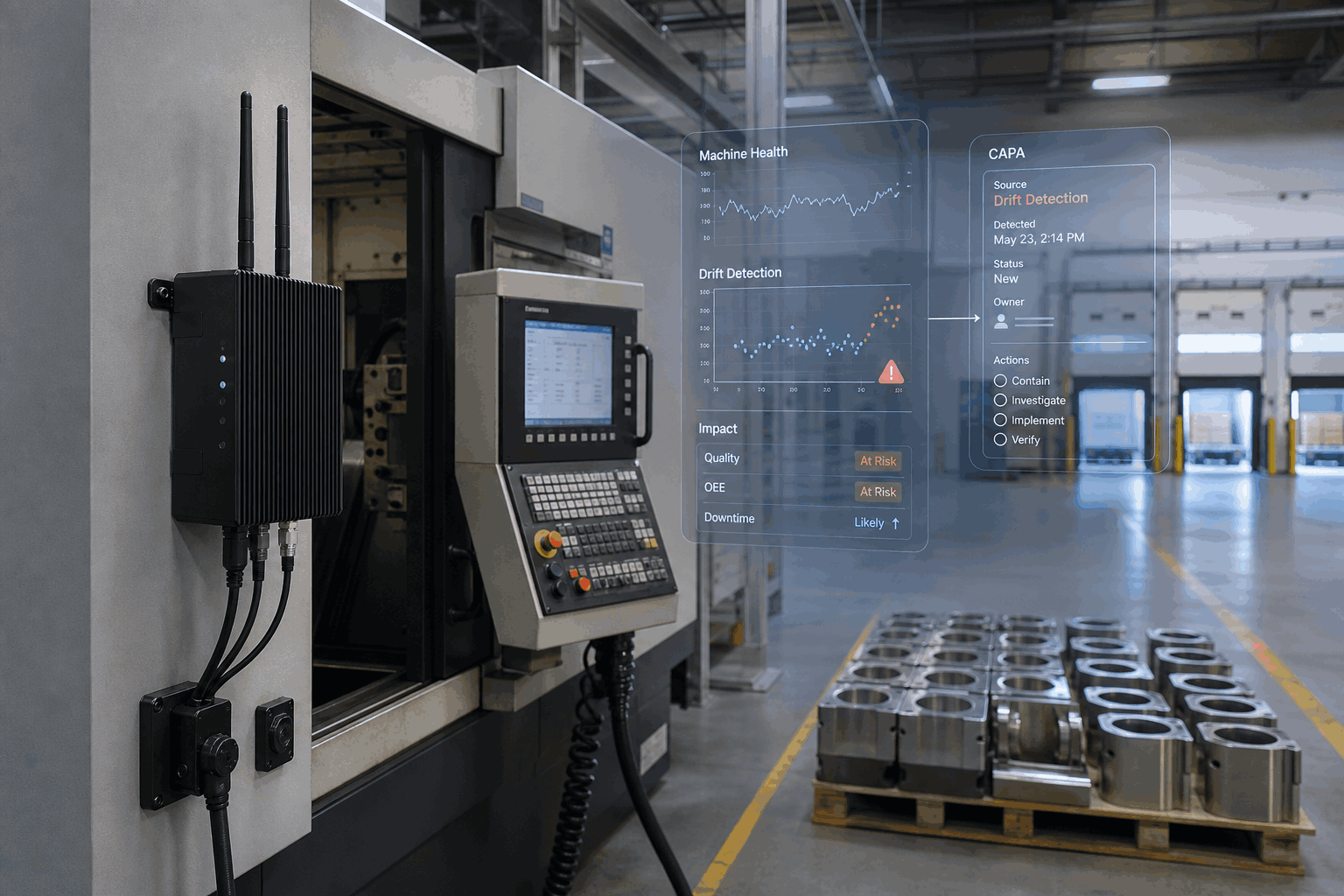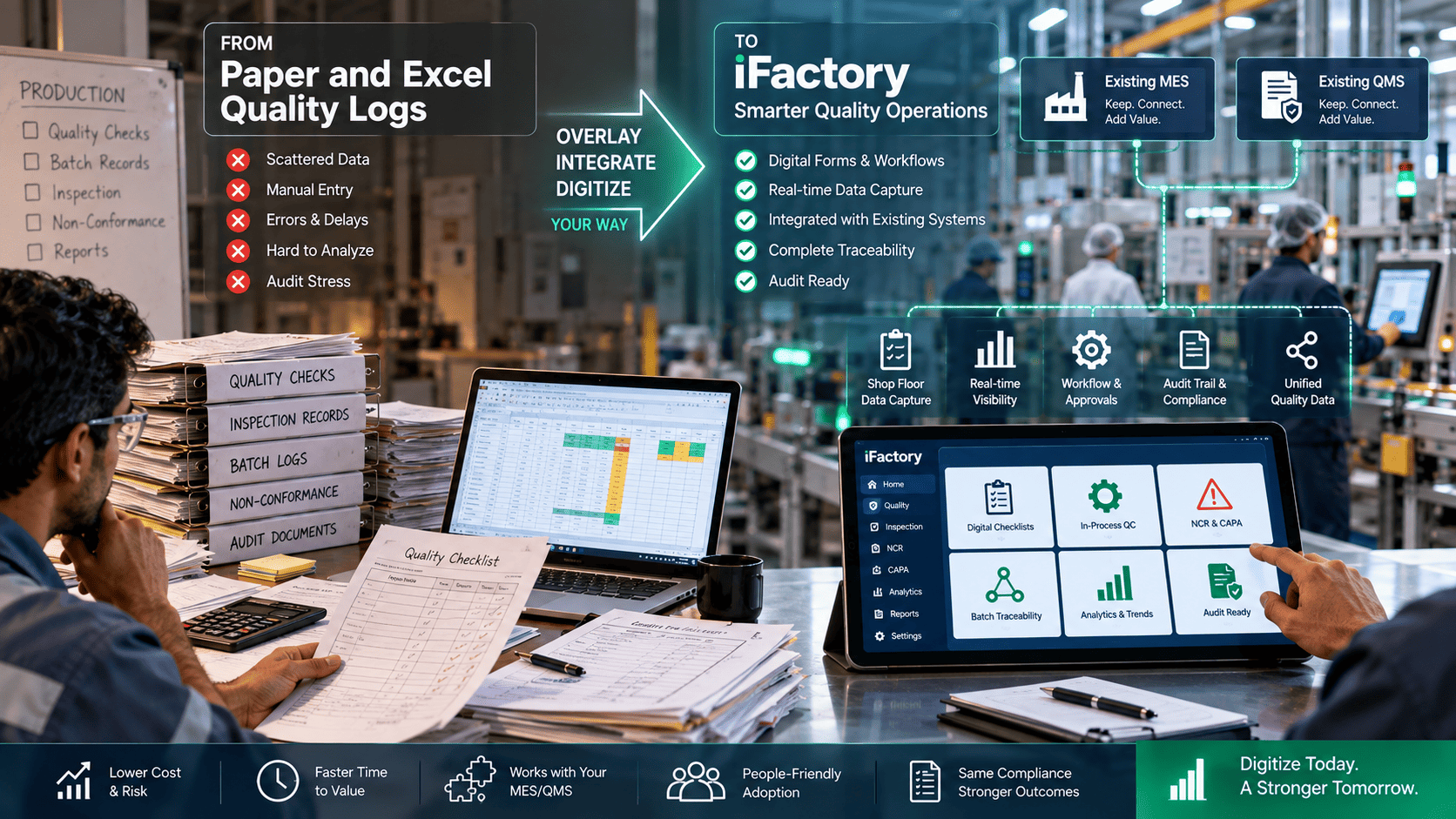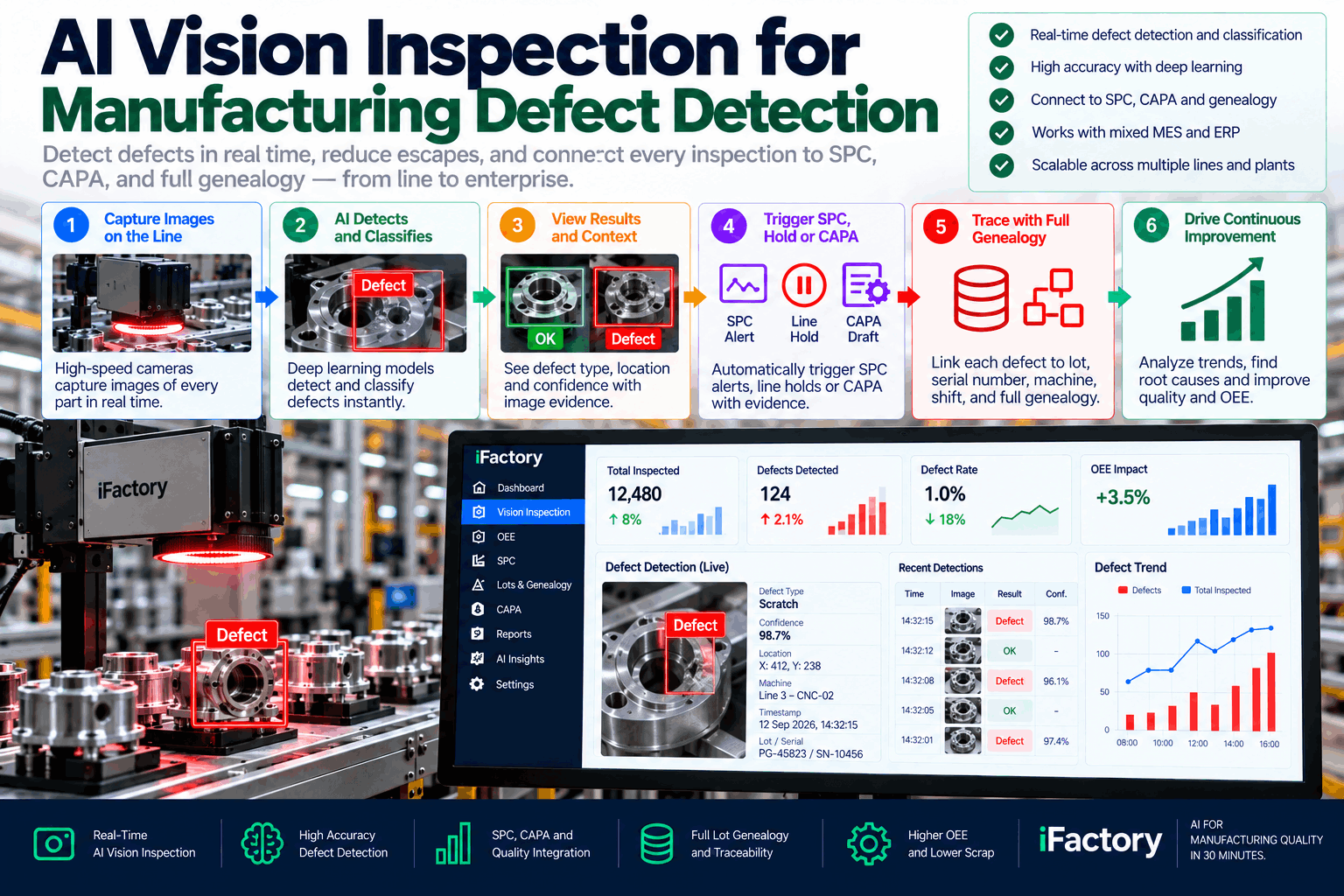
A defect frame shows up on the inspection screen at 2:14 p.m. and the line keeps moving — that is exactly where AI vision inspection stops being just a camera and starts being a governed quality workflow. Vision detection alone catches the flaw, but it is the hold, the CAPA draft, the verification, and the preserved genealogy that stop the escape from reaching the customer. iFactory AI overlays your existing MES, QMS, historian, and SPC stack so every vision frame becomes a scoped hold, an evidence-linked CAPA record, a verified recovery, and a traceable genealogy trail — with human sign-off preserved on every release decision. Book a 30-minute walkthrough of vision frame to CAPA closure.
Detection is the first step. Governed hold, evidence-linked CAPA, verified recovery, and preserved genealogy are what keep the escape off the truck.
At a Glance
Why Vision Detection Alone Fails Manufacturing Quality
The camera can be perfect and the plant can still lose money. That is the paradox many quality teams live with — an AI vision system running at line speed catches the defect in milliseconds, but the workflow that should turn detection into containment is manual, delayed, or scattered across four systems. By the time the hold is placed, more product has moved through the line. By the time the CAPA is drafted, the reviewer is reconstructing events from screenshots and memory. By the time verification runs, the genealogy of exposed units is incomplete. The camera did its job. The plant did not.
That gap between detection and controlled action is where quality escapes actually happen. It is also why the search intent behind AI vision inspection is shifting — buyers are no longer asking whether the camera can see the defect. They are asking whether the workflow around the camera can convert that signal into a traceable, defensible, audit-ready response before the escape reaches a customer.
The Closed-Loop Path — Vision Frame to Verified Release
A strong AI vision inspection program does not stop at pass or fail. It runs a sequence where each step preserves evidence for the next, and human authority sits at every meaningful decision point. iFactory AI is designed to make that sequence operational beside the systems your plant already runs.
Camera class, confidence score, station ID, timestamp, lot, and image evidence pull together into one structured event.
MES receives the structured event and places the correct WIP segment on hold. Narrow enough to protect throughput, broad enough to protect quality.
Defect class, station history, genealogy links, and image evidence pre-populate the quality record for human review.
Known good and known bad parts prove the correction worked before the line returns to full speed.
Every hold, release, rework, and disposition stays tied to the affected unit, lot, and process history for audit review.
Where AI Vision Pays for Itself
The financial case for AI vision inspection is straightforward when the workflow is closed-loop. Detection avoids escape cost, containment reduces scope, and preserved genealogy shortens investigation time — the same event that used to cost hours of triage now closes in a governed sequence.
Scratches, dents, contamination, paint flaws, weld spatter — visual defects that traditional inspection misses under fatigue and speed.
Missing components, misalignment, wrong parts, incomplete assembly — caught at the station where they happen, not at final test.
Gap and flush, feature location, dimensional drift — measured against digital reference and trended against SPC limits.
Print quality, date code legibility, label placement, barcode readability — every unit checked, not a sample.
Contamination, packaging debris, wrong material inclusions — flagged before the unit moves downstream.
Every inspection logged with image, timestamp, defect category, severity, and disposition for audit-ready records.
Bring one inspection station and one defect family. We walk through detect, hold, CAPA draft, verify, and genealogy — all beside your existing MES and QMS.
Event Contracts — The Backbone of Vision to MES Integration
A vision event should not be a vague defect detected message. It should be a structured manufacturing record that downstream systems can trust and act on consistently. Without an event contract every vision station produces a different shape of alert, governance breaks down, and the MES cannot apply consistent hold logic across the plant.
- Every station sends a different alert shape
- MES cannot apply consistent hold rules
- CAPA drafting starts from memory
- Genealogy links break at the handoff
- False rejects create quarantine backlog
- Every event carries defect class and confidence
- Machine, lot, timestamp, and evidence attached
- Hold rules route by severity automatically
- CAPA draft inherits full production context
- Human sign-off preserved on borderline calls
Frequently Asked Questions
AI vision inspects every unit at line speed with consistent accuracy that manual inspection cannot sustain over a full shift. When paired with a governed workflow, each detection becomes a scoped hold, a CAPA draft, and a genealogy record instead of a dashboard alert.
No. iFactory AI works as an overlay beside MES, QMS, historian, and SPC. It orchestrates the vision-to-CAPA workflow and preserves genealogy without touching your systems of record.
Yes, when the model is monitored and tuned with operational feedback. The closed loop tracks reject patterns, compares them to downstream verification, and supports threshold adjustment when the system drifts.
High-confidence critical defects can trigger automatic containment, but release always requires human review. The overlay records who approved, why, and what evidence supported the decision.
Surface defects, assembly errors, dimensional deviations, label and OCR issues, and foreign object detection — anything that presents a visual signature the model can be trained to recognize consistently.
The real value of AI vision inspection is not the camera. It is the governed workflow that converts every reject into a scoped hold, a CAPA draft, verified recovery, and preserved genealogy — before the escape reaches your customer.