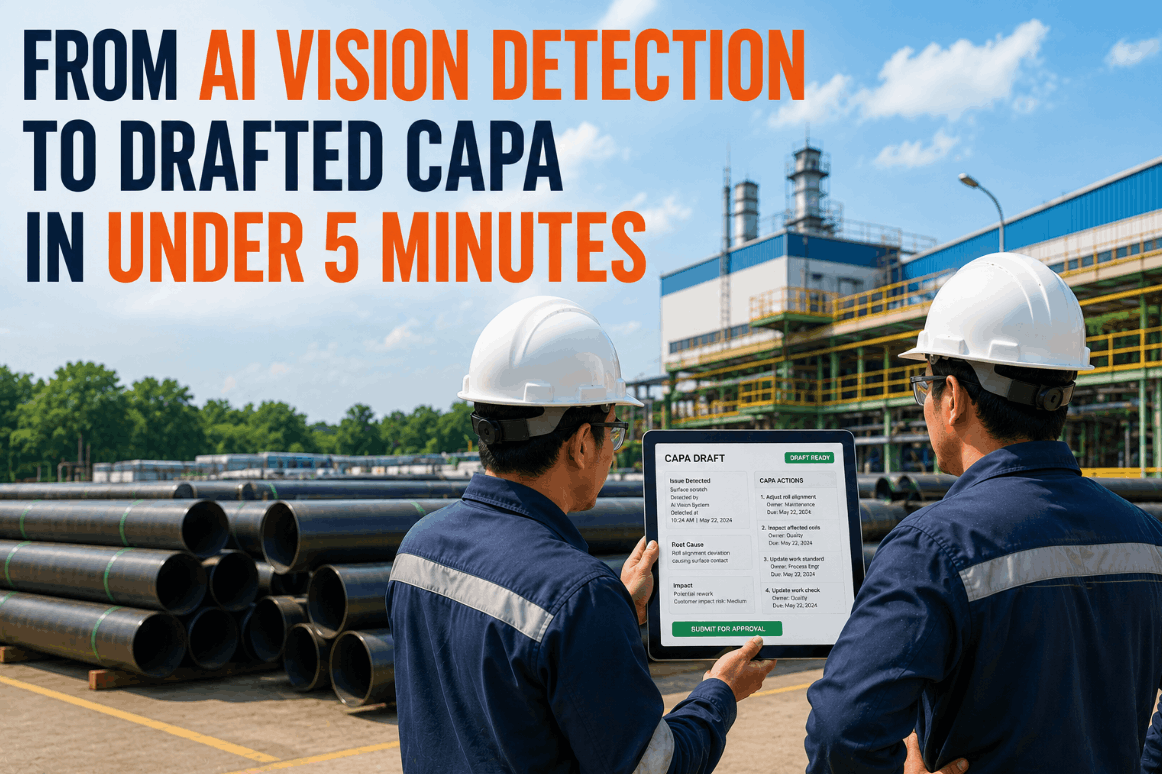
From AI Vision Detection to Drafted CAPA in Under 5 Minutes

By Henry Green on June 4, 2026

from-ai-vision-detection-to-drafted-capa-in-under-5-minutes

In modern manufacturing, a surface defect spotted by an AI vision camera used to trigger hours of paperwork, manual root-cause analysis, and delayed containment decisions. Quality engineers would spend the better part of a shift composing CAPA documentation from a blank form — identifying the affected lot window, hypothesizing the root cause, determining containment scope, and drafting corrective and preventive actions — all while production continued and the risk of additional escapes remained open. For plants running multiple lines and managing dozens of quality events per week, this documentation burden is not just inefficient; it is a structural compliance risk. CAPA records written under pressure, from memory, with inconsistent depth are the single most common finding in IATF 16949 and ISO 9001 audits. iFactory's Plant Copilot changes that entirely — the moment a vision system flags a defect, a fully drafted CAPA is generated in under 5 minutes, pre-filled with root cause, containment action, corrective action, and preventive action drawn from actual defect data and process context. The quality manager reviews, edits if needed, and signs. No blank forms. No guesswork. No delay. The gap between detection and documented corrective action — which used to span hours — now spans minutes.

AI Vision · CAPA Automation · Quality Workflow 2026
From AI Vision Detection to Drafted CAPA in Under 5 Minutes

Plant Copilot drafts CAPA instantly from any AI vision defect — root cause, containment, CA, PA pre-filled. Quality lead reviews and signs. Built for U.S. manufacturing quality managers.

<5 min
Vision defect to fully drafted CAPA, every time
100%
CAPA fields pre-filled — root cause, containment, CA, PA
0
Blank forms filled manually by quality engineers
Auto
Audit-ready records linked to defect lot and inspection event

Why Manual CAPA After Vision Detection Is a Broken Workflow

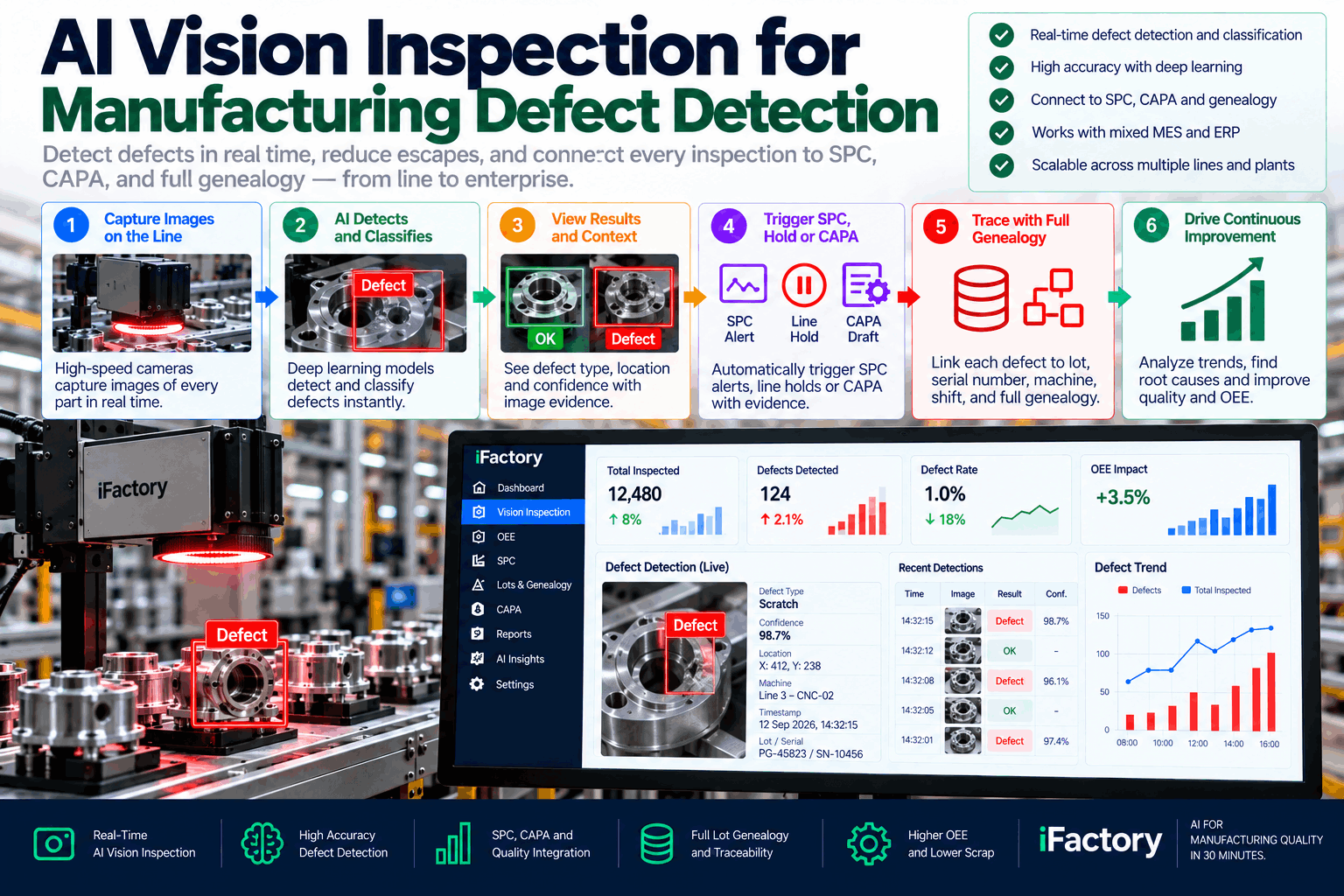
AI vision systems have become standard in high-volume discrete manufacturing — catching surface defects, dimensional anomalies, and assembly errors at line speed with accuracy that surpasses human inspection. But in most plants, what happens after the alert is still entirely manual. A quality engineer receives a notification, opens a CAPA form, and begins the familiar struggle: What was the root cause? Which lots are affected? What containment is needed right now? What systemic fix prevents recurrence? That process — even for experienced quality managers — takes 45 minutes to several hours per event. It depends on individual knowledge, is inconsistent across shifts, and creates compliance gaps when the pressure is high and documentation falls behind.

The disconnect is structural. Vision systems generate rich defect data — defect type, location, severity, image evidence, timestamp, station ID, operator shift — but that data stays locked inside the inspection platform. It never flows into the CAPA workflow automatically. iFactory's Plant Copilot closes this gap by reading vision detection outputs and instantly generating a structured, pre-filled CAPA document that quality managers can review, edit, and sign — not start from scratch.

How the AI Vision-to-CAPA Workflow Works

Automated CAPA Workflow — Vision Detection to QM Signature
01
Detection
Vision Camera Flags Defect
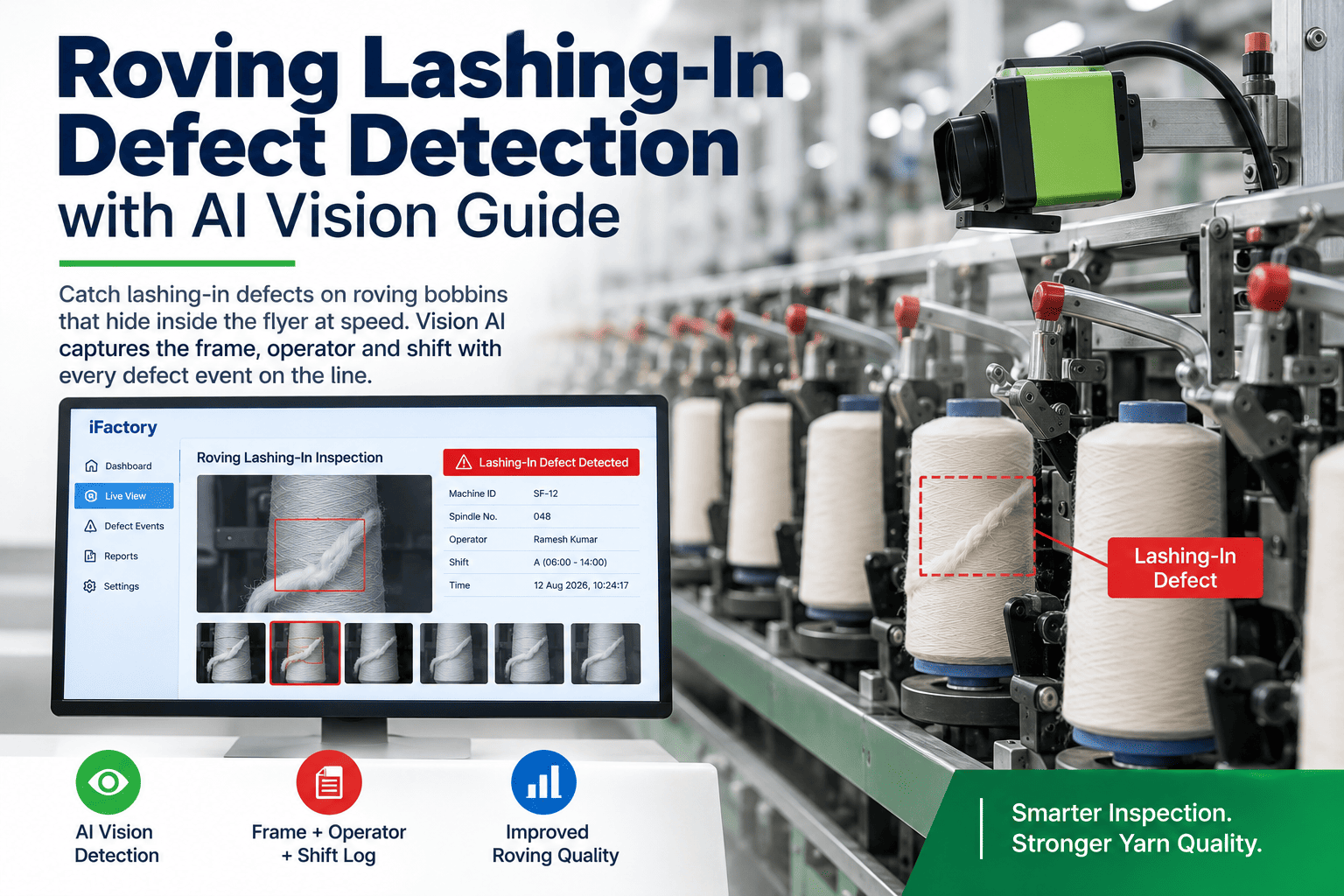
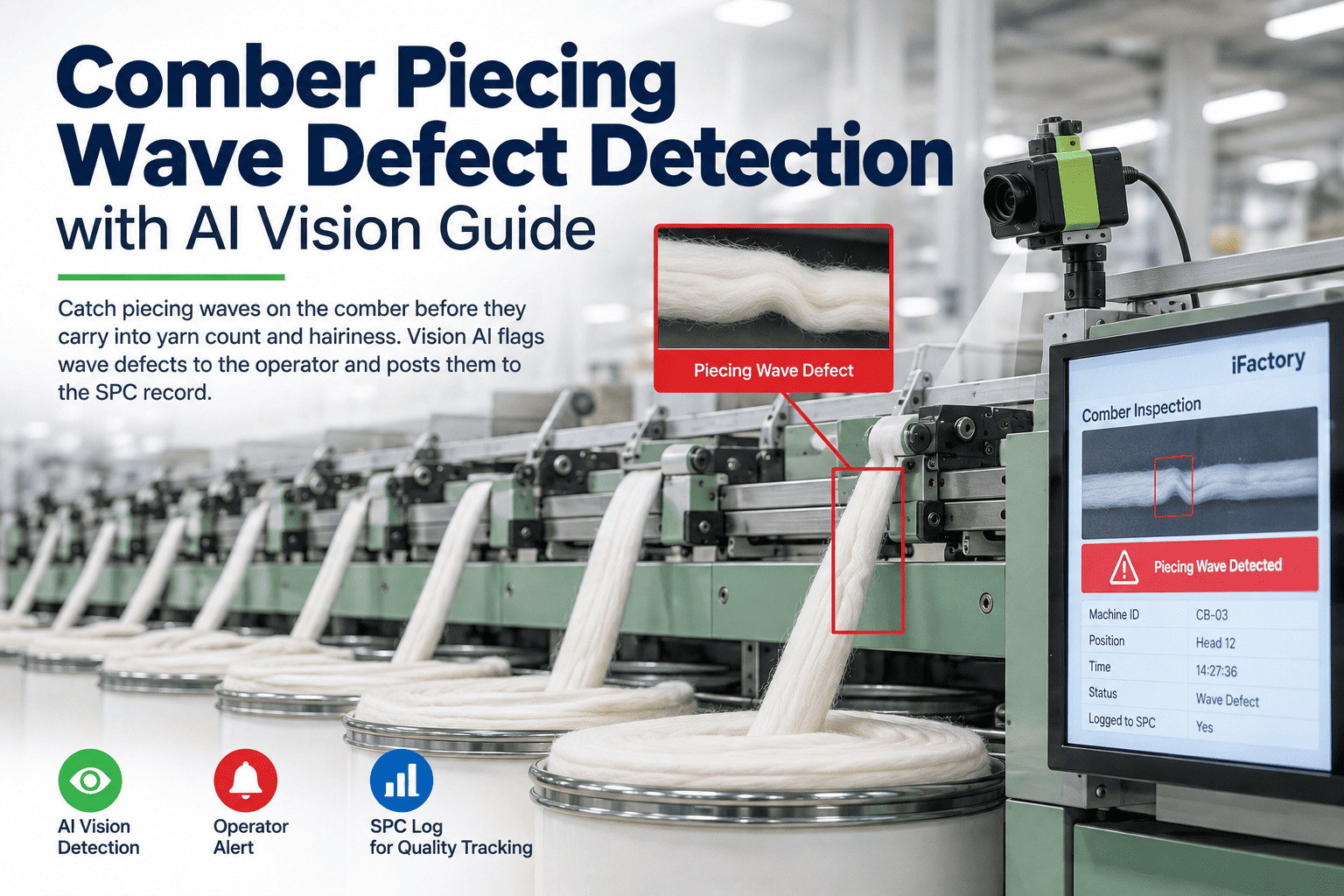
AI vision system detects surface defect, dimensional anomaly, or assembly error — capturing defect class, location, severity, image, station, shift, and lot ID.
02
AI Processing
Plant Copilot Analyzes Context
Plant Copilot cross-references defect type with historical failure data, process parameters, equipment state, and known root causes for that defect class.
03
Draft Generation
CAPA Pre-Filled in Under 5 Min
Root cause hypothesis, containment action, corrective action, and preventive action are drafted automatically. Affected lot scope is identified and flagged.
04
Review
Quality Manager Reviews & Edits
Quality lead reviews the AI-drafted CAPA, makes any corrections, and approves or escalates. Review typically takes 3–8 minutes vs. 45–90 minutes from blank.
05
Close
Signed, Logged, Audit-Ready
Signed CAPA is stored with full traceability — linked to the vision detection event, defect image, lot record, and corrective action owner. Audit-ready instantly.

What Plant Copilot Drafts Inside Every CAPA

01
Root Cause Analysis — Pre-Populated, Not Guessed
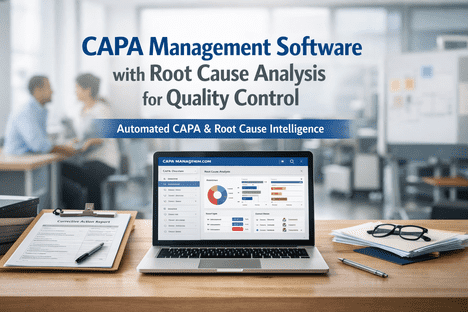
Plant Copilot does not generate generic root cause text. It draws on the defect classification from the vision system, correlated process parameter data at the time of detection, equipment health signals from iFactory's predictive maintenance layer, and historical CAPA records for that defect class on that line. The output is a specific, evidence-backed root cause hypothesis — the kind a senior quality engineer would write after 30 minutes of investigation, delivered in under 5 minutes.
Evidence-backed hypothesis Cross-references process data Defect-class specific
02
Containment Action — Lot Scope Identified Automatically
Containment is the most time-critical section of any CAPA. Plant Copilot identifies the affected lot window based on when the vision system first detected anomaly patterns — not just the flagged part. It recommends hold, quarantine, or enhanced inspection actions for the suspect lot scope, and populates the containment section with the responsible team, affected station, and expected completion timeframe. Quality managers no longer have to determine lot scope from production records manually.
Auto lot scope Quarantine recommendation Responsible owner assigned
03
Corrective & Preventive Actions — Structured and Assignable
The corrective action (CA) section addresses the immediate cause; the preventive action (PA) addresses systemic recurrence. Plant Copilot drafts both sections based on the root cause analysis, available process adjustment levers, and maintenance recommendations from iFactory's CMMS. PAs are formatted as assignable tasks with suggested owners and target completion dates — ready for the quality manager to confirm or reassign rather than compose from scratch. Book a Demo to see how Plant Copilot drafts CA and PA in your manufacturing context.
CA + PA pre-drafted Assignable tasks CMMS-linked actions

CAPA Automation vs. Manual Process — Side-by-Side Comparison

CAPA Activity
Manual Process
iFactory Plant Copilot
Quality Impact
Defect-to-CAPA trigger
Manual notification, delayed start
Auto-triggered on vision detection
Eliminates trigger latency
Root cause drafting
30–90 min, engineer-dependent
Pre-filled in <5 min by Plant Copilot
Consistent, evidence-backed output
Containment lot scope
Manual record review, hours
Auto lot window from vision timeline
Faster, more accurate containment
Corrective action assignment
Blank form, manager composes
Drafted with suggested owner + date
Actionable from review, not blank slate
Preventive action
Often incomplete or skipped
PA linked to CMMS work order
Systemic recurrence addressed
Audit traceability
Manual filing, inconsistent links
Auto-linked to defect image + lot record
Audit-ready at signature
See Plant Copilot Draft a CAPA Live

Watch iFactory's Plant Copilot take a vision detection event and produce a fully pre-filled CAPA — root cause, containment, CA, PA — in under 5 minutes. Quality managers review, not compose.

What Quality Managers Actually Experience with Automated CAPA

Expert Perspective

Quality managers in discrete manufacturing consistently cite CAPA documentation as their highest non-value-added time sink. The knowledge to write a good CAPA exists — the barrier is the blank form and the pressure to produce compliant documentation quickly across multiple concurrent events. When Plant Copilot pre-fills the CAPA structure from the vision detection data, the quality manager's role shifts from author to reviewer. That shift — from 60-90 minutes of composition to 5-10 minutes of review — changes what's possible per shift, per engineer, per event.

The compounding benefit is consistency. Manual CAPAs vary in depth and rigor depending on who wrote them and how much time they had. AI-drafted CAPAs produced from a structured prompt and connected to actual process data are structurally consistent across every event — which matters significantly during FDA, IATF 16949, or ISO 9001 audits when reviewers compare CAPA records across quarters.

Shifts quality manager from author to reviewer
Consistent CAPA depth across all shifts and engineers
Audit-ready documentation linked to defect evidence
Scales CAPA capacity without adding quality headcount

iFactory Capabilities That Power AI Vision-to-CAPA

Plant Copilot AI
Drafts CAPA from any vision detection event — root cause, containment, CA, PA pre-filled
AI Vision Integration
Connects to existing vision platforms — defect class, image, severity, station, and lot ID flow automatically
CMMS Work Order Link
Preventive actions auto-generate CMMS work orders tied to the root cause — maintenance and quality aligned
Shift Logbook Traceability
Every CAPA event logged with full traceability — defect image, lot, process parameters, and QM signature in one record

Conclusion: Closing the Loop Between Vision Detection and Quality Action

AI vision inspection has solved the detection problem in manufacturing quality control. The remaining gap is speed and consistency between detection and corrective action. iFactory's Plant Copilot closes that gap — turning every vision detection event into a fully drafted, structured CAPA in under 5 minutes. Quality managers review rather than compose, containment starts sooner, and every record is audit-ready from the moment of signature. For U.S. manufacturers operating under IATF 16949, FDA 21 CFR Part 820, or ISO 9001 requirements, that shift from reactive documentation to AI-assisted quality action is a measurable competitive and compliance advantage. Book a Demo to see the full workflow in action for your facility.

FAQ

Plant Copilot integrates with third-party vision systems via standard APIs — defect classification output, image metadata, and lot traceability data flow into the CAPA drafting engine regardless of the vision platform deployed.
Plant Copilot provides a hypothesis based on defect data and process context — it is designed for quality manager review and approval, not autonomous sign-off; the QM always reviews and signs before the CAPA is finalized.
iFactory generates structured, traceable CAPA records with defect evidence, lot scope, signed approvals, and linked corrective actions — meeting the documentation format requirements of major quality management standards.
iFactory deploys in 1–2 weeks against pre-built templates for common manufacturing equipment; connecting to existing vision systems and QMS typically adds 1–2 additional integration days depending on protocol support.
Yes — every section of the AI-drafted CAPA is fully editable before the quality manager signs; Plant Copilot provides the starting structure, and the QM has complete control over the final record.
Deploy AI Vision-to-CAPA Automation with iFactory

Plant Copilot turns every AI vision defect detection into a fully drafted CAPA — root cause, containment, corrective action, and preventive action pre-filled — in under 5 minutes. Quality managers review, approve, and close the loop. Audit-ready records generated automatically.
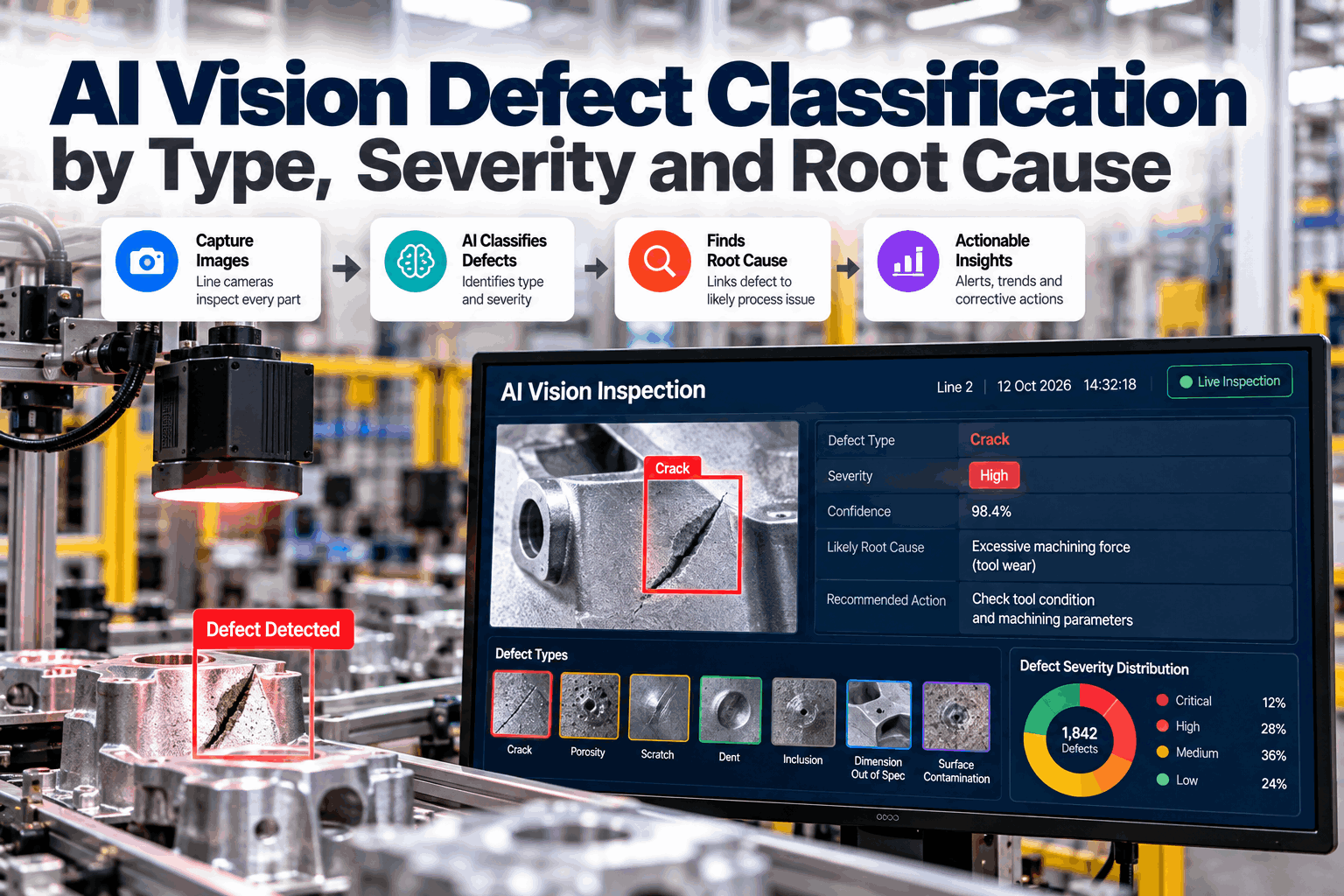

Plant Copilot CAPA Automation AI Vision Integration Root Cause AI Audit Traceability CMMS-Linked PA

Share This Story, Choose Your Platform!