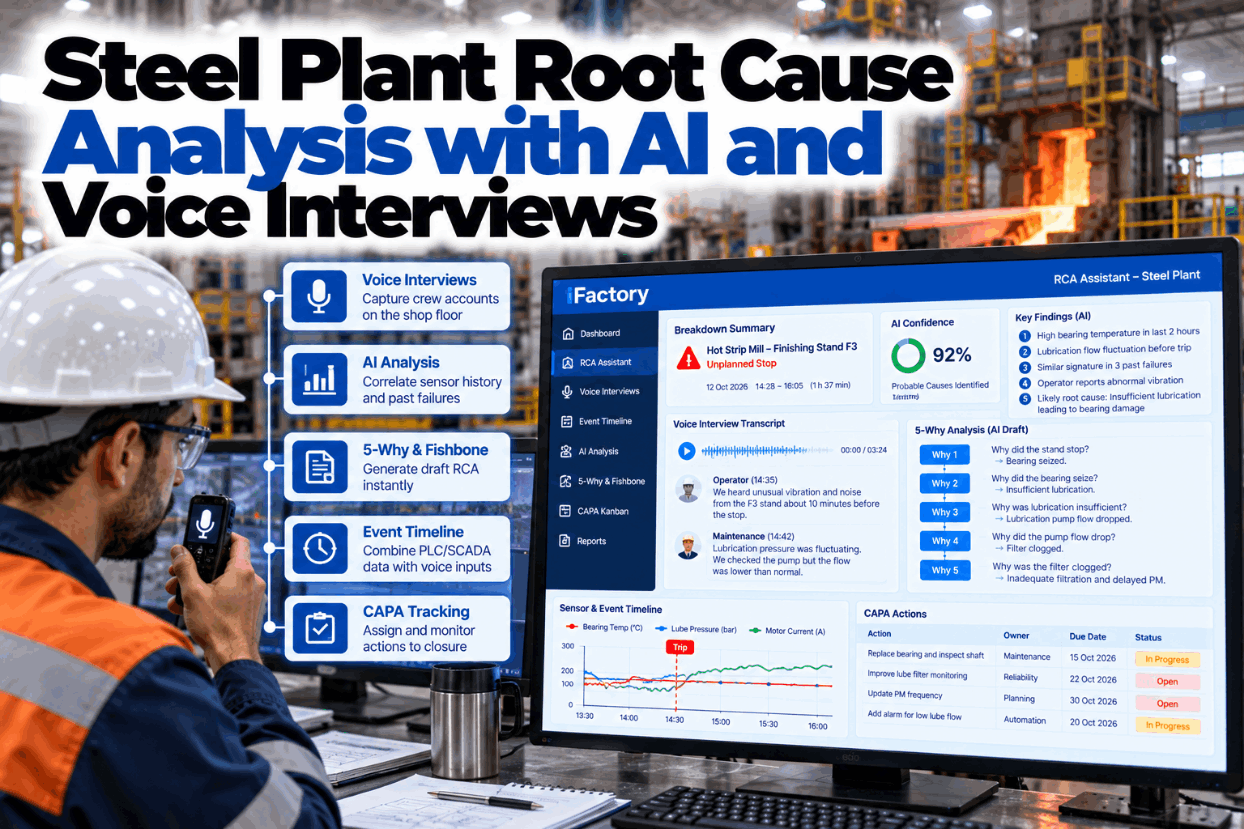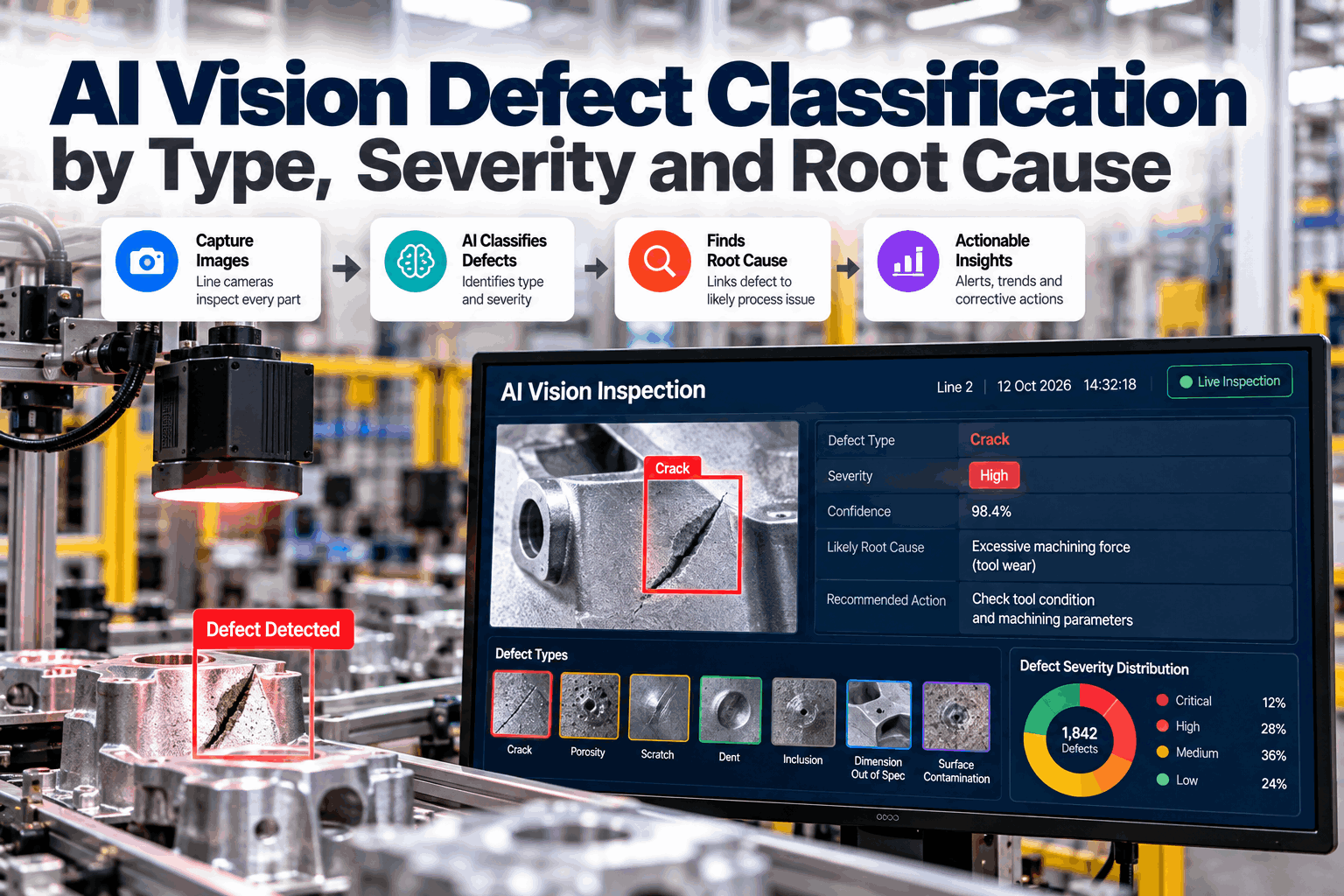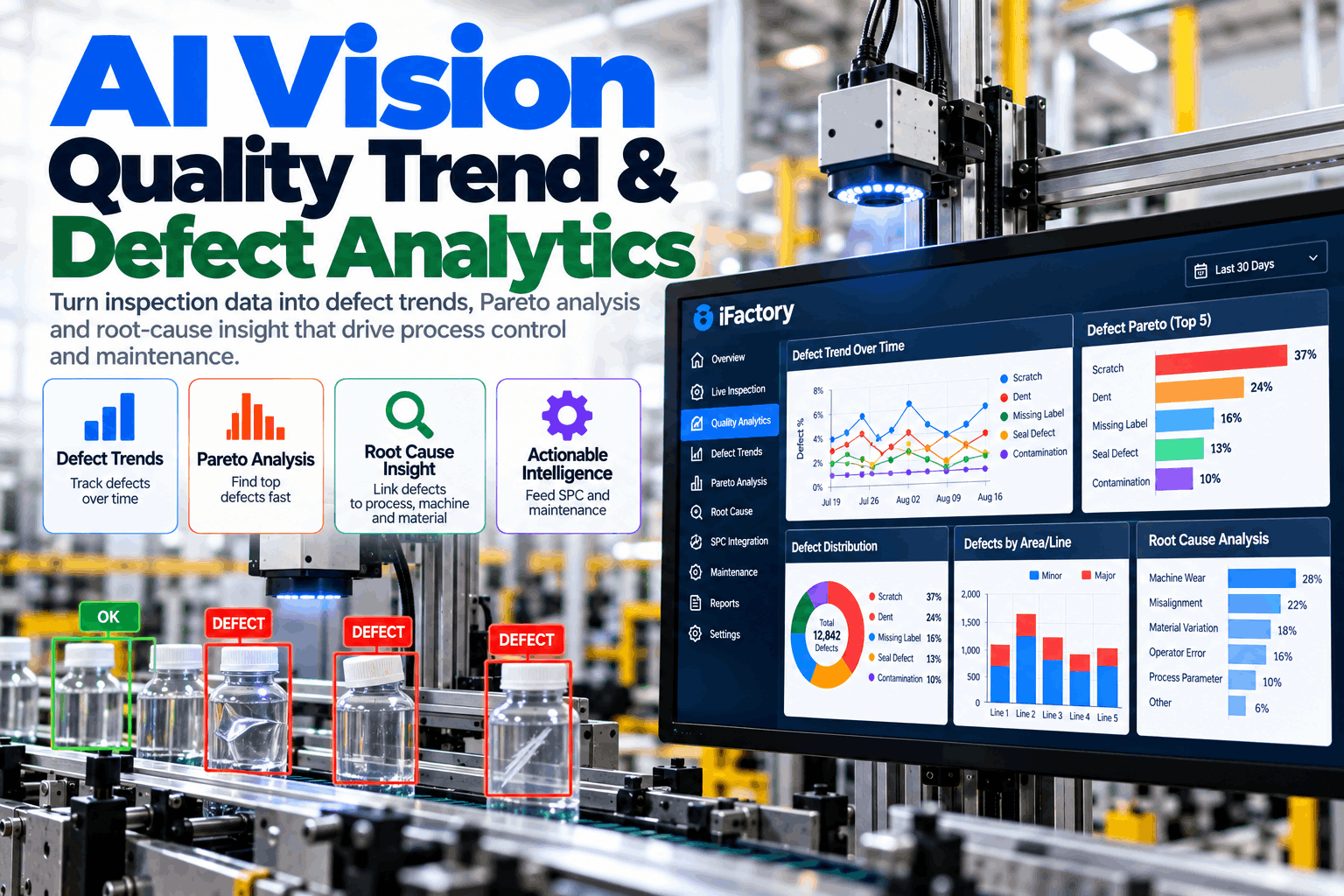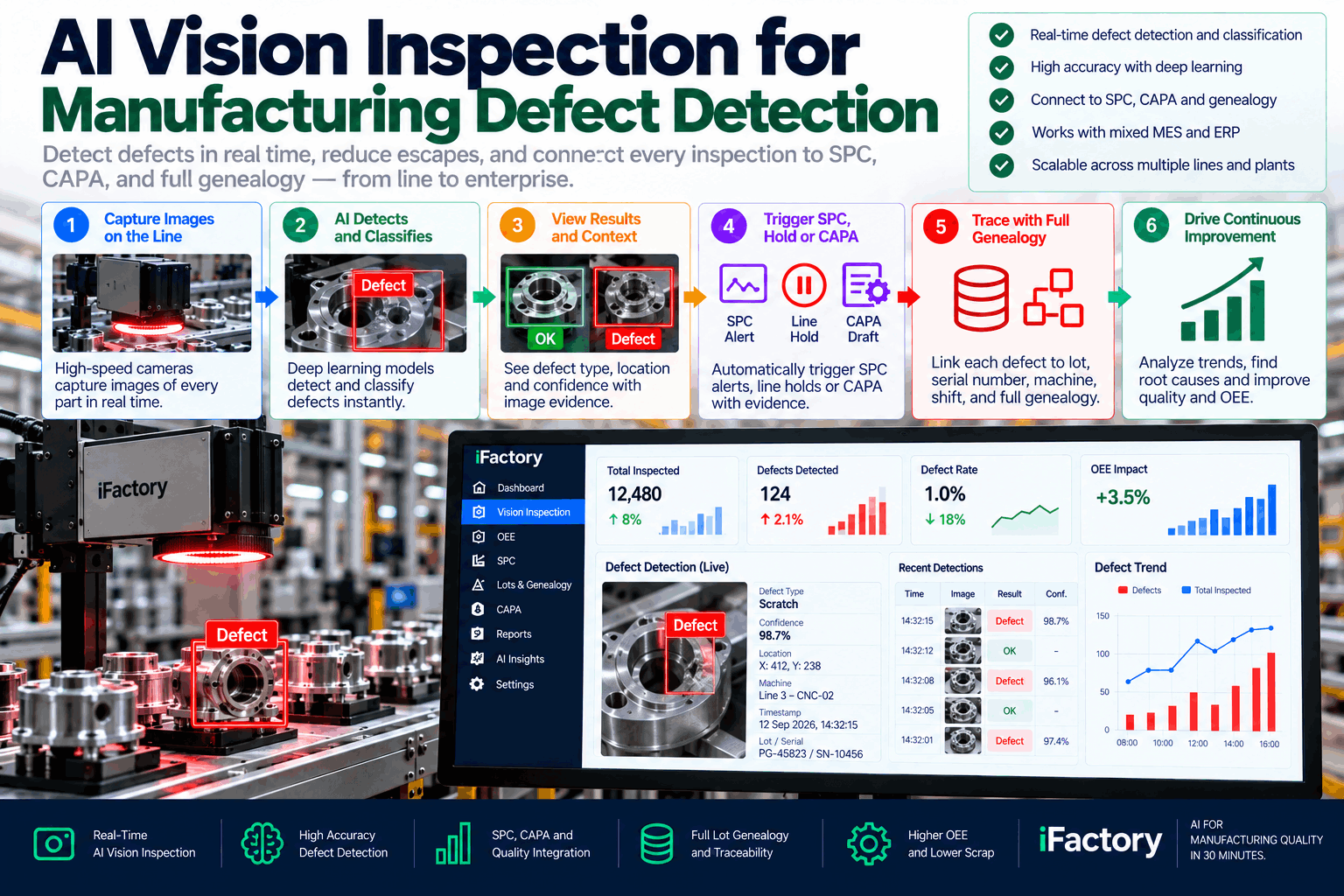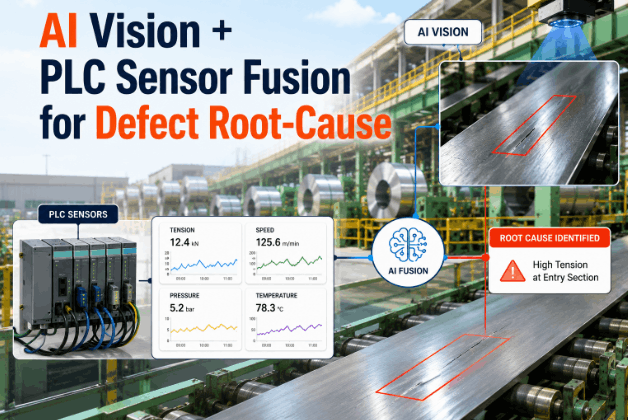
When a dimensional defect surfaces at final inspection, the question every quality engineer immediately asks is: where in the process did this originate? Traditional quality systems give you half an answer — the camera frame shows the dent, the scratch, the surface deviation. What they cannot tell you is which upstream process variable drove it. Was tension out of spec at that exact moment the part passed under the forming die? Was the recipe version on the line during that shift the one with the revised feed rate? Did an operator acknowledge an alarm and run through it? Without correlating the visual detection timestamp against the full PLC tag history, you are doing archaeology, not root-cause analysis. iFactory AI's sensor fusion engine closes that gap permanently. The platform links camera detection events to PLC tag states, recipe version records, and operator action logs in a single time-synchronized ledger — delivering attributed root cause in seconds, not shift-review cycles. Plants that have deployed iFactory's vision-PLC fusion platform are reporting 54% reductions in defect recurrence rates and 71% faster root-cause closure times within the first 90 days of live correlation monitoring.
Why Defect Detection Without Process Correlation Is Only Half the Solution
Every modern production line that runs AI vision inspection has solved the detection problem. The model flags the anomaly. The part is diverted. The count goes into the quality dashboard. What most facilities have not solved is the attribution problem — the ability to answer, for every defect event, which specific process condition caused it and when that condition first appeared. Without attribution, defect detection is a containment tool, not a prevention tool. You stop bad parts from reaching the customer. You do not stop the process from making them.
The attribution gap is structural. Vision systems operate on image timestamps. PLC historians store tag state changes by scan cycle. Recipe management systems log version commits by shift or batch. Operator action records sit in a separate MES layer. These four data sources are never synchronized in a standard quality stack — which means that the vision system that captured the surface deviation at 14:23:07.4 has no way to know that the line tension PLC tag was running 8% above setpoint from 14:21:52 through 14:24:18, that the recipe version had been changed 40 minutes earlier, or that an operator acknowledged a tension alarm at 14:20:44 and continued production. iFactory's sensor fusion engine synchronizes all four data streams to a common millisecond timeline, so every defect event arrives with full process context already attached.
The Four Data Layers iFactory Fuses for Every Defect Attribution Event
Root cause attribution requires that every defect detection event be enriched with the complete process context that existed at the moment of detection — not the shift average, not the nearest historian snapshot, but the actual millisecond-synchronized state of each process variable. iFactory's sensor fusion architecture builds that context from four distinct data layers, each connected through a common time reference that makes cross-layer correlation deterministic rather than approximate.
Vision Detection: Timestamped Defect Events With Spatial Coordinates
The vision layer is the triggering event in the iFactory root-cause ledger. Every camera frame that produces a defect classification — surface anomaly, dimensional deviation, assembly error, contamination, missing component — is logged with a UTC-synchronized timestamp accurate to the millisecond, the defect type and confidence score, the spatial coordinates on the part, the camera station ID, and the part serial or lot number. This event record becomes the anchor point against which all other data layers are correlated. iFactory supports standard industrial camera protocols including GigE Vision, USB3 Vision, and OPC-UA image metadata — connecting to existing line cameras without hardware replacement in most deployments.
PLC Tag History: Process State at Every Detection Timestamp
The PLC layer answers the process variable question: what was each critical tag reading at the exact moment the camera detected the defect, and what was it doing in the configurable lookback window before that moment? iFactory connects to PLC historians via OPC-UA, collecting tag state records at the scan cycle rate of the source controller — typically 10ms to 100ms intervals for critical process variables. For each defect event, iFactory automatically queries the PLC historian for every tag in the pre-configured relevance set for that camera station, returning current value, deviation from setpoint, trend direction, and time-in-deviation for each tag. This transforms a vision detection event into a structured process state snapshot without any manual historian query.
Recipe Version Tracking: Which Parameter Set Was Active at Defect Time
Recipe changes are among the highest-frequency root causes of defect rate shifts in batch and mixed-model manufacturing — and the hardest to correlate manually because the defect often appears several cycles after the recipe change, not immediately. iFactory maintains a continuous recipe version ledger for every production line, logging each recipe commit with a UTC timestamp, the parameter delta from the previous version, the user ID that committed the change, and the lot or part number active at commit time. When a defect event is detected, iFactory automatically checks whether a recipe version change occurred within the configurable attribution window (default: 30 minutes) and flags the parameter deltas from that change as candidate root cause contributors in the attribution record.
Operator Action Log: Human Decisions Correlated Against Defect Events
Operator actions — alarm acknowledgments, manual overrides, speed adjustments, material changeovers — are the most underutilized root-cause data source in manufacturing quality systems. They are typically stored in a separate MES or HMI log, disconnected from vision events and PLC tag history. iFactory integrates the operator action log as a first-class layer in the sensor fusion architecture, correlating every alarm acknowledgment, override, and parameter adjustment with the defect events that followed within the attribution window. This closes the human-factor gap in root-cause analysis — identifying cases where process alarms were acknowledged and run-through rather than resolved before defect rates increased. Book a Demo to see operator action correlation in a live environment.
How iFactory Plant Copilot Converts Fused Data Into Root-Cause Attribution in Seconds
Collecting synchronized multi-source data is the prerequisite. Converting that data into an attributed, actionable root-cause conclusion — without requiring an engineer to manually query four systems and build a correlation table — is where iFactory's Plant Copilot delivers its core value. The workflow below describes exactly how a defect detection event moves from camera trigger to closed root-cause record in the iFactory platform.
Vision-PLC Fusion vs. Standalone Vision Inspection: What Changes in Practice
The table below documents the operational difference between a standalone AI vision inspection deployment and a vision-PLC sensor fusion deployment with iFactory. Every difference maps directly to quality outcomes and cost impact. Book a Demo to see how the comparison applies to your current quality architecture.
| Quality Capability | Standalone AI Vision | iFactory Vision-PLC Fusion | Operational Impact |
|---|---|---|---|
| Defect Detection | Detects and classifies defect at camera station | Detects, classifies, and immediately queries process context | Containment + attribution from single detection event |
| Root-Cause Identification | Requires manual historian review by quality engineer (4–8 hours typical) | Attributed root cause returned in under 8 seconds automatically | 71% faster closure; no engineering time consumed per event |
| Recipe Change Attribution | Not linked; recipe changes invisible to vision system | Recipe version active at detection logged; parameter deltas flagged | Recipe-driven defect spikes identified before full batch is impacted |
| Operator Action Correlation | No operator context available at vision event | Alarm acknowledgments and overrides correlated to subsequent defect events | Human-factor root causes surfaced that would otherwise be invisible |
| Defect Recurrence Prevention | Depends on engineer reviewing trends and writing corrective action | Recurrence trigger set automatically in PLC tag monitoring after first attributed event | Same-cause defect recurrence rate reduced 54% on average |
| Audit Trail for Quality Systems | Vision log only; no process context attached | Full 4-layer record per event: vision + PLC + recipe + operator action | ISO 9001, IATF 16949, and AS9100 audit documentation complete per event |
| Model Improvement Over Time | Requires labeled defect images; process cause unknown | Each closed attribution adds labeled cause-effect pair to correlation model | Prediction accuracy improves with every corrective action cycle |
Common Defect Types and the Process Variables iFactory Correlates at the Detection Timestamp
Different defect types have different upstream process drivers. iFactory's sensor fusion library ships with pre-built correlation sets for the most common manufacturing defect categories — mapping each defect type to the PLC tags, recipe parameters, and environmental variables most likely to be causal contributors. These correlation sets are configurable and are refined over time as the platform accumulates closed attribution records from each facility. Book a Demo to review the pre-built correlation library for your production process.
Expert Perspective: Why Multi-Source Correlation Is the Only Defensible Root-Cause Method in Modern Manufacturing
I have consulted on quality system failures at 40-plus manufacturing facilities across automotive, aerospace, and industrial equipment sectors. In almost every case where a defect escaped to the customer — or where a corrective action failed to prevent recurrence — the investigation had relied on single-source analysis. The vision system said there was a surface deviation. The quality team pulled the historian for the press pressure. Pressure looked fine. Case closed. What they did not pull was the lubrication flow data from a different PLC node, the recipe version that had been quietly updated two days earlier, or the operator log that showed an alarm acknowledged and run through at the start of that shift. The defect had a multi-factor cause that required multi-source correlation to see. The challenge historically was not willingness — it was that manually correlating four data systems against a timestamped event takes hours of engineering time per occurrence. When you have 30 defect events per shift, that time simply does not exist. The value of a platform like iFactory's sensor fusion architecture is not that it is smarter than a good quality engineer. It is that it does the correlation work in seconds rather than hours, consistently, for every detection event, without an engineer having to decide whether this particular event is worth the time to investigate. Every event gets the same analytical treatment. That consistency is what drives recurrence prevention — not just the cases someone chose to investigate manually.
Conclusion: The Root-Cause Gap That Persists After Vision Inspection Is Deployed
AI vision inspection has become the standard for defect detection in high-volume U.S. manufacturing — and it has largely solved the detection problem. Parts with surface anomalies, dimensional deviations, assembly errors, and contamination are identified at line speed with accuracy that manual inspection cannot match. What it has not solved, as a standalone capability, is the attribution problem: why that defect occurred, which process variable drove it, and how to prevent the same cause from producing the same defect on the next shift.
iFactory's sensor fusion engine closes that gap by linking every vision detection event to the full process context that existed at that timestamp — PLC tag state, recipe version, and operator action — in a single synchronized ledger that Plant Copilot converts to an attributed root cause in under eight seconds. The result is not faster detection. It is faster correction, fewer recurrences, and a quality system that learns from every defect event rather than containing it and moving on. The data to attribute every defect is already being generated in your facility. iFactory connects the layers that have never been connected before.
Frequently Asked Questions
Sensor fusion is the time-synchronized combination of vision detection events with PLC tag history, recipe versions, and operator actions — giving every defect a complete process context rather than just a camera image. Without it, vision inspection identifies that a defect occurred but cannot tell you which process variable caused it, making recurrence prevention dependent on manual engineer investigation rather than automatic attribution.
No. iFactory connects to existing GigE Vision and USB3 Vision cameras via standard protocols and integrates with PLC historians through OPC-UA — compatible with Allen-Bradley, Siemens, Rockwell, Beckhoff, and Mitsubishi controllers. Most deployments require no hardware replacement, only a software integration layer that synchronizes the existing data streams to a common time reference. Book a Demo to confirm compatibility with your specific equipment configuration.
The Plant Copilot returns a ranked probable-cause attribution with supporting evidence from all four data layers in under 8 seconds from the detection trigger — compared to 4–8 hours of manual historian review in traditional quality workflows. Early deployments report a 71% reduction in root-cause closure time from this automated correlation capability.
Yes. Every defect attribution record in iFactory's ledger includes the full four-layer evidence set — vision event, PLC tag state, recipe version, and operator action — with timestamps, user IDs, and corrective action documentation that satisfies the nonconformance record and corrective action requirements under ISO 9001 Clause 10.2 and IATF 16949's 8D-compatible problem-solving documentation requirements. Records are exportable in structured format for audit and customer submission.
Every confirmed root-cause attribution — where an engineer validates the Copilot's ranked cause and closes the corrective action — is written back to the correlation model as a labeled cause-effect training record specific to that facility's equipment and processes. Over time, the model builds an increasingly accurate prediction of which tag deviations, recipe changes, and operator actions are most predictive of each defect type on that line, improving attribution confidence and reducing false-positive cause candidates in future events.