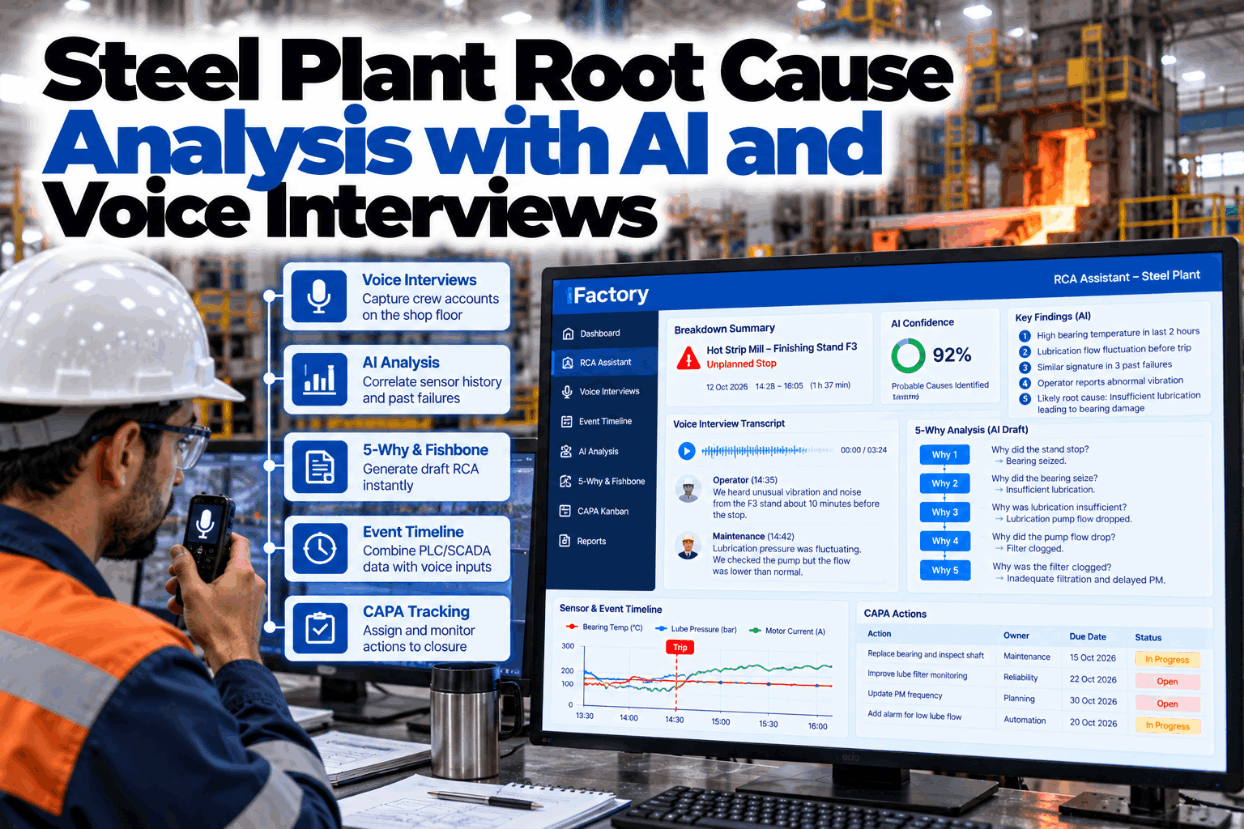
When a mill stand gearbox or a ladle crane fails in a steel plant, the investigation usually starts a day or two later. By then the PLC data is still there, but the crew's memory of the sounds, alarms and small decisions has already faded or merged into one shared story. An RCA assistant changes the order: it interviews the crew by voice soon after the event, lines their accounts up against the PLC and historian timeline and drafts the 5-Why and fishbone for the team to test. See a full investigation run in an RCA assistant demo.
RCA ASSISTANT · STEEL RELIABILITY
Root Cause Analysis That Starts While Memories Are Fresh
The iFactory RCA Assistant interviews crew by voice after a breakdown, merges their accounts with PLC event timelines and proposes 5-Why and fishbone drafts. Every action then moves across the CAPA kanban until it is verified.
Interview · F4 gearbox trip40 min after
Hot strip mill · pulpit operator, B shift
RCA AssistantGo back to the moment before the trip. What did you see or hear first?
Operator"The lube flow alarm flashed on F4. I acked it, it does that a lot. Then the knocking started."
Confirm-backLube flow alarm first, acknowledged, then knocking from F4. Correct?"Yes."
WHY CREW ACCOUNTS FADE
The Evidence That Disappears First
Parts can be bagged and data can be exported, but what people saw and heard starts to change within hours. Memory research has long shown that recall weakens with delay. Talking it over also changes it: in a 2003 study by Gabbert, Memon and Allan, 71% of witnesses who discussed an event with a co-witness later reported details they had only picked up in that discussion. In a steel plant, the crew talks it through at the pulpit, in the canteen and at handover. Ask our reliability team how to protect that evidence.
First hour
Raw, separate accountsSounds, smells, alarm order, who stood where, what was triedBy shift end
Stories start to mergeThe crew has talked it through. Gaps fill with what others saidNext day
A rebuilt accountSequence guessed, small details gone, opinions mixed with facts
What this means for the investigation
Interview each person separately and early. Treat every account as evidence to be checked against data, never as the final word.
VOICE INTERVIEW CAPTURE
An Interview Built on the Cognitive Interview
The cognitive interview, set out by Fisher and Geiselman, uses open questions, mental context and a full free account to draw out more detail. Meta-analyses by Köhnken and colleagues (1999) and Memon and colleagues (2010) found it brings out more correct detail than a standard interview, with a small rise in errors, so answers must still be checked. The RCA Assistant follows the same pattern by voice, one person at a time, and reads each key fact back. Hear a sample interview in a voice interview walkthrough.
Set the scene"Picture the pulpit just before coil 5 threaded. Where were you and what was on your screens?"
Report everything"Tell me everything you remember, even small things that seem unimportant."
Change the order"Now start from the trip and work backwards. What happened just before it?"
Open probes"You mentioned a knocking. Where did it seem to come from?"
Confirm-back"I have: flow alarm first, then knocking from the drive side. Is that right?"
EVENT TIMELINE RECONSTRUCTION
Worked Example: An F4 Gearbox Trip, Second by Second
This illustration follows a finishing stand gearbox failure on a hot strip mill. The assistant merges four sources into one timeline: the CMMS, the historian, PLC alarms and voice interviews. Where an account and the data disagree, it flags the conflict instead of choosing a winner, and the next interview asks about it. Ask our support team which of your data sources can feed a timeline.
23:40CMMSLube pump P2 put in service, P1 out for repairWork order closed by night fitter
01:52HistorianF4 drive-side bearing temperature leaves its usual bandRise continues over the next 20 minutes
02:02:41PLCF4 lube flow low alarm, acknowledged nine seconds laterAlarm history: same alarm raised many times that month
02:11VoiceRoller: "Knocking started, then I saw the alarm"Conflict: PLC shows the alarm about eight minutes earlier. Follow-up question queued
02:14:07PLCF4 main drive trip on high bearing temperatureMill stops with strip in the stand
02:21VoiceShift lead: "We tried one restart, it tripped again"Matches PLC restart at 02:21:30
STEEL PLANT ROOT CAUSE ANALYSIS BEST PRACTICES
Failure Investigation Starts With Five Kinds of Evidence
The PROACT method starts with preserving evidence and sorts it into five P's: Parts, Position, People, Paper and Paradigms. Apollo-style cause-and-effect charting adds a useful rule: every cause on the chart needs evidence, and each effect usually has at least two causes, an action and a condition. The matrix shows how the five P's apply to the F4 example. Plan your own evidence routine in an investigation setup session.
Interviews, Timeline and Drafts Before the Next Shift
The RCA Assistant talks to each crew member by voice, merges what they say with PLC events and proposes 5-Why and fishbone drafts. Your team tests the drafts against evidence and owns the conclusions.
Reliability engineer and iFactory · 07:30
EngineerWhere do the F4 accounts disagree with the data?
iFactoryOne place. The roller says knocking came before the alarm. PLC shows the flow alarm about eight minutes earlier.
EngineerAsk him if he could see the alarm screen from his post.
iFactoryQueued for his next shift start. I will add his answer to the timeline and flag any change.
5 WHY ANALYSIS
A 5-Why Draft Where Every Step Has Evidence
A 5-Why is only as good as the proof behind each answer. The assistant drafts the chain from the timeline and marks the evidence for each step, so the team can see where it is solid and where it is still a guess. In this example the chain splits into two root causes, a missing procedure step and an alarm people had learned to ignore. Review a draft with our reliability engineers.
Why 1Why did F4 trip?The drive-side bearing overheated and failed.
Historian trend, bearing
Why 2Why did it overheat?Lube oil flow to the bearing was low.
PLC flow alarm
Why 3Why was flow low?P2 discharge valve was left part-closed after the swap.
Valve photo
Why 4Why was it left that way?The pump swap SOP has no valve line-up check.
SOP, work order
Why 5Why was the alarm not acted on?It raised so often that crews saw it as noise.
Alarm history, interviews
FISHBONE DIAGRAM AI
A Fishbone Draft That Shows What Is Proven
A fishbone keeps the team from stopping at the first likely cause. The assistant sorts every candidate into the usual categories and marks it as supported, open or ruled out, based on the evidence in the case file. Open items become tasks, such as an oil sample, rather than opinions. See a live fishbone in a fishbone draft demo.
People
Alarm acked as routineHandover note on pump swapMethod
No valve line-up stepRestart rule not followedMachine
Bearing wear before eventGear tooth damage firstMaterial
Oil contaminationMeasurement
Nuisance flow alarmTemperature alarm setpointEnvironment
Hot lube cellar
EffectF4 gearbox bearing failure and mill stop
SupportedOpen, task raisedRuled out by evidence
RCA ACTION FOLLOW UP
Actions on the CAPA Kanban Until They Are Proven
Many investigations end with a good report and actions that never finish. On the CAPA kanban, every action has an owner and a due date, and it can't close until someone checks that it worked. The board below shows the F4 actions a week after the event. Set up your own board with our support team.
Open1
Oil sample analysisLab · due Friday
In progress2
Add valve line-up step to pump swap SOPLube engineer · due in 2 weeks
Rationalise the F4 lube flow alarmControls engineer · due in 3 weeks
Verify1
Brief all four crews on alarm responseCheck: crew quiz and alarm ack audit
Closed1
Replace F4 bearing, inspect gearsVerified at restart
STEEL PLANT ROOT CAUSE ANALYSIS IMPLEMENTATION GUIDE
Match the Depth of Investigation to the Event
Not every stop needs a full team RCA. A clear trigger rule saves effort on small events and makes sure serious ones get the full treatment. Your plant sets the thresholds. The tiers below show a common pattern, and the assistant starts voice interviews automatically for every tier. Agree your own trigger rules in an RCA rollout session.
Tier 1 · Short stop
Quick 5-Why by the shift leadVoice interviews, timeline and a short 5-Why. Closed within the week.Tier 2 · Long stop or repeat failure
Team RCA with fishboneEngineer leads, evidence preserved, actions on the CAPA kanban.Tier 3 · Major loss, injury risk or near miss
Full PROACT-style investigationCross-functional team, five P's, management review and effectiveness check.
STEEL PLANT ROOT CAUSE ANALYSIS COST AND ROI
Count the Hours an Investigation Really Takes
The biggest value of better RCA is the repeat failure that never happens, which you should judge on your own records rather than a promised figure. The part you can measure now is investigator time. The worksheet uses assumed inputs to show the arithmetic only. Our team can help you build the case with your own data.
Interview and write-up time · assumed inputs
Tier 2 and 3 investigations per year40, assumed
People interviewed per investigation5, assumed
Minutes to interview, write up and file each account45, assumed
Investigator time on accounts per year40 × 5 × 45 = 9,000 min = 150 h
Compare this with the time to review voice transcripts, then add repeat failures avoided only once your own data shows them.
STEEL PLANT ROOT CAUSE ANALYSIS FOR PLANT MANAGERS
Four Measures That Show RCA Is Working
A plant manager doesn't need to read every report to know whether investigations are improving. These four measures, reviewed monthly, show speed, quality and follow-through. Set baselines for them in a reliability review call.
01
Event to first interviewHours between the stop and the first recorded account02
Causes with evidenceShare of root causes backed by at least one piece of evidence03
Actions closed on timeCAPA actions verified by their due date04
Repeat failuresSame failure mode on the same asset within 12 months
TURNKEY AI DEPLOYMENT
Voice Interviews and Timelines Running Inside the Plant
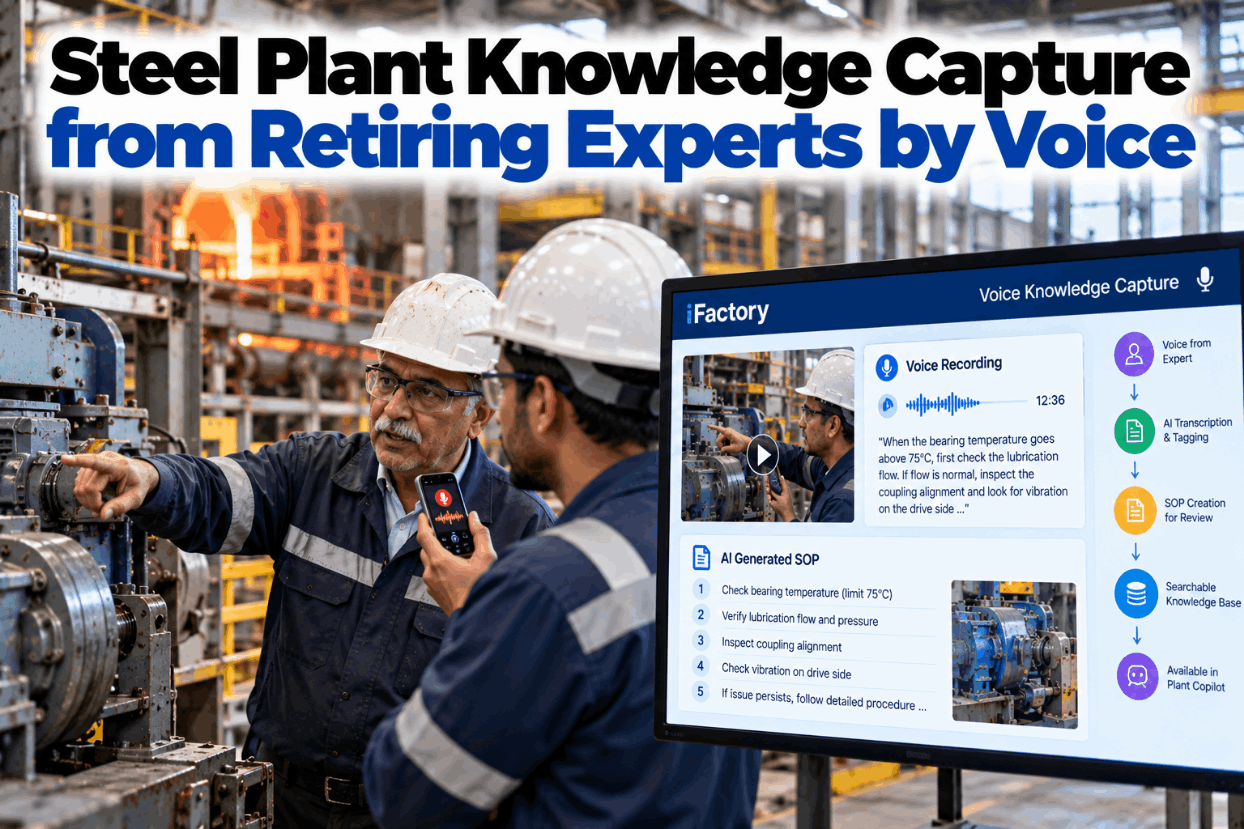
A pre-configured NVIDIA AI server ships racked and ready, with speech models, timeline merging and the RCA Assistant pre-loaded, so crew audio never leaves the site. You rack it, plug in power and Ethernet, and the AI is live. Confirm the scope with our integration team.
What's Included
- Pre-configured NVIDIA AI server, racked and ready
- RCA Assistant with on-site speech models
- PLC and historian links for event timelines
- CMMS link for work orders and asset history
- 5-Why, fishbone and CAPA kanban set up
- Training for investigators and shift leads
- 24x7 remote monitoring of server and models
Live in 6–12 weeks
Wk 1–4
Install and Connect
Server racked, PLC, historian and CMMS links running.
Wk 5–8
Pilot on Real Events
Interviews and timelines on live breakdowns, tuned to your terms.
Wk 9–12
Go-Live and Training
Trigger rules set, all shifts trained, kanban in daily use.
HOW iFACTORY FITS
RCA Software for Steel That Does the Legwork
The RCA Assistant handles the slow, easy-to-skip parts of an investigation so engineers can spend their time on judgement. See it on a real steel breakdown in an RCA assistant demo.
1
Interviews crew by voice. Each person is interviewed separately, soon after the breakdown, with confirm-back.
2
Merges accounts with PLC timelines. Accounts are lined up against alarms, trends and work orders, with conflicts flagged.
3
Proposes 5-Why and fishbone drafts. Every step shows its evidence, ready for the team to test.
4
Tracks actions on the CAPA kanban. Owners, due dates and a verify step before anything closes.
1000+
Industrial clients running iFactory
99.9%
Platform uptime for round-the-clock mills
6-12 wks
From racked server to live RCA interviews
FREQUENTLY ASKED QUESTIONS
Steel Plant RCA Questions From Reliability Leaders
Why interview the crew so soon after a breakdown?
Because memory changes quickly. Recall weakens with delay, and research on co-witness discussion shows people adopt details they only heard from others. Separate interviews within the shift capture each account before it merges into a shared story.
Does the AI decide the root cause?
No. It drafts the timeline, the 5-Why and the fishbone and shows the evidence for each step. The investigation team tests the drafts, adds what is missing and signs off the conclusions and actions.
How are crew accounts matched to PLC data?
Each statement is time-stamped from the interview and lined up against PLC alarms, historian trends and CMMS work orders. Where they agree, the timeline is confirmed. Where they disagree, the conflict is flagged and a follow-up question is queued.
Will crews feel the interview is about blame?
That depends on how the plant runs it. The interview asks what people saw and heard, not who was at fault, and the 5-Why looks for system causes such as missing procedure steps. Sharing findings with crews builds trust over time.
Does it work with PROACT or Apollo methods?
Yes. The five P's map directly to the case file, and every cause on a draft needs evidence, in line with cause-and-effect charting. Teams keep their chosen method and use the assistant to gather and organise evidence faster.
Where is crew audio stored?
On the iFactory AI server inside your plant. Speech is processed on site, confirmed text goes into the case file and audio retention follows your own policy. Our
support team can help you set retention rules.
Capture the Story Before the Next Shift Rewrites It
Voice interviews soon after the event, accounts merged with PLC timelines, evidence-backed 5-Why and fishbone drafts, and actions tracked until verified. Live in 6 to 12 weeks on a turnkey NVIDIA AI server.
Example case file · F4 gearbox trip
Interviews4 crew, all within the shift
Timeline6 events, 1 conflict resolved
Root causesSOP gap, nuisance alarm
CAPA actions5 on the kanban
Effectiveness check due in 90 days