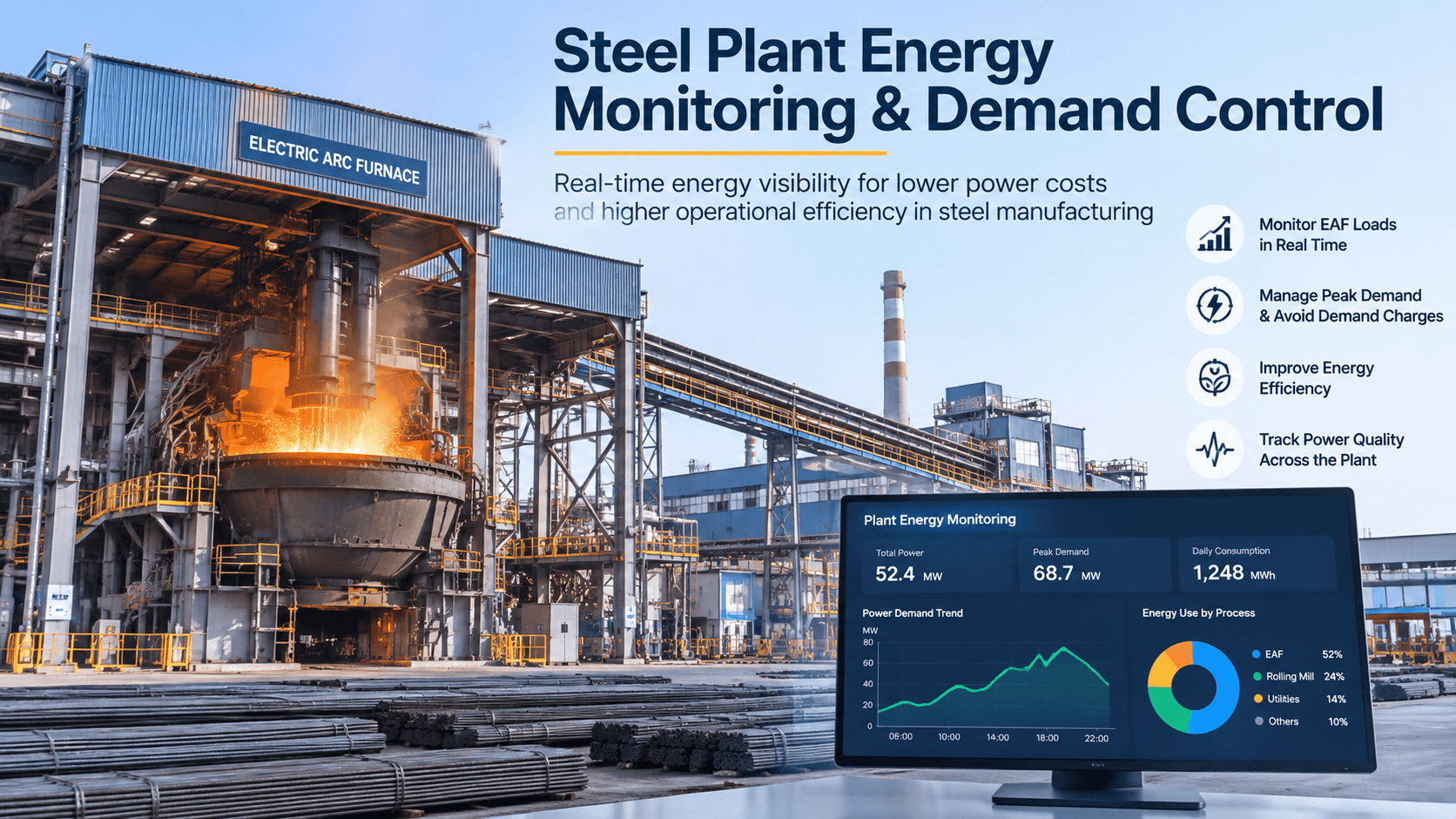
Electric arc furnaces now make 29% of the world's steel, and close to 59% of India's. For every one of them, electricity is the bill that hurts most, and it arrives one heat at a time. Software that trims a few kilowatt-hours from each tonne is worth real money, which is why so many vendors now claim to be the best at it. This guide explains, in plain language, what EAF energy optimization software actually does, the four kinds on the market in 2026, how to compare them fairly, and where iFactory fits. To look at your own heats instead of a brochure, book a heat review.
Best EAF Energy Optimization Software for Steel 2026
AI power profiles, scrap-mix modelling and tap-to-tap analytics: what each one does, who offers it, and how to tell a real saving from a sales claim.
- Four kinds of software, compared without a ranking
- Eight questions to ask every vendor, including us
- A simple way to prove a saving on your own furnace
There is no single best product. There are four kinds of EAF energy software, and the right one depends on what your furnace already has, who will look after it, and whether you want it to advise or to control.
Where the Energy Goes in an EAF
Roughly half the energy you pay for ends up in the steel. Software works on the other half.
An arc furnace is fed by more than its transformer. Oxygen, carbon and gas burners add chemical energy, and all of it has to go somewhere. The published balance below, from one furnace, shows the pattern. Your own numbers will differ, but the shape rarely does. Our support team can build the same picture from your heat logs.
Electricity is about 61% of the total. Nearly four tenths comes from chemistry.
One published example. Figures are rounded, so the two sides differ by a kilowatt-hour.
A furnace can cut its electricity simply by burning more gas, carbon and oxygen. The meter looks better and the cost per tonne may not. Any honest comparison looks at total energy and total cost per tonne, not electricity by itself. Ask every vendor which of the two their figures describe.
Three Levers Good Software Pulls
Power profile, scrap mix and tap-to-tap time. The three in the title are the three that matter.
Every product in this field works on some mix of the same three levers. What differs is how many it covers, how much it automates, and how much new hardware it needs. Understand the levers first and the vendor claims become much easier to read. To see all three on your own heats, book a working session.
Power profile
The plan for arc length and power through the heat. Software moves each step to the right moment for this charge, not the average one.
Scrap mix
What goes in each bucket. Software predicts energy, yield and chemistry for a recipe before it is charged, and suggests a better one.
Tap-to-tap time
Minutes from one tap to the next. Software shows which minutes had the power on, which did not, and why.
- 1 and 3. Bore-in. Short arc and lower power while the electrodes dig into fresh scrap.
- 2 and 4. Main melting. Long arc and full power while scrap shields the walls.
- 5. Refining. Shorter arc, buried in foaming slag.
- 6. Superheat. Just enough to reach tapping temperature.
What the AI changes
A fixed profile changes step at set energy counts. That suits the average heat and nobody else.
An AI profile reads what this heat is doing: how steady the arc is, how hot the panels are running, whether the slag is foaming. It then moves each step earlier or later, by seconds or by minutes.
The gain is small on any one heat. It adds up because it happens on every heat.
Every minute with the power off or the roof open, the furnace loses heat that has to be bought back.
Why scrap mix is an energy decision
- Density. Light scrap can mean a third bucket: more minutes with the roof open.
- Yield. Dirt and rust are melted, paid for, and tapped off as slag.
- Chemistry. Copper and tin cannot be removed, so they limit which grades a mix can make.
- Price. The cheapest recipe is rarely the cheapest tonne of liquid steel.
Scrap-mix models weigh all four at once, for the grade on the schedule and the scrap in the yard today.
Four Kinds of EAF Energy Software in 2026
We have not ranked them. A ranking written by a vendor is not worth much.
Instead, here are the four kinds you will meet, with real examples, what each is strongest at, and the question to ask before buying. Product details come from each company's own published material. Ask our steel specialists which kind suits your furnace, even if the answer is not ours.
What vendors and mills have published
Danieli Q-MELT
At Gerdau Midlothian: power-on time down 14%, electricity down 9%, electrodes down 24%. Reported by the vendor, 2019.
EMSTEEL, in-house
A model built on more than 8,800 heats: 10 kWh per tonne less energy and 7 tonnes an hour more output.
Primetals Melt Expert
An electrode control system for arc and ladle furnaces. The vendor states payback is typically under six months.
Tenova iEAF
Off-gas analysis from the start to the end of the heat, used for closed-loop control of post-combustion.
Single sites, reported by the companies themselves. Read them as what is possible, not as what is promised. Note the scale: single digits in percent, or around ten kilowatt-hours a tonne. Be careful with any promise far above that until it has been proven on your furnace.
What a 3% Saving Is Worth
Small percentages are large sums on an arc furnace. Put your own tonnage and tariff into the same arithmetic.
How to Choose: Eight Questions for Every Vendor
Ask all eight, of everyone. That includes us.
Demonstrations all look good. The differences show up in what the system needs from you, who looks after it, and how the result is measured. These eight questions sort that out in one meeting. To go through them against your own furnace, book a vendor-neutral review.
Does it advise or control?
Advice needs a melter to act. Control needs trust, limits and a safe way to hand back.
What new hardware does it need?
An off-gas analyser, a new regulator, extra sensors? Each adds cost, downtime and upkeep.
Does it work with what we have?
Your electrode regulator, your Level 2 system, your burner and injection controls.
Which levers does it cover?
Power profile only, or scrap mix, chemical energy and delays as well?
How is the saving measured?
Against which baseline, on which grades, with which scrap? Electricity only, or total cost?
Who maintains the models?
Scrap, refractory and electrodes all change. A model nobody retrains is out of date within months.
Where does our data live?
On a server in the plant, or in somebody else's cloud? Who else can see your heat data?
What happens when a sensor fails?
The furnace must keep melting. Ask to see the fallback, not just hear about it.
Start with a baseline of at least 200 recent heats, grouped by grade and scrap recipe. Then run the software in blocks: a few days on, a few days off, same grades, same crews. Compare like with like, and look at total energy and cost per tonne. A vendor who is confident in the product will welcome the test.
Where iFactory Fits
Above your existing controls, not in place of them.
iFactory is the fourth kind in the list above. It reads your regulator, Level 2 system, meters and scrap records, and puts power profile, scrap mix and tap-to-tap analytics on one screen. It begins by advising. Control is handed over step by step, only where you choose. Our integration team can confirm what your furnace already provides.
A good fit when
- Your regulator and Level 2 system work, and you want more from their data.
- You want scrap mix, power and delays looked at together.
- You also run a ladle furnace and caster, and want one system across them.
- Your heat data has to stay inside the plant.
Look elsewhere first when
- Your electrode regulator itself needs replacing. That is a furnace specialist's job.
- You want off-gas analysis hardware as the centre of the project.
- You are building a new furnace and want controls from the builder.
In each of these cases iFactory can still sit above the new system later.
One set of data, three views
- Melter. This heat: predicted energy at tap, the next profile step, and why.
- Melt shop manager. Every heat this week by grade and recipe, with the outliers explained.
- Energy and finance. Cost per tonne, demand peaks and the trend against the baseline.
The same heat record feeds all three, so the saving reported upstairs is the one the melter saw.
Turnkey AI: Delivered, Connected and Live in 6–12 Weeks
You do not build this. It arrives ready.
iFactory ships as a pre-configured NVIDIA AI server, racked and ready, with the software pre-loaded. Rack it, plug in power and Ethernet, and the AI is live on your network.
Our team handles cabling, network setup, PLC and SCADA integration, operator training and 24×7 remote monitoring. The server sits inside your own network, so heat and scrap data stay on site. For a scope matched to your melt shop, request a turnkey quote.
Ship, network and data
Server installed. Regulator, Level 2, power meters, scrap weights and heat logs connected. Baseline built from your recent heats.
Model training and pilot
Energy and scrap-mix models trained on your furnace. Suggestions shown to melters without touching the controls, and checked against results.
Go-live and training
On-off trial run against the baseline. Melters and managers trained, crew by crew. 24×7 remote monitoring begins.
Frequently Asked Questions
What is EAF energy optimization software?
It is software that uses data from the furnace to reduce the energy needed for each tonne of steel. Most products work on three things: the power profile through the heat, the scrap going into each bucket, and the minutes lost between taps. Some advise the melter; others adjust set-points themselves.
How much electricity can it save?
It depends on where you start. Published single-site results range from about 10 kWh a tonne for a data model alone to 9% of electricity after a full control upgrade. A well-run furnace has less to gain than a poorly tuned one. The only figure that counts is one measured on your furnace against a fair baseline.
What is a power profile?
It is the plan for arc length and power at each stage of the heat: gentle while the electrodes bore in, full power during main melting, and a shorter arc under foaming slag for refining. A fixed profile follows the plan. An AI profile adjusts the timing to how each heat is really melting.
How does scrap mix affect energy?
Light scrap can mean an extra bucket and more time with the roof open. Dirty scrap melts material that ends up as slag. Chemistry limits which grades a mix can make. A scrap-mix model predicts energy, yield and chemistry for a recipe before it is charged, so the cheapest tonne of liquid steel can be chosen.
Does the software control the furnace?
That is your choice. iFactory starts in advisory mode, where each suggestion needs the melter's approval. Once results are proven, chosen set-points can be handed over within limits you define. Safety interlocks and the electrode regulator stay exactly as they are.
Do we need new sensors or an off-gas analyser?
Not to begin. Most of the first gains come from data the furnace already produces: electrical readings, panel temperatures, injection flows, weights and heat logs. Off-gas analysis adds a clearer view of chemical energy and can be brought in later if the case is there.
How long does it take to go live?
Six to twelve weeks from delivery. We need a place for the server with power and Ethernet, read access to the regulator and Level 2 data, recent heat logs, and time with your melters. To check your set-up first, contact our team.
Bring 200 Heats. See Where the Kilowatt-Hours Went.
In thirty minutes we sort your recent heats by grade and recipe, and show which used more energy than they should have, and why. You keep the analysis whichever software you choose.
- 1Heat logs for the last 200 heats or more
- 2Scrap recipes and bucket weights
- 3The make of your regulator and Level 2 system
- 4Your power tariff, including demand charges
- 5Your three most common delays