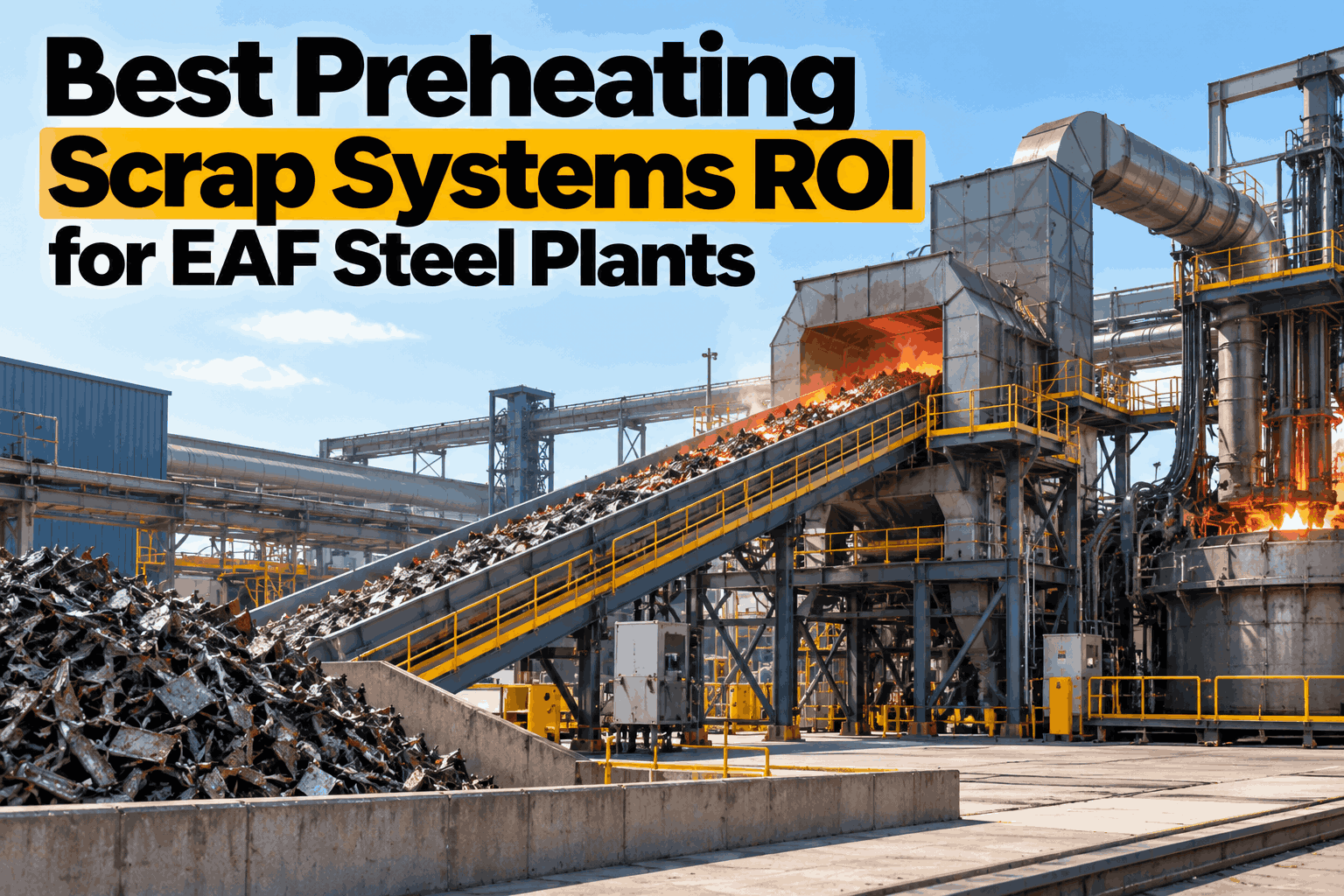
Every kilowatt-hour an EAF spends heating cold scrap is power the off-gas could have supplied for free. Scrap preheating captures some of that heat before the scrap reaches the bath, cutting electricity per tonne and often tap-to-tap time too. But the routes differ a lot in cost, savings and how well they fit an existing melt shop, so ROI has to be worked out plant by plant. To test the numbers on your own furnace, book a preheating ROI review.
Scrap Preheating Systems ROI for EAF Steel Plants
Continuous conveyor, shaft furnace and bucket preheating compared on savings, cost and fit. Plus a simple way to build an ROI case from your own heat data, before you talk to a single vendor.
- How much each preheating route really saves
- A worked payback example you can adapt
- Why your heat data matters more than the brochure
Bucket preheating
Off-gas blown through scrap in the charging bucket.
- Savings40–60 kWh/t
- CapitalLower
- RetrofitEasier
Continuous conveyor
Scrap fed on a conveyor through the off-gas tunnel, as in Consteel systems.
- Savings80–120 kWh/t
- Capital€5–10M retrofit
- RetrofitNeeds space
Shaft furnace
Scrap held in a shaft above the furnace, heated by rising off-gas.
- SavingsUp to ~100+ kWh/t
- CapitalHigher
- RetrofitOften new build
Ranges come from published sources quoted on this page. Bars compare the three routes with each other, not with any absolute scale. Your result depends on scrap mix, furnace design and how much chemical energy you already use.
Why Preheating Pays, and When It Does Not
The heat is already there. The question is whether you can use it well.
A large share of EAF energy leaves with the off-gas, still hot enough to do useful work. Preheating sends that gas through the scrap first, so less electricity is needed to melt it, and the arc spends less time on cold charge. Savings are real, but they depend on scrap type, tap-to-tap time, layout and the cost of power where you are. A route that pays in two years in one plant may take five in another. Our steel support team can help you see which applies to your shop.
Power price
The higher your electricity cost, the faster any kWh saving pays back, and the more a weak saving hurts.
Tonnage
Savings scale with tonnes. Small shops wait longer for the same equipment to pay back.
Scrap mix
Some routes need sized scrap. Heavy or bulky scrap can limit the choice or add preparation cost.
Layout
Conveyors and shafts need space and crane access that many older shops simply lack.
Electricity
The headline saving, in kWh per tonne of liquid steel, and the easiest to measure.
Electrodes
Less arc time usually means less electrode wear, a real saving at today's prices.
Tap-to-tap
Faster melting can lift output, if the caster and ladle furnace keep up.
Maintenance
Conveyors, shafts and buckets all add equipment to look after, with its own spares and shutdowns.
Heating scrap that carries plastics, paint or oils can form dioxins and furans in the off-gas. Continuous systems are reported to cut dust and NOx compared with bucket charging, but every route needs proper off-gas treatment. Include it in the cost, not as an afterthought.
Comparing the Routes in Detail
Savings are only one column. Maintenance, flexibility and downtime matter as much.
The right route is the one that fits your scrap, your furnace and your space, with savings you can actually hold every heat. Brochure figures come from good plants on good days, often with scrap and practice that suit the design. To compare routes against your own constraints, book a route comparison session.
A five-point readiness check
- Data. At least a year of heat-by-heat energy records.
- Space. A layout that fits the route you are considering.
- Scrap. A supply that suits the route's sizing needs.
- Off-gas. Treatment capacity for the new gas path.
- Downtime. A shutdown window long enough to install it.
Questions for any preheating vendor
- Which reference plants use a scrap mix like ours?
- What kWh/t do they hold month after month?
- How long was the retrofit shutdown?
- What maintenance does the system need each year?
Costs often left out of the case
- Melt shop downtime during installation
- Off-gas treatment upgrades
- Scrap preparation or sizing changes
- Operator training and ramp-up losses
Hot scrap melts differently from cold scrap. Arc power, burner use, oxygen timing and slag practice all need retuning, or part of the saving is lost to a power profile designed for the old charge. Plan this tuning as part of the project, not as a later fix.
A Payback Case, Worked Out
Here is a simple payback for a mid-size melt shop adding continuous preheating. Change the inputs to your own and the shape of the answer stays the same.
What Changes the Payback Most
Three inputs move the answer more than all the others combined.
Savings per tonne, tonnes per year and the price of power decide most of the case. A plant that loses half its expected saving to poor practice can double its payback time. If you want help testing your inputs, our engineers can help.
Saving you hold
Not the best month, but the average across all heats, grades and crews, held for a full year.
Tonnes per year
Double the tonnes and the payback roughly halves, all else equal. Plan for realistic utilisation, not nameplate.
Power price
Use a realistic forward price, including demand charges where they apply, not today's spot price.
How the worked example moves
Published figures range from under a year for some small retrofits to several years for major rebuilds. A single "typical payback" number hides more than it shows, because the inputs differ so much between plants. Work it out from your own inputs, and test what happens if the saving is 30 percent lower than promised.
How iFactory Supports a Preheating Decision
Before: a baseline you can trust. After: proof the savings are real.
iFactory's EAF Energy AI builds a heat-by-heat baseline from your furnace, power and scrap data, separating savings from better practice from savings only preheating can give. After installation, Power Profile Optimization helps the furnace use the hotter scrap well, and every heat is tracked against the business case. To see a baseline from your own data, book a baseline session.
The same baseline is useful whichever way you decide. If preheating does not pay on your figures, the practice gains it uncovers are still worth having, and they cost far less to capture.
Baseline
kWh/t, tap-to-tap and yield per heat, by grade, crew and scrap mix.
Separate
Practice gains split from what only preheating can deliver, so no saving is counted twice.
Model
Payback under several saving, tonnage and power price scenarios.
Verify
After start-up, every heat checked against the approved business case.
What finance sees
- A baseline both sides of the deal agree on
- Savings per month in money and kWh
- Payback tracked against the approved case
What the melt shop sees
- Heats that lost the saving, and why
- Power profile hints for hotter scrap
- Scrap mixes that preheat best
iFactory does not sell preheating equipment. The aim is an honest baseline and a fair check on whatever route you choose. Questions on data and fit go to our support desk.
After Start-Up: Holding the Savings
The first month proves the system works. The next year proves the case.
Many preheating projects hit their target early, then drift as scrap, crews and habits change. The drift is slow, so it is easy to miss until the annual review. Savings hold when every heat is tracked, drift is spotted early and the power profile is tuned for hotter scrap. Most of this needs data more than hardware.
Track
kWh/t and tap-to-tap for every heat, against the business case and the baseline.
Spot drift
Heats that lose the saving flagged with a likely cause, such as scrap mix or delays.
Tune
Power profile adjusted to suit preheated scrap, grade by grade.
Report
Monthly savings in kWh, money and CO2 for finance and sustainability teams.
Agree with the supplier how many weeks the system has to reach its target, and on what measure. A shared, heat-by-heat baseline makes that conversation short and factual instead of a debate over whose numbers are right.
Turnkey AI: Delivered, Connected and Live in 6–12 Weeks
You do not build this. It arrives ready.
iFactory ships as a pre-configured NVIDIA AI server, racked and ready, with the software pre-loaded. Rack it, plug in power and Ethernet, and the AI is live on your network.
Our team handles cabling, network setup, PLC and SCADA integration, operator training and 24×7 remote monitoring. The server sits inside your own network, so furnace and power data stay on site. For a scope matched to your melt shop, request a turnkey quote.
Ship, network and data
Server installed. Furnace, level 2, power and scrap yard data connected. A full year of heat history loaded.
Model training and pilot
Heat baseline built from your history. Practice gaps and preheating potential separated and reviewed with your team.
Go-live and training
Energy dashboards live for every heat. Melt shop, energy and finance teams trained. 24×7 remote monitoring begins.
Frequently Asked Questions
How much electricity does scrap preheating save?
Published figures range from about 40–60 kWh/t for bucket preheating to 80–120 kWh/t for continuous conveyor systems. EU reference data puts full preheating at up to about 100 kWh/t. Your result depends on scrap, furnace and practice, so use published figures as a range, not a promise.
Is a 20–30% electricity cut realistic?
For some plants, yes, especially continuous or shaft systems on furnaces with high current use. Others see less: the EU expects around 10–15% for a revamped top-charge EAF, and plants with heavy chemical energy use may see less again. Measure your baseline before you count on the top of the range.
What is the typical payback?
It varies widely, from under a year for some retrofits to several years for major rebuilds. It depends mostly on tonnage, power price and the saving you actually hold. Test your case with a saving 30 percent below the vendor's figure.
Which route suits an existing melt shop?
Bucket preheating is the easiest add-on. Continuous conveyors suit shops with space beside the furnace and a steady scrap supply. Shaft designs usually suit new builds or major rebuilds. Layout, crane access and scrap sizing narrow the choice quickly.
Does preheating affect emissions?
It can. Continuous systems are reported to lower dust, NOx and noise compared with bucket charging, partly because the roof stays closed. But heating contaminated scrap can form dioxins, so off-gas treatment must be part of the plan.
Should we improve practice before investing?
It is usually worth it. Better power profiles, fewer delays and steadier slag can close part of the gap at low cost, and make the preheating case more honest. They also help the new system reach its target faster.
Can iFactory help after the system is installed?
Yes. It tracks each heat against the business case, flags heats that lose the saving and helps tune the power profile for preheated scrap. To discuss your plans, contact our team.
Build Your Preheating Case on Real Heats
In thirty minutes we look at your heat data and power costs, estimate how much a preheating route could save once practice gaps are removed, and sketch the payback range. You keep the numbers whether or not you go further with iFactory.
- 1A year of kWh/t and tonnage figures
- 2Your electricity tariff and demand charges
- 3Typical scrap mix by grade
- 4A melt shop layout drawing
- 5Any vendor proposals you already have