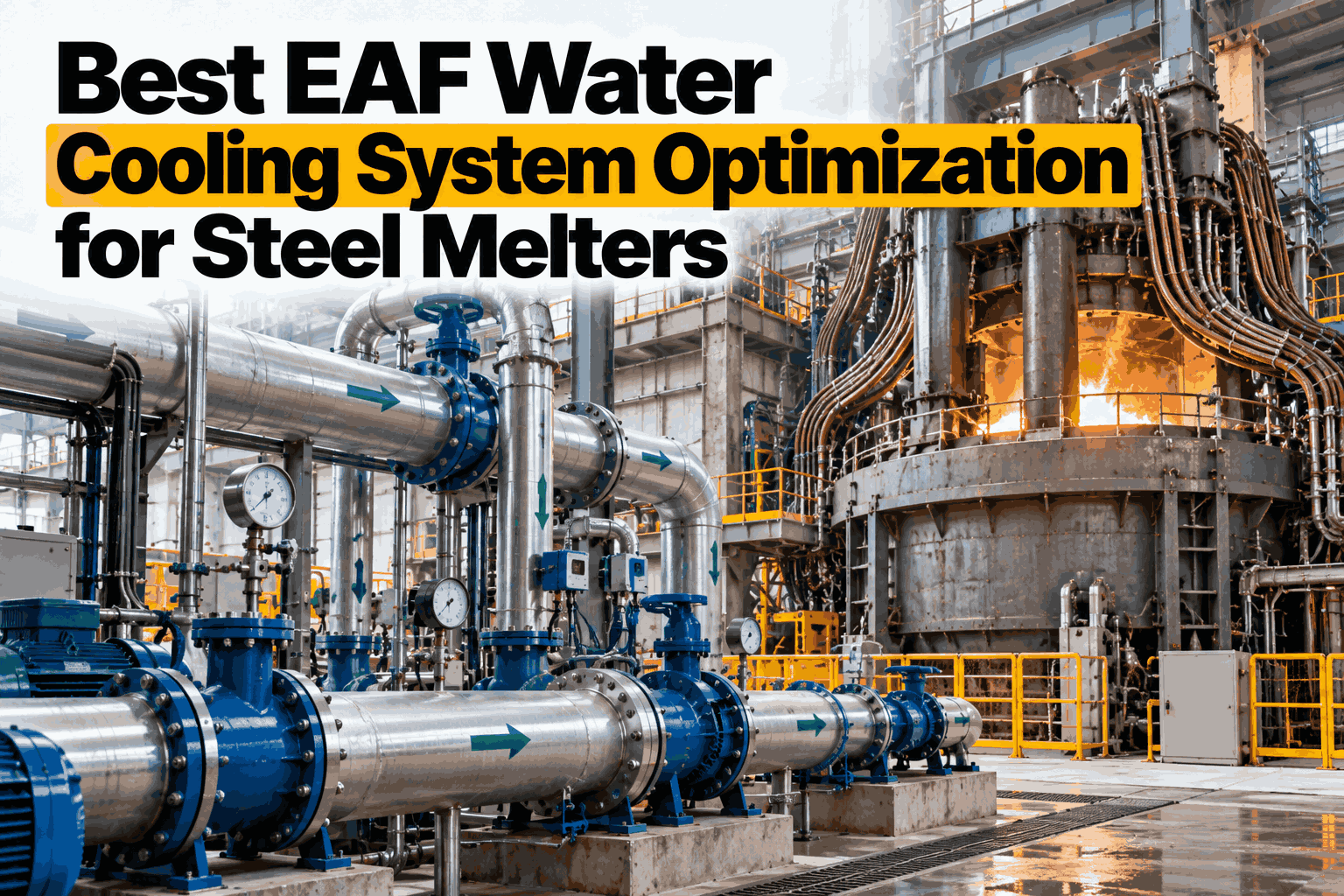
An EAF's water-cooled panels, roof and delta take the furnace's heat every second of every heat. Run too little water and a panel can burn through. Run too much, or at the wrong pressure, and you pay for pumping you do not need. Good cooling control reads flow, temperature and pressure panel by panel, so melters see trouble early and engineers can trim pumping safely. To look at your own cooling data, book an EAF cooling review.
EAF Water Cooling System Optimization for Steel Melters
Panel-by-panel flow, temperature and pressure tuning that spots hot panels and leaks early, and trims pumping energy only where the cooling margin allows it. Safety first, savings second.
- What each cooling reading tells a melter
- Early signs of panel failure and water leaks
- Where pumping energy can be cut, and where it must not
Temperature rise times flow gives the heat each panel removes. A cluster of warm panels, here P6 to P8, usually points to a thin slag coating or an arc aimed too close to the wall.
Why EAF Cooling Deserves Daily Attention
Cooling is both a safety system and a large, steady energy user.
Water-cooled panels let modern EAFs run hard with high power and long campaigns. But a failed panel can stop the furnace for hours, and water reaching molten metal can cause a steam explosion. At the same time, cooling pumps run every hour of the year, often well above what the furnace needs at that moment. Our steel support team can help you weigh both sides.
Panel burn-through
Local overheating cracks a panel. Cooling stops, water may leak, and the furnace stops for repair.
Hidden leaks
Small leaks into the furnace are hard to see, and dangerous if water is trapped under slag.
Scale and blockage
Poor water quality narrows passages and reduces cooling, a little more every week.
Wasted pumping
Pumps run at full speed and pressure even when the load is low, for thousands of hours a year.
Side panels
Take radiant heat from the arc and bath. Most exposed when slag cover is thin or the arc flares.
Roof panels
Exposed to off-gas, splash and radiation, especially near the electrodes and the fourth hole.
Centre section
Sits closest to the electrodes. Arcing and build-up here need fast attention from the crew.
Elbow and duct
Carries hot gas and dust away. Heat load here tracks post-combustion and off-gas flow.
A published EAF incident started with a cracked roof delta cooling pipe, damaged by earlier arcing. Water collected under molten material and flashed to steam, collapsing part of the roof. The lessons: treat cooling parts as safety-critical, compare inlet and outlet flows continuously, and stop at once on signs of water entry.
What Flow, Temperature and Pressure Tell You
Three readings per circuit. Together they tell the whole story.
Flow shows whether water is reaching the panel in the amount it was designed for. Temperature rise shows how much heat it carries away. Pressure shows whether the system can push water through when it matters, at the peak of the heat. To map your sensors against what you need, book a sensor mapping call.
A drifting flow meter or a failed thermocouple can look like a cooling problem, or hide one. Check sensor health as part of the system, and treat a sudden flat line or jump as a sensor question before a process one.
Heat load is the key number
- Flow times temperature rise gives heat removed
- Compare each panel with its own history
- Rising load warns of slag or arc problems
- Sudden falls can mean lost flow or a sensor fault
Never ignore these
- Unexplained gap between inlet and outlet flow
- Steam or water seen at the furnace
- Abnormal arcing near cooled parts
- A panel alarm during tapping or charging
Trimming Pump Energy, Safely
Here is one cooling pump with spare margin. Slowing it a little saves a lot of power, because pump power follows roughly the cube of speed. Every panel keeps at least its design minimum flow.
Cutting Pumping Energy Without Cutting Safety
The rule is simple: save energy where there is margin, never where there is not.
Many cooling systems were sized for the worst case and then run at full speed all the time, whatever the furnace is doing. Variable speed drives, pressure set points that follow real demand, and well-maintained filters can save energy. But furnace panels must always get their design minimum flow. If you want help finding safe margins, our engineers can help.
Excess pressure
Lower the pressure set point where every circuit still gets its minimum flow, checked with real meters.
Idle periods
Reduce flow on auxiliary circuits during long stops, under clear written rules and with automatic restore.
Panel minimums
Shell, roof and delta flows stay at or above design minimum, always, whatever the energy price.
Clogged filters, scaled pipes and worn pumps waste energy and weaken cooling at the same time. Cleaning and repair often save energy and improve safety together, which makes them the best first step.
Predicting Panel Failure Before It Happens
Panels rarely fail without warning. The warning is in the heat load trend.
Before a panel fails, its heat load often climbs heat after heat, or swings more than usual, as slag cover thins or water flow weakens. One reading means little. A trend means a lot. Watching each panel against its own history turns those trends into early warnings. To see this on your furnace, book a panel health session.
Early warning signs
- Load creep. Heat load rising over several heats.
- Wide swings. Bigger peaks during bore-in and melting.
- Neighbour effect. Adjacent panels warming together.
- Flow drift. Slowly falling flow at the same valve setting.
Water Quality and Maintenance: The Quiet Half of Cooling
The best control system cannot fix water that is fouling the panels.
Scale, corrosion and suspended solids slowly narrow cooling passages and insulate the copper or steel from the water. The change is slow, which is why it is easy to miss. Panels run hotter at the same flow, pumps work harder, and failure risk rises. Tracking water quality next to heat load shows the link clearly, and gives maintenance a reason to act before a panel fails.
Watch these with cooling data
- Conductivity and hardness of make-up water
- Filter pressure loss and cleaning dates
- Cooling tower approach temperature
- Chemical treatment dosing records
Signs of fouling
- Panel temperatures creeping up at the same flow
- Pumps needing more pressure for the same flow
- Uneven temperatures between twin circuits
- Deposits found at every panel repair
Instead of cleaning on a fixed calendar, use rising pressure loss and falling heat transfer to decide when circuits need flushing or descaling. Some circuits will need it far more often than others. Work gets done where it matters, during planned stops.
How iFactory Watches EAF Cooling
Every circuit, every heat, in one view the melter can read at a glance.
iFactory's EAF Energy AI reads flow, temperature and pressure from your cooling system alongside furnace and power data. It tracks heat load per panel, compares inlet and outlet flows, and flags trends early. It also shows where pumps run above need, so engineers can trim safely, one circuit at a time, with flows checked after every step. Questions on fit go to our support desk.
Heat load per panel
Against its own normal range, heat by heat, with trends over the campaign.
Flow balance
Inlet minus outlet, per circuit, every second. Any gap needs explaining.
Pump kWh per tonne
Cooling energy per tonne of steel, month by month, after any change.
Read
Flow, temperature and pressure from every circuit, plus pump speed, power and running hours.
Compare
Heat load per panel against its own history and its neighbours, heat by heat.
Alert
Rising loads, flow gaps and pressure drift flagged with likely causes and a suggested check.
Optimize
Pump speed and pressure suggestions that keep every circuit above its minimum flow.
What the melter sees
- Panels colour-coded by heat load, live
- Clear alerts with a suggested check
- Flow balance status for every circuit
What engineers see
- Panel trends across heats and campaigns
- Pump energy against cooling need
- Fouling and maintenance signals
iFactory adds early warning and analysis. It does not replace your furnace's safety interlocks, leak detection or trip systems, which stay in charge.
Turnkey AI: Delivered, Connected and Live in 6–12 Weeks
You do not build this. It arrives ready.
iFactory ships as a pre-configured NVIDIA AI server, racked and ready, with the software pre-loaded. Rack it, plug in power and Ethernet, and the AI is live on your network.
Our team handles cabling, network setup, PLC and SCADA integration, operator training and 24×7 remote monitoring. The server sits inside your own network, so furnace and cooling data stay on site. For a scope matched to your melt shop, request a turnkey quote.
Ship, network and data
Server installed. Cooling, furnace and pump data connected. Missing or faulty sensors listed for repair.
Model training and pilot
Panel baselines learned from your heats. Alerts run in the background and are checked by your melters and engineers.
Go-live and training
Cooling view live on the pulpit and in the control room. Melters, engineers and maintenance teams trained. 24×7 remote monitoring begins.
Frequently Asked Questions
What causes EAF water-cooled panel failure?
Usually local overheating from thin slag cover, arc flare or burner flames, weakened cooling from low flow or scale, mechanical damage, or arcing near cooled parts. Most give warning signs in the heat load trend first, often several heats before the failure.
How do you detect a water leak in an EAF?
Compare inlet and outlet flow on each circuit continuously, and investigate any unexplained gap. Steam, unusual arcing or hydrogen alarms are further signs. Any suspected leak into the furnace calls for an immediate stop under your safety procedure, and no restart until the cause is found.
Can we reduce cooling water flow to save energy?
Only where there is spare margin. Furnace panels must always get their design minimum flow. Savings usually come from pressure set points, pump speed on circuits with margin, and fixing filters and scale. Measure before and after every change.
What is a normal temperature rise across a panel?
It depends on the design, the panel's position and the stage of the heat. The useful measure is each panel against its own normal range, not one figure for the whole furnace. Learn those ranges from your own history.
Does water quality matter?
Very much. Scale and deposits reduce heat transfer and flow, raising panel temperatures and pumping effort. Keep water treatment and filter maintenance on the same dashboard as cooling performance, so cause and effect are easy to see.
Does iFactory control the cooling pumps?
It suggests speed and pressure changes. Your engineers decide, and any automatic link goes through your change process and safety review. Furnace safety systems remain in charge at all times.
What sensors do we need?
Flow and temperature on each circuit, inlet and outlet where possible, plus supply pressure and pump data. Many furnaces have most of these already, though some circuits may lack an outlet flow meter. To check yours, contact our team.
See Your Cooling System Clearly
In thirty minutes we look at your cooling circuits and data, point out where panels show early warning signs, and show where pumps may be running above need. You keep the findings whether or not you go further with iFactory.
- 1A cooling circuit diagram
- 2Flow and temperature trends per circuit
- 3Recent panel failures and repairs
- 4Cooling pump sizes and running hours
- 5Your water treatment records