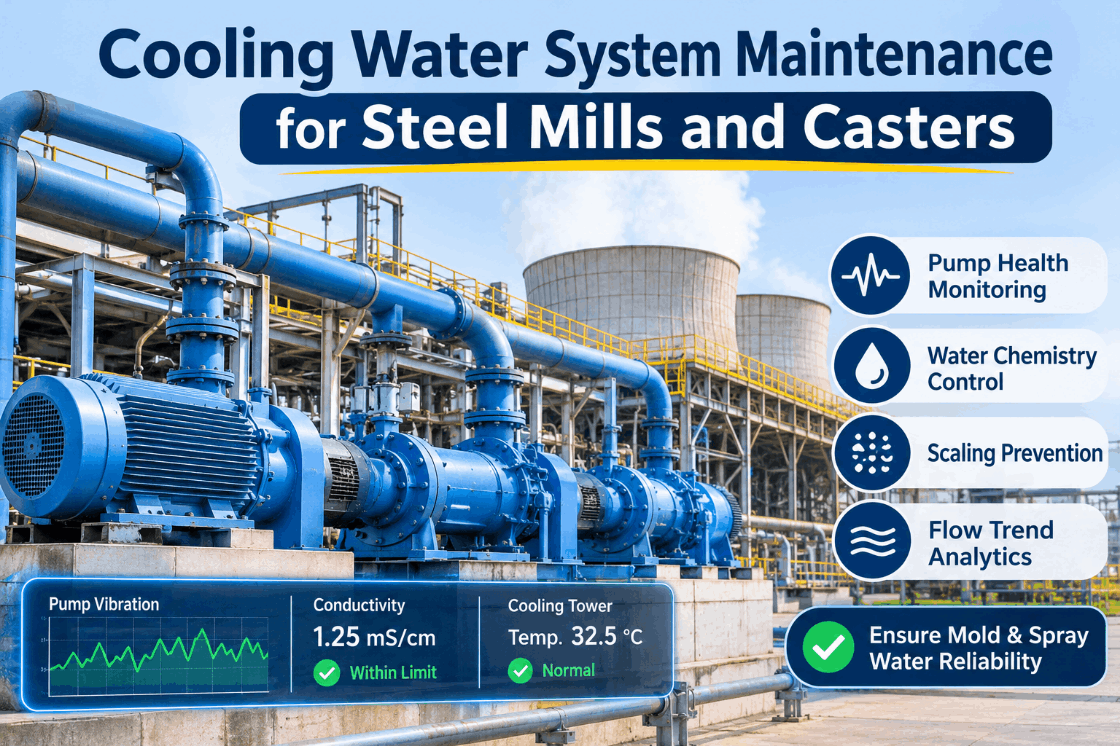
Cooling Water System Maintenance for Steel Mills and Casters

By Josh Brook on November 19, 2026

cooling-water-system-maintenance-steel-mills-casters

A caster depends on water it rarely thinks about until something goes wrong: a closed, treated loop through the copper mold, an open spray loop over the strand, and the pumps, exchangers, strainers and towers behind both. Pump wear, scale, plugged nozzles and drifting chemistry all show up in data before they show up as a stopped strand. This page covers each circuit, a PM schedule template and two worked checks. Review your own water data in a short call.

PREDICTIVE AI + WATER CHEMISTRY LOGS

Cooling Water System Maintenance for the Mold Loop and the Spray Loop

iFactory trends pump vibration and flow, mold water ΔT, conductivity and scaling indices. When a reading drifts, it opens work orders automatically and tells the utilities crew by voice.

Caster 2 · strand 1Illustrative values
Mold loopclosed
Flow520 m³/h
ΔT7.8 °C
Treated water · steady
Spray loopopen
Header9.6 bar ↓
Conductivity1,850 µS/cm
LSI+1.4 · scale risk
Tower water · watch
Strainer check and chemistry review opened · utilities crew told by voice
STEEL PLANT WATER CIRCUITS

Separate Circuits, Separate Ways to Fail

Steel plants split cooling water by how close it gets to the steel. Indirect circuits stay inside pipes and copper and can be kept clean; direct circuits spray onto hot metal and pick up scale, fines and oil. Each needs its own PM rhythm. Ask our support engineers to sketch your own circuits.

Mold loop · closed
Demineralised or soft waterFlow and ΔT watched continuously because the shell forms here.
Machine cooling · closed
Segments, rolls, bearingsIndirect cooling of the strand guide. Leaks and blocked passages are the usual faults.
Secondary spray · open
Water straight onto the strandReturns dirty and hot, so it needs settling, filtration and a tower.
Furnace and EAF panels
Closed loops, brieflyPanels and hoods follow the same pump, exchanger and chemistry checks.
MOLD COOLING WATER

The Mold Loop Is Small, Clean and Unforgiving

Molds normally run a closed circuit with demineralised or soft water so scale never insulates the copper, and tube molds need about 11 to 13 m/s through the channels to suppress boiling, per ispatguru. If the mold stops doing its job, a breakout can follow. Heat removed is flow × specific heat × ΔT, the calorimetric method a Leoben caster study logged every 10 seconds. See it on your data in a live demo.

Mold water flow, illustrative520 m³/h
Mass flow, density assumed 1,000 kg/m³520 × 1,000 ÷ 3,600 = 144.4 kg/s
Heat removed, cp assumed 4.18 kJ/kg·K144.4 × 4.18 × 7.8 = 4,709 kW
Same heat with flow down 15%7.8 ÷ 0.85 = 9.2 °C ΔT
Read ΔT against casting speed and width

A higher ΔT can mean less flow, or simply a faster cast or a wider slab putting more heat in. iFactory compares ΔT and flow with the speed and width at that minute, so a pump or valve problem is not confused with a schedule change.

EMERGENCY WATER AND INTERLOCKS

No Monitoring System Can Promise a Cast Never Fails

Monitoring gives earlier warning of a tired pump or a fouling exchanger, which buys time to act between casts. It does not replace the protection that keeps water on the mold when power or a pump fails. As one design example, a Chinese steel patent (CN110804683A) on furnace cooling pairs an elevated emergency water tower, sized for at least 15 minutes, with an auto-start diesel pump. Check your own arrangement with our support team.

WHAT EARLIER WARNING GIVES YOU
  • Pump wear seen weeks ahead, swapped between sequences
  • Strainer loading caught before the spray header falls
  • Scale tendency flagged before it reaches the exchanger
  • Standby pumps proven by logged test starts
WHAT STILL PROTECTS THE STRAND
  • Emergency water supply, tested on a schedule
  • Hardwired low-flow and high-ΔT interlocks
  • Standby pumps on auto-start with separate power
  • Your caster's own stop procedure and trained crews
PUMP HEALTH ANALYTICS

Duty and Standby Pumps: Five Signals Worth Trending

Each cooling circuit runs duty pumps with at least one standby, and the standby is only useful if it starts. iFactory reads these signals together, so a falling flow can be traced to the pump, the strainer or the valve. Walk through a pump trend in a working session.

Signal
What it shows
Usual causes
Typical response
Bearing vibration
Mechanical condition
Bearing wear, misalignment, looseness, cavitation
Plan swap to standby
Flow vs motor current
Hydraulic efficiency
Impeller wear, recirculation, partly closed valve
Check curve and valves
Discharge and suction pressure
Where pressure is lost
Loaded strainer, low sump level, air in suction
Strainer and sump check
Bearing and winding temp
Heat in motor and pump
Lubrication, overload, blocked motor cooling
Lube and load review
Standby test start
Readiness
Failed start, slow pressure build, stuck check valve
Fix before next cast
Illustrative · standby test
P-4 slow to build pressureA monthly test start took twice its usual time. The check valve was found sticking and repaired before the next sequence.
Illustrative · slow loss
Mold pump flow down 4%Same current, less flow over six weeks. Impeller wear confirmed and the pump swapped to standby between casts.
Illustrative · no fault
ΔT up on a wide slabMold ΔT rose after a width change. Flow was steady, so the model raised nothing.

Know Whether It's the Pump, the Strainer or the Valve

When a header pressure falls, iFactory checks the pump, the strainer and the zone flows together and names the likely cause. The crew gets one clear job instead of three guesses.

Caster 2 · Utilities tech and iFactory · illustrative
Utilities techSpray header on strand 1 is at 9.6 bar and falling. Is P-2 going?
iFactoryP-2 current, flow and vibration match last week. Differential pressure across strainer S-3 has doubled since Monday, and zone 4 flow is down 6% at the same valve position.
Utilities techBackwash S-3 and check zone 4 nozzles at the turnaround.
iFactoryBoth work orders opened and the shift told by voice. Mold loop flow and ΔT are steady.
SPRAY WATER SYSTEM

Nozzles and Strainers Decide Whether the Strand Cools Evenly

Spray water returns carrying mill scale fines and oil, and Spraying Systems notes that abrasive conditions, variable water quality and long campaigns cause drift in nozzle flow, angle and impact. A plugged nozzle cools one patch of strand less than its neighbours. Strainers protect the nozzles, so their differential pressure is the first thing to watch. Our support team can help set zone baselines.

Turnaround nozzle check, strand by strand
COOLING TOWER STEEL MILL

Exchangers and Towers Set the Temperature Everything Else Gets

Plate exchangers pass the closed loop's heat to tower water, and towers reject it to air. A fouled exchanger shows as a wider approach and a higher differential pressure; a tired tower shows as warmer basin water. Towers also carry Legionella risk, and ASHRAE Standard 188-2021 sets minimum risk management requirements for building water systems, industrial buildings included. Review tower PMs in a tower review call.

Plate exchangers
Approach and differential pressureClean when both rise at the same flows. Check gaskets for cross-leaks.
Tower fans
Gearbox and motor vibrationOil level, coupling and blade pitch on a set round.
Fill and eliminators
Scale, sludge and damageBlocked fill raises basin temperature at the same heat load.
Basin and makeup
Sludge, level and blowdownClean on schedule and keep a water management plan current.
WATER CHEMISTRY MONITORING

Reading LSI and RSI Without Over-Reading Them

The Langelier index is pH minus pHs, the pH at which calcium carbonate is saturated. Above zero, scale is favoured; below zero, the water tends to dissolve scale and can be corrosive. The Ryznar index is 2pHs minus pH, and below 6 means scale-forming. Hach notes neither index says how much scale forms, only the tendency. Check your own inputs with our support team.

Spray loop sample · all inputs assumed
Temperature35 °C
pH8.1
TDS, about 0.65 × 1,850 µS/cm1,200 mg/L
Calcium hardness as CaCO3400 mg/L
Alkalinity as CaCO3300 mg/L
A = (log 1,200 − 1) ÷ 100.21
B = −13.12 × log(35 + 273) + 34.551.90
C = log 400 − 0.4 · D = log 3002.20 · 2.48
pHs = (9.3 + 0.21 + 1.90) − (2.20 + 2.48)6.73
LSI = 8.1 − 6.73 · RSI = 2 × 6.73 − 8.1+1.37 (≈ +1.4) · 5.36
What the result means for maintenance

Both indices point to scale. Expect deposits on hot exchanger plates and in nozzle tips first. The response is a chemistry review with your treatment supplier: blowdown, inhibitor dose, pH. Closed loops also need corrosion inhibitor residuals checked, and open loops a biocide programme.

COOLING WATER SYSTEM MAINTENANCE STEEL TEMPLATE

A PM Schedule Template by Circuit and Asset

Use this as a starting point. Final intervals come from your OEM manuals, your water treatment supplier and your own failure history, so the frequencies shown are illustrative. Load it into iFactory during a guided setup.

Asset
Each shift
Weekly
Monthly to quarterly
Caster turnaround or annual
Owner
Mold loop pumps
Flow, ΔT, pressure
Vibration route
Standby test start
Coupling, seals, alignment
Utilities
Mold loop exchanger
Approach temp
Differential pressure
Chemistry and leak check
Open and clean plates
Utilities
Spray pumps
Header pressure
Vibration route
Standby test start
Impeller and wear rings
Utilities
Strainers and filters
Differential pressure
Backwash result
Basket and screen check
Full strip
Caster mechanic
Spray nozzles
Zone flows
Flow vs pressure review
Air-mist line check
Pattern test, tip swap
Caster mechanic
Cooling tower
Basin temp, fans
Gearbox oil, drift
Fill and basin check
Fill and eliminator work
Utilities
Water chemistry
Conductivity, pH
Hardness, LSI, RSI
Inhibitor and microbial tests
Programme review
Water treatment
Emergency water
Tank level
Diesel pump run
Valve stroke test
Full supply test
Utilities lead
COOLING WATER SYSTEM MAINTENANCE STEEL COST AND ROI

What a Water-Caused Caster Stop Costs You

There is no promised saving on this page. The figures below are placeholders, each marked assumed, chosen only so the multiplication can be checked; your stop log, cast rate and labour rate belong in their place. Our support engineers can point you to the records.

Unplanned caster stops from water faults per year3, assumed
Hours lost per stop, including restart5, assumed
Caster output250 t per hour, assumed
Tonnes lost per year3 × 5 × 250 = 3,750 t
Unplanned nozzle changes outside turnarounds4 a year × 3 people × 6 h = 72 h, assumed
Yearly exposure3,750 t × your margin + 72 h × your labour rate
TURNKEY AI DEPLOYMENT

Water Models, Chemistry Logs and the Server, Delivered Together

Hardware and software come as one delivery. A pre-configured NVIDIA AI server ships racked and ready, with pump models, ΔT checks and chemistry logs pre-loaded, so plant data stays on site. You rack it, plug in power and Ethernet, and the AI is live. Cabling, network work, PLC/SCADA integration, operator training and 24×7 remote monitoring are all in scope. Map it out in a rollout call.

What's Included
  • Pre-configured NVIDIA AI server, racked and ready
  • Connectors for caster PLCs, pump house and water analysers
  • Pump health models for duty and standby pumps
  • Mold ΔT and flow checks normalised for speed and width
  • Chemistry log with LSI and RSI worked out per sample
  • Voice alerts and automatic work orders for the utilities crew
  • Site work covered: cabling, network, PLC/SCADA, crew training, 24×7 watch
Live in 6–12 weeks
Wk 1–4
Connect the Water

Server racked, pump house and caster signals linked, chemistry history loaded.

Wk 5–8
Baseline and Shadow

Zone, pump and ΔT baselines built; alerts reviewed by the crew before any go live.

Wk 9–12
Go Live and Extend

Automatic work orders and voice alerts on, then furnace and mill circuits added.

HOW iFACTORY FITS

Cooling Water System Maintenance Software for Caster Utilities

iFactory runs beside your caster automation, your water treatment supplier's programme and your CMMS. Send fit questions to our support desk.

1
Watches the pumps. Vibration, flow, current and pressure read together for duty and standby units.
2
Reads mold ΔT in context. Compared with casting speed and width before it raises anything.
3
Keeps the chemistry log. Conductivity, hardness, LSI and RSI per sample, with trends.
4
Acts on drift. Opens work orders automatically and tells the crew by voice.
1000+
Industrial clients running iFactory
99.9%
Uptime that matches a caster's 24/7 rhythm
6-12 wks
From racked server to live water alerts
FREQUENTLY ASKED QUESTIONS

What Caster Managers Ask About Cooling Water Maintenance

What does cooling water system maintenance cover at a caster?
The mold and machine loops, the spray loop, their pumps and standby pumps, exchangers, strainers, nozzles, the tower, water chemistry and the emergency supply. Each needs its own checks and owner. You can see a sample schedule laid out that way.
Can AI make sure mold water never fails mid-cast?
No system can promise that. AI gives earlier warning of pump wear, fouling and strainer loading. Emergency water, hardwired interlocks and standby pumps remain the protection. To see how warnings reach the crew, book a short demo.
What is the difference between LSI and RSI?
LSI is pH minus the saturation pH; above zero favours scale. RSI is twice the saturation pH minus pH; below 6 favours scale. Both show tendency, not the amount of scale.
How can we tell a spray nozzle is plugged?
Zone flow falls at the same header pressure and valve position, often after strainer differential pressure has climbed. A pattern test at the turnaround confirms it. Our support team can help set zone baselines.
Does ASHRAE 188 apply to our cooling towers?
ASHRAE 188-2021 covers water systems in industrial buildings among others, and is widely used for tower water management plans. Local rules may add more, so check with your EHS team.
Where should we start?
Start with the mold loop pumps and the spray strainers on one caster. Baseline flow, ΔT and differential pressure for a few weeks, then add chemistry and the tower. To shape that first caster, book a pilot planning call.

Keep Mold and Spray Water Healthy Between Casts

Trend pump health, mold ΔT, strainer loading and scaling indices, and turn drift into work orders the crew hears about. One hardware and software delivery, live inside 6 to 12 weeks.

Example shift view · Caster 2
Mold loop strand 1520 m³/h · ΔT 7.8 °C
Strainer S-3Backwash done
Spray loop LSI+1.4, review set
Standby pump P-4Test start passed
Every drift tied to a work order and an owner

Share This Story, Choose Your Platform!