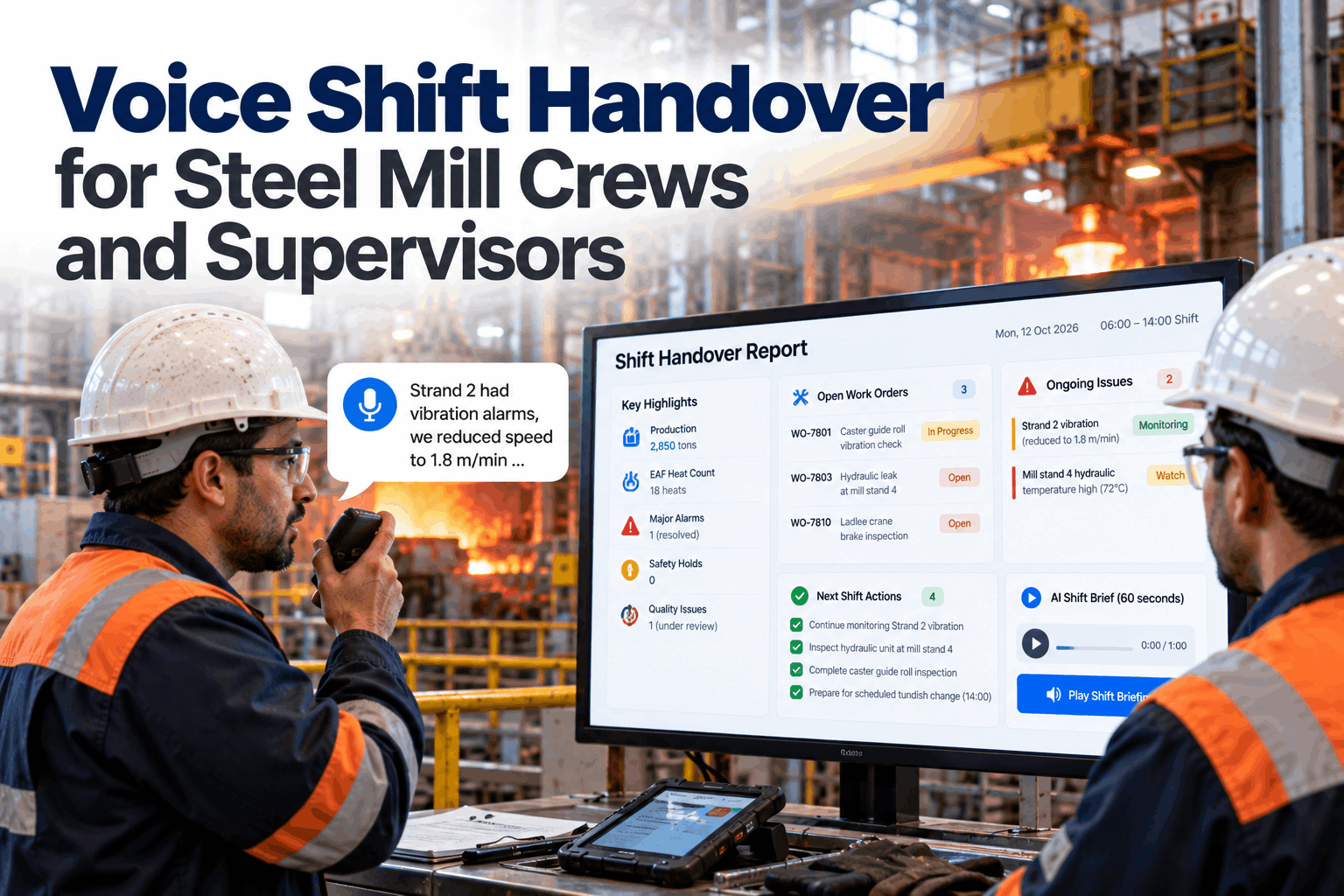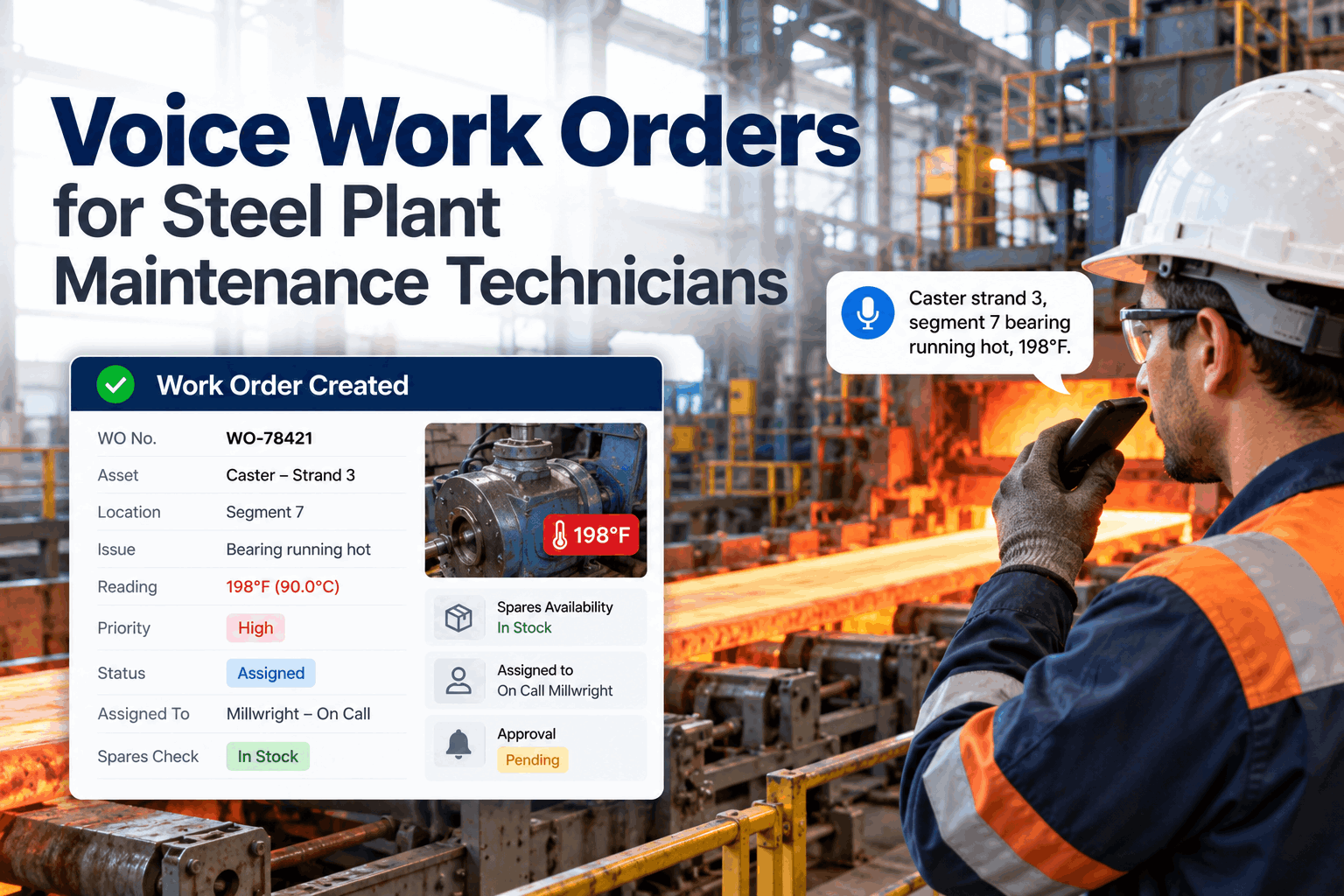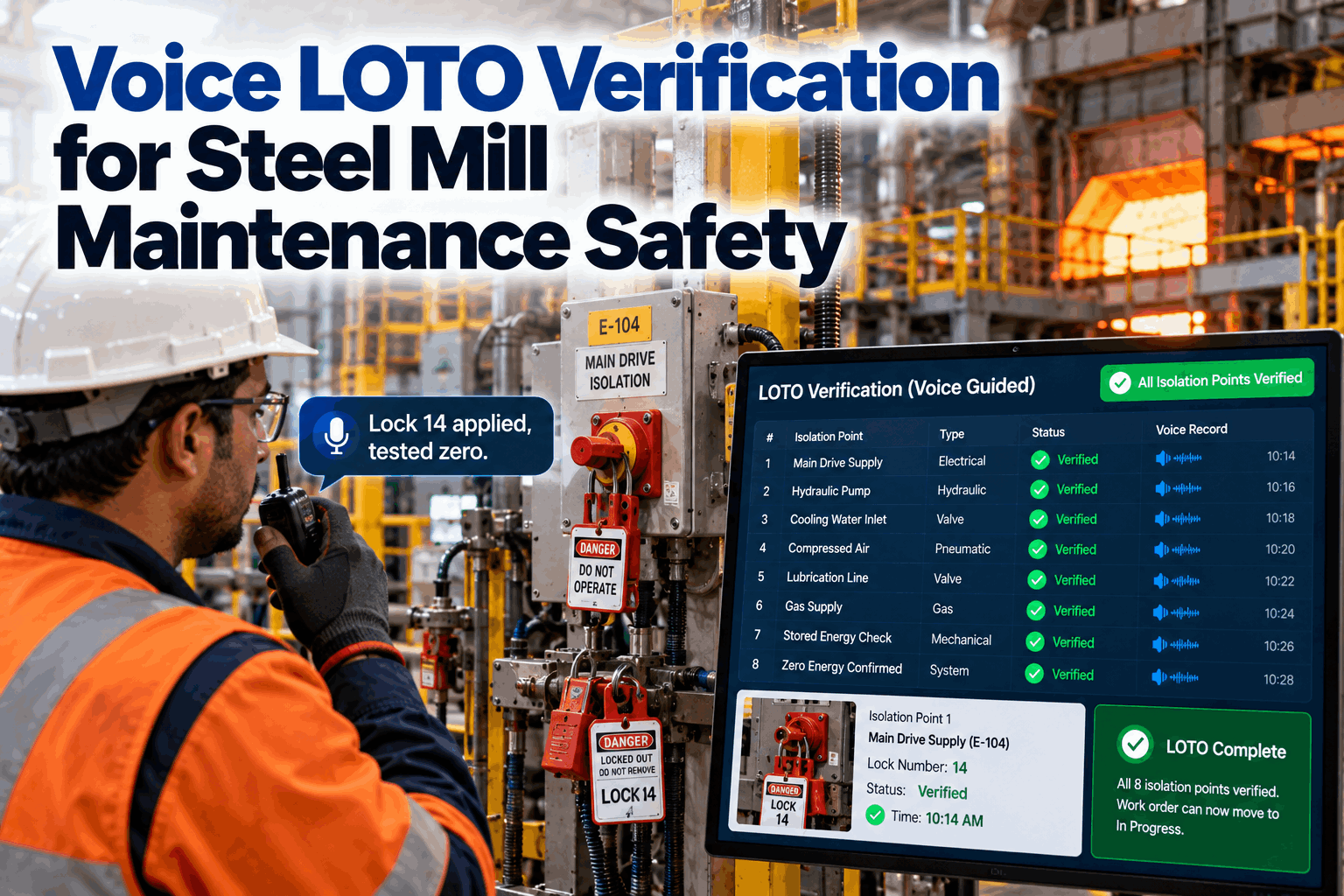
Lockout/tagout on a steel mill means multiple energy sources on each job: main drives, hydraulic accumulators, raised rolls, steam and process gas. Crews also need both hands free and gloves on to do the work. A paper LOTO sheet filled in after the fact is how an isolation point gets skipped. A voice agent walks the crew through each point, records every lock and zero-energy test as it happens, and keeps the job closed until all points are verified. You can see it in a short live demo.
Verify Every Isolation Point by Voice Before the Job Can Start
The iFactory Voice Agent reads each isolation point aloud. The technician confirms the lock number and the zero-energy test hands-free. The work order stays locked out of In Progress until every point is verified and timestamped.
One Job, Many Energy Sources, and No Free Hand for a Clipboard
Control of Hazardous Energy (29 CFR 1910.147) was the fourth most-cited OSHA standard in fiscal 2025, with 2,177 citations. In a steel mill, a single roll change or chock replacement can involve electrical, hydraulic, pneumatic, gravity and thermal energy at the same time. Some of these sources stay live after the main breaker is open, such as accumulators, raised rolls and counterweights. Each one must be isolated, locked and proven at zero, in the right order, by people wearing gloves, hearing protection and face shields. If you'd like to map these energy sources across your mill, our safety team can help.
Main drive motors, MCC feeders, control power and HV switchgear
AGC cylinders, roll balance and the accumulators that hold pressure after shutdown
Raised rolls, top chocks, counterweights, coil cars and suspended loads
Clamps, guides, gates and air-actuated valves
Hot strip, scale, cooling water and steam lines
Blast furnace, coke oven and natural gas lines, plus nitrogen purge
How Isolation Points Get Missed When the Record Is a Clipboard
Most LOTO failures in heavy industry don't come from crews who don't care. They come from a process that depends on memory, legible handwriting and a form completed after the work rather than during it. The four failure patterns below show up again and again in incident reviews and audit findings, and each one is a gap that a guided, recorded voice workflow is designed to close. If any of them sounds familiar, our safety specialists can walk through them with you.
Experienced crews know the stand, so the procedure sheet stays in a pocket, and a point added after a modification is the one that gets missed.
Gloves, heat and noise make writing during the job impractical, so the form records what people remember doing rather than what they actually did.
Applying the lock is visible and gets recorded. The try-out or gauge check is the step most often skipped, and it is the one that proves the energy is gone.
Nothing physically stops a work order from starting while LOTO is still in progress, especially when several crews share an outage.
The Six Steps of 1910.147(d) and What the Voice Agent Records at Each One
OSHA's energy control procedure follows a fixed sequence: preparation, shutdown, isolation, applying the lockout or tagout devices, releasing stored energy, and verifying isolation. The voice agent follows the same order. It moves the crew from one step to the next only when the current step has been confirmed and logged. We can walk through this mapping against your own procedures in a scoping call.
What Keeps the Work Order From Moving Forward
A voice LOTO workflow only adds safety if it can say no. These are the conditions under which the agent refuses to release the job and holds the work order in its LOTO column on the kanban board. Our support team can configure these rules to match your written program.
Any isolation point without a spoken confirmation keeps the job closed. Skipping ahead is not allowed.
A lock number that isn't assigned to the speaker is flagged and has to be corrected before the session continues.
"Locked" isn't enough. Every point needs a try-out or a gauge reading reported as zero.
In a group lockout, every worker on the job must add their own lock to the group box before the release.
Hear a Full Voice LOTO Session on a Mill Stand
See the agent read each isolation point, catch a wrong lock number and keep the work order blocked until every point is tested at zero. Everything is captured hands-free, with a timestamp on each step.
The Work Order Stays Out of In Progress Until LOTO Is Verified
On the maintenance kanban, every job that needs energy isolation passes through a LOTO Verify column. The card shows live progress, for example four of six points, and the In Progress column won't accept it until the voice session closes with every point tested at zero. Supervisors see at a glance which jobs are safe to start and which are waiting on isolation. During a busy outage with dozens of open jobs, that view replaces the radio calls and walk-arounds otherwise needed to find out whether a stand is actually locked out. When a job finishes, the card moves to Restore and Close, where the agent guides lock removal in reverse order. We can show this board running on your work orders in a short demo.
Group Lockout, Shift Changes, Contractors and Restore
Mill outages rarely fit the one-technician, one-lock picture. OSHA addresses group lockout, shift and personnel changes, and the restoration of equipment to service with their own requirements, and these are the moments when paper records tend to fall apart. If your outages involve several crews, our support team can plan the setup with you.
A primary authorized employee runs the session. Each crew member adds a personal lock to the group box, and the agent records every name and lock before release.
The outgoing crew's locks stay on until the incoming crew's locks are confirmed by voice, so protection is continuous and both sides of the handover are recorded.
Contractor technicians are added to the session with their own lock numbers, so the host employer and the contractor share one record of who is protected.
The agent reverses the sequence: tools cleared, people clear, each lock removed by its owner and affected employees notified before re-energizing.
Physical Locks and Human Judgment Stay in Charge
A voice agent guides the procedure, enforces its order and records it. It doesn't isolate energy, and it doesn't make a hazardous condition safe on its own. Your energy control program, training and periodic inspections remain the foundation. The panel below shows where that boundary sits.
- Applying a personal lock on every isolation point
- Physically trying out or testing for zero energy
- Blocking and pinning raised components
- The annual periodic inspection of each procedure
- Training and retraining authorized employees
- Reading every point in the correct sequence
- Checking lock numbers against assigned locks
- Refusing release without a zero-energy test
- Gating the work order on the kanban
- Keeping a timestamped, audit-ready record
Voice Hardware, AI Server and Integration Delivered Together
iFactory delivers voice LOTO as a turnkey bundle. A pre-configured NVIDIA AI server ships racked and ready with the voice agent and the permit and LOTO workflow pre-loaded, so speech is processed on site and doesn't depend on the internet. You rack it, plug in power and Ethernet, and the AI is live. To scope it for your mill, request a turnkey quote.
- Pre-configured NVIDIA AI edge server, racked and ready
- Noise-rated headsets with push-to-talk for the mill floor
- Your equipment-specific LOTO procedures loaded as voice scripts
- Cabling, plant Wi-Fi and network setup
- PLC/SCADA and CMMS kanban integration
- Crew and supervisor training
- 24×7 remote monitoring of the system
Server installed, coverage tested in high-noise areas, procedures and lock registers loaded.
Speech tuned to your crews and equipment names, then piloted on one mill area alongside paper LOTO.
Kanban gate switched on, crews trained and paper sheets retired area by area.
Voice Agent and Permit/LOTO Workflow, Working as One System
iFactory connects the voice agent, the LOTO procedure library, the lock register and the maintenance kanban, so the record and the work order share a single source of truth. Our support team can review your current LOTO program before a pilot.
What Steel Mill Safety and Maintenance Teams Ask
Make Every Isolation Point Provable
Give mill crews hands-free LOTO guidance and a job gate that won't open until every point is tested at zero, plus an audit record that builds itself. The full system is delivered turnkey and goes live in 6 to 12 weeks.