At 6 a.m. in a steel mill, the outgoing foreman has ten minutes, a logbook full of half-legible notes and a dozen things the next crew must know. A crane is restricted, a caster segment is under a permit, a furnace alarm keeps coming back. Some of it gets said, some gets written and some is lost at the gate. This guide shows how voice shift handover lets crews speak open issues while AI writes a structured report, links open work orders and briefs the incoming supervisor in a minute. See a live handover demo.
Voice Shift Handover for Steel Mill Crews and Supervisors
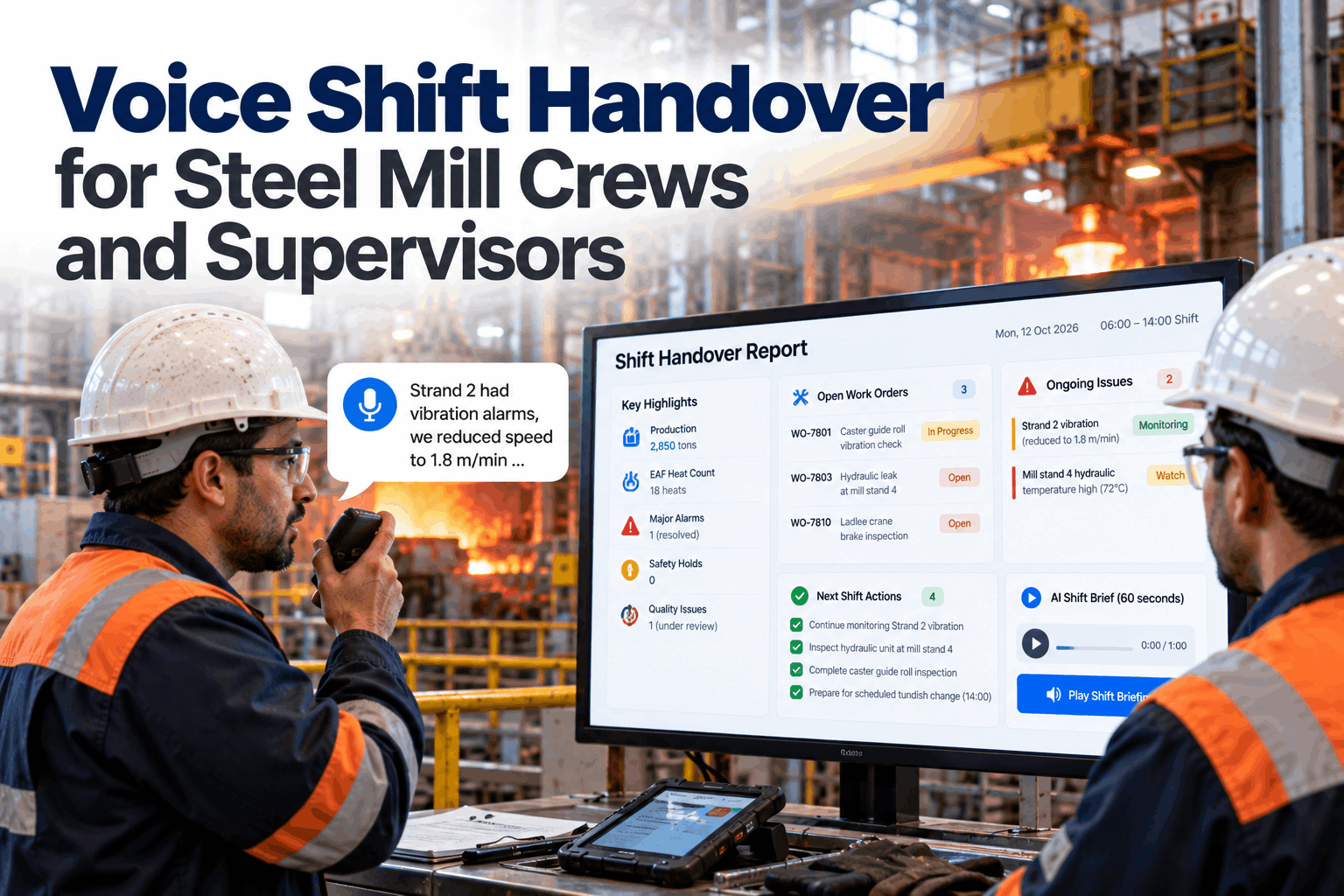
The outgoing foreman talks for two minutes. The AI turns it into a structured handover with open jobs, alarms and safety holds, links every work order and reads a 60-second briefing to the incoming crew.
- What safety guidance says a good handover needs
- A structured handover template for steel mills
- How voice and AI fit around the face-to-face talk
Safety holds
Strand 3 segment 7 locked out under permit. Do not restart until millwright signs off.
Open jobs
Bearing change in progress, 2 hours left. Tundish car drive waiting on seal.
Alarms
EAF 1 panel 6 water temperature alarm, three times overnight. Trend attached.
Restrictions
Bay 2 crane limited to slow speed until brake check.
Why Shift Handover Matters in a Steel Mill
The shift change is when knowledge is most likely to be lost.
Shift handover is one of the riskiest moments in any continuous process. The UK Health and Safety Executive lists poor shift handover among key human factors issues and points to the Piper Alpha disaster, where information about a pump under maintenance did not pass between shifts. Steel mills face the same risk every day: equipment under permit, safety systems bypassed, alarms that keep returning and jobs half-finished across the change. Our safety specialists can review your current process.
Illegible logbooks
Hurried notes that the next crew cannot read.
Missing context
What was done, but not why or what is left.
Rushed talks
Ten minutes at the gate for a twelve-hour shift.
No link to work
Notes that never connect to the work orders.
What Good Handover Looks Like
Safety guidance is clear about the basics.
HSE guidance on shift handover says effective communication is two-way and face to face, uses both verbal and written records, follows a structure and is given enough time. It also notes that longer shifts, such as twelve-hour patterns, rely more on the written record. Voice handover is designed to support each of these, not to replace the conversation. The agent gives the foreman a structure to speak to, produces the written record without extra typing and leaves the saved minutes for the face-to-face talk, where the incoming supervisor can ask questions and confirm what they heard. Map your process against them in a handover review.
Face to face
The incoming supervisor can ask questions and check understanding.
Both records
A spoken account plus a written report the next crew can return to.
Same sections every time
Safety holds, open jobs, alarms and restrictions in a fixed order.
Enough of it
Time for the handover is built into the shift, not squeezed out.
Linked to records
Open jobs and permits tied to their work orders and permit numbers.
Confirmed
The incoming supervisor accepts the handover by name.
HSE singles out handovers that need extra care: maintenance that runs across a shift change, safety systems that are overridden, deviations from normal working, staff returning after a long absence and handover from experienced to less experienced staff. The voice agent asks about each of these by name, so they are never skipped.
A Structured Handover Template for Steel Mills
Fixed sections, steel examples, nothing left to memory.
A good template makes the foreman's job easier because it prompts for what matters. The voice agent walks through these sections in order and asks follow-up questions when something is unclear. Adapt it to your areas with our support desk.
What Each Area Hands Over
Same structure, different priorities across the mill.
The template stays the same everywhere, but each area of a steel mill has its own items that must never be missed. The voice agent learns the prompts for each area, so a caster foreman is asked about strands and segments while a melt shop foreman is asked about furnace panels and the transformer. Set up your area prompts with our implementation team.
Furnace and ladles
Panel water alarms, refractory condition, electrode status, ladle rotation and any tap hole concerns.
Strands and moulds
Strands down, segment work, spray nozzle issues, mould level alarms and breakout risks.
Stands and shears
Roll changes due, gearbox vibration, hydraulic leaks and cooling bed problems.
Lifting and services
Crane restrictions, brake checks, water and power issues and compressor alarms.
Handovers That Need Extra Care
Some shift changes carry more risk than others.
Long shifts, returning staff and work that spans the change all make handover harder. On a twelve-hour pattern the written record carries more weight, because the next crew may need to look back at it many hours later. When someone returns from leave or a stretch of nights off, a short history of what changed in their area helps them catch up. The agent can produce both on request. Ask our support desk how this is set up.
Prompts the agent adds
- Is any maintenance running across the change?
- Is any safety system bypassed or overridden?
- Is anything running outside normal limits?
- Is anyone new or returning on the next crew?
Extra output on request
- Catch-up summary of the last few shifts
- History for one asset or area
- All open permits in one list
- Repeat alarms across the week
When a less experienced supervisor takes over from a veteran, ask the agent for a seven-day history of the area as well as the handover. Repeat alarms and recurring jobs often explain more than a single shift report, and give the new supervisor the context the veteran carries in their head.
Never Lose a Safety Hold at Shift Change
Every lockout, permit and bypass is spoken, written and linked to its record, then confirmed by the incoming supervisor by name.
How Voice Shift Handover Works
Speak, structure, link, brief, confirm.
The outgoing foreman speaks into a headset or rugged handheld, either as one account or answering the agent's prompts section by section. The AI structures it, links it to open work orders and permits, and has it ready before the incoming supervisor arrives. Walk through it in a product demo.
Speak
Foreman narrates jobs, alarms and holds.
Structure
AI sorts it into fixed handover sections.
Link
Open work orders, permits and alarm trends attached.
Brief
60-second summary read to the incoming crew.
Confirm
Incoming supervisor accepts by name.
The 60-Second Briefing
The incoming crew hears what matters before they walk the floor.
The briefing is not a replacement for the face-to-face talk. It is a short, consistent summary the incoming supervisor can play to the crew at the start of shift, so every person hears the same safety holds and priorities. The supervisor can then ask the agent follow-up questions. Questions about the setup go to our support team.
When a lockout or permit stays open across a shift change, the handover should name the permit, the person who holds it and what must happen before release. The agent pulls these from the permit record, so the incoming supervisor sees exactly who must sign off and the crew cannot assume the equipment is free.
Voice Handover Mistakes to Avoid
Technology helps only when the habits around it are right.
Voice handover works when it supports the conversation and the permit system. It fails when it becomes a recording nobody listens to. These patterns come up most often. A short readiness call helps you plan around them.
What works
- Voice record plus a face-to-face talk
- Fixed sections every shift
- Safety holds always first
- Incoming supervisor accepts by name
What fails
- Skipping the talk because the report exists
- Free-form notes with no structure
- Permits mentioned without their numbers
- Handover squeezed into the last minute
How iFactory Runs Voice Shift Handover
Voice Shift Log Agent, on your own network.
iFactory's Voice Shift Log Agent listens to the outgoing foreman, writes a structured handover, links open work orders and permits, and reads a 60-second briefing to the incoming crew on request. Everything runs on an on-prem AI server inside your plant. Fit questions go to our solutions team.
Noise-robust voice
Built for headsets and handhelds on the mill floor.
Structured report
Same sections every shift, written by AI.
Linked records
Work orders, permits and alarm trends attached.
Safety holds first
Lockouts and bypasses always lead the handover.
60-second briefing
Read aloud to the incoming crew on request.
Named acceptance
Incoming supervisor confirms receipt.
Results depend on your shift pattern, crews and how well handover habits are kept. We measure handover time, linked records and confirmed safety holds on your own data during the pilot, rather than promising a general figure.
Turnkey AI: Delivered, Connected and Live in 6–12 Weeks
You do not build this. It arrives ready.
iFactory ships as a pre-configured NVIDIA AI server with the software pre-loaded, racked and ready. Rack it, plug in power and Ethernet, and the AI is live on your network. Our team handles cabling, network setup, PLC, SCADA, DCS and CMMS integration, permit and CMMS links, operator training and 24×7 remote monitoring. Data stays on your network. For a scope matched to your plant, request a turnkey quote.
Ship, network and data
Server installed. CMMS, permit system and alarm history connected. Headsets tested on the floor.
Model training and pilot
Handover template tuned with foremen. Agent runs beside paper logbooks in one area.
Go-live and training
Voice handover live across shifts. Supervisors trained. 24×7 monitoring begins.
Frequently Asked Questions
What is voice shift handover?
It is a way for the outgoing foreman to speak the handover instead of writing it. AI turns the speech into a structured report, links open work orders and permits, and can read a short briefing to the incoming crew.
Does it replace the face-to-face talk?
No. Safety guidance favours two-way, face-to-face handover backed by a written record. Voice handover gives the written record and briefing, and the talk still happens.
Will speech recognition work in a noisy mill?
Yes, with the right hardware. Noise-cancelling headsets and push-to-talk handhelds are tested on your floor during the pilot.
How are lockouts and permits handled?
Safety holds always come first. The agent pulls permit numbers and holders from your permit system so the incoming supervisor knows exactly who must sign off.
What does the 60-second briefing include?
Safety holds, open jobs, repeat alarms, equipment restrictions and anything unusual about people or parts. It is the same order every shift, so crews learn where to listen for what affects them.
Can the incoming supervisor ask questions?
Yes. They can ask the agent about any item, such as who raised a work order or what an alarm trend shows, by voice or on screen.
What if the foreman forgets an item?
The agent prompts for each section and for the high-risk cases, and it checks open work orders and permits in the area. If a permit is open but was not mentioned, it asks about it before the handover is finished.
Where is the handover stored?
On the on-prem server in your plant, linked to work orders and searchable by area, asset and date.
How do we start?
Start with one area, such as the caster or melt shop. A 6-week pilot sets up the template, tests headsets and runs voice handover beside your logbook. To plan it, contact our team.
Make Every Shift Change Count
In thirty minutes we review how handover works in your mill today and sketch a voice handover template for one area. You keep the template either way.
- 1A photo of a recent logbook page
- 2Your shift pattern and handover times
- 3How permits and lockouts are tracked
- 4Areas with the most handovers
- 5One incident linked to a missed handover