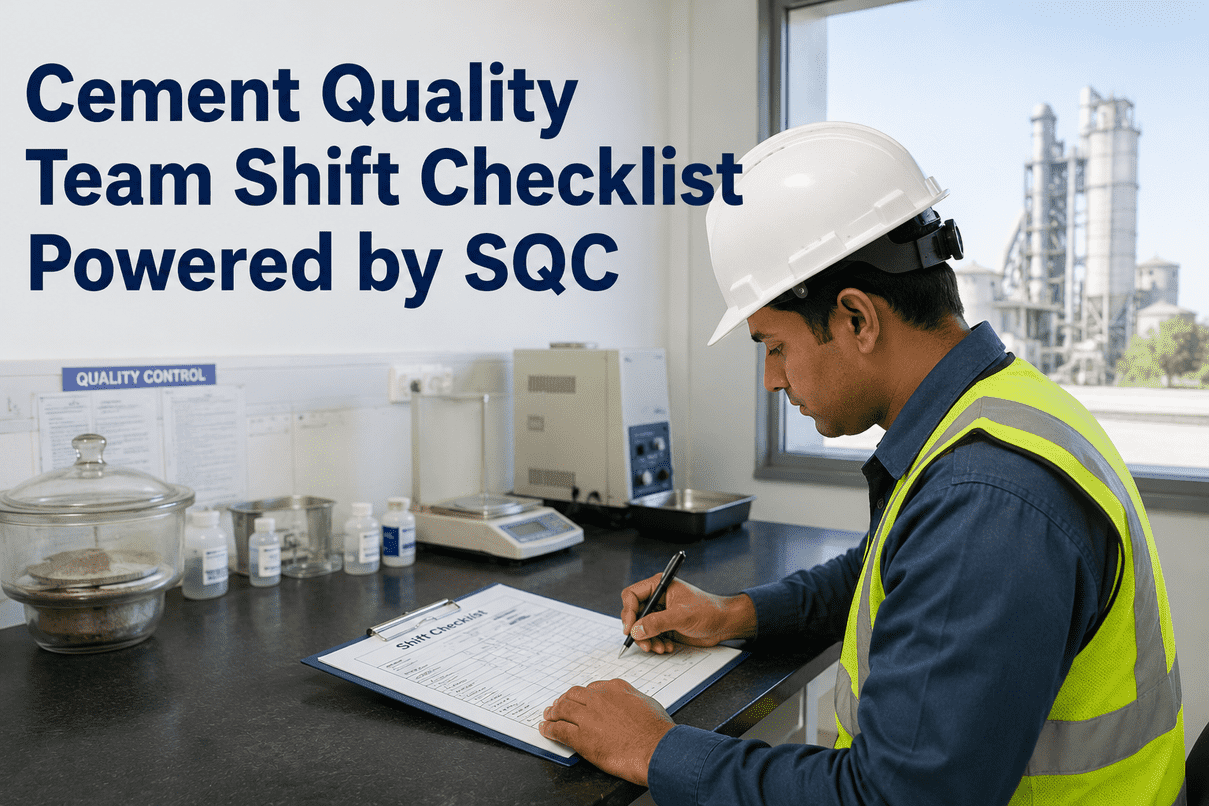
Cement Quality Team Shift Checklist Powered by SQC
By Larry Eilson on May 12, 2026
At 2:47 AM in a cement plant outside Satna, a senior chemist finishing his graveyard shift wrote one line in the handover register: "Blaine running a bit fine, watch it." Six hours later the day-shift QC engineer pulled the lab results and discovered Blaine had drifted from 305 to 358 m²/kg across the night — a 53-point climb hidden in the gaps between hourly samples. By the time the data was reviewed, 1,420 tonnes of OPC had been packed and dispatched. Three weeks later, two ready-mix customers flagged setting time issues, returns started, and a quality team that thought they were running a tight operation realized they had been operating blind between samples for years. This is the gap a real shift quality checklist closes — not the paper kind that gets ticked at the end of the shift, but a live, SQC-powered routine that catches drift the moment it starts.
Cement Quality · Shift Checklist · Powered by SQC
A Great Shift Checklist Is Half SQC. The Rest Is What You Do With the Drift It Catches.
The per-shift checklist used by cement quality teams to catch parameter drift the moment it starts — not 4 hours later, not at the end of shift, not when the customer calls. 6–12 weeks to live. Hardware + software included.
Typical lab lag between Blaine sample and result — drift hides here
8 hrs
Shift length where 47% of quality drift originates and goes unnoticed
28 days
Cement strength lab cycle — too slow for shift-level decisions
±50
Best-in-class Blaine standard deviation (typical plants: ±100–150)
What's Wrong With Your Current Shift Checklist
Most cement quality teams already have a shift checklist. It's printed, laminated, taped to the QC office wall, ticked once or twice a shift, and signed at the end. It's also fundamentally broken — because it tracks what got tested, not what's drifting. A real SQC-powered shift checklist doesn't ask "did you take the 6 AM Blaine sample?" It asks "is Blaine trending toward UCL three consecutive hours, and what are you doing about it before it crosses?" That single shift in framing is the difference between a quality team that policies the process and a quality team that controls it.
The Old Checklist
"Free lime sample taken at 06:00" — but free lime has been climbing since 03:00 and nobody saw it
"Blaine within spec at 14:00" — but lab result reflects what came out of the mill at 13:00
"Kiln burning zone temperature checked" — checked, not trended, not compared to control limits
"Shift handover completed" — verbal handoff, written summary, no data continuity
The SQC-Powered Checklist
Free lime soft-sensor reading every 30 seconds, control chart open on shift dashboard, alert at 3-point trend
Blaine virtual lab predicting fineness continuously from mill power + separator data — 30-minute lead on the actual lab result
BZT, kiln drive torque, preheater exit O₂ all displayed with Shewhart limits + Western Electric rule flags
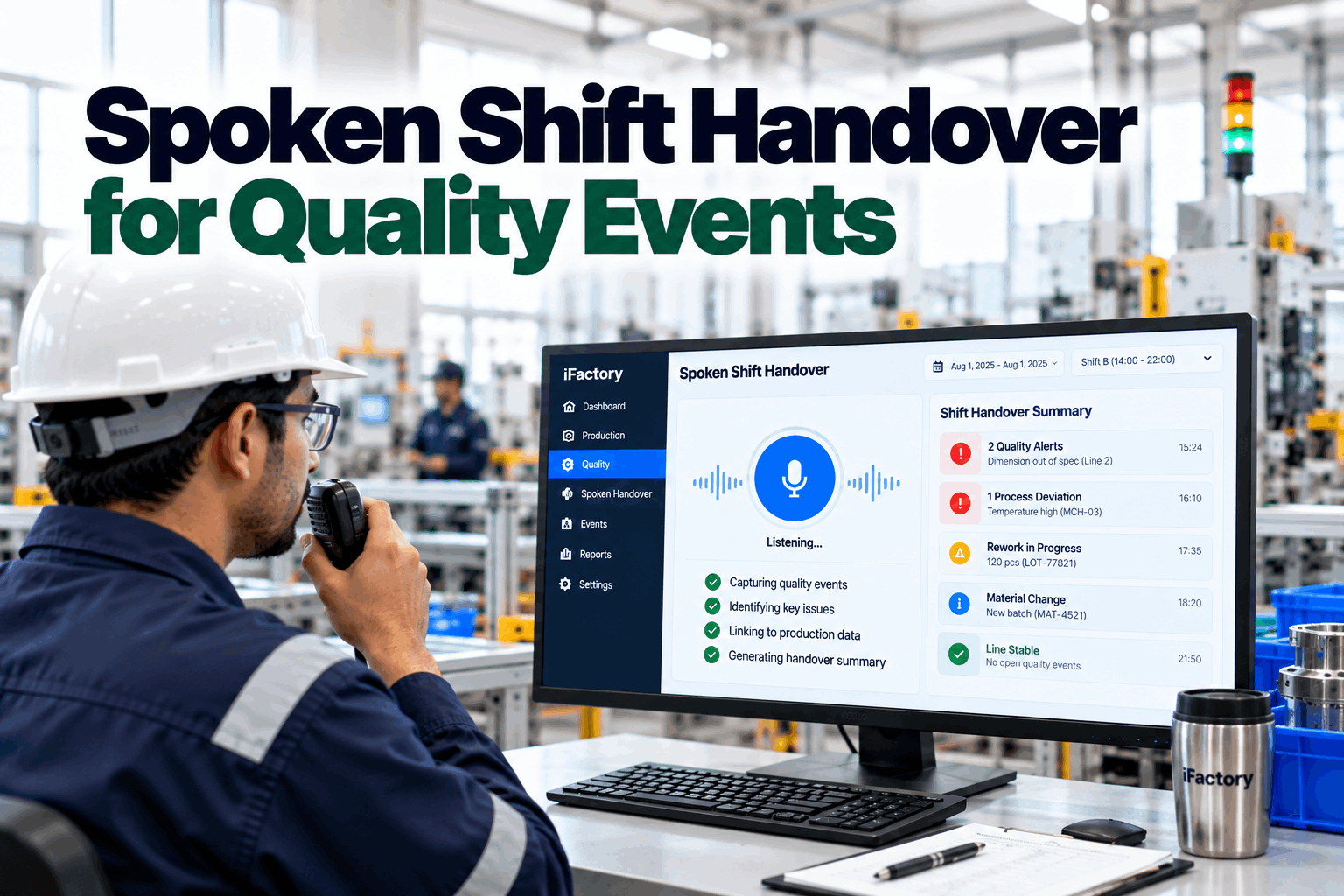
Digital handover auto-generated from shift data: every flag, every excursion, every corrective action timestamped
The 8-Hour Shift Quality Clock — What Gets Checked, When
Every shift has a rhythm. The first 30 minutes are about taking control of the process from the outgoing team. The middle hours are about holding the process inside control limits. The last 30 minutes are about handing the process off with a clean, data-backed handover. Here's what a complete, SQC-powered shift clock looks like.
Hour 0 — Walk & Read
Walk the QC lab, read the previous 4 hours of control charts for Blaine, free lime, SO₃, LSF — note any pattern flags before you take handover
Hour 1 — Takeover
Sign-off on the digital handover register; verify all open quality flags from previous shift have either resolved, escalated, or been accepted with rationale
Hour 2 — Baseline
Confirm baseline samples (LSF, SM, AM, free lime, Blaine) all inside ±1σ; if not, log a Cause Investigation before drift expands
Hours 3–4 — Hold & Trend
Live SPC chart watch: 7-point trend flags, 2-of-3 outside 2σ flags, hugging-the-limit flags — operator-facing alerts on any of them
Hour 5 — Mid-Shift Quality Review
15-minute structured review: shift QC engineer + kiln CCR + finish mill CCR walk through every control chart together; lock in any corrective actions
Hour 6 — SPC Pattern Review
Look for Western Electric rule signals (Rule 1 through Rule 4), check Cpk for current shift vs running 30-day baseline, flag any deteriorating capability
Hour 7 — Wrap-up & CoA Prep
Run shift summary against dispatch records, prepare CoA inputs, flag any product produced this shift that needs hold-on-silo status until 1-day strength verified
Hour 8 — Handover
Auto-generated digital handover: every parameter, every flag, every action taken, signed off by outgoing + incoming shift engineer with timestamps
The Complete Per-Shift Checklist — Grouped by Phase
This is the actual SQC-powered checklist a cement quality team runs on the iFactory platform. Every item below is either a live data check on the shift dashboard, a structured review event, or a documented decision. Nothing is "ticked and forgotten."
01
Start-of-Shift · 0–60 Minutes
Walk the lab and CCR — visual confirmation of operating state before sitting down to the screen
Bag house dust + cooler heat recovery — secondary indicators of combustion stability
03
Mid-Shift Quality Review · 15 Minutes
Three-screen walkthrough — kiln CCR + finish mill CCR + QC engineer review the same dashboard together
Run Western Electric rule check — Rule 1 (any point outside 3σ), Rule 2 (2 of 3 outside 2σ), Rule 3 (4 of 5 outside 1σ), Rule 4 (8 consecutive on one side)
Compare shift Cpk against 30-day baseline — deteriorating capability triggers an upstream investigation, not a downstream correction
Lock in corrective actions — each with owner, target value, target time, and outcome verification step
Update the digital running log — every decision timestamped, no clipboards, no end-of-shift retro-fill
04
End-of-Shift & Handover · 30 Minutes
Auto-generated shift quality summary — all parameters, all excursions, all corrective actions, all dispatched lots
Hold-on-silo decisions — flag any product produced this shift requiring 1-day strength verification before release
CoA inputs prepared — chemical, physical, strength prediction signed off ready for dispatch CoA generation
Open flags for next shift — what's drifting, what's being watched, what action is in progress, what verification is pending
What an SQC Control Chart Actually Tells Your Shift Team
The single most important skill a shift quality engineer can develop is reading a control chart in 15 seconds and knowing whether the process is in control, drifting, or hunting. Here's what the live Blaine fineness chart looks like on the iFactory shift dashboard — and what the team should be reading from it.
04:30 onward — seven consecutive points trending upward. Western Electric Rule 3 triggered. Even though Blaine is still inside UCL, the trend says the process is no longer random — something has changed.
Likely cause — separator speed drift, mill ball charge wearing, ambient humidity drop overnight, or clinker grindability shift from a new kiln campaign.
Action — CCR adjusts separator setpoint by –4 rpm; mill operator verifies ball-charge log; lab pulls a confirmation sample. Trend should reverse within 90 minutes.
Why this matters — If the team waited for Blaine to cross UCL at 360, the process would already have been producing oversized particles for 2+ hours. By acting at the trend signal, the shift catches the drift before it becomes a deviation.
The 4 SQC Drift Signatures Every Cement Shift Engineer Should Recognize
01 · Trend
7 or more consecutive points moving in one direction. Means: something is steadily changing — separator wear, raw mix shift, ambient drift. Act before it crosses UCL.
02 · Shift
Sudden jump to a new level that persists. Means: a step change — fuel switch, raw mix change, equipment swap. Investigate what changed and confirm intent.
03 · Hugging the Limit
Process stays close to UCL (or LCL) but doesn't cross. Means: operator over-control or running too close to spec margin. Open the operating envelope — quality risk is hidden in plain sight.
04 · Cycle / Hunt
Regular up-down oscillation. Means: control loop instability or operator over-correction. Tune PID parameters, or look for periodic upstream variability (shift handover effect, batch raw mix).
Your Quality Team Already Has the Data. They Just Don't Have the Routine.
iFactory's shift quality module ships as a turnkey on-premise appliance — pre-configured NVIDIA AI server, SPC engine, virtual lab predictors, digital handover system. Plug power and Ethernet. We handle the rest. Live in 6–12 weeks.
The Digital Shift Handover — What Replaces the Paper Register
The traditional shift handover is a verbal conversation backed by a half-page handwritten note. The digital handover is a structured, auto-generated quality report with everything the next shift needs — pre-filled, timestamped, signed off, and archived for audit.
Shift Quality Handover · Auto-Generated
Shift B to Shift C · 14:00 IST · 12 March
Outgoing Engineer
R. Sharma · QC Engineer
Incoming Engineer
P. Verma · QC Engineer
Shift Production
3,840 t OPC · 920 t PPC
Cpk (this shift)
1.42 · vs 30-day 1.38
Quality Flags This Shift
11:24 — Blaine 7-point upward trend on OPC mill 2. Action: separator speed –4 rpm at 11:38. Trend reversed by 12:50. Status: CLOSED.
13:42 — SO₃ feeder drift, persistent –0.3% bias on gypsum line. Action: feeder calibration scheduled for 16:00. Hold-on-silo flag on 240t produced 13:00–14:00. Status: OPEN, escalated to Shift C.
Open Items for Next Shift
1 · Verify gypsum feeder calibration outcome at 16:00 and clear hold-on-silo on 240t batch · 2 · Monitor kiln free lime closely — three small excursions in last 24 hours, possible coating shift in BZ · 3 · Lab confirmation Blaine sample due 15:30 to verify OPC mill 2 separator change held
Outgoing signature
R. Sharma · 14:02 IST · digitally signed
Incoming signature
P. Verma · 14:04 IST · digitally signed
Paper vs Digital — The Same Data, Two Completely Different Outcomes
Shift Task
Paper Checklist
SQC-Powered Checklist
Drift detection
Caught at next lab sample (1–4 hours later)
Caught at trend signal (within minutes)
Handover content
Verbal + handwritten summary
Auto-generated structured report
Action traceability
Mostly absent — operator memory
Every action timestamped + owner-assigned
SPC rule monitoring
End-of-shift retrospective review
Continuous, with operator-facing alerts
Audit readiness
Hours of clipboard archaeology
Three clicks to any past shift, any parameter
Shift-to-shift consistency
Varies with operator experience
Same routine, same thresholds, every shift
6–12 Weeks From Kickoff to a Working Shift Routine
Weeks 1–4
Ship · Connect · Baseline
Pre-configured NVIDIA AI appliance ships to site. Field techs integrate DCS, SCADA, lab LIMS, XRF, NOx analyzer. Historical 90 days of shift data ingested for SPC baseline establishment.
Weeks 5–8
Build · Pilot · Train
Plant-specific control limits and Cpk baselines established per grade. Virtual lab models trained on plant data. Pilot one shift on the new checklist. Train all 3–4 quality shifts on the routine.
Weeks 9–12
Go Live · Optimize
Full plant cutover to digital shift handover. SPC pattern alerts go from advisory to active. Monthly Cpk and capability review begins. 24×7 remote support and quarterly model retraining engaged.
What's Included — Hardware, Software, Training, Support
Pre-loaded AI Appliance — NVIDIA GPU server, racked and shipped ready. SPC engine, virtual lab predictors, handover system all installed.
Integration Kit — OPC-UA, Modbus, MQTT, REST adapters for your DCS, SCADA, LIMS, XRF, and analyzer ecosystem.
Field Services — On-site cabling, network setup, sensor verification, commissioning of all data feeds.
Plant-Specific SPC Models — Control limits, capability indices, virtual lab predictors built on your 90-day baseline, not a generic library.
Shift-Team Training — On-site + recorded training for every shift, every QC engineer, every CCR operator who'll use the system.
Managed Service — 24×7 remote monitoring, monthly model retraining, quarterly capability review with your QC head.
Why iFactory for Cement Shift Quality
01
Built Around the Shift, Not the Month
Most quality platforms are built around month-end review meetings. iFactory is built around what a shift engineer needs to see in the next 60 seconds — drift signals, open flags, decisions, and the handover. The 30-day capability review still happens — but it's a consequence of getting shifts right, not the only place quality is measured.
02
Virtual Lab Beats Real Lab Lag
Free lime soft-sensors from NOx correlation, Blaine virtual sensors from mill power + separator data, 28-day strength predictions from clinker chemistry — all running continuously. By the time the real lab result arrives 60 minutes later, the shift team has already acted on the prediction, verified the response, and moved on.
03
SPC the Way Shewhart Intended
Every Western Electric rule runs continuously, not just at end-of-shift review. Trend signals, 2-of-3 outside 2σ, hugging-the-limit patterns, cycle detection — all flagged the moment they emerge, with the underlying data one click away. SPC stops being a retroactive audit and starts being a real-time control discipline.
04
Audit-Ready by Default
Every shift handover, every flag, every corrective action, every CoA — all timestamped, all signed off, all archived in an immutable log. When an ISO 9001 or external auditor asks for the Blaine history of a specific dispatch lot from eight months ago, the answer is three clicks away. No clipboards. No "we'll get back to you."
Frequently Asked Questions
Will this replace our existing QC team?
No — it raises what they do. The team that used to spend 60% of its time on data entry, transcribing lab results, and writing handover notes spends that time on the work quality engineers actually trained for: investigating drift causes, validating capability improvements, driving upstream process changes, and running structured cross-shift reviews. Headcount stays the same; quality outcomes change dramatically. Plants typically report their QC team becoming more confident and more strategic within the first two months.
Do we need to upgrade our XRF analyzer, NOx monitor, or lab equipment?
In most cases, no. iFactory connects to whatever you already have — XRF analyzers, NOx CEMS, particle size analyzers, free lime analyzers, lab LIMS — through standard industrial protocols (OPC-UA, Modbus TCP, MQTT, REST, OPC DA). Where there are genuine data gaps that affect SPC quality, we identify them in the first 30 days and recommend targeted additions — but the platform itself works with your current instrumentation. The fastest deployments use the data already streaming into your DCS today.
How long before our shifts run the new checklist consistently?
Most plants see the morning A-shift adopting the routine within the first 2 weeks of go-live; afternoon B-shift within 3–4 weeks; and night and Sunday shifts within 6–8 weeks. The deciding factor isn't the technology — it's the training cadence and the shift in-charge's engagement. We run on-site training for every shift, and the routine itself is designed to take less time than the old paper version. By week 12, the digital handover and SPC review become the operating norm, not a parallel process.
What does the auto-generated handover do that a good engineer can't?
Three things consistently. First — it's never skipped, never partial, never rushed at 13:55. Second — it captures things engineers don't think to write down (Cpk vs baseline, hugging-the-limit patterns, feeder drift bias) because those don't fit on a paper template. Third — every claim in the handover is backed by clickable data, so when the incoming engineer wants to verify a flag, they're looking at the actual control chart, not someone's interpretation. The best engineers love it because it frees them to handover the things only they can: judgment, context, the "watch out for" intuition.
How does this integrate with our existing 28-day strength testing?
It runs alongside it, doesn't replace it. The 28-day cube test remains the regulatory and customer-facing strength validation. What changes is what your team knows during the 28 days the cubes are curing. The virtual lab predicts 28-day strength from clinker mineralogy and finish mill data with R² above 0.95, available continuously. So instead of finding out about a strength miss 28 days after dispatch, your shift team gets a strength deviation alert while the cement is still in the silo — when corrective action is still cheap.
Can we customize the checklist to our plant's grades and SOPs?
Yes — the platform ships with a strong default checklist built on industry best practice, but every item is configurable. Different grades have different priority parameters, different plants run different fuel blends and SCM strategies, different shift in-charges have different escalation thresholds. During the weeks 5–8 build phase, we sit with your senior QC engineer to align the checklist to your SOPs, your grade catalogue, your customer specifications, and your audit framework. The result is a routine your team would have built themselves if they'd had the platform.
The Drift Hiding in Your Next Shift Already Has a Signature. Read It Before It Costs You.
Every cement plant has the data. The ones running ahead have the routine. iFactory's turnkey shift quality module ships in weeks, integrates with your existing lab and DCS, and turns your next shift handover into the most useful document in the plant. Let's walk through your shift quality routine together.