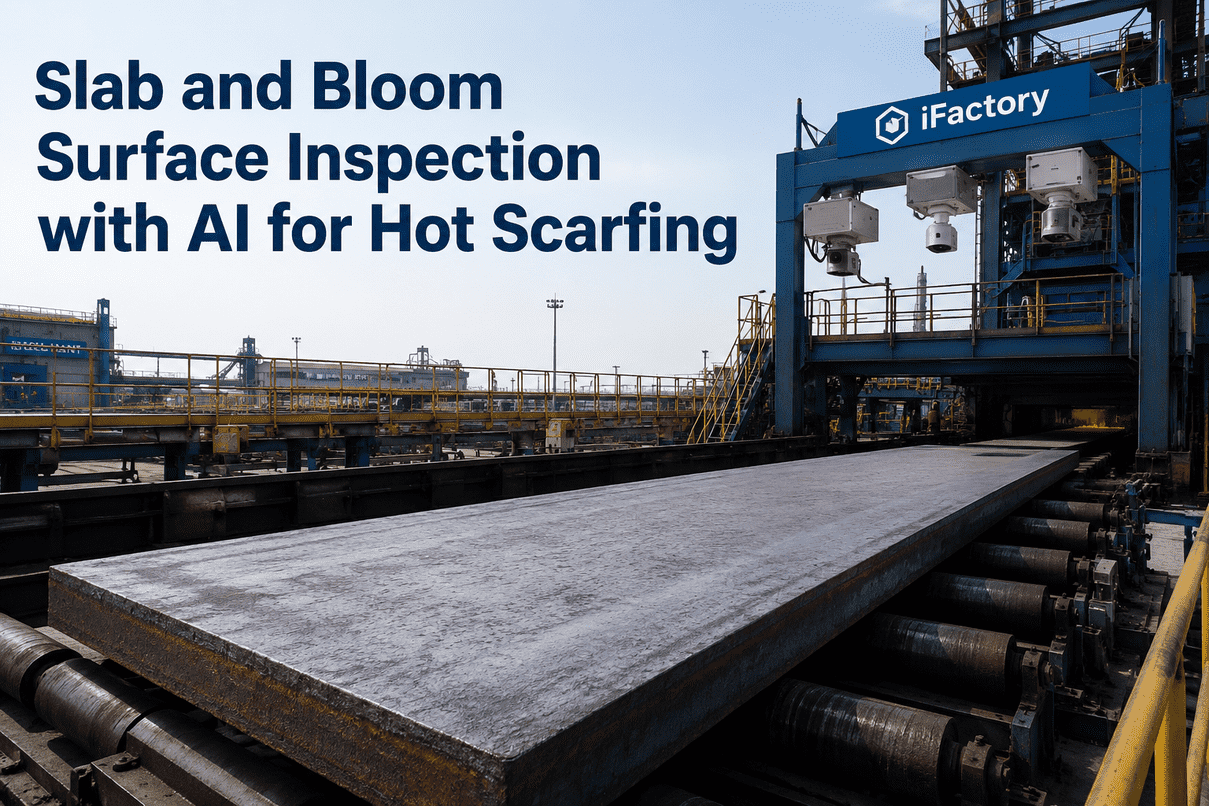
Slab and Bloom Surface Inspection with AI for Hot Scarfing
By Josh Brook on May 12, 2026
At 1,150°C, a freshly cast slab leaves the caster glowing the color of a sunset — and that's exactly the problem. A trained scarfing-bay inspector standing twelve meters away has roughly four seconds to look at a 220mm-thick, 9-meter-long slab moving past on a roller table, judge whether a hairline shadow is a 0.3mm transverse crack or just an oscillation mark, and call a scarfing decision that will cost the mill either ₹14 lakh in wasted yield (if they full-face scarf unnecessarily) or ₹1.2 crore in downstream rework (if they miss a real defect that propagates into the hot strip mill). Multiply that decision by 800 slabs a day, across three shifts, with inspector accuracy hovering between 60% and 70% on hot surfaces, and you have the single biggest invisible quality leak in modern steel production. Slab vision AI fixes this — by giving the caster exit a pair of eyes that never blink, never fatigue, see infrared as easily as visible light, and make scarfing decisions in 180 milliseconds based on the exact defect type, depth, and location.
Slab & Bloom Vision AI · Turnkey Deployment
See Every Crack. Scarf Only What You Must. Ship Only What's Clean.
AI vision at the caster exit detects transverse cracks, longitudinal cracks, corner cracks, and oscillation mark anomalies on slabs and blooms at 900°C — then triggers the exact scarfing decision in 180 milliseconds. 6–12 weeks to live. Hardware + software included.
Manual inspector detection rate at caster exit speeds and temperatures
99%+
AI detection accuracy across 14 defect classes
180 ms
From image capture to scarfing decision signal
$8M/yr
Typical savings from eliminating defensive full-face scarfing
The Two-Million-Dollar Question Every Caster Asks 800 Times a Day
Every slab that exits a continuous caster faces three possible fates: ship as-is, spot-scarf the defective area, or full-face scarf the entire surface. The decision sounds simple. It isn't. Full-face scarfing every slab "to be safe" burns through 1.5–3% of yield — at a 2-million-tonne caster, that's anywhere from $6M to $14M of steel converted to scrap iron every year. But skipping a real defect is worse: a single missed transverse crack becomes a lamination in the hot strip mill, then a press-shop reject at the automotive customer, then a 14,000-tonne claim that ends a supply contract. AI vision is the only way to make this decision right, every time, at production speed.
The Scarfing Decision — Without AI vs. With AI
Today: Operator Judgment
1
Visual check at 12m distance on a 900°C glowing surface — 4 seconds per slab, 0.3mm defects routinely invisible
2
Gut-call scarfing code based on operator memory of similar slabs from this heat number and grade
3
Default to "scarf everything" when in doubt — full-face scarfing burns 1.5–3% of slab yield as defensive insurance
4
30–40% of real defects still slip through — they show up as edge cracks in the hot strip, then as customer rejects 4 weeks later
Result: Over-scarfing + under-detection · Yield bleeds both ways
With Slab Vision AI
1
Multi-spectrum capture — line-scan cameras + thermal imaging + structured light at 0.1mm resolution per pixel, full slab in 6 seconds
2
Deep-learning classification — 14 defect classes identified, each with depth, length, position, and severity score
3
Grade-aware scarfing code generated automatically — skip / spot-scarf / band-scarf / full-face — based on this exact slab's defect map and the downstream order book
4
Defect map persists — every slab carries a digital quality fingerprint into the hot strip mill, so downstream defects can be traced back to caster conditions
Result: 30–40% yield recovery from over-scarfing + 99%+ defect capture
The Four Defect Families That AI Catches Before Scarfing
Continuous casting produces a remarkably consistent menu of surface defects — and almost every one of them traces back to a specific upstream cause. The reason AI matters here isn't just that it sees the defects. It's that it classifies them, links them to root cause, and tells the scarfing system exactly what to do.
01
Transverse Cracks
Run perpendicular to the casting direction, initiate at oscillation mark valleys, propagate along austenite grain boundaries. Most dangerous in peritectic and microalloyed grades — they become laminations in the hot strip mill.
Run parallel to casting direction along the slab face. Caused by uneven shell solidification in the mould. Often deep enough that scarfing cannot remove them — entire slab gets downgraded or scrapped.
Appear at slab edges and corners, especially in hypo-peritectic and high-carbon grades. Critical — when missed, they elongate into edge scabs during rolling and force scrapping of the rolled product.
Normal oscillation marks are fine. Deep marks (>0.4mm), irregular pitch, or hooked profiles are the precursor zone where transverse cracks initiate. AI distinguishes acceptable from rejectable — a judgment human inspectors get wrong 30%+ of the time.
Root cause: mould oscillation frequency/stroke, meniscus instability, slag rim instability
The Scarfing Decision Tree: From 0.3mm Defect to Action in 180 Milliseconds
The real power of slab vision AI isn't in detecting defects — it's in deciding what to do about them. Different defect types, different depths, different positions on the slab, and different downstream orders all demand different scarfing responses. AI weighs them all in under a fifth of a second.
Defect classification + depth + position + grade context
↓
Path A · 62%
Skip Scarfing
No defects detected above grade threshold. Slab routes directly to hot mill — saves the scarfing pass entirely, recovers 100% of yield on this slab.
Path B · 24%
Spot Scarf
Localized defect detected — corner crack, isolated transverse cluster, or single longitudinal flaw. AI generates exact coordinates: scarf 0.4m² area only. Yield loss: 0.3% vs. 2.5% for full-face.
Path C · 11%
Band Scarf
Edge or corner defects running across multiple positions. AI generates band coordinates — scarf two 0.2m-wide bands along the slab edges only. Targeted, predictable yield loss.
Path D · 3%
Full-Face or Downgrade
Systemic defect across face — deep longitudinal cracks, severe oscillation mark hooks, multiple grade-specific failures. AI flags for full-face scarfing or downgrade to non-prime — and triggers an upstream caster investigation work order.
↓
Scarfing code transmitted to scarfing machine PLC · Defect map archived to slab digital twin · Investigation flagged if upstream pattern detected
The Live Inspection Sequence: What Happens in 6 Seconds
0 ms
Slab Enters Inspection Zone
Encoder triggers acquisition. Slab surface at 900–1,150°C. Inspection cabin shielded against radiant heat with positive-pressure cooling.
0 – 6,000 ms
Multi-Spectrum Image Capture
Line-scan cameras (16k pixels each, top + bottom + two sides) sweep the full slab. Thermal IR captures surface temperature uniformity. Structured-light laser profilers measure oscillation mark depth and dimensional deviations to ±0.05mm.
6,020 ms
Edge AI Inference
GPU-accelerated industrial computer runs the YOLO-derived defect detection model + a CNN-based defect classifier + a depth-regression model in parallel. All processing happens on-premise — no cloud round-trip, no external data exposure.
6,100 ms
Scarfing Code Generation
Defect map combined with grade-specific rules, current order book, and downstream routing constraints. AI emits a scarfing instruction: skip / spot coordinates / band coordinates / full-face / downgrade.
6,180 ms
Decision Transmitted to Scarfer
Scarfing code sent to scarfer PLC via OPC-UA or Profinet. Defect images, classifications, and coordinates archived to the slab's digital twin. Operator HMI updated. Upstream caster team alerted if pattern emerging.
Your Next Caster Investigation Is Already in the Data — AI Just Hasn't Read It Yet
iFactory's Slab Vision AI ships as a complete on-premise appliance: pre-configured NVIDIA AI server, cameras, thermal imagers, structured-light scanners — racked, pre-loaded, and ready. Plug power and Ethernet. We handle cabling, PLC integration, and operator training. 6–12 weeks to live.
The headline "99% accuracy" obscures what matters operationally: how well does AI catch the defects that actually cause downstream problems? Here's the defect-by-defect breakdown after a typical 8–10 week training cycle on plant-specific data.
99.6%
Transverse Cracks
Manual baseline: 65%
99.2%
Longitudinal Cracks
Manual baseline: 70%
98.7%
Corner Cracks
Manual baseline: 55%
97.8%
Oscillation Anomalies
Manual baseline: 40%
99.5%
Slab Width / Geometry
Manual baseline: 80%
98.3%
Inclusion Clusters
Manual baseline: 35%
What One Missed Slab Actually Costs You
A single defective slab that escapes the caster doesn't stop at the caster — it cascades. Every downstream step makes the cost worse. Here's the real waterfall when a transverse crack slips past manual inspection.
Stage 1 · Caught at Caster
₹40,000
Scarfing cost + yield loss on this slab only
Stage 2 · Caught at Hot Strip Mill
₹2.8 lakh
Rolled coil downgrade + remelt + lost mill time
Stage 3 · Caught at Cold Mill / Coating
₹9.6 lakh
Multiple value-add steps wasted, additional yield loss
Stage 4 · Caught by Customer
₹32–68 lakh
Full coil return + freight + rework + claim processing
Stage 5 · Field Failure / Recall
₹1.4 cr+
Automotive press-shop failure, supplier qualification at risk, contract penalties
Slab vision AI is not a multi-year IT project. iFactory ships the entire system as a turnkey appliance — hardware, software, training, and integration in one bundle. You provide line power, Ethernet, and access to the caster exit area. We do everything else.
Weeks 1–4
Ship · Network · Data Foundation
Pre-configured NVIDIA AI server + cameras + thermal imagers + structured-light scanners ship to site
Field techs dispatched for cabling, camera mounting, network setup, PLC tap-in
Historical scarfing logs + caster Level-2 data ingested for model warm-start
Inspection cabin commissioning with positive-pressure cooling and shielding
Weeks 5–8
Train · Pilot · Calibrate
Model training on plant-specific defect samples across grade range (carbon, HSLA, IF, peritectic, silicon)
AI predictions run in parallel with manual inspection — accuracy benchmarked daily
Scarfing code generation tested in advisory mode, then closed-loop with scarfer PLC
Operator HMI tuned, defect classification thresholds adjusted per grade
Weeks 9–12
Go Live · Training · Optimize
Full production cutover — AI becomes primary scarfing decision system
Operator and quality team training sessions (in-person + recorded)
Defect-to-root-cause correlation activated — caster team gets upstream alerts
24×7 remote monitoring + monthly model retraining begin
What You Get — All Included, No Surprise CAPEX
Pre-loaded AI Appliance
NVIDIA-powered GPU server, racked and shipped ready. Edge inference under 200ms. No separate hardware purchase.
Vision Hardware Kit
Line-scan cameras (top, bottom, both sides), thermal imagers, structured-light profilers, inspection cabin with cooling.
Field Integration
Cabling, mounting, PLC/SCADA tap-in, OPC-UA / Profinet integration with existing scarfer, Level-2 data bridge.
Plant-Specific Model
Defect detection model trained on your grade mix, your defect history, your scarfing codes — not a generic library.
Operator & QC Training
On-site and recorded training for caster operators, scarfing-bay staff, quality engineers, maintenance team.
"Strand 2 is throwing more corner crack flags on heat 4881 than usual. What changed?"
iFactory AI
Corner crack rate on Strand 2 has risen 3.4× over the last 14 slabs of heat 4881 (peritectic grade, 0.12% C). Two upstream changes correlate: (1) mould powder feed rate dropped 8% at 11:03 AM on this strand, (2) secondary cooling zone-3 nozzle 7 is showing flow variance — likely partial clog. I've drafted a work order for nozzle inspection and flagged mould powder feed for QC review. Recommend reducing casting speed to 0.9 m/min on Strand 2 for the next 3 slabs while you verify.
Why iFactory for Slab & Bloom Vision
01
Built for the Caster Floor
Generic vision AI breaks down at 900°C with steam, scale, radiant heat, and mill vibration. iFactory's vision stack is hardened for caster environments — ruggedized enclosures, positive-pressure cooling, vibration isolation, multi-spectrum sensors that see through scale and steam.
02
100% On-Premise, 0% Cloud
Inference runs entirely on the in-plant NVIDIA appliance. Slab images, defect maps, caster Level-2 data never leave your network. Critical for plants with strict IP, export-control, or sovereign data requirements.
03
Grade-Aware, Not Generic
Peritectic, IF, HSLA, silicon, and high-carbon grades all produce different defect signatures. iFactory trains separate model branches per grade family — so a 0.3mm transverse crack on peritectic gets classified differently from the same defect on HSLA.
04
Defect-to-Root-Cause in the Same Platform
Most slab inspection systems stop at "defect detected." iFactory links every detected defect back to caster parameters — mould oscillation, taper, cooling spray, casting speed, ladle chemistry — so corrective action happens upstream, not just downstream.
Frequently Asked Questions
Will the cameras survive the heat and conditions at the caster exit?
Yes. The vision hardware ships in ruggedized enclosures with positive-pressure air cooling, IP-rated optical windows, and vibration-isolated mounts. The system has been deployed at slab exit temperatures of 1,150°C and bloom temperatures up to 1,050°C without performance degradation. Camera modules are field-replaceable in under 30 minutes if needed, and the AI appliance lives in a separate climate-controlled rack remote from the caster.
How long before AI accuracy beats our existing scarfing bay inspectors?
Most plants see AI parity with manual inspection by week 6 of the deployment, and AI exceeds manual accuracy across all defect classes by week 8–10. The crossover happens fastest on the hardest defects — oscillation mark anomalies, micro-transverse cracks, low-contrast inclusion clusters — where manual detection hovers at 35–55%. By go-live in weeks 9–12, AI is typically running at 97–99%+ accuracy across the full defect catalogue.
Do we need to buy NVIDIA hardware separately?
No. The complete AI appliance — pre-configured NVIDIA GPU server, all vision hardware, networking equipment, and inspection cabin — ships as part of the turnkey package. It arrives racked, pre-loaded with the iFactory platform, and ready to commission. You provide line power and an Ethernet uplink. We handle everything else, including field cabling, PLC integration, and on-site commissioning.
Can the system handle different slab widths, thicknesses, and grades on the same caster?
Yes. The line-scan cameras and laser profilers automatically adjust to slab width and thickness using the encoder feed and dimensional calibration. The defect classification model has separate branches trained per grade family — peritectic, IF, HSLA, microalloyed, silicon, high-carbon, and specialty grades — so a slab's grade context flows from the Level-2 system and applies the right detection thresholds automatically. Casters running 6+ grade families per shift are common deployments.
What does the integration with our existing scarfer look like?
The AI appliance connects to your scarfer PLC over OPC-UA, Profinet, or Modbus TCP — whichever your scarfer supports. The scarfing code (skip / spot / band / full-face / downgrade) plus coordinate data is transmitted as a structured message that your scarfer's automation logic consumes directly. We work with all major scarfing platforms (Evertz, ESAB / L-TEC, Harsco ARC, and custom-built scarfers). For plants without an automated scarfer, the system can drive an operator HMI that displays the recommended scarfing pattern visually.
Does this replace our scarfing-bay inspection team?
No — it shifts their role from manual judgment to system oversight, edge-case review, and continuous improvement. The team that used to call scarfing decisions 800 times a shift now validates AI decisions, investigates flagged anomalies, drives upstream caster improvements based on defect-pattern data, and manages model retraining cycles. Headcount typically stays the same; the quality outcomes get dramatically better, and the team finally gets the bandwidth to work on improving the process instead of just policing it.
Stop Guessing at Glowing Slabs. Start Knowing.
Every shift you run without slab vision AI, you're either over-scarfing good slabs or under-detecting bad ones — and there's no way to tell which is hurting you more without the data. iFactory's turnkey AI appliance ships in weeks, integrates with your existing scarfer, and pays back in months. Let's walk through your caster together.

-—-mold-level-and-tundish-spc-for-slab-quality.png)