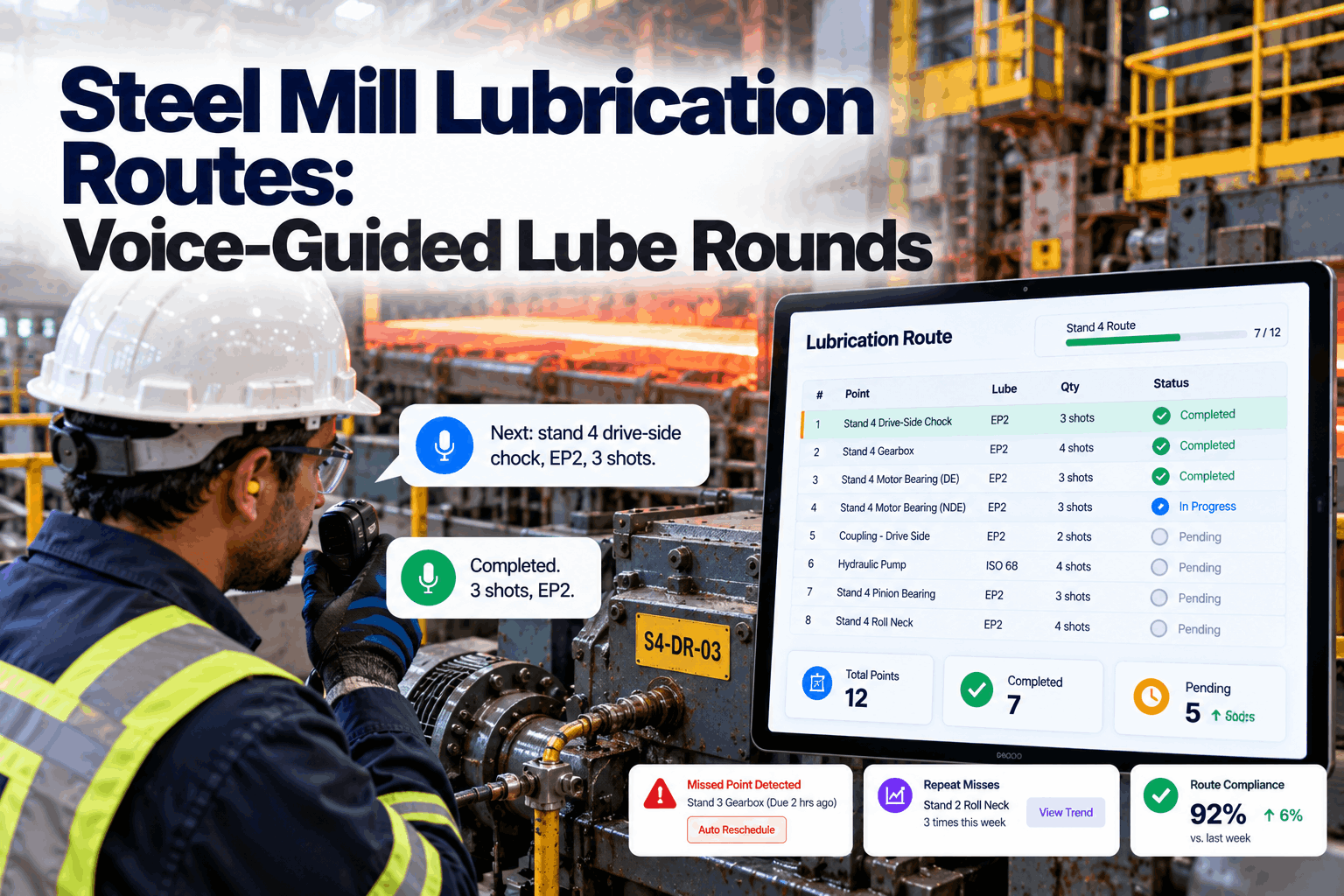
Lubrication is the simplest maintenance task in a steel mill and one of the easiest to get wrong. Routes are long, points are hidden behind guards, and paper cards rarely say which grease or how much. Points get missed when the mill is busy, the wrong grease goes into a coupling, or a bearing gets far more than it needs. Voice-guided lube rounds read each point aloud, capture grease type and quantity hands-free and flag missed points automatically, so every point gets the right lubricant. Plan yours in a lube route review.
Steel Mill Lubrication Routes: Voice-Guided Lube Rounds
The agent reads the next point, the grease and the number of shots. The technician confirms by voice. Skipped points reschedule themselves, and repeat misses show up on the reliability dashboard.
- Why paper lube routes miss points and mix greases
- How voice guidance works point by point
- Missed points, centralised systems and reliability data
Why Lube Routes Go Wrong in Steel Mills
Small mistakes, repeated hundreds of times a week.
A steel mill can have thousands of lubrication points across rolling stands, roller lines, cranes, conveyors and auxiliaries. Many are greased by hand on routes that take hours. Paper route cards rarely show the exact grease and quantity for each point, and there is no easy way to record which points were actually done. Bearings fail from too little grease, from too much, and from the wrong grease mixing with the right one. When a bearing does fail, nobody can say for sure whether it was lubricated correctly, because the record is a tick on a card rather than a quantity and a time. Our reliability team can review your current routes.
Missed points
Skipped when the mill is busy or a guard is in the way.
Wrong grease
Incompatible greases mixed in the same bearing.
Over-greasing
Too much grease overheats bearings and pushes out seals.
No record
A ticked card says nothing about what was actually done.
What Every Lube Point Needs to Say
A good route card removes guesswork at every point.
Voice guidance is only as good as the route behind it. Each point needs a clear location, the lubricant, the quantity, the method and the frequency. Most mills find that building this list is the most valuable step of the whole project. It often uncovers points nobody has greased for months, duplicate points on different routes and lubricants that no longer match the equipment maker's recommendation. Build your route data with our implementation team.
"Three shots" only means something if every gun delivers about the same amount per shot. Weigh the output of each grease gun over a set number of strokes, label it, and recheck it regularly. Then the quantity on the route card is the quantity that reaches the bearing.
How Voice-Guided Lube Rounds Work
The route talks the technician through, point by point.
The technician starts the route on a headset or rugged handheld. The agent reads the next point, lubricant and quantity. The technician greases the point and confirms by voice, adding a short note if something looks wrong. The agent records the time, quantity and any condition notes, then moves to the next point. Routes follow a sensible walking order, so technicians are not sent back and forth across the mill, and the agent can tell a new technician exactly where to look for a hidden fitting. See it in action in a live demo.
Guide
"Next: stand 4 drive-side chock, EP2, 3 shots."
Grease
Technician lubricates the point.
Confirm
"Done, 3 shots, purge clean."
Note
Leaks, noise or heat reported by voice.
Next
Agent moves to the next point.
A Route on the Page
Tick through a sample section of a finishing mill route.
The interactive list below shows part of a route as the technician would hear it. In the live system, each point is confirmed by voice rather than a tick, and the record keeps the time and quantity. Ask our route designers to build your first route.
Every Point, Right Grease, Right Amount
Voice-guided rounds that tell technicians exactly what to do at each point, record what was done and never lose a missed point.
Missed Points Are Rescheduled, Not Forgotten
A skipped point is fine. A lost one is not.
In a running mill, some points cannot be reached on every round: a stand is running, a guard is locked out, a crane is overhead. The technician says why the point was skipped, and the agent reschedules it to the next safe opportunity, such as a roll change or the next shift. Critical points have a limit on how long they can wait, and the supervisor is told when that limit is close. If the same point is missed again and again, it surfaces on the reliability dashboard. Set rescheduling rules with our planning team.
When a point is skipped
- Reason recorded by voice
- Point rescheduled to the next window
- Supervisor sees overdue critical points
- Route timing adjusted for next time
When a point is missed repeatedly
- Flagged on the reliability dashboard
- Access or route order reviewed
- Candidate for a centralised system
- Bearing condition checked
Centralised Lubrication Systems
Automatic systems still need someone watching them.
Many rolling mills use centralised grease and oil systems for chocks, roller lines and gearboxes. They remove many manual points, but they can fail quietly: a blocked line, an empty reservoir or a pump that runs without reaching pressure. Because nobody greases those points by hand any more, a failure can go unnoticed until a bearing overheats. Monitoring pump cycles, pressure and reservoir levels, and adding system checks to the voice route, closes that gap. Discuss centralised system data with our engineering team.
Cycle and pressure
Pump runs and reaches pressure each cycle.
Level
Refill before it runs low, with the right grease.
Blockage and leaks
Divider valve faults and broken lines found early.
End-point checks
Visual checks on the route that grease is arriving.
Condition Notes Become Work Orders
The lube technician sees more machines than anyone else.
Lube rounds take technicians past hundreds of bearings, gearboxes and couplings every week. They notice leaks, unusual noise, heat and damaged fittings long before a sensor might. With voice, a short note such as "stand 5 gearbox leaking at the input seal" becomes a structured observation linked to the asset, and the agent can draft a work order for the planner. Ask our planning team how notes reach your CMMS.
Oil or grease leaks
Seal and fitting leaks reported with location.
Unusual sound
Grinding or knocking noted at the point.
Hot bearings
Temperature checked with a handheld if fitted.
Damaged fittings
Blocked or broken nipples replaced as work.
Lubricant Storage and Handling
Clean, labelled lubricant is the start of every good lube point.
Contaminated or mixed lubricant can do as much harm as no lubricant. The voice route can include storeroom and refill checks: confirming the grease in a gun before the route starts, checking cartridge labels and noting when containers are left open. Plan lubricant handling with our reliability team.
Good practice
- One labelled grease gun per lubricant
- Sealed, dated containers in a clean store
- Fittings wiped before greasing
- Refill checks at the start of each route
Common problems
- Unlabelled guns shared across greases
- Open drums collecting dust and water
- Dirty fittings pushing grit into bearings
- No record of which batch was used
Lube Data on the Reliability Dashboard
Turn route records into reliability insight.
Every confirmed point, skipped point and condition note becomes data. Combined with bearing failures and vibration readings, it shows whether lubrication is helping or hurting reliability. The exchange below shows a reliability engineer using it. Review dashboard needs with our analytics team.
Lube Route Mistakes to Avoid
More grease is not better lubrication.
These are common problems in mill lubrication programs. A short route review can find them.
What works
- Exact lubricant and quantity per point
- Calibrated grease guns
- Colour-coded fittings and guns by grease
- Skipped points rescheduled, not lost
What fails
- "Grease until it purges" on every point
- One gun used for several greases
- Routes that ignore running equipment
- Ticked cards with no quantities
How iFactory Runs Voice-Guided Lube Rounds
Voice Agent and Route Manager, on your own network.
iFactory guides technicians point by point with lubricant and quantity, records confirmations by voice, reschedules skipped points and shows repeat misses on the reliability dashboard. It runs on an on-prem AI server inside your mill and works with your CMMS. Fit questions go to our solutions team.
Voice guidance
Point, lubricant and shots read aloud.
Voice confirmation
Done, quantity and notes spoken.
Auto-reschedule
Skipped points moved to the next window.
Reliability dashboard
Repeat misses and condition notes.
Route manager
Points, greases, quantities and frequencies.
Condition alerts
Leaks, noise and heat raised as work.
Results depend on your routes, assets and crews. We measure completion, skipped points and condition findings on your own data during the pilot, rather than promising a general figure.
Turnkey AI: Delivered, Connected and Live in 6–12 Weeks
You do not build this. It arrives ready.
iFactory ships as a pre-configured NVIDIA AI server with the software pre-loaded, racked and ready. Rack it, plug in power and Ethernet, and the AI is live on your network. Our team handles cabling, network setup, PLC, SCADA, DCS and CMMS integration, CMMS and route links, operator training and 24×7 remote monitoring. Data stays on your network. For a scope matched to your plant, request a turnkey quote.
Ship, network and data
Server installed. Lube points, greases and routes loaded from your CMMS. Headsets tested.
Model training and pilot
Routes and rescheduling rules tuned. Voice rounds run on one mill area.
Go-live and training
Voice lube rounds live for all routes. Technicians trained. 24×7 monitoring begins.
Frequently Asked Questions
What are voice-guided lube rounds?
Lubrication routes where an agent reads each point, lubricant and quantity aloud, and the technician confirms by voice, creating a complete record of every point.
What happens if a point cannot be reached?
The technician says why it was skipped, and the agent reschedules it to the next safe window, such as a roll change.
How does it prevent the wrong grease?
Each point has its lubricant named on the route and read aloud. Many mills also colour-code fittings and grease guns to match.
Can it help avoid over-greasing?
Yes. Quantities are set per point and read aloud, and calibrated grease guns make the number of shots meaningful.
Does it cover centralised lubrication systems?
Yes. System checks can be added to routes, and pump, pressure and reservoir data can be monitored where available.
Can technicians report problems during the round?
Yes. A short spoken note such as a leak or unusual noise is linked to the asset, and the agent can draft a work order for the planner to review.
Will voice work in a rolling mill?
Yes, with noise-cancelling headsets or push-to-talk handhelds, tested in your mill during the pilot.
Where do routes come from?
From your CMMS and lube surveys. We help clean the point list so every point has a location, lubricant, quantity and frequency.
How do we start?
Start with one mill area and its main routes. A 6-week pilot cleans the route data and runs voice rounds with your technicians. To plan it, contact our team.
Make Every Lube Round Count
In thirty minutes we review one of your lube routes and show how it would run as a voice-guided round. You keep the notes either way.
- 1A current lube route card
- 2Your list of greases and oils
- 3Centralised system layouts
- 4Recent bearing failures
- 5One point that is always missed