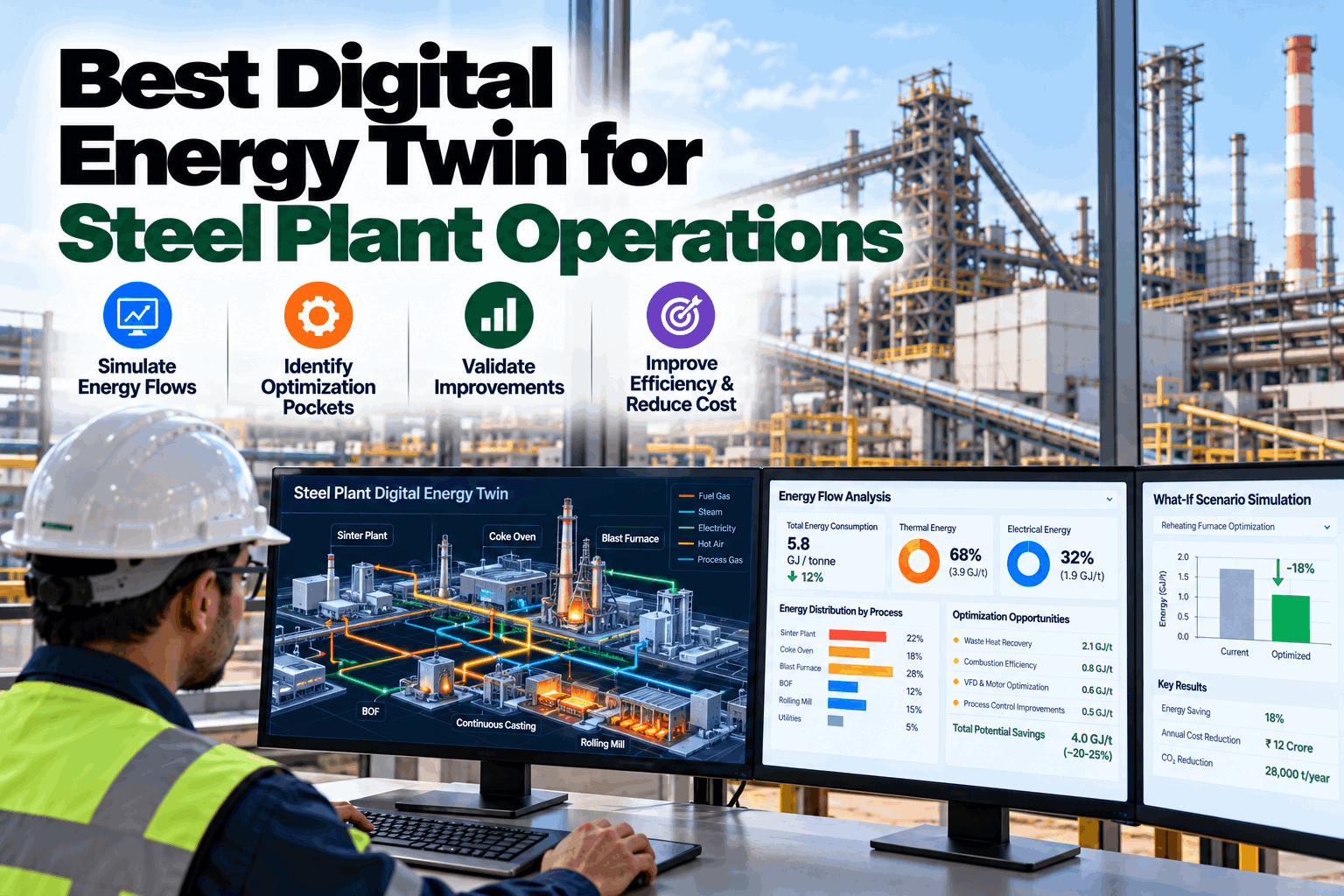
Every steel plant makes energy decisions it cannot safely test in real life: how to split byproduct gases between furnaces and the power plant, how far to lower a furnace setpoint, whether a heat recovery project will still pay back after the next caster upgrade. A digital energy twin, a physics-based model of the plant’s energy flows calibrated with real operating data, lets engineers ask those questions first and change the plant second. It finds optimization pockets and validates improvements before capital or production is put at risk. Book a 30-minute energy twin assessment with your plant data.
Physics-based, data-calibrated models of your energy flows that find optimization pockets and prove improvements before the plant is touched.
At a Glance
What a Digital Energy Twin Is, and What It Isn’t
The phrase digital twin has been stretched to cover everything from 3D walkthroughs to dashboards. For energy, a useful twin is a model that computes how energy flows through the plant: fuel, byproduct gases, steam, electricity, oxygen and compressed air, between the units that produce and consume them. It responds to the same inputs as the real plant, such as production rates, schedules and setpoints, and predicts energy use, costs and emissions.
What makes a twin valuable is that it can be asked questions the plant cannot safely answer by experiment. What happens to purchased gas if the reheating furnaces take more coke oven gas? How much flaring would a second gas holder remove? Would a sinter cooler boiler still pay back if the new caster raises the hot-charge ratio? The best digital energy twins answer these with numbers that have been checked against reality.
Physics, Data or Both
| Approach | Strengths | Limits | Where it fits in steel |
|---|---|---|---|
| Physics-based | Extrapolates to new conditions; explains cause and effect | Needs engineering effort; parameters drift as equipment ages | Furnaces, gas networks, steam systems, heat recovery design |
| Data-driven | Fast to build from historian data; captures real behavior | Weak outside the conditions seen in training data | Expected-energy models, anomaly detection, short-term forecasting |
| Hybrid | Physics structure calibrated and corrected with data | Requires both skill sets | Most production twins: reliable within range and sensible beyond it |
In practice the most dependable energy twins are hybrid. Physics provides the mass and energy balances that must always hold, and data calibrates the parameters that change over time, such as heat-transfer coefficients, fouling, efficiencies and leak rates.
Byproduct Gas: The Network Most Worth Twinning
An integrated plant produces three byproduct gases with very different fuel value. Coke oven gas is rich, roughly 17–19 MJ/Nm³. Blast furnace gas is lean, around 3–3.5 MJ/Nm³ but produced in huge volumes. Converter gas from the BOF shop falls between the two. These gases feed coke oven heating, hot stoves, reheating furnaces and the power plant, balanced through holders and mixing stations. When supply and demand fall out of step, gas is flared while the same plant buys natural gas or grid power.
A gas network twin forecasts generation and demand hours ahead from production schedules, then recommends how to allocate gases, when to fill or draw holders and how to dispatch the power plant, so that flaring and purchased energy both fall.
Illustrative figures. The twin checks what the simple calculation cannot: whether the power plant has spare capacity at those hours, whether holder levels allow it, and what happens to the other gas users.
Optimization Pockets a Twin Finds
Holder levels, gas allocation and power plant dispatch planned hours ahead to cut flaring and purchased fuel.
Zone temperatures and residence times tuned to discharge targets, not to comfortable margins.
Letdown valves versus turbines, boiler loading and header pressures balanced for lowest cost.
Production and storage scheduled to match demand and tariff periods.
For EAF and electricity-heavy plants, melt and load schedules aligned with tariff and demand charges.
Waste heat recovery, VFD or burner projects simulated against real operating data before capex is committed.
Calibration and Validation Before Anyone Relies on It
Model units and networks with mass and energy balances.
Fit parameters to months of historian data.
Test on a period the model has not seen.
Run alongside operations, with recommendations reviewed by people.
Measure the results of accepted recommendations against baselines.
Validation is the step most often skipped, and the one that decides whether operators will trust the twin. A model that reproduces a hold-out period within agreed tolerances has earned the right to make recommendations. When a twin is used to estimate savings where direct measurement is impossible, this calibration is also what IPMVP Option D requires.
What a Twin Needs to Get Started
Flows, temperatures, pressures and calorific values for the network or units being modeled, ideally a year at hourly resolution.
Planned rates, campaigns and outages, which let the twin forecast hours ahead.
Design and nameplate information for furnaces, boilers, turbines, holders and compressors.
Holder limits, minimum firing rates and safety margins, so recommendations stay practical.
What iFactory Delivers
Physics-based unit and network models calibrated continuously with historian data.
COG, BFG and BOF gas generation, holders, users and power plant in one model.
Engineers test setpoints, schedules and projects before touching the plant.
Recommendations hours ahead, based on production schedules and planned outages.
Calibration and hold-out accuracy documented for every model.
Accepted recommendations measured against normalized baselines.
Share a few months of historian data for your gas network or furnaces. We build a first calibrated model and show the optimization pockets it finds.
How Deployment Works
Server racked on site, historian, meter and production data connected, and metering gaps listed against the units that matter most.
Baselines and expected-energy models built per unit, then piloted with your energy and process engineers reviewing every finding.
Dashboards, alerts and reports rolled out plant-wide, teams trained, and 24×7 remote monitoring of the system in place.
Most plants start with one network, usually byproduct gases in integrated plants or furnaces and utilities in EAF plants, and extend the twin once the first model has proved itself against measured results.
Frequently Asked Questions
A working model of the plant’s energy flows, including fuels, byproduct gases, steam, electricity and utilities, that responds to production and setpoints and predicts energy use, cost and emissions.
No. A 3D model shows what equipment looks like. An energy twin calculates how energy moves between units, and that is what enables optimization and what-if analysis.
Usually both. Physics provides energy and mass balances that must hold, and data from the historian calibrates parameters such as efficiencies and fouling that change over time.
In integrated plants, often in the byproduct gas network, by reducing flaring and purchased fuel. Furnace setpoints, steam networks and investment validation are other common uses.
It is calibrated on historical data and then validated on a period it has not seen. Its recommendations are also verified against measured results after they are applied.
Not by default. Recommendations are advisory and reviewed by operators and engineers. Closed-loop control is considered only where suitable control systems and approvals already exist.
iFactory builds calibrated digital energy twins of your gas networks, furnaces and utilities, then helps you prove every improvement against measured results.