Voice Data Queries in Steel Mills: Ask in Plain English
By David Cook on October 27, 2026
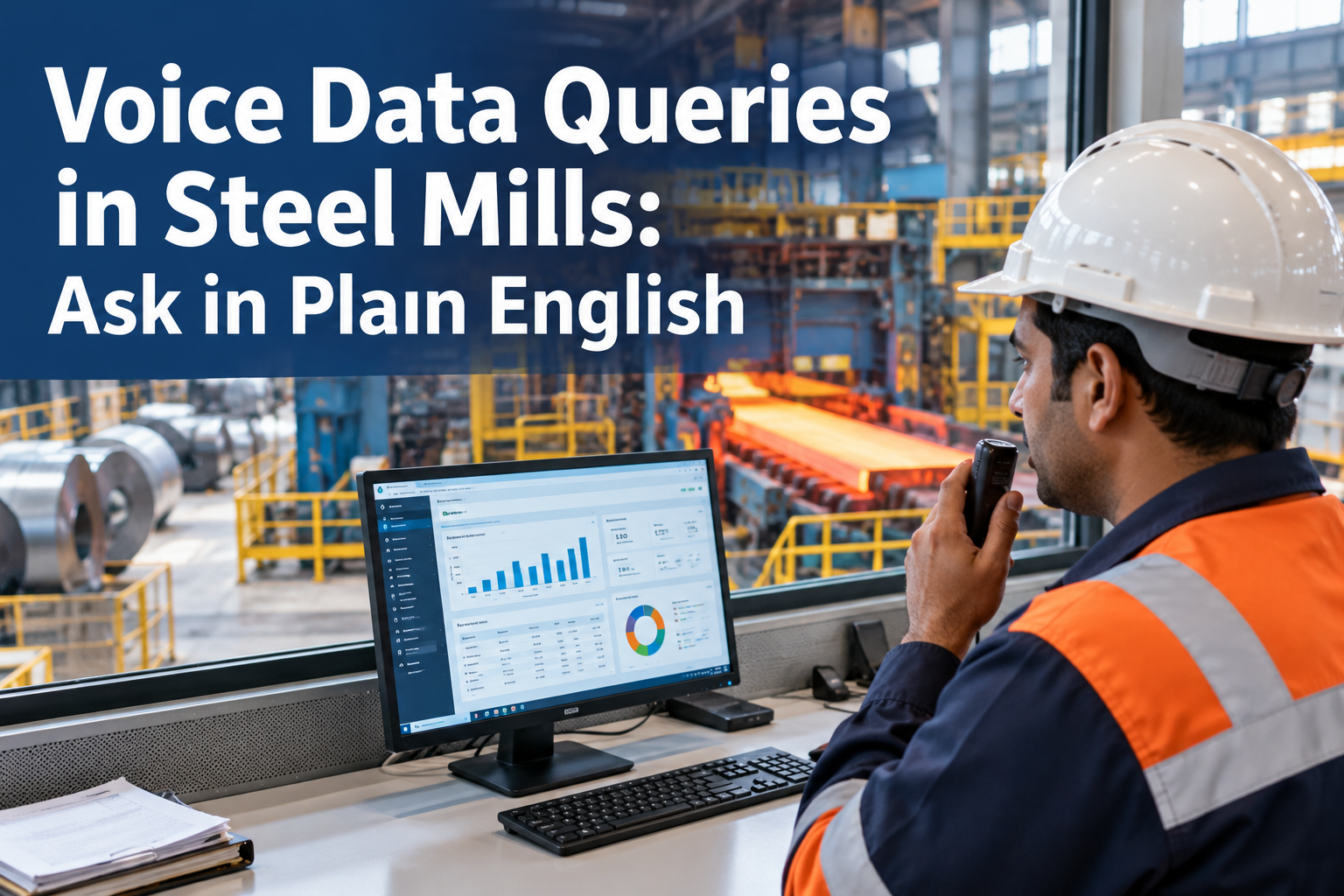
A shift manager walking from the furnace pulpit to the coiler usually has three questions: how much have we rolled, why did we stop, and what is still open. The answers sit in the MES, the PLC historian, the delay log and the CMMS, each behind its own screen and login. Voice data queries let managers ask those questions in plain English and hear the figure in seconds, with the unit, the time window and the source said out loud. Hear it answered from mill data in a short Factory Copilot demo.
FACTORY COPILOT · VOICE QUERY
Ask the Mill a Question Out Loud, Hear the Number With Its Window and Source
iFactory Factory Copilot answers natural-language questions over MES, PLC historian and CMMS data. It speaks the answer and puts a chart on the nearest screen, so a manager on the floor gets the figure without waiting for a report.
"Tons per hour on the hot strip mill since 6 a.m.?"Heard 12:04
548metric t/h average
HSM · 06:00–12:00 · coil scale"Hot strip mill since six: 548 tonnes an hour, 3,288 tonnes in total. The 08:00 hour was low, a roll change."
Hourly · 06 to 12
VOICE DATA QUERIES STEEL MILLS
Four Questions Mill Managers Ask Before Lunch
Most data requests in a steel mill are not deep analysis. They are look-ups: how much did we roll, why did we stop, how well are we running and what work is still open. Each answer lives in a different system, and the person asking is usually on the floor, not at a desk. These four are where a spoken query earns its place first. List your own top questions with our support team.
Throughput
"Tons per hour on the hot strip mill since six?"Rate and total from coil scale weights in the MES, hour by hour
Delays
"What stopped the caster this morning?"Delay minutes grouped by delay code from the mill delay log
OEE
"OEE on the pickling line last shift?"Availability, performance and quality from MES counts and historian run signals
Open jobs
"Open priority one jobs in the melt shop?"Work orders not yet closed, read from the CMMS for the asker's area
TEXT-TO-QUERY OVER HISTORIAN AND MES
What Happens Between the Question and the Spoken Answer
Generic text-to-query tools let a language model write a query straight against raw data. In a mill that is risky. A model can produce a query that looks right, reads a neighbouring tag or sums the wrong field, and the answer still sounds confident. iFactory takes a governed route: the model only chooses from named metrics and tags, and a semantic layer writes the actual query. See the five steps run on mill data in a live copilot session.
1HearSpeech to text tuned to mill words: stand numbers, cobble, tundish, coil IDs
2InterpretWords matched to one metric, one asset and one time window
3CheckIf any of the three is unclear, one short question back
4QueryThe semantic layer sends a read-only query to the source system
5AnswerFigure spoken with unit, window and source, chart on screen
SEMANTIC LAYER AND TAG DICTIONARY
One Agreed Definition Behind Every Spoken Word
A semantic layer is the shared dictionary between the words people use and the raw data. In a mill it has two parts: metric definitions agreed by production, maintenance and finance, and a tag dictionary that gives each historian tag a plain name. Without it, two managers can ask the same question and hear two numbers. For OEE, ISO 22400-2 already gives a common formula, availability × effectiveness × quality ratio, which saves an argument. Review your metric list with our data team.
Words people say
Metric it maps to
Agreed definition (example)
Source
Unit spoken
"How much did we roll"
Rolled tonnage
Coil scale weights, counted by coil finish time
MES
t or net tons
"Tons per hour", "rate"
Production rate
Rolled tonnage ÷ clock hours in the window; rolling-hour rate on request
MES
t/h
"Why did we stop"
Delay minutes by cause
Delay log entries in the window, grouped by delay code and area
Delay accounting
minutes
"How are we running"
OEE index
Availability × effectiveness × quality ratio, per ISO 22400-2
MES and historian
%
"What's still open"
Open work orders
CMMS work orders not closed, filtered to the asker's area
CMMS
count by priority
"Furnace 2 exit temp"
Historian tag
Reheat furnace 2 discharge pyrometer, one-minute average
PLC historian
°C
Tons are not always tons
Many US mills report net tons of 2,000 lb, while others use metric tonnes of 1,000 kg. One tonne is about 1.102 net tons, so the unit is part of the answer, not a footnote. The semantic layer fixes one unit per site and the copilot always says it.
Ask in Mill Language, Get a Figure You Can Repeat in the Meeting
Factory Copilot knows stand names, delay codes and shift words, reads the right source and says where the figure came from. The chart goes to the nearest screen for anyone who wants the detail.
Shift managerHow many delay minutes on the caster today?
iFactorySince 06:00, or the production day from 07:00 yesterday?
Shift managerSince six.
iFactoryCaster 1, 06:00 to 11:30, from the delay log: 74 minutes, 41 of them tundish change. The chart is on the pulpit screen.
AMBIGUITY HANDLING
When the Copilot Should Ask Back Instead of Guessing
A wrong guess costs more than a short question. The copilot asks one clarifying question when a request could match more than one valid answer, and stays quiet when a default has been agreed. Defaults come from the asker's role and home area, so a hot mill shift manager who says "the mill" is not asked which one every time. Try your own vague questions in a copilot walkthrough.
A
Which asset?"The mill" at a site with a hot strip mill and a plate mill. Asks: "Hot strip or plate?"
W
Which window?"Today" can mean the calendar day or the production day. Asks: "Since midnight or since 07:00?"
D
Which definition?"Tons per hour" per clock hour or per rolling hour, with delays left out. Asks only if no default is set.
U
Which unit?Tonnes or net tons, set once per site. Never asked, always said in the answer.
VOICE DATA QUERIES STEEL MILLS TEMPLATE
An Answer Spec: What Every Spoken Figure Must Carry
Use this spec for each question you switch on. A figure without a unit, a window and a source invites a second question, or it gets repeated in a meeting and nobody can trace it later. The example is filled in for the hero question. Ask our support team for a blank answer spec.
Figure548 average, 3,288 total
UnitMetric tonnes per clock hour
Window06:00 to 12:00 today
AssetHot strip mill, all coils
SourceMES, coil scale weights
FreshnessLast coil weighed 12:02
CaveatOne coil still waiting for a weight
ChartHourly bars on the pulpit screen
CHART ON SCREEN
The Spoken Part Stays Short, the Chart Holds the Detail
Speech carries one figure well and a long list badly. So the copilot speaks the headline and sends a chart that suits the question to the nearest pulpit screen or handheld. The chart type follows the question type, so people learn where to look. The delay chart below matches the caster answer in the chat above and is an illustration. See each chart type in a screen and voice demo.
Rate or total
Hourly bars for the window, low hours marked
Causes
Ranked bars, largest cause first, top five shown
OEE
Three factor bars so the weak factor stands out
Open jobs
List by priority with age, oldest first
Comparison
Side-by-side bars for shift, crew or week
Caster 1 · delay minutes by cause06:00 to 11:30 · illustration
Tundish change41
Mould level alarm14
Crane wait11
Strand guide8
Total 74 minutes · spoken: "74 minutes, 41 of them tundish change"
VOICE DATA QUERIES STEEL MILLS BEST PRACTICES
What Keeps Managers Asking After the First Week
People stop asking the moment one answer turns out wrong. These rules keep the copilot honest about what it read, who may hear it and how well it is doing. Most of them are set up before the first question is ever asked. Work through them with our support team.
Read-only accountsConnectors to MES, historian and CMMS can read and nothing else
Same rights as the sourceIf a person can't see cost per tonne in the MES, they can't hear it either
Log the whole chainQuestion, interpretation, query and answer kept together for review
Test with a question bankReal questions with known answers, checked before each go-live
Track the missesCount answers, clarifying questions and "can't answer" replies each week
One owner per metricDefinitions change only through the named owner, never ad hoc
VOICE DATA QUERIES STEEL MILLS COST AND ROI
Size the Look-Up Time With Your Own Numbers
The clearest value is engineer and analyst time spent pulling figures for other people. Faster decisions on the floor matter too, but they are harder to price and should not be guessed. The worksheet uses assumed inputs to show the arithmetic only, so replace each one with your own. Build the case with your figures in a sizing call.
Data look-up requests to engineers per week30, assumed
Minutes to find, check and send each one15, assumed
Engineer time per week30 × 15 = 450 min = 7.5 h
Working weeks per year48, assumed
Engineer hours per year on look-ups7.5 × 48 = 360 h
Only the share of those requests the copilot can answer counts as freed time. Measure it from the question log during the pilot instead of assuming it.
TURNKEY AI DEPLOYMENT
Factory Copilot, Data Connectors and AI Server in One Package
iFactory delivers Factory Copilot as a turnkey system. A pre-configured NVIDIA AI server ships racked and ready, with speech and language models running on site, so questions and plant data stay inside the mill network. You rack it, plug in power and Ethernet, and the AI is live. Scope the connectors for your systems with our integration team.
What's Included
Pre-configured NVIDIA AI server, racked and ready
Speech models tuned to mill words and accents
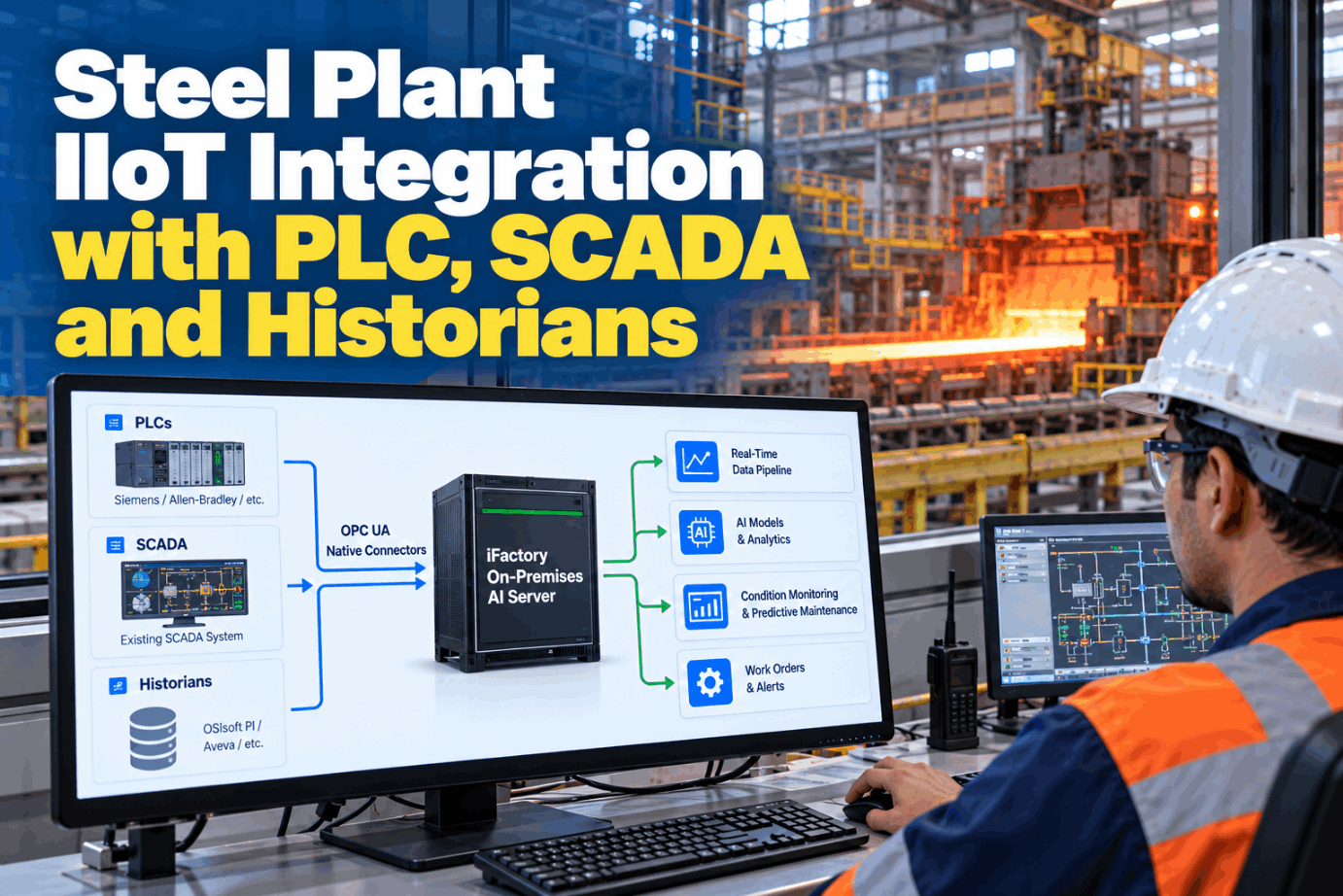
Read-only connectors for MES, PLC historian and CMMS
Starter semantic layer: rate, delays, OEE, open jobs
Headset, handheld and pulpit screen support
Question log with query and source kept
24×7 remote monitoring of models and hardware
Live in 6–12 weeks
Wk 1–4
Connect and Define
Read-only links made, top questions listed, metric definitions agreed with owners.
Wk 5–8
Test and Tune
Question bank run against known answers, vocabulary and defaults tuned per area.
Wk 9–12
Go-Live and Review
Managers start asking, charts routed to screens, weekly review of the question log.
VOICE DATA QUERIES STEEL MILLS FOR PLANT MANAGERS
Plant Data You Can Ask For Between Pulpits
Factory Copilot is built for managers who spend the shift on their feet and need one figure at a time, with proof of where it came from. See how it fits your morning meeting in a plant manager demo.
1
Asks across systems. One question reaches MES, PLC historian or CMMS without a second login.
2
Speaks the answer. The figure, unit, window and source are said aloud in seconds.
3
Shows the chart. Detail lands on the nearest screen in a form that matches the question.
4
Keeps the trail. Every answer is logged with the query behind it for later checks.
1000+
Industrial clients running iFactory
99.9%
Platform uptime for round-the-clock mills
6-12 wks
From racked server to first spoken answers
FREQUENTLY ASKED QUESTIONS
What Plant Managers Ask About Voice Data Queries
What can managers ask with voice data queries in a steel mill?
Mostly look-up questions with a clear answer in plant systems: production rate and tonnage from the MES, delay minutes by cause from the delay log, OEE from MES counts and historian signals, historian tag values and open work orders from the CMMS. Each question type is switched on once its metric definition is agreed and tested.
Is this text-to-query, and how is it kept accurate?
It is a governed form of text-to-query. The language model never writes free-form queries against raw data. It maps the words to a named metric, asset and time window, and the semantic layer produces the query from definitions your owners agreed. A question bank with known answers is run before go-live and after every definition change. You can watch the mapping step by step on sample mill data.
What happens if a question is unclear?
The copilot asks one short question back, such as "hot strip mill or plate mill?" or "since midnight or since 07:00?". If a default has been agreed for the asker's role and area, it uses the default and says it in the answer, so the person can correct it.
Can the copilot change anything in the MES, historian or CMMS?
No. Connectors use read-only accounts, and each person hears only what they could already see in the source system. If someone asks for data outside their rights, the copilot says it can't share that. Our integration team can review account and network setup with your IT and OT owners.
How are units and tonnage definitions handled?
Each site sets one tonnage unit, metric tonnes or net tons, and the copilot always says it. Rate definitions, such as per clock hour or per rolling hour, are fixed in the semantic layer with a named owner. That way the figure heard at the coiler matches the one in the monthly report. Book a 30-minute session to go through your own definitions.
How do we start with voice data queries?
Start with one mill and the four questions managers ask most. Agree the definitions, connect the sources read-only, test with real questions and then hand headsets to two or three shift managers. Widen the question list from what the log shows people actually ask. Plan that first mill with our team.
Put the Mill's Numbers One Question Away
Ask for tons, delays, OEE or open jobs in plain English and hear the answer with its window and source. Factory Copilot is delivered turnkey on an on-site AI server and goes live in 6 to 12 weeks.