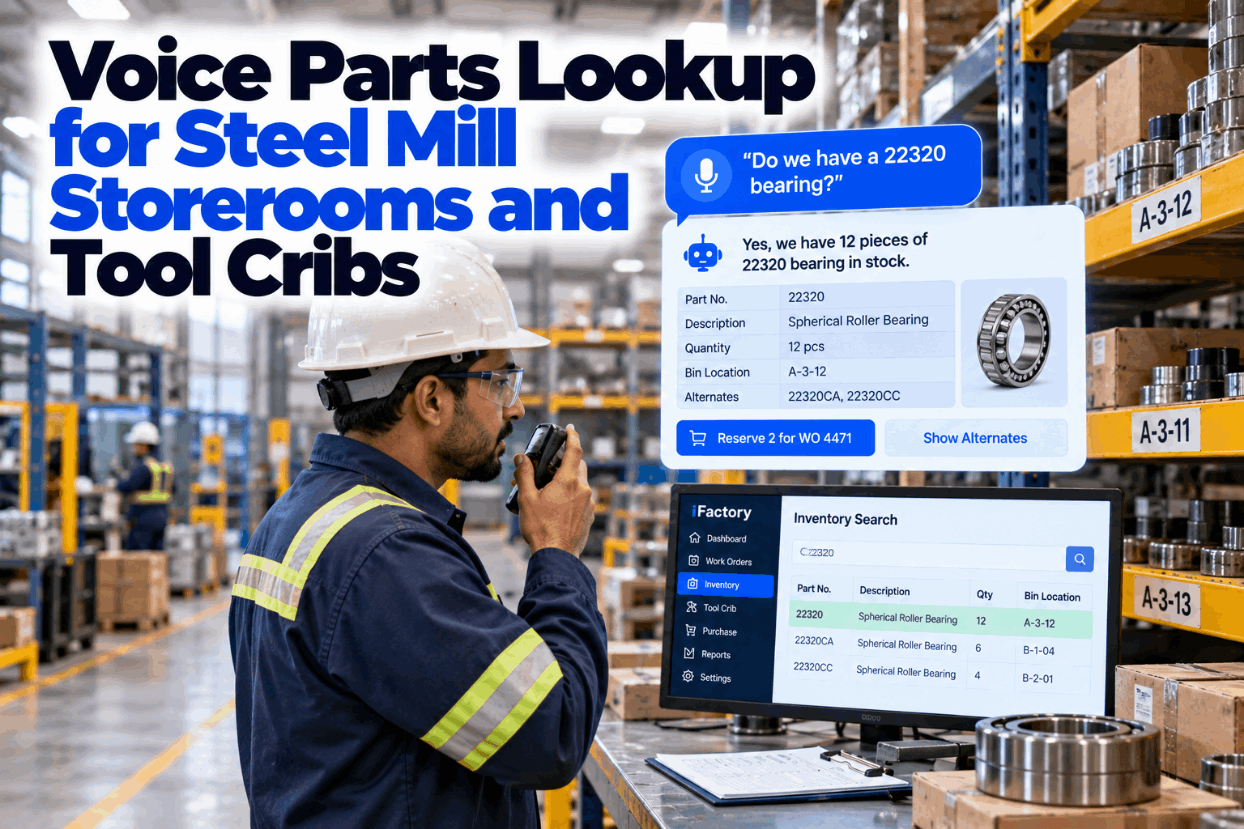
A fitter on a hot strip mill finds a noisy pinch roll bearing at 2 a.m. The next question is always the same: do we have one, where is it, and will anything else fit? Too often the answer means a long walk to the storeroom, a search through the bins and a walk back empty-handed. Voice parts lookup lets the technician ask from the job, hear the stock, bin and approved equivalents, and reserve the part in one sentence. Hear it on a real mill part number in a short voice inventory demo.
Ask for a Part From the Job, Hear the Bin, Reserve It by Voice
iFactory Voice Inventory Agent answers "Do we have a 22320 bearing?" with quantity, bin and approved equivalents. Say "reserve two for WO 4471" and it reads the request back, reserves the parts and notifies the storeroom.
Why a Storeroom Trip Costs More Than the Walk
Wrench time is the share of a shift spent actually working on equipment. Travel to get parts and tools, and obtaining parts, count as delays. In steel mills the stores can sit hundreds of metres from the job, and a trip that ends at an empty bin costs twice. The figures below come from published sources, not from iFactory customers. See how voice cuts wasted trips in a quick call with our team.
Reading a 22320 Before You Ask for One
A bearing number is a description, not just a code. In 22320, the 223 is the spherical roller bearing series and the 20 is the bore code: multiply by five for a 100 mm bore. The SKF 22320 E/C3 measures 100 × 215 × 73 mm. The suffixes after the base number decide whether two bearings that share it are really the same part, so the voice agent always reads them out. Check your own item master with our parts data specialists.
Same Bearing, Four Ways to Write It
Each maker writes the same features in its own way, which is why a storeroom search for "22320" can miss stock that is sitting on the shelf. Some features must match exactly. Others are often interchangeable, but only an engineer should say so. iFactory offers equivalents only from a cross-reference list your reliability engineer has approved, and it never offers a part whose bore or clearance differs. Build that list with our support engineers.
Suffix codes change between catalogue editions. Check every pair against the current maker data and record who approved it. The voice agent says "approved equivalent" only for pairs on that list.
The Right Bearing, Not Just the Right Number
iFactory checks the full designation, including bore and clearance, before it answers. When the exact part is out, it offers only the equivalents your engineers approved, then reserves what you choose against the work order.
A Bin Address the Agent Can Read Aloud
Voice only helps if the answer leads straight to the shelf. That needs one bin address format across main stores and every satellite store, written the same way on the label and in the system. Keep each part in a named position, and record overflow stock as a second bin rather than "somewhere in aisle B". Agree your own format in a storeroom setup session.
From Question to Staged Kit in Six Steps
A reservation only works if stock is held for the job and nobody else can issue it. iFactory reads every request back before it acts, so a misheard quantity or work order is caught at the source. The storeroom then picks and stages the parts, ready for collection or delivery. Talk through your issue process with our support team.
Calibrated Tools Need More Than a Sign-Out Sheet
A tool crib issues torque wrenches, gauges and meters that must be in calibration when used. ISO 9001 clause 7.1.5.2 asks that measuring equipment is calibrated at set intervals and its status identified, and that past results are reviewed if it is found out of tolerance. Torque wrench makers such as Norbar suggest a 12-month check, sooner with heavy use. Voice check-out records who has which tool, and on which job. Set up crib rules with our tool crib specialists.
- Name written, job often left blank
- Calibration due date checked by eye, if at all
- Overdue tools found when someone needs them
- No link between a tool and the work it was used on
- "Check out torque wrench TW-07 for WO 4471," read back and confirmed
- Tools past their due date are blocked from issue
- Overdue returns flagged to the crib at shift end
- If a tool fails calibration, every job it touched is listed
Three Things That Make Voice Work Near a Mill Stand
Where noise reaches the 85 dBA action level in OSHA 29 CFR 1910.95, hearing protection is part of the job, so voice has to work alongside it. Open-air speech recognition struggles in that noise. Mills get better results from push-to-talk, noise-cancelling headsets and a read-back on every request that changes stock. Choose headsets that fit your hearing protection with our hardware team.
What Every Voice Reservation Should Record
A spoken request still needs a full record behind it. These eight fields give the storeroom what it needs to pick, and give planners an audit trail for every part that leaves a bin. Ask our implementation team for a blank version.
Best Practices Checklist Before and After Go-Live
Voice cannot fix a messy item master. Most of the work happens before the first spoken query: clean descriptions, real bin addresses and a signed equivalents list. Tick the items below as you go. For a version loaded with your own stores and asset list, contact our support team.
Size the Time Saved With Your Own Numbers
The clearest value is technician time no longer spent on wasted trips: the part was not there, was in another store or was the wrong suffix. Every input below is assumed, to show the arithmetic only. Replace them with figures from your own work sampling. Our team can help you build the case.
Recovered hours become more wrench time, not fewer people. Add the value of shorter breakdowns where the part was found sooner, but only with your own downtime data.
Voice Agent, Headsets and AI Server in One Package
iFactory delivers the Voice Inventory Agent turnkey. A pre-configured NVIDIA AI server ships racked and ready, with speech models running on site so queries work fast and stores data stays in your plant. You rack it, plug in power and Ethernet, and the AI is live. To scope it for your stores, request a turnkey quote.
- Pre-configured NVIDIA AI server, racked and ready
- On-site speech models tuned to mill part names
- Link to your CMMS or ERP stock and work orders
- Equivalents list loaded with engineer approvals
- Push-to-talk headsets matched to hearing protection
- Tool crib check-out with calibration blocking
- 24×7 remote monitoring of models and hardware
Item master reviewed, bin addresses agreed, server installed and linked to stock.
One storeroom and one crew use voice queries, and gaps in the data are fixed.
Voice reservations and crib check-out switched on, then rolled out to all stores.
Voice Parts Lookup Built for Steel Mill Stores
iFactory is designed for long walks, loud bays and part numbers with suffixes that matter. Plan a single-store pilot in a short planning call.
Voice Parts Lookup Steel Mill Questions for Plant Managers
Fewer Wasted Trips, Every Part Accounted For
Give technicians stock, bin and equivalents by voice, reserve parts with a read-back and run the tool crib from the same system. Delivered turnkey and live in 6 to 12 weeks.