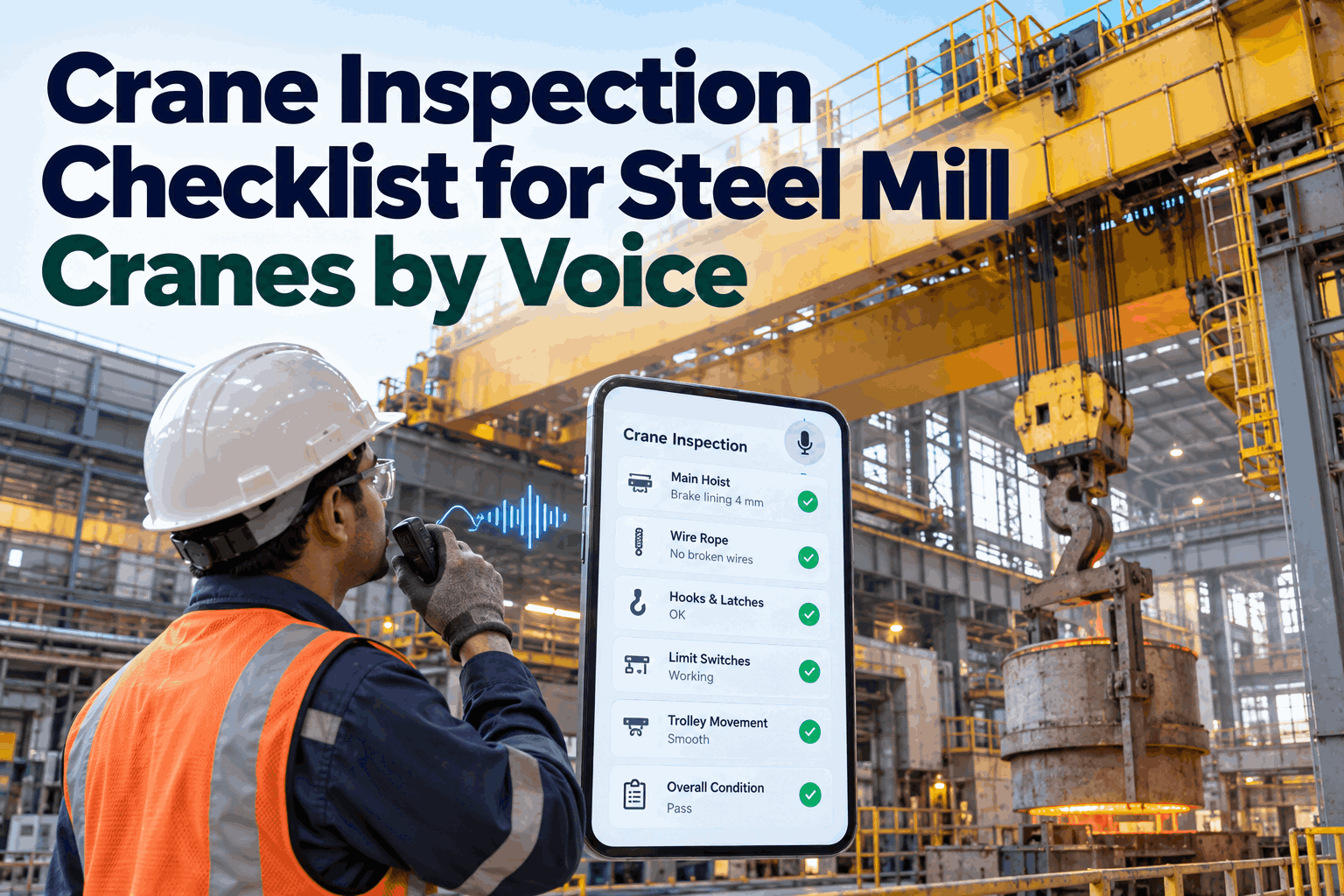
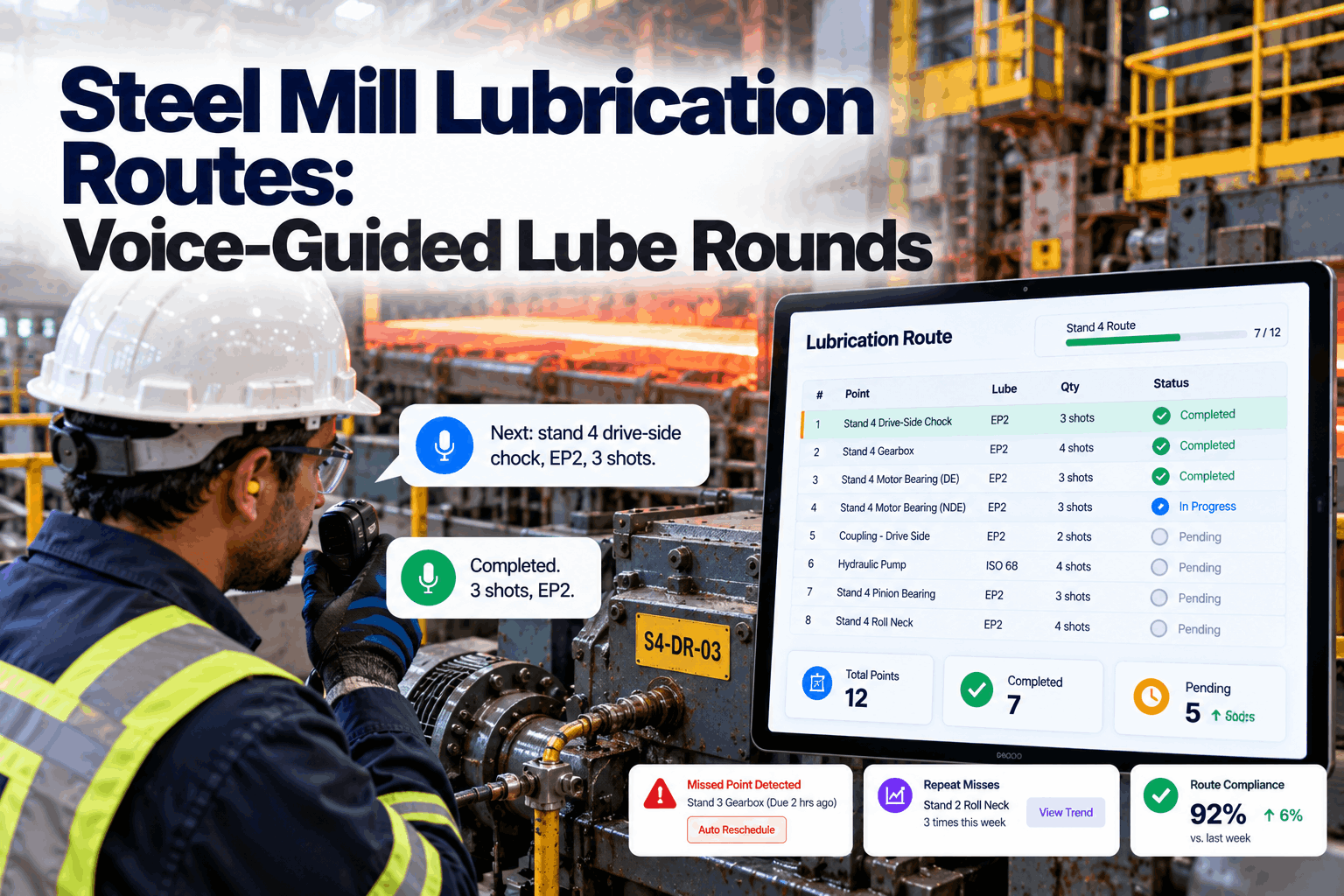
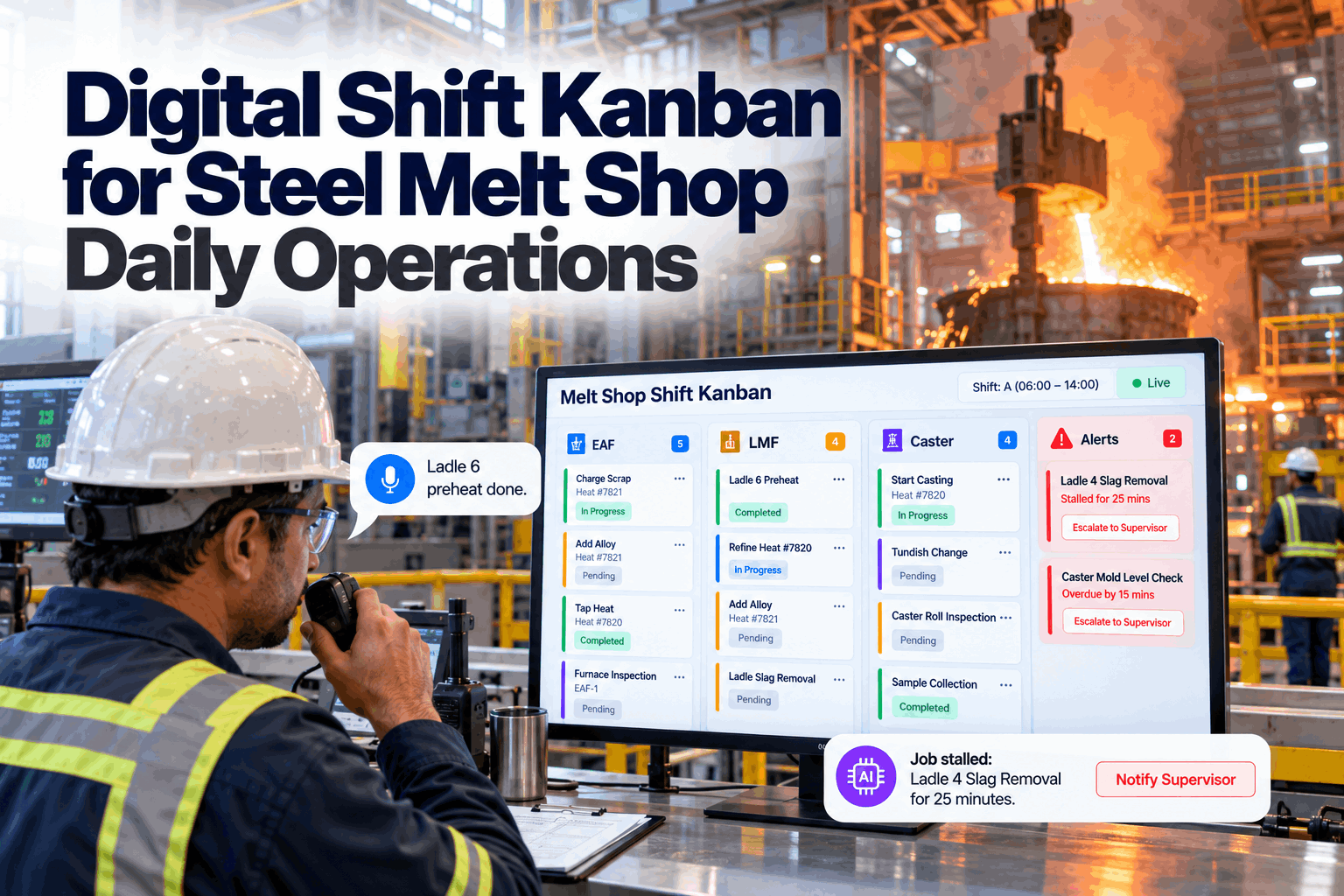
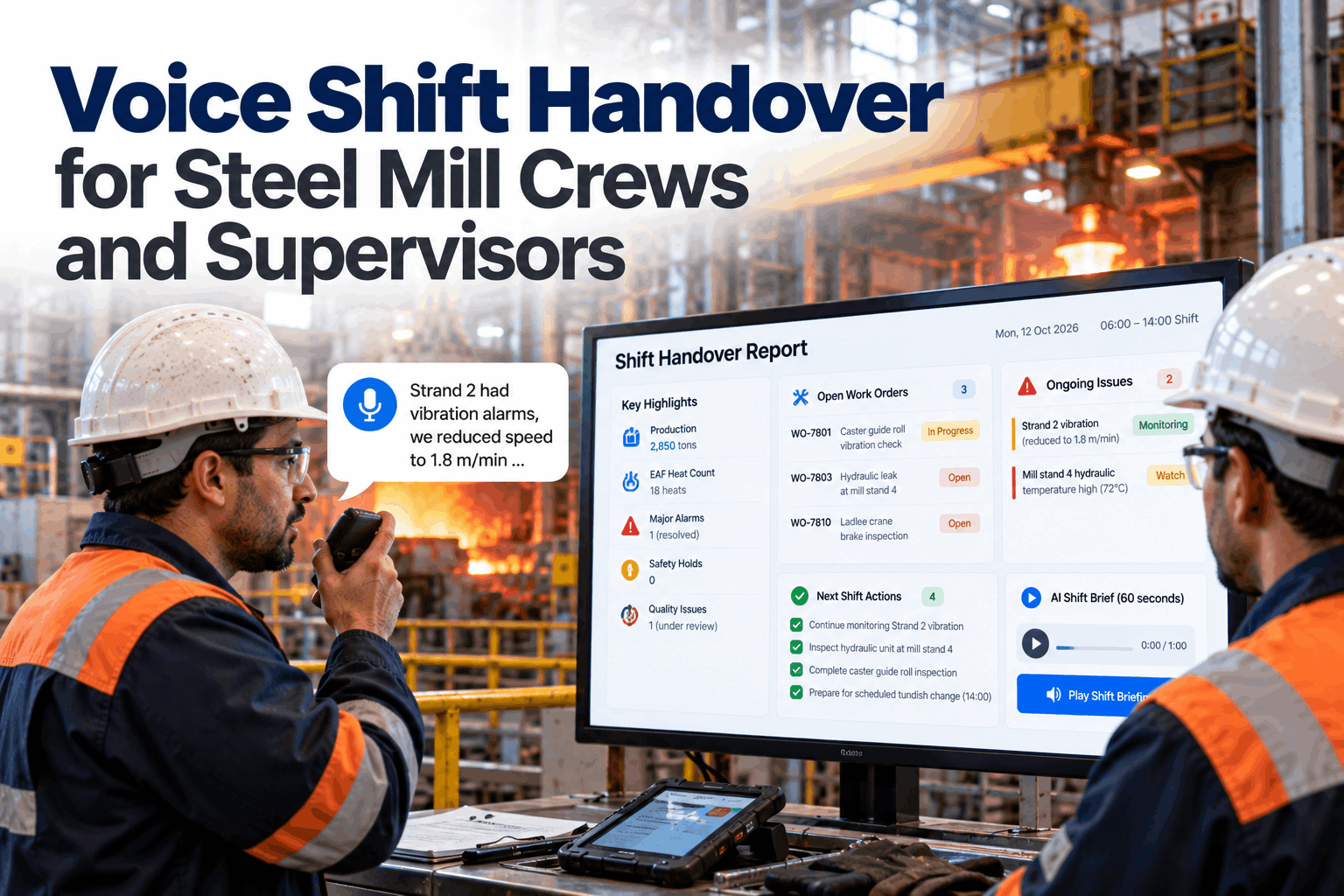
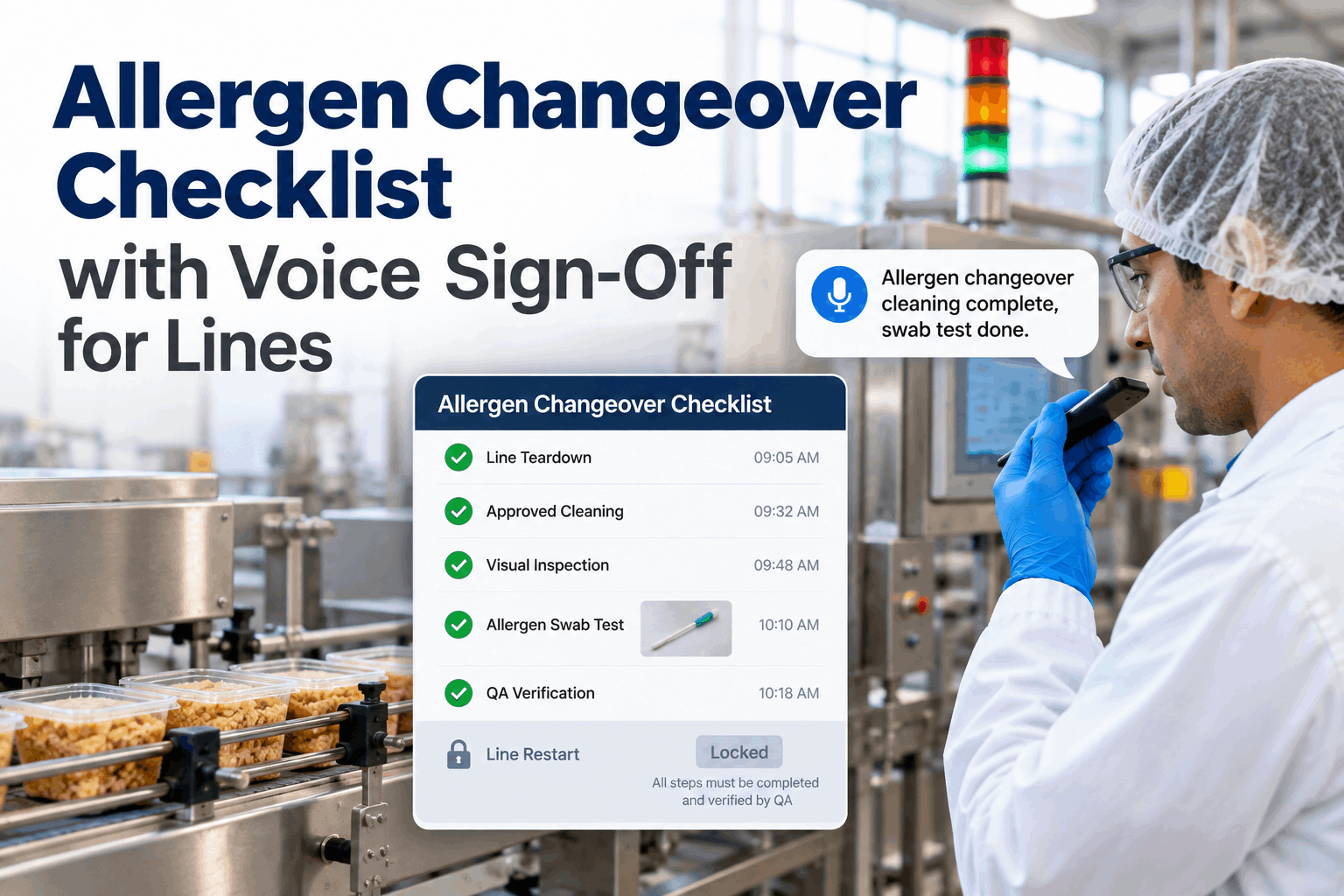
Steel mill cranes work above molten metal, in heat, dust and around the clock. A worn brake lining or a damaged rope on a ladle crane is not a routine defect. Yet many crane checks are still written on paper and typed into the CMMS hours later. This checklist covers what to inspect and how often, and shows how voice capture turns each finding into a record or repair job right away. To see voice rounds on a real crane, book a short voice inspection demo.
VOICE AGENT · CRANE INSPECTIONS
Speak the Finding, and the Crane Checklist Fills Itself
With iFactory Voice Inspection Rounds, the inspector says what they see. AI fills the OSHA 1910.179 checklist fields, flags anything that fails and raises the repair work order in the CMMS before the inspector leaves the crane.
Voice round · Melt shopLive
Inspector said"Bay 2 ladle crane, main hoist brake lining 4 mm, pass."
CraneBay 2 ladle crane
ItemMain hoist brake lining
Reading4 mm
ResultPass, above OEM limit
STEEL MILL CRANE TYPES
Not Every Crane Carries the Same Risk
A steel mill runs several types of overhead crane, and each one wears differently. The same checklist structure works for all of them, but the focus and the frequency should follow the duty. In the US, OSHA 29 CFR 1910.179 sets the inspection rules for overhead and gantry cranes, and ASME B30.2 is the consensus standard most mills also follow. For cranes that move molten metal, OSHA requires at least two holding brakes on each independent hoisting unit with power control braking. Our support team can help you sort your crane fleet by risk.
Highest risk
Ladle cranesCarry molten steel. Radiant heat, dual load paths and two holding brakes per hoist. Brakes, ropes and hooks need the closest watch.Heavy shock loads
Charging and scrap cranesLift scrap buckets and magnets. Impact loading strains structure, wheels and hoist gearing.High cycle count
Bay and finishing cranesHandle slabs, coils and rolls all shift long. Wear builds fast on ropes, wheels and contactors.Maintenance duty
Workshop and roll shop cranesLower duty, but often idle for weeks. Idle periods trigger extra checks before use.
HOW OFTEN
Inspection Frequency Under OSHA 1910.179
OSHA splits crane inspections into two groups. Frequent inspections run daily to monthly, and periodic inspections run every 1 to 12 months, depending on how hard the crane works. Hooks, hoist chains and ropes also need a monthly inspection with a signed certification record. In a steel mill, most cranes sit at the short end of every range. Set your own intervals with a crane schedule review.
Every shift or day
Frequent checksOperating mechanisms, limit switches, air and hydraulic leaks, visual hook and chain checkMonthly
Certified checksHooks, hoist chains and all ropes, with date, signature and component ID on record1 to 12 months
Periodic inspectionStructure, bolts, sheaves, drums, brake parts, gearing, electrical apparatusAfter idle time
Return to serviceIdle 1 to 6 months: frequent and rope checks. Over 6 months: full inspection. Standby cranes: at least every 6 months
THE CHECKLIST
Steel Mill Crane Inspection Checklist
Use this checklist as a starting point and adjust it to your OEM manuals and your mill's procedures. Each box can be ticked here, or spoken item by item on a voice round. Limits such as brake lining thickness and wheel wear come from the crane maker, so record the reading, not just pass or fail. For a version loaded with your own crane IDs and limits, contact our support team.
OUT OF SERVICE
When the Crane Stops, Whatever the Schedule Says
Some findings don't wait for the next planned job. These conditions mean the crane, or at least that hoist, comes out of service until it is repaired and checked by a qualified person. The hook limits come from OSHA 1910.179 and the rope limits from ASME B30.2. Your mill's own rules may be stricter, and on ladle cranes they usually are. Make sure the stop rules are built into your rounds with a checklist setup call.
Remove from serviceAny one of these is enough
×Hook cracked, opened more than 15% or twisted more than 10°
×Rope broken wires at or above the limit, or any heat damage
×Kinked, crushed or birdcaged rope, or core showing
×A holding brake that slips, or one of two hot metal brakes not working
×Upper limit switch that fails to trip
×Cracked girder, end truck or ladle hook
Hands on the Crane, Not on a Clipboard
Inspectors in a melt shop wear gloves, face shields and hearing protection. Voice rounds let them keep working while each reading is captured, checked against its limit and logged. A fail opens a repair order on the spot.
Bay 2 ladle crane · Inspector and iFactory
InspectorMain hoist rope, three broken wires in one lay near the drum, no heat marks.
iFactoryLogged on the monthly rope record. That is below the removal limit, but up from one last month. Should I raise a watch task and shorten the next check to two weeks?
InspectorYes. Next item.
iFactoryDone. Next: auxiliary hoist holding brake, both units.
HOW VOICE ROUNDS WORK
From Spoken Words to Checklist Fields and Work Orders
The inspector talks the way they would to a colleague. The voice agent picks out the crane, the component, the reading and the result, matches them to the right checklist item and compares the reading with its limit. If something fails, it asks for confirmation and raises a work order with the crane ID, the finding and the inspector's name already filled in. Ask our support team how it handles mill noise and local terms.
1SpeakSay the crane, part, reading and result
2ParseAI matches the words to the checklist item
3CheckReading compared with OEM and mill limits
4FlagFails confirmed and highlighted at once
5ActRepair WO raised in the CMMS with evidence
RECORDS
The Records an Auditor Will Ask For
Doing the inspection is only half the job. You also need to prove it was done. OSHA requires signed monthly certification records for hooks, hoist chains and ropes, and test reports for rated load tests, which must not exceed 125% of rated load unless the maker says otherwise. Voice rounds produce these records as a by-product of the inspection itself, with time stamps and the inspector's name. See a sample record set in a records walkthrough.
Monthly hook recordDate, inspector signature, hook ID, throat and twist readings
Monthly rope recordDate, signature, rope ID, broken wire count, diameter, notes
Periodic inspection reportEvery item checked, readings, findings and follow-up WOs
Load test reportTest load, result and who witnessed it, kept where staff can reach it
Repair close-outWhat was fixed, parts used and the check before return to service
Trend historyReadings over time for brakes, ropes and wheels, per crane
COST AND ROI
A Simple Way to Size the Benefit
The value of voice inspection comes from three places: less time writing up checks, faster repair orders, and better records when an auditor or an incident review asks for them. You can size the first one with your own numbers. The example below uses assumed inputs to show the arithmetic, so replace each one with figures from your mill. Our team can help you build the full case.
Cranes on daily checks24
Checks per crane per day3, one per shift
Checks per day24 × 3 = 72
Write-up time saved per check4 minutes, assumed
Inspector time freed per day72 × 4 = 288 min, about 4.8 hours
Harder to count, often larger
A failed brake or rope finding that reaches the planner in minutes instead of the next morning can mean the repair happens in a planned stop rather than after a breakdown. Track the time from finding to work order before and after the change.
IMPLEMENTATION GUIDE
Five Steps to Voice Crane Rounds
Most mills start with the cranes that matter most, usually ladle and charging cranes, and expand once the crews trust the system. The steps below follow that path. Plan your first crane group in a rollout call.
1
List cranes and componentsCrane IDs, hoists, hooks, ropes and brakes, each with an asset tag in the CMMS.
2
Load limitsOEM limits for linings, wheels and ropes, plus your mill's stricter rules.
3
Build checklistsDaily, monthly and periodic lists per crane type, with stop rules flagged.
4
Train on local wordsTeach the voice agent your crane names, bay numbers and shop terms.
5
Run in parallel, then switchUse voice and paper side by side for a few weeks, compare, then retire paper.
TURNKEY AI DEPLOYMENT
Voice Agent, Checklists and AI Server in One Package
iFactory delivers Voice Inspection Rounds as a turnkey bundle. A pre-configured NVIDIA AI server ships racked and ready with the voice agent, crane checklists and CMMS connector pre-loaded, so speech is processed on site even in areas with weak network coverage. You rack it, plug in power and Ethernet, and the AI is live. To scope it for your mill, request a turnkey quote.
What's Included
- Pre-configured NVIDIA AI edge server, racked and ready
- Voice agent tuned for mill noise and crane terms
- OSHA 1910.179 based checklists per crane type
- CMMS connector for findings and repair work orders
- Rugged headsets or handheld setup for inspectors
- Inspector, planner and supervisor training
- 24×7 remote monitoring of software and hardware
Live in 6–12 weeks
Wk 1–4
Install and Load
Server installed, crane list, components and limits loaded, CMMS connected.
Wk 5–8
Pilot Rounds
Voice rounds on ladle and charging cranes, run alongside paper to compare.
Wk 9–12
Go-Live and Training
All crane groups switched over, crews trained, paper checklists retired.
HOW iFACTORY FITS
Crane Inspections Built for the Melt Shop
iFactory Voice Inspection Rounds are designed for inspectors who work in heat, noise and full protective gear. Our support team can walk you through a pilot plan.
1
Hands-free capture. Inspectors speak each finding and keep working with both hands.
2
Checks every reading. Values are compared with OEM and mill limits as they are spoken.
3
Fails become work orders. Repair jobs are raised in the CMMS with the crane, part and finding attached.
4
Audit-ready records. Monthly certification records and inspection reports are produced automatically.
1000+
Industrial clients running iFactory
99.9%
Platform uptime for round-the-clock mills
6-12 wks
From racked server to live voice rounds
FREQUENTLY ASKED QUESTIONS
What Plant Managers Ask About Steel Mill Crane Inspections
How often should steel mill cranes be inspected?
Under OSHA 1910.179, frequent inspections run daily to monthly and periodic inspections every 1 to 12 months, based on how hard the crane works. Hooks, hoist chains and ropes need a monthly inspection with a signed record. Most steel mill cranes, and ladle cranes in particular, work at the severe end, so mills usually inspect them at the shortest intervals in each range.
What is different about inspecting a ladle crane?
Ladle cranes carry molten metal, so a failure has far worse consequences. OSHA requires at least two holding brakes on each independent hoisting unit with power control braking, and both must be checked. Heat also damages ropes, lubricant, cables and structure, so heat shields, rope condition and hooks deserve extra attention and shorter intervals.
When must a crane hook be taken out of service?
OSHA says hooks with cracks, a throat opening more than 15% above normal, or more than 10° of twist from the plane of the unbent hook must be discarded. Welding or reshaping a damaged hook is generally not recommended. Many mills set their own action point earlier, so a hook is replaced before it reaches the limit.
Does voice inspection work in a noisy melt shop?
Yes, with the right setup. iFactory uses noise-cancelling headsets and a voice model tuned to crane terms, bay numbers and plant names. If the agent is unsure of a word or a reading, it repeats it back and asks for confirmation, so nothing is saved on a guess.
Can the voice records satisfy OSHA documentation?
Each record carries the date, time, inspector identity, component ID and readings, which covers what OSHA asks for in its monthly certification records. Your safety and legal teams should still confirm the format meets your own procedures and any state plan rules. Our
support team can share a sample record set.
What does it cost to get started?
Cost depends on the number of cranes, inspectors and integrations. A typical first step is a pilot on ladle and charging cranes, delivered as a turnkey package with the AI server, voice agent and CMMS connector. A short scoping call is enough to produce a quote for your mill.
Every Finding Logged, Every Fail Acted On
Load your cranes and limits, hand inspectors a headset and let each spoken finding become a record or a repair order. The full system is delivered turnkey and goes live in 6 to 12 weeks.
Example round summary · Melt shop
Cranes inspectedLadle, charging and bay cranes
Readings capturedBy voice, with limits checked
Fails foundRepair WOs raised on the spot
Monthly recordsSigned and filed automatically
Every check traceable to an inspector