It is 5:15 a.m. and the line is due to start at 6:00. The sanitarian walks the room with a clipboard, a torch and a pen that keeps failing in the cold. Every finding has to be written, every re-clean chased by radio and every pass initialled before QA can sign. When the clock runs short, the walk gets faster and the checks get thinner. This guide shows how to run food plant pre-op inspection by voice, zone by zone, so startup is faster and the record is complete. Start with a pre-op review.
Food Plant Pre-Op Inspection by Voice: Faster Startup Checks
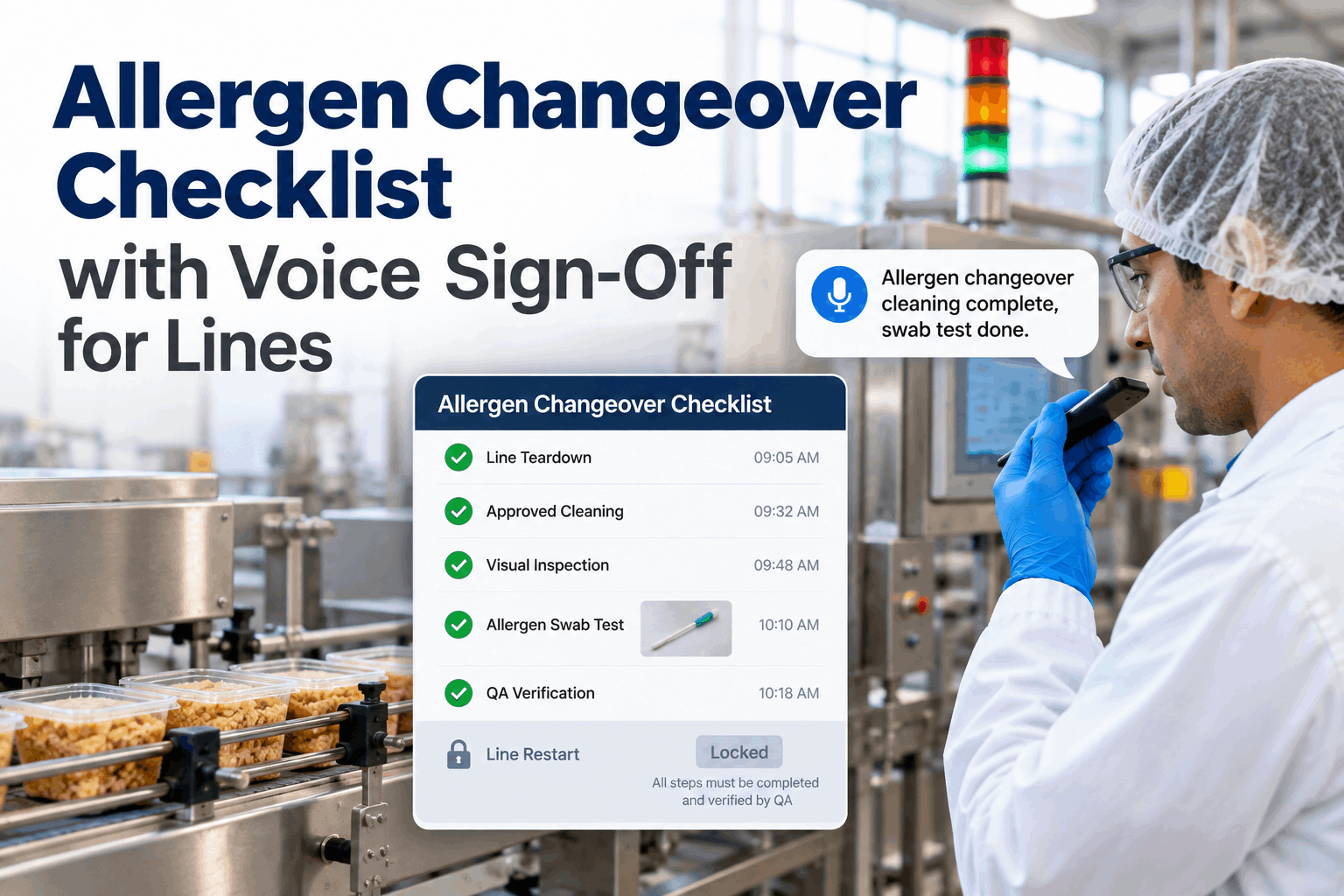
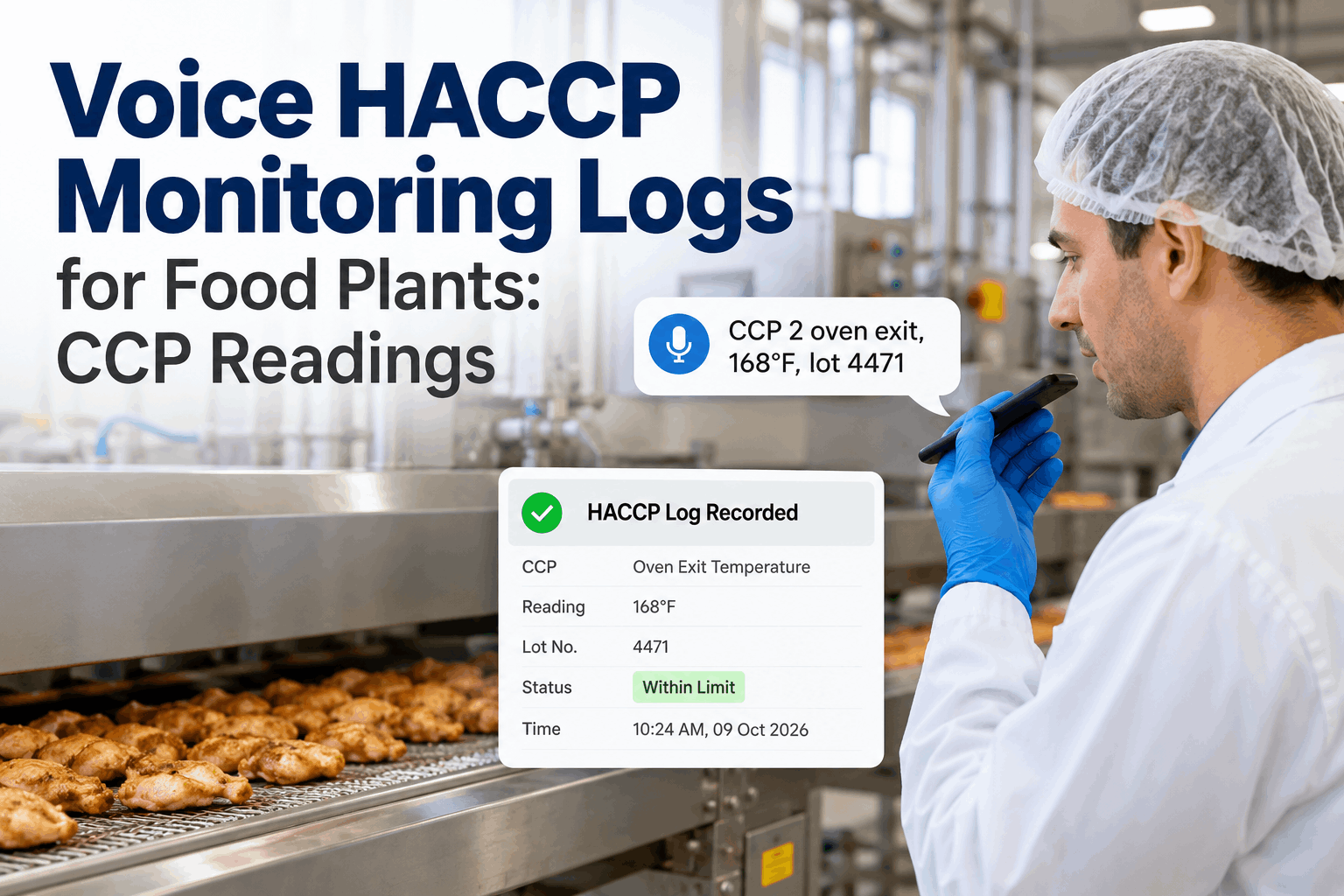
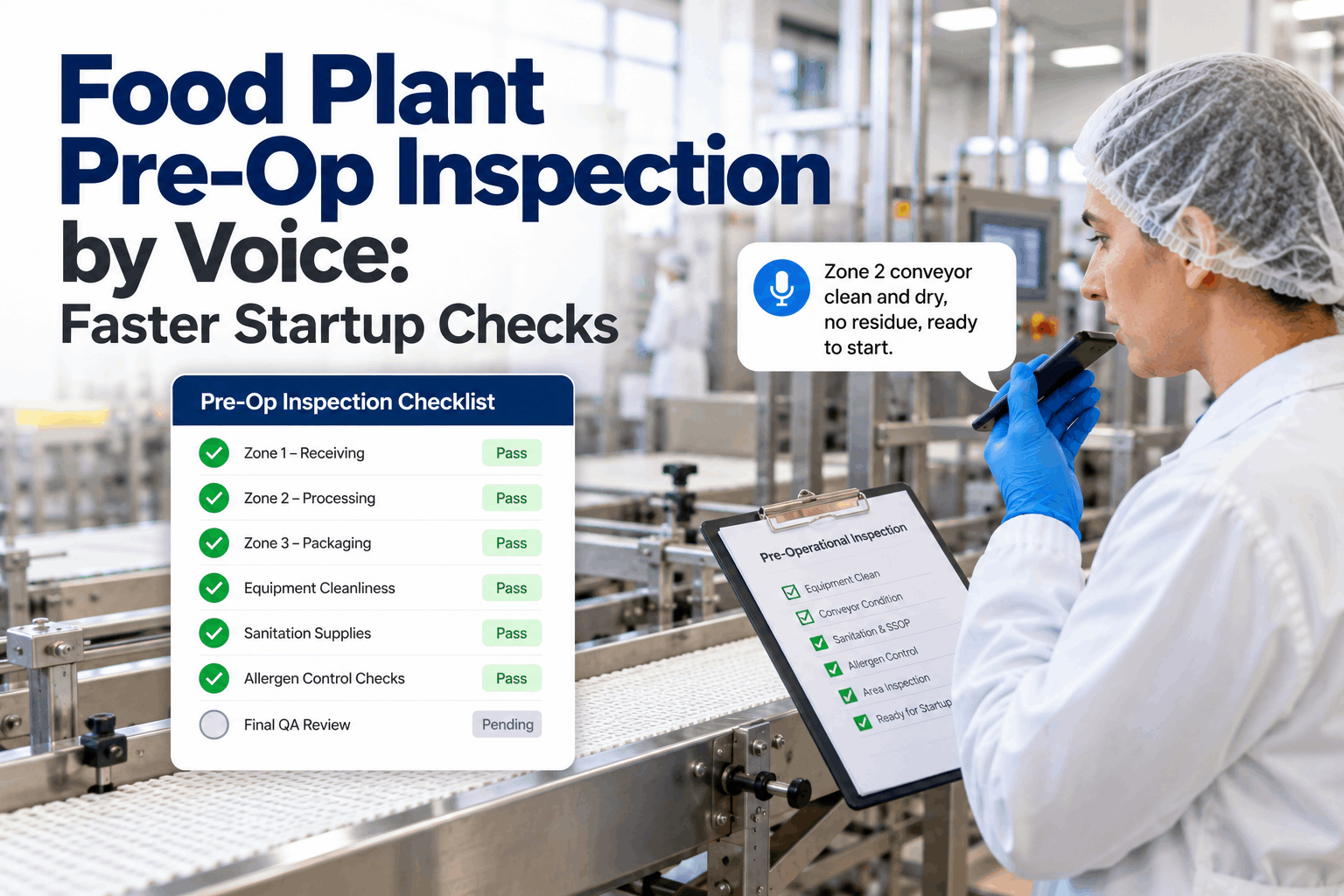
The voice agent reads each zone's checklist aloud. Sanitarians and QA speak each finding, snap a photo and move straight on to the next point. Failed points become re-clean tasks, and the line is released only when every point passes, with a timestamp for audits.
- What pre-op must cover under SSOP rules
- A zone-by-zone pre-op checklist
- How voice speeds the walk and locks the release
"Zone C, tray former guide rail, product residue on underside. Photo taken."
Why Pre-Op Runs Late and Thin
The inspection is quick. Writing it down and chasing re-cleans is not.
Pre-op is the last line of defence before product touches equipment each day. Yet it happens in the hardest conditions: early morning, cold and wet rooms, a fixed start time and gloves that make writing slow. Findings get written in shorthand, photos are not taken and re-cleans are passed on by shouting or radio, so some are never closed. When QA signs at the end, the record often shows a pass with little detail behind it. Our sanitation team can show where your pre-op loses time.
When the line is due to start, inspectors are tempted to sign zones they have not fully checked. A process that is faster to do properly than to rush removes that temptation. Voice removes the slowest part, which is writing.
What Pre-Op Must Cover
The rules are short. The record has to prove them.
For USDA-inspected plants, the Sanitation SOP rules in 9 CFR 416 require pre-operational procedures that, at minimum, cover the cleaning of food-contact surfaces of facilities, equipment and utensils. They must be done before operations start, and daily records must be initialled and dated by the responsible employee. FDA-regulated plants follow similar sanitation control expectations. Check your SSOP against these points in an SSOP review.
Written procedures
Pre-op procedures identified in the SSOP and covering food-contact surfaces at a minimum.
Before operations
Pre-op procedures carried out before the start of production, and monitored daily.
Corrective action
Action taken when procedures fail, including restoring sanitary conditions and preventing recurrence.
Daily records
Records initialled and dated, kept at least six months and available to inspectors.
9 CFR 416.16 requires SSOP records to stay at the plant for 48 hours after completion. After that, they may be stored elsewhere if they can be produced within 24 hours of an inspector's request. Digital records make both easy, because they never leave the plant network and can be searched in seconds.
Pre-Op Versus Operational Sanitation
Pre-op proves the start is clean. Operational checks keep it that way.
SSOP rules separate checks done before production from checks done during it. Both matter, but they answer different questions, happen at different times and often belong to different people. Keeping them clearly apart in the record helps inspectors see that the day started clean and stayed under control. Questions about your SSOP structure go to our QA team.
Before the first product
- Equipment and room cleaned and sanitised
- Food-contact surfaces inspected point by point
- Failures re-cleaned before release
- Release signed before production starts
During production
- Hygiene practices of workers watched
- Mid-shift cleaning and product changes checked
- Condensation and drips controlled
- Findings recorded with corrective actions
Who Does What on the Morning Walk
Clear roles stop the release from becoming a guess.
Pre-op works best when everyone knows their part. The sanitation crew cleans, the sanitarian inspects, QA confirms and releases, and the line lead waits for the release before starting. Voice pre-op makes each handoff explicit and timed, so nobody starts the line on a verbal "it's done". Set up roles in a roles workshop.
A Zone-by-Zone Pre-Op Checklist
Inspect by zone, from product contact outward.
Splitting the room into zones keeps the walk orderly, makes the record easy to read and makes sure nothing is skipped. Start with food-contact surfaces, then move outward to nearby equipment, the wider room and finally drains, walls and overheads. Tick items as you read, and adapt the list to your own equipment. Questions on zoning go to our support desk.
Food-contact surfaces
Near-contact equipment
Room and environment
Drains, overheads and release
A fixed route, from food-contact surfaces outward, makes the walk faster and stops points being skipped. The voice agent keeps the order, so a new or covering sanitarian follows the same path as the regular one.
This checklist is a general template. Your SSOP, equipment and product risks set the exact points for each zone.
What a Faster Pre-Op Gives Back
Minutes saved on pre-op mean the line starts on time without cutting corners or skipping zones. Across a year of production days, the time and the stronger records both add up.
How Voice Pre-Op Works
The agent leads the walk. The inspector keeps eyes and hands on the work.
The inspector wears a headset and carries a phone or rugged handheld for photos, leaving both hands mostly free. The voice agent reads each point in order, using the names your team already uses. The inspector says "pass" or describes the finding, takes a photo if needed and moves on. Failed points go straight to the sanitation crew as re-clean tasks, and the agent brings the inspector back to them once the crew reports done. Plan your rollout in a walkthrough session.
Agent reads
"Zone C, tray former guide rail."
Inspector speaks
"Fail, residue on underside."
Photo captured
Image linked to the point and time.
Re-clean task
Sent to the crew with the photo.
Re-inspect and release
Point passed, QA signs, line released.
The release step stays locked while any point is failed or waiting for re-inspection. That one rule stops the most common pre-op failure: a line started because "the crew said it was done". The release time is then recorded to the minute for auditors.
Pre-Op Mistakes to Avoid
Most pre-op problems are habits, not missing knowledge.
Sanitarians know what clean looks like, and most crews clean well. Problems come from rushing, vague checklists and records that do not show what was found. A short rollout plan session helps fix the habits.
What works
- Zone-based walk starting with food-contact surfaces
- Photos on every failed point
- Re-cleans tracked as tasks, not radio calls
- Release locked until every point passes
What fails
- One generic checklist for every room
- "All OK" written for a whole zone
- Re-inspection done from memory
- Signing release before the walk is complete
Every failed point is a lesson. When the same spot fails week after week, the cleaning procedure, the tools or the equipment design needs to change. Voice records make these repeat points easy to see, sorted by room, zone and shift.
How iFactory Runs Voice Pre-Op
Voice Pre-Op Agent, on your own network.
iFactory runs speech recognition and checklist rules on an on-prem AI server inside your plant, so voice, photos and records stay on your network. The Voice Pre-Op Agent reads each zone, records findings with photos, sends re-clean tasks and keeps the release locked until every point passes. Fit questions go to our solutions team.
Guided voice walk
Each zone and point read aloud in a fixed order, so nothing gets skipped.
Photo capture
Photos linked to each finding with the time and inspector name.
Re-clean tasks
Failed points sent to the crew and tracked through to re-inspection.
Locked release
Line release stays locked until every single point passes.
Timestamped records
Every finding, re-clean and release kept with initials, date and time.
Repeat-point trends
Points that fail often shown by room, zone, shift and week.
Results depend on your rooms, SSOP and how consistently the voice walk is used. We measure pre-op time, findings and re-clean rates on your own data during the pilot, rather than promising a general figure.
Turnkey AI: Delivered, Connected and Live in 6–12 Weeks
You do not build this. It arrives ready.
iFactory ships as a pre-configured NVIDIA AI server with the software pre-loaded, racked and ready. Rack it, plug in power and Ethernet, and the AI is live on your network. Our team handles cabling, network setup, PLC, SCADA and MES integration, headset setup, sanitation and QA training and 24×7 remote monitoring. Data stays on your network. For a scope matched to your plant, request a turnkey quote.
Ship, network and data
Server installed. Rooms, zones and SSOP checklists loaded.
Model training and pilot
Voice model tuned to your rooms and terms. Pilot in one room.
Go-live and training
Voice pre-op live across rooms. Teams trained. 24×7 monitoring begins.
Frequently Asked Questions
What is a pre-op inspection in a food plant?
It is the check, done before production starts, that equipment and the room are clean and ready. It confirms food-contact surfaces are clean and sanitary, and records any findings and corrective actions. The day's production should not start until it is complete.
What does USDA require for pre-op?
9 CFR 416 requires written pre-operational SSOP procedures covering at least food-contact surfaces, carried out before operations start, with daily records initialled and dated and kept at least six months.
How does voice make pre-op faster?
The agent reads each point, so inspectors do not look up the list. Findings are spoken instead of written, photos are captured on the spot and re-cleans are sent as tasks, not chased by radio. The inspector keeps walking while the crew re-cleans.
What happens when a point fails?
The finding and photo are recorded, a re-clean task goes to the sanitation crew and the release stays locked. Once the crew reports done, the inspector re-checks the point and the result is recorded. The original failure stays in the record as evidence of corrective action.
Are voice pre-op records accepted by inspectors?
Digital records are accepted when they contain the required details and are protected from unauthorised changes. Voice records capture who, what, when and a photo, which is more detail than most paper logs.
Does it work in cold and wet rooms?
Yes, with headsets and handhelds rated for washdown and cold, and a voice model tuned to your room names, equipment and terms. Read-back confirmation catches anything misheard over fans and compressors.
Can pre-op be done room by room as cleaning finishes?
Yes. Each room or zone can be inspected and released on its own, so rooms that finish cleaning early can start while others are still being checked. The release is recorded per room, with its own time and signature.
Should we swab during pre-op?
Many plants add ATP or microbial swabs to pre-op on chosen surfaces. Results can be attached to the same voice record, and a failed swab can lock the release just like a failed visual check.
How do we start?
Start with one room where pre-op most often runs late or where inspectors raise the most findings. A 6-week pilot loads your zones and checklist, tunes the voice model and runs voice pre-op beside your current process. To plan it, contact our team.
Start Every Line Clean and On Time
In thirty minutes we look at your SSOP, your pre-op records and where the morning walk loses time. You keep the notes whether or not you go further with iFactory.
- 1Your Sanitation SOP and pre-op checklist
- 2A week of pre-op records
- 3A room layout with equipment
- 4Recent inspector findings on sanitation
- 5The room where pre-op runs late most