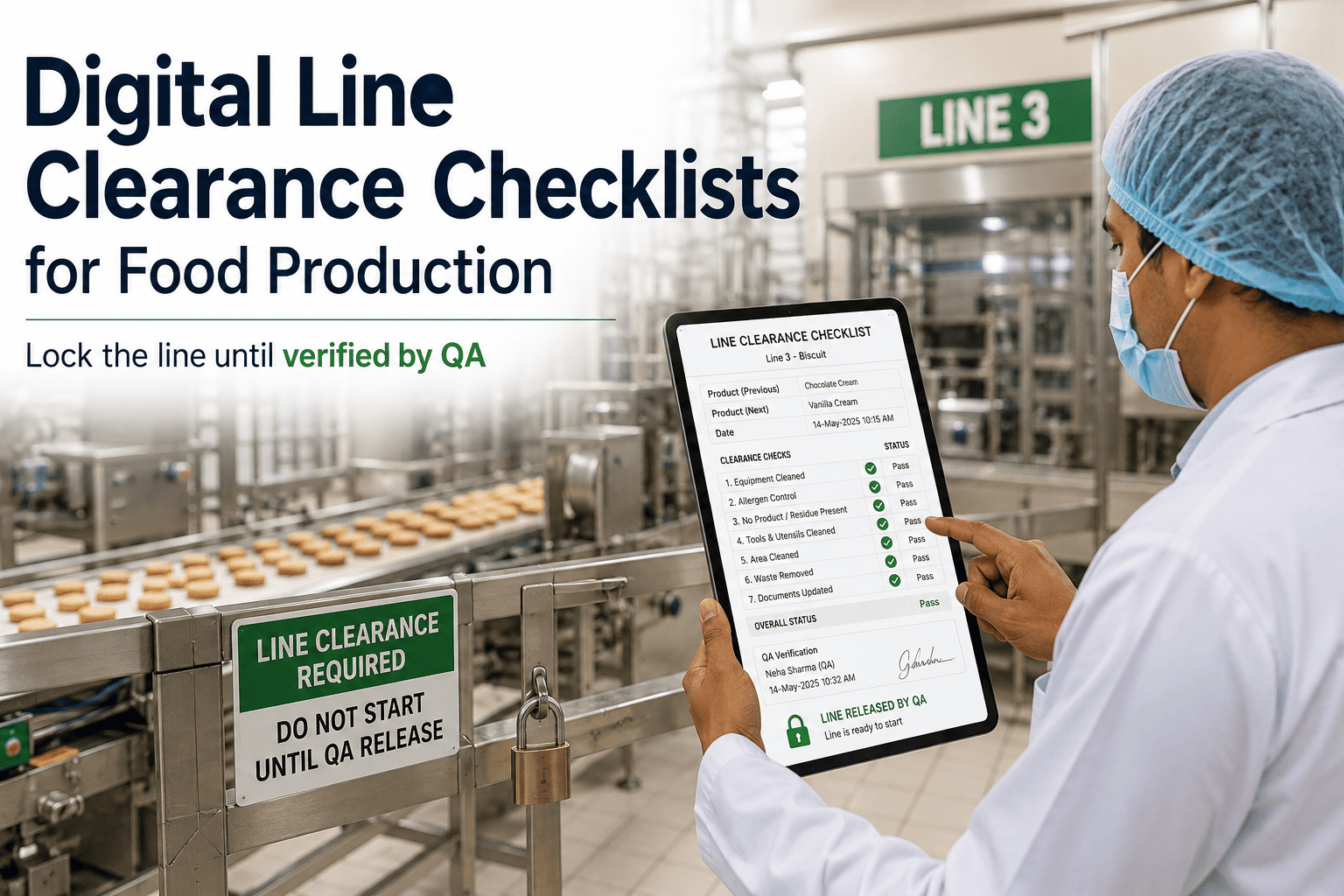
A production line finishes a peanut butter granola run at 11:40 PM. The next product is a nut-free cereal bar. The operator wipes down the hopper, swaps the packaging film, and starts the new run at 11:55 PM. The line clearance form — a paper sheet on a clipboard — gets filled in at 12:20 AM, from memory, after the first pallet is already wrapped. Nobody swabbed the mixer blade. Nobody verified the label matched the new SKU. And nobody signed the form before the nut-free product was already moving down the line. That fifteen-minute gap between "line cleared" and "form completed" is how undeclared allergen recalls start — and undeclared allergens accounted for 34% of all food recalls in 2024, costing the industry $1.92 billion. An iFactory digital line clearance system makes that gap impossible: the line does not release until every check is completed, every swab is recorded, and QA has signed off — digitally, before a single unit of new product is made.
iFactory · Food Production AI
Digital Line Clearance: The Line Stays Locked Until Every Check Is Verified and QA Signs Off
Paper line clearance is the most common food audit finding. Digital checklists enforce every step in sequence — allergen swabs, label verification, equipment check, QA sign-off — and hold the line until the clearance is complete. No shortcuts, no after-the-fact forms.
34%
of 2024 food recalls from undeclared allergens
$1.92B
label-related recall cost in 2024
85%
of allergen incidents from process failure, not cleaning
On-prem
runs inside your plant network
Why Paper Line Clearance Fails
The line clearance form is the single most audit-sensitive document on a food production floor. Every BRC, SQF, and FSSC 22000 audit checks it. Every FDA inspector asks for it. And paper fails the test not because operators are careless, but because paper has no enforcement mechanism — it cannot stop a line from starting, cannot require a step to be completed before the next one begins, and cannot prove the sequence happened in the right order. The failure is structural, not human.
Form completed after production starts
Line clearance becomes a record of what someone remembers, not what they verified
Steps completed out of sequence
Allergen swab taken after label check, or skipped entirely under time pressure
No enforced QA sign-off before line release
Production starts before QA reviews — product is made and packed before anyone verifies clearance
Swab locations vary by operator
Risk-assessed critical surfaces are not consistently tested — audit reveals inconsistent sampling plans
No photo evidence of cleaning
Auditor sees a checkbox marked "clean" — no proof the disassembly, cleaning, or reassembly actually happened
Records lost or misfiled
Recall investigation cannot locate the changeover record for the affected lot — recall scope widens
What a Digital Line Clearance Actually Enforces
The difference between paper and digital is not the checklist — it is the enforcement. A digital line clearance system does not allow the operator to skip steps, does not allow steps to happen out of order, and does not release the line until QA has reviewed and signed off. Every action is timestamped, every photo is attached, and every record is linked to the lot code of the product about to be produced.
Previous product cleared
All WIP, rework, packaging, and labels from the previous run physically removed and documented. Operator photographs the empty line. Cannot proceed until photo is attached.
Equipment cleaned and inspected
Each food-contact surface cleaned per the SOP for the allergen transition type. Disassembly points photographed. Cleaning agent, contact time, and rinse verification recorded.
Allergen swabs completed
Swab locations locked to the risk assessment for this specific changeover type. Same surfaces tested every time. Rapid test result entered — positive result triggers automatic re-clean workflow. Cannot proceed on a failed swab.
Label and packaging verified
Next product's label, packaging film, and artwork confirmed against the production schedule. Allergen declaration cross-checked. Wrong label = system blocks progression.
QA sign-off and line release
QA reviews the complete digital record — photos, swab results, label confirmation — and e-signs the release. Line does not start until this signature is captured. No exceptions.
Every step must be completed in sequence. No step can be skipped. No step can be completed after the line starts. The system holds the line until QA releases it.
Want to see the enforced sequence running on your changeover types? Talk to a food safety specialist — we will configure a demo with your allergen matrix and line layout.
The Allergen Changeover: Where the Risk Concentrates
Not all line clearances carry the same risk. An allergen-to-allergen-free changeover is the highest-risk event in food manufacturing — and the one where paper fails most dangerously. The cleaning happened, but the verification step was skipped, undocumented, or not reviewed before production restarted. Research shows that 85% of allergen incidents are caused by process failure — not cleaning failure. The cleaning was done; the proof was not.
What goes wrong
Swab taken but result not reviewed before production starts
Swab locations change with the operator — critical surfaces missed
Positive swab result filed after the run — not acted on in real time
Rework from allergen-containing product incorporated without verification
What digital enforcement does
Swab result required before line release step is accessible
Swab locations locked per risk assessment — same surfaces every time
Positive swab triggers auto re-clean workflow — production blocked
Rework allergen profile verified against next product before incorporation
What the Auditor Sees
The audit test for line clearance is simple: the auditor picks a date, picks a line, picks a changeover, and asks for the complete record. With paper, this is a binder search. With digital, it is a filter and a click.
Digital line clearance record
Changeover type
Allergen to allergen-free (peanut to nut-free)
Previous product cleared
Operator ID, timestamp, 3 photos attached
Cleaning completed
SOP-AC-007 followed, contact time 15 min, rinse verified
Allergen swab results
4 locations tested, all negative, rapid test photos attached
Label verification
SKU confirmed, allergen declaration cross-checked, artwork photo
QA sign-off
QA Manager e-signature, timestamp, line released
Lot linkage
Linked to production lot, ingredient lots, and finished product code
One record. Every step documented. Fully searchable by date, line, operator, product, or lot. Retained for product shelf life plus one audit cycle — automatically.
Beyond Allergens: Every Changeover, Every Line
Allergen changeovers are the highest-risk line clearance, but every product changeover needs verification. Flavour cross-contamination, wrong packaging, incorrect date codes, and foreign material from the previous run are all findings that start with incomplete line clearance. The digital system applies the same enforced sequence to every changeover type — scaled to the risk level.
Allergen-to-allergen-free
Full protocol
Disassembly, wet clean, allergen-specific swab, QA sign-off, system hold until release
Allergen-to-same-allergen
Standard protocol
Dry clean, visual inspection, label verification, supervisor sign-off
Flavour or colour change
Standard protocol
Rinse, visual check for residue, first-off quality check, label swap confirmed
Same product, new lot
Basic protocol
Date code change verified, packaging check, lot number updated in system
Ready to lock every changeover on every line? Book a demo — we will configure your allergen matrix and changeover types in a live walkthrough.
Frequently Asked Questions
Does the system physically lock the line, or is it a software hold?
It is a documented software hold — the system will not generate the production release record until QA has e-signed the completed line clearance. The production schedule in the system shows the line as "pending clearance" until release. Whether the physical line start is also interlocked depends on your PLC integration — the platform supports both approaches.
What happens if a swab comes back positive?
The system blocks progression to the next step and triggers an automatic re-clean workflow: the operator re-cleans the failed surface, re-swabs, and re-enters the result. The original positive result and the re-clean are both recorded in the audit trail. Production cannot release until a negative swab is documented and QA signs off.
Can different changeover types have different checklist steps?
Yes — every changeover type is configured independently. An allergen-to-allergen-free changeover has a full protocol with swabs and QA hold. A same-product lot change has a basic protocol with date code and label verification only. The system selects the correct checklist automatically based on the production schedule and the allergen profiles of the outgoing and incoming products.
How does this integrate with our production scheduling system?
The line clearance checklist launches automatically from the production schedule. When the system detects a product change on a line, it triggers the appropriate changeover protocol based on the allergen matrix. No manual checklist selection required — the system knows which protocol applies and presents the correct sequence to the operator.
How long does deployment take?
A typical food plant is live in six weeks. Week 1-2: allergen matrix, line layouts, and changeover types configured. Week 2-3: sensor and device integration. Week 3-5: operator training and parallel run. Week 5-6: go live and paper retirement. Turnkey on-prem deployment includes pre-configured server, 90 days post-launch support, 1000+ industrial clients, 99.9% uptime.
The next allergen recall starts with a skipped verification step. Make that impossible.
See Digital Line Clearance Running on Your Production Lines
Bring your allergen matrix, your changeover types, and your line layout. We will configure the enforced sequence, show you the QA hold, and demonstrate what the auditor sees when they ask for any changeover record from any date. Turnkey on-prem: pre-configured server, live in six weeks, 1000+ clients, 99.9% uptime.
0
steps skippable in the enforced sequence
100%
changeovers with QA sign-off before release
1 click
audit export by date, line, product, or lot
On-prem
your records stay in your plant