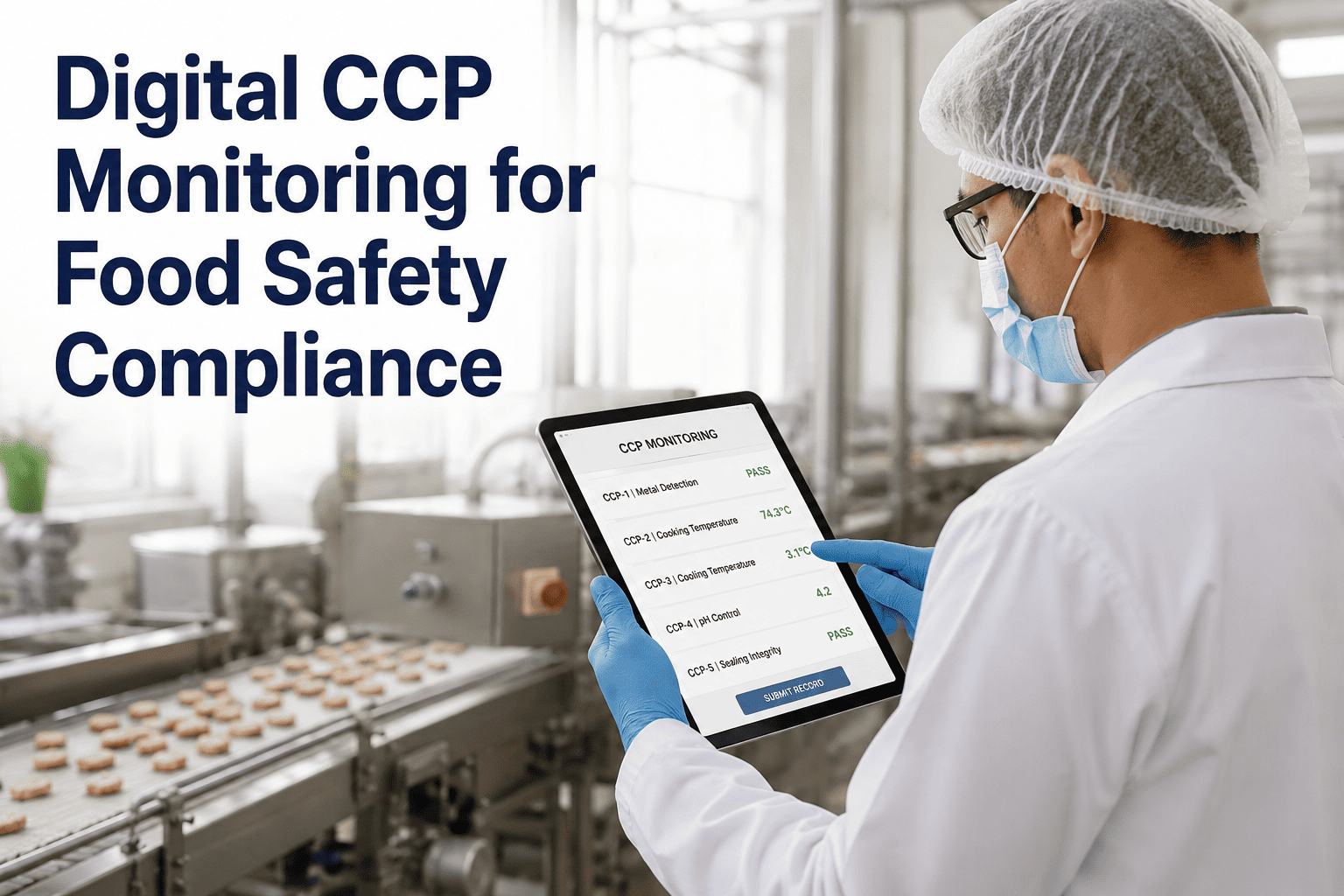
The auditor opens a binder, picks a date at random, and asks for the CCP records from second shift on a Thursday three months ago. The quality manager flips through pages of handwritten temperature logs, looking for a signature that might be illegible, a timestamp that was filled in after the fact, or a gap where someone forgot to log a reading entirely. That moment — the binder-flip — is the most expensive minute in food manufacturing. Because if the record is missing, unclear, or unsigned, the finding is the same whether the product was safe or not: your CCP monitoring programme has a gap, and the auditor writes it up. An iFactory digital CCP layer eliminates the binder entirely — every critical limit check is timestamped, operator-signed, deviation-linked, and searchable before the auditor finishes the question.
iFactory · Food Safety AI
Digital CCP Monitoring: Every Critical Control Point Locked with Audit Trail, Timestamp, and Signature
Paper CCP records get questioned in every audit. Digital monitoring captures every reading at the point of activity — immutable timestamp, operator ID, automatic deviation alerts, corrective action workflow — so the record is never the finding.
Every food safety scheme — FSMA, BRC, SQF, FSSC 22000 — requires the same thing from CCP monitoring: a record that proves the critical limit was met, at the right time, by an identified person, with a corrective action trail if it was not. Paper logs fail this requirement in five distinct ways, and auditors know every one of them. The weakness is not carelessness — it is the medium itself. Paper cannot timestamp itself, cannot alert anyone when a value is out of range, cannot link a deviation to a corrective action, and cannot be searched. Every audit that opens a binder is testing whether a human being remembered to write the right number at the right time on the right page — and the failure rate on that test is never zero.
1
Timestamp gaps
A 2-hour monitoring interval means a CCP excursion can run for up to 120 minutes before anyone checks. Paper cannot alert. If the operator is busy on the line, the check gets delayed — and the timestamp, if written at all, is approximate.
2
Illegible or missing signatures
Auditors require operator identification on every CCP record. A handwritten initial that cannot be tied to a trained operator is the same as no signature — the record is unverifiable.
3
No deviation linkage
A paper log shows an out-of-range reading. Where is the corrective action? In a different binder. Linked to a different lot number. Filed by a different person. Auditors flag the disconnect every time.
4
After-the-fact recording
When a 2 AM temperature excursion is recorded at 6 AM from memory, the record is a reconstruction, not a measurement. Auditors and regulators can tell — and the finding is the same as a missing record.
5
Unsearchable during recall
A recall investigation demands complete production records for a specific lot in hours. Paper binders cannot deliver the speed and completeness that regulators require — and the delay widens the recall scope.
What Digital CCP Monitoring Actually Replaces
The shift from paper to digital is not a technology upgrade — it is a structural change in how evidence of food safety is created, stored, and retrieved. Every weakness of paper becomes a capability of the digital system.
Paper record
Digital record
Operator writes temperature on a log sheet
Mobile device captures reading with automatic timestamp, GPS, and operator ID
Out-of-range value sits on paper until someone reviews it
System compares against critical limit instantly — deviation alert fires in seconds
Corrective action written in a separate binder, different format
Corrective action work order auto-generated, linked to CCP record and lot code
Supervisor reviews logs at end of shift — hours after the event
Supervisor notified in real time — reviews and signs off within minutes
Auditor requests records — quality manager searches binders for 30 minutes
One-click audit export — filtered by date, line, CCP, lot, or operator in seconds
Recall investigation assembles records from multiple sources over days
Full lot traceability — every CCP reading linked to ingredient lot and finished product
The CCP Monitoring Lifecycle — Digitised
Every CCP follows the same lifecycle: monitor, compare, act, verify, record. In a paper system, each step is disconnected — a reading on one page, a judgement in someone's head, a corrective action in another binder. Digital monitoring connects them into a single closed loop where nothing falls through the gap between steps.
1
Monitor
Operator records CCP measurement via mobile device at the point of activity — or sensor feeds data directly. Automatic timestamp and user ID captured. No transcription, no delay.
2
Compare
System compares value against the critical limit configured for that CCP. In-range readings are logged. Out-of-range readings immediately flag a deviation — no human judgement required at this step.
3
Act
Deviation triggers simultaneously: affected lot placed on hold, corrective action work order dispatched to supervisor, notification sent to quality team. Response is guided by pre-loaded corrective action playbooks specific to each CCP.
4
Verify and Record
Corrective action documented with root cause, product disposition, and preventive measures. Supervisor e-signs. The complete chain — reading, deviation, action, verification — is stored as a single linked record with immutable audit trail.
Want to see this lifecycle running on your HACCP plan? Talk to a food safety specialist — we will map your CCPs into the platform during a live demo.
Which CCPs the System Monitors
Every Critical Control Point in your HACCP plan becomes a system object with its own critical limit, target limit, monitoring parameter, required check frequency, and corrective action playbook. The platform handles every CCP type a food plant operates — from thermal processing to foreign body detection to chemical concentration.
Cooking / pasteurisation temperature
Core temperature at slowest heating point
Product-specific; e.g. 72 C for 15 seconds
Chilling / cold storage
Product temperature, cold room ambient
Product-specific; e.g. below 5 C within 4 hours
Metal detection / X-ray
Detector sensitivity confirmed by test pieces
Fe/Non-Fe/SS test wands pass at set frequency
pH and water activity
Product pH, Aw reading
Product-specific; e.g. pH below 4.6 for acidified foods
Sanitiser concentration
Chemical concentration in wash water
Minimum effective concentration per supplier spec
Allergen changeover verification
Visual and swab test confirmation
Negative swab and visual pass before product change
What the Auditor Sees — Before and After
The real test of digital CCP monitoring is the audit. Not the daily operation — daily operation is easier with any organised system. The test is when a third-party auditor or FDA inspector asks for a specific record from a specific date and expects to see the complete chain from monitoring reading to corrective action to product disposition, with signatures and timestamps at every step.
The paper audit
Quality manager retrieves binder from archive room
Flips through pages to find the requested date and shift
Auditor notes illegible signature on one CCP record
Corrective action for a deviation is in a different binder
Finding written: incomplete CCP documentation
The digital audit
Quality manager filters by date, shift, and CCP on screen
Complete record appears: reading, timestamp, operator e-signature
Deviation linked to corrective action, lot hold, and disposition
Auditor exports the record set in one click
Finding: none. Documentation is complete and traceable.
Deployment: Six Weeks, Not Six Months
Unlike ERP implementations that take quarters to configure, HACCP digitisation follows a structured six-week deployment that mirrors your existing HACCP plan rather than requiring you to rebuild it. Each milestone delivers a working compliance capability, not a work-in-progress.
Week 1-2
Import your HACCP plan
Every CCP mapped as a system object with critical limits, monitoring frequency, operator assignments, and corrective action playbooks. Allergen matrix and production line architecture configured.
Week 2-3
Connect sensors and devices
Temperature probes, pH metres, metal detectors, and operator mobile devices integrated. Sensor-fed CCPs begin logging automatically; manual CCPs configured with check prompts at required intervals.
Week 3-5
Train and shadow
Operators trained on mobile data capture. System runs in parallel with paper for one week to validate data integrity. Deviation alerts and corrective action workflows tested against real production scenarios.
Week 5-6
Go live and retire paper
Paper logs retired. Digital CCP records become the primary compliance documentation. First audit-ready report generated. Ongoing 24/7 support included for 90 days post-launch.
Ready to digitise your CCP monitoring before the next audit? Book a demo — we will walk through your HACCP plan and show the deployment mapped to your CCPs.
Frequently Asked Questions
Does this replace our HACCP plan?
No — it digitises your existing plan. Your critical limits, monitoring procedures, corrective actions, and verification activities are imported exactly as they are. The platform enforces the plan you already have; it does not create a new one. Your food safety team retains full ownership of the HACCP plan content.
Which food safety schemes does the system support?
The platform is pre-configured with record templates for FSMA, BRC, SQF, FSSC 22000, and IFS. Each scheme has specific documentation and verification frequency requirements — the system enforces the correct standard for your certification and generates audit-ready reports in the format your certification body expects.
Can it connect to our existing temperature sensors and metal detectors?
Yes. The platform integrates with temperature probes, pH metres, conductivity sensors, metal detectors, X-ray systems, and checkweighers via standard industrial protocols. Sensor-fed CCPs log automatically with no manual entry. For CCPs that require human judgement — visual inspections, swab tests — operators use mobile devices with guided forms.
What happens when a CCP reading is out of range?
Four things happen simultaneously: the affected production lot is placed on hold in the system; a corrective action work order is dispatched to the designated supervisor; a deviation record is created and linked to the monitoring record; and notifications are sent to the quality team. The corrective action cannot be closed without documenting root cause, product disposition, and preventive measures — with supervisor e-signature.
Is the system truly on-premise?
Yes. The platform runs on a pre-configured server inside your plant network. Your CCP data, production records, and corrective action history never leave your facility. This matters for food manufacturers who consider their HACCP records, product specifications, and quality data as proprietary. Turnkey deployment: pre-configured hardware, live in six weeks, 1000+ industrial clients, 99.9% uptime.
The next audit is coming. Be ready without the binder.
See Digital CCP Monitoring Running on Your HACCP Plan
Bring your HACCP plan — your CCPs, your critical limits, your monitoring schedule. We will map every control point into the platform and show you what the auditor sees: every reading timestamped, every deviation linked, every corrective action signed. Turnkey on-prem: pre-configured server, live in six weeks, 1000+ clients, 99.9% uptime.