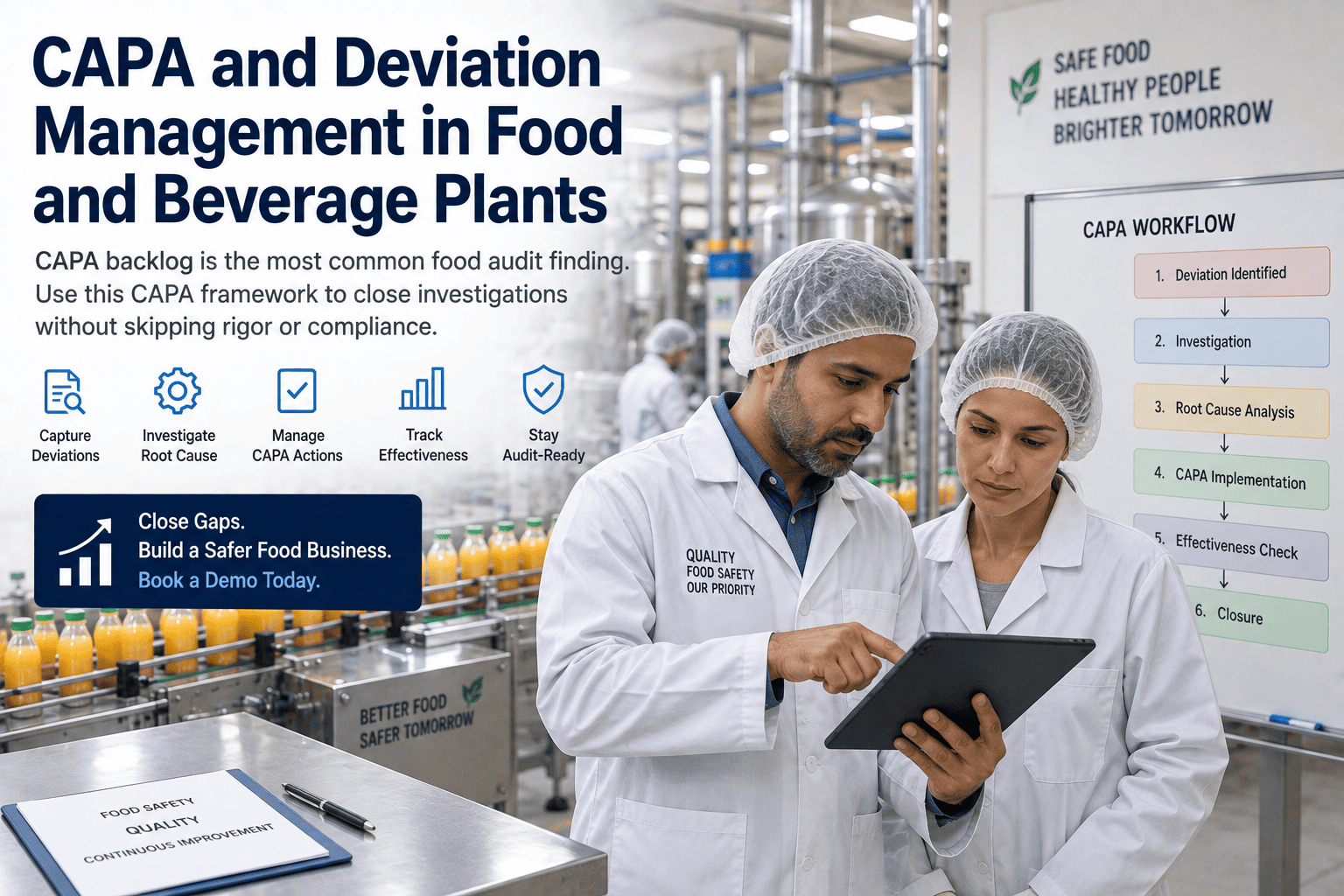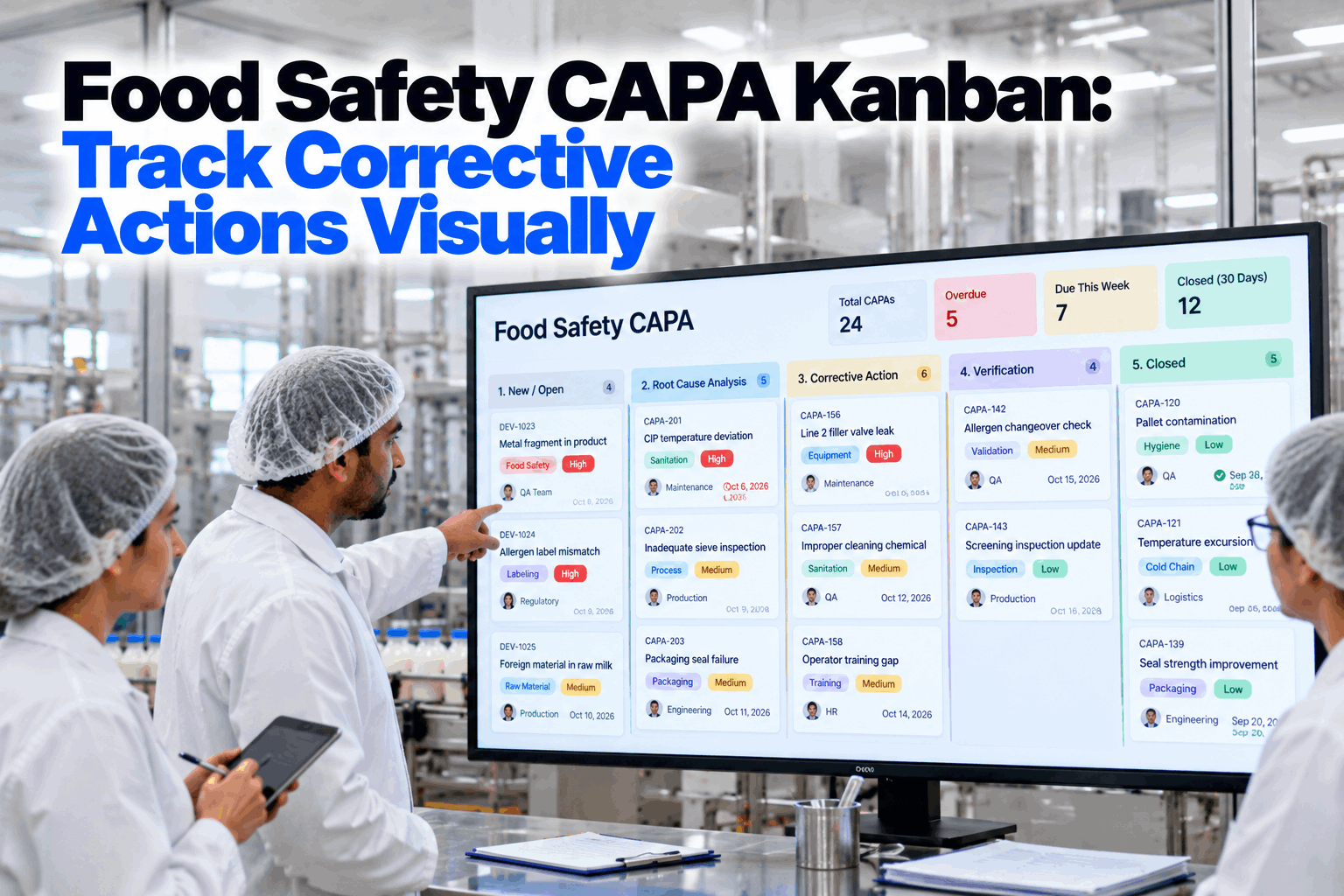
A food safety deviation rarely ends with the fix on the day. The detector is retested, product is held, and then the corrective action begins: find the cause, stop it coming back and prove that it worked. That second half is where CAPAs stall, in a spreadsheet nobody opens until the auditor arrives. A food safety CAPA kanban shows every corrective action as a card, from deviation to verified effectiveness, with owners, ages and overdue items visible at a glance. This guide covers columns, sources and checks. Plan yours in a CAPA review.
Food Safety CAPA Kanban: Track Corrective Actions Visually
Deviations open cards automatically. AI suggests likely root causes from past events, reminds owners by voice and schedules effectiveness checks, so QA sees every open action and what is overdue.
- From deviation to verified effectiveness
- Owners, ages and overdue items on one board
- Root cause suggestions from your history
Why Food Safety CAPAs Stall
The correction happens fast. The corrective action does not.
When a CCP fails, the immediate response is usually quick and well practised. Product is held, the line is stopped and the control is restored. The work that follows is slower and easier to lose: investigating the cause, changing a procedure or a piece of equipment, training people and then checking weeks later that the problem has not returned. These steps belong to different people and often sit in different files. Without one view, effectiveness checks are the first thing to be forgotten. The same deviation then returns a few months later, opens a new record and starts the cycle again, with no link to the CAPA that should have prevented it. Our food safety specialists can review how your CAPAs move today.
CAPA log in a spreadsheet
- Rows nobody looks at between audits
- Owners unclear once the day is over
- Effectiveness checks left blank
- Same deviation returns months later
CAPA kanban
- Every open action visible as a card
- Owner and age on each card
- Effectiveness check scheduled on closing
- Repeats linked to earlier CAPAs
What FSMA Expects from a Corrective Action
Four things must happen, and each one belongs on the card.
Under the FDA's Preventive Controls for Human Food rule, 21 CFR 117.150, corrective action procedures must make sure that appropriate action is taken to identify and correct a problem, that action is taken when necessary to reduce the likelihood of it recurring, that all affected food is evaluated for safety, and that affected food is prevented from entering commerce if its safety cannot be ensured. Corrective actions must also be documented. GFSI schemes such as SQF and BRCGS add their own expectations, including root cause analysis. Map your procedure in a working session.
Identify and correct
Find the problem and fix it.
Reduce recurrence
Act on the cause where needed.
Affected food
Assess the safety of all affected product.
Keep it out of commerce
Hold product whose safety is not assured.
Summary for orientation only. Read the regulation and your certification scheme for the full requirements.
Board Columns for Food Safety CAPA
Each column has evidence it must show before a card moves.
The columns of a food safety CAPA board should follow your corrective action procedure. What makes the board useful is the exit rule for each column, written as evidence rather than opinion. A card leaves Contain only when affected product is held and evaluated, and leaves Verify only when the effectiveness check has passed. That stops actions from being closed on the strength of a promise. Keep the number of columns small, because every extra stage is one more place for a card to wait. Agree your exit rules with our QA team.
Where CAPA Cards Come From
Every deviation source feeds the same board.
Food safety CAPAs start in many places. Bringing them onto one board, with cards opened automatically from the system where each deviation is first recorded, means nothing depends on someone remembering to copy it across. Each card type can carry its own target ages, taken from your procedures and customer requirements. The examples below are typical sources. Connect your sources with our implementation team.
Critical limit deviation
Metal detection, cooking or pasteurization limits.
PC deviation
Allergen, sanitation or supply-chain controls.
Environmental positive
Swab results from the monitoring program.
Customer or consumer
Foreign matter, allergen or quality complaints.
Audit finding
Certification, customer or internal audits.
Supplier issue
Ingredient or packaging nonconformance.
See Every Food Safety CAPA on One Board
Deviations open cards automatically, owners get voice reminders, AI suggests causes from history and effectiveness checks are scheduled the moment an action is complete.
Root Cause Suggestions from History
Most deviations have happened before, somewhere in your records.
Root cause analysis is the step where CAPAs most often stall, because it needs time and evidence. The AI helps by searching past deviations, CAPAs, maintenance records and sanitation logs for similar events on the same line, product or area, and showing what was found then. It does not decide the cause. It gives the investigator a head start and a list of places to check, and the investigator confirms or rejects each one with evidence. Linking the new card to earlier ones also shows auditors that repeat events are recognised and treated as a pattern, not as isolated incidents. See an example in a short demo.
Scheduling Effectiveness Checks
A CAPA is not done when the action is done. It is done when it worked.
Effectiveness checks are the most skipped step in food safety CAPA. The action is complete, everyone moves on, and nobody returns to confirm the deviation has stopped. On a kanban board, moving a card into Verify schedules the check automatically, with a date, a method and an owner. The method depends on the problem: more swabs, more frequent checks, a trend review or a follow-up audit. The card cannot close until the check is recorded. Plan your verification methods in a short session.
Examples only. Your food safety plan, EMP and certification scheme set the methods and timing.
Voice Reminders and Aging Alerts
Owners hear about their actions where they work.
QA owners are rarely at a desk. A voice reminder at the start of a shift, naming the card, the next step and the due date, keeps actions moving without another email. Every card shows its age, and cards that pass their target are raised at the daily QA meeting and then escalated to the QA manager if they stay stuck. Ask our team how reminders and escalation are set.
Open
Card opened from the deviation.
Assign
Owner and target dates set.
Remind
Voice reminder each shift.
Flag
Overdue cards highlighted.
Escalate
Stuck cards to the QA manager.
Food Safety CAPA Kanban Checklist
Eight checks before the board goes live.
Use this checklist to set up the board for one plant first. Tick items already in place. Get help with any gaps from our setup team.
Food Safety CAPA Mistakes to Avoid
A closed CAPA that did not work is worse than an open one.
These are the patterns that most often weaken food safety CAPA programs. A short CAPA review can find them.
What works
- Exit rules written as evidence
- Affected product evaluated before moving on
- Root cause backed by facts
- Effectiveness checks scheduled on closing
What fails
- "Operator error" as the root cause
- Retraining as the only action
- Cards closed before verification
- Repeat deviations not linked to old CAPAs
How iFactory Runs the Food Safety CAPA Kanban
CAPA Kanban and AI Follow-Up, on your own network.
iFactory's CAPA Kanban opens cards automatically from deviations, while AI Follow-Up suggests likely root causes from history, reminds owners by voice and schedules effectiveness checks. It runs on an on-prem AI server inside your plant.
One board
CCPs, PCs, EMP, complaints and audits.
Auto cards
Opened from the deviation record.
Cause suggestions
Similar past events and findings.
Voice reminders
Next step and due date each shift.
Effectiveness checks
Scheduled when actions complete.
Overdue alerts
Aging cards escalated.
Product disposition, root cause and closure decisions remain with your QA team. Figures on this page are worked examples.
Turnkey AI: Delivered, Connected and Live in 6–12 Weeks
You do not build this. It arrives ready.
iFactory ships as a pre-configured NVIDIA AI server with the software pre-loaded, racked and ready. Rack it, plug in power and Ethernet, and the AI is live on your network. Our team handles cabling, network setup, PLC, SCADA, DCS and CMMS integration, QMS and food safety system links, operator training and 24×7 remote monitoring. Data stays on your network. For a scope matched to your plant, request a turnkey quote.
Ship, network and data
Server installed. Deviation, EMP, complaint and audit records connected. Columns and card types loaded.
Model training and pilot
Exit rules, target ages, voice reminders and effectiveness check methods set up for one plant.
Go-live and training
CAPA board live. QA team trained. 24×7 monitoring begins.
Frequently Asked Questions
What is a food safety CAPA kanban?
A visual board that shows every food safety corrective action as a card moving from deviation to verified effectiveness, with an owner and age on each card.
What does FSMA require for corrective actions?
Under 21 CFR 117.150, procedures must correct the problem, reduce recurrence where needed, evaluate affected food and keep unsafe food out of commerce, with records kept.
Which deviations should become CAPA cards?
CCP and preventive control deviations, environmental positives, complaints, audit findings and supplier issues, as set by your procedures.
What is an effectiveness check?
A planned check, after the action is complete, that shows the problem has not returned, such as follow-up swabs or a records review.
Does the AI decide the root cause?
No. It suggests likely causes from similar past events. The investigator confirms or rejects each with evidence.
How do voice reminders work?
Owners hear the card, next step and due date at the start of a shift, on a headset or phone, and can reply by voice.
Does this replace our QMS?
No. Records stay in your system of record. The board shows them as one flow and adds reminders and checks.
Will it help at audits?
It makes it easier to show each corrective action, its cause, its verification and its dated history in one place.
How do we start?
Start with one plant and its main deviation sources. A 6-week pilot connects records and sets up columns, reminders and checks. To plan it, contact our team.
Close Food Safety CAPAs That Stay Closed
In thirty minutes we map your open corrective actions onto one board and show which are stuck and which lack effectiveness checks. You keep the map either way.
- 1An export of open CAPAs
- 2Your corrective action procedure
- 3Recent EMP and CCP deviation records
- 4Last audit report and findings
- 5One deviation that keeps coming back