Walk into almost any food or beverage plant's quality office and you'll find the same thing: a stack of CAPAs marked "in progress," some of them months old. It's one of the most common findings auditors write up, and it rarely means the team is careless. The immediate fix got done — the lot was quarantined, the line re-sanitized, the batch re-inspected — and everyone moved on, while the deeper investigation that would actually stop the problem recurring quietly never closed. Auditors from SQF, BRCGS, and FSSC 22000 have learned to look straight past the correction to ask whether the corrective action ever happened. This guide lays out a CAPA framework that closes investigations with rigor and without the backlog. You can book a demo to see the workflow in action.
Close the Backlog Without Skipping the Rigor an Auditor Expects
A food-plant CAPA framework that separates correction from corrective action, drives every deviation to a verified root cause, and keeps the whole trail audit-ready for SQF, BRCGS, FSSC 22000, and FSMA.
Correction Is Not Corrective Action — and Auditors Know the Difference
This is the single most important idea in food CAPA, and the one most often conflated on the floor. A correction is the immediate response to contain the problem: quarantine the affected product, notify the customer, re-inspect the batch, re-sanitize the line. A corrective action is the systemic response: understand why the problem happened and change something so it can't recur. BRCGS auditors specifically look for both, documented separately, and will challenge any record where the two are blurred together. When a plant logs the correction and calls the CAPA closed, it has done the urgent half and skipped the half that actually matters.
The reason this matters beyond passing an audit is that a correction, by definition, cannot prevent recurrence — it only cleans up the instance in front of you. A plant that only ever corrects is condemned to meet the same deviation again and again, each time paying the containment cost of quarantine, rework, and lost product, while the underlying cause sits untouched. The corrective action is where the actual return on the whole exercise lives, because it's the only step that changes the odds of the problem happening next week. Skipping it doesn't just risk a finding; it guarantees the work repeats.
Quarantine the lot, re-inspect, re-sanitize, notify the customer. Necessary and urgent — but it only addresses this instance of the problem, not the reason it happened.
Find the root cause and change the process, control, or training so the same deviation can't happen again. This is the half that closes the audit finding — and the half that gets skipped.
Address the same risk in similar processes or lines before it becomes an actual problem there. FSSC 22000 explicitly expects you to check whether the issue could occur elsewhere.
No Food Plant Sets Out to Fall Behind on CAPAs — the System Lets It Happen
The backlog isn't a discipline problem, it's a structural one. CAPAs stall in predictable places, and on paper or in scattered spreadsheets nobody sees them aging until an auditor pulls the list. Root cause analysis in food and beverage is cross-functional — research shows most plants involve three or more departments — so a single investigation depends on inputs from quality, production, maintenance, and sanitation that no clipboard can chase down. Here's where they get stuck.
The urgent fix is done, the pressure lifts, and the root-cause investigation drops to the bottom of the list — where it ages until it's an audit finding.
An investigation waiting on maintenance data or a sanitation record stalls with no owner and no visible deadline, because the handoff lives in someone's inbox.
Under time pressure, investigations settle for the nearest human cause instead of the systemic one, so the CAPA closes but the deviation comes back.
The action is implemented and the CAPA marked closed, but no one checks months later whether it actually worked — the step auditors increasingly demand to see.
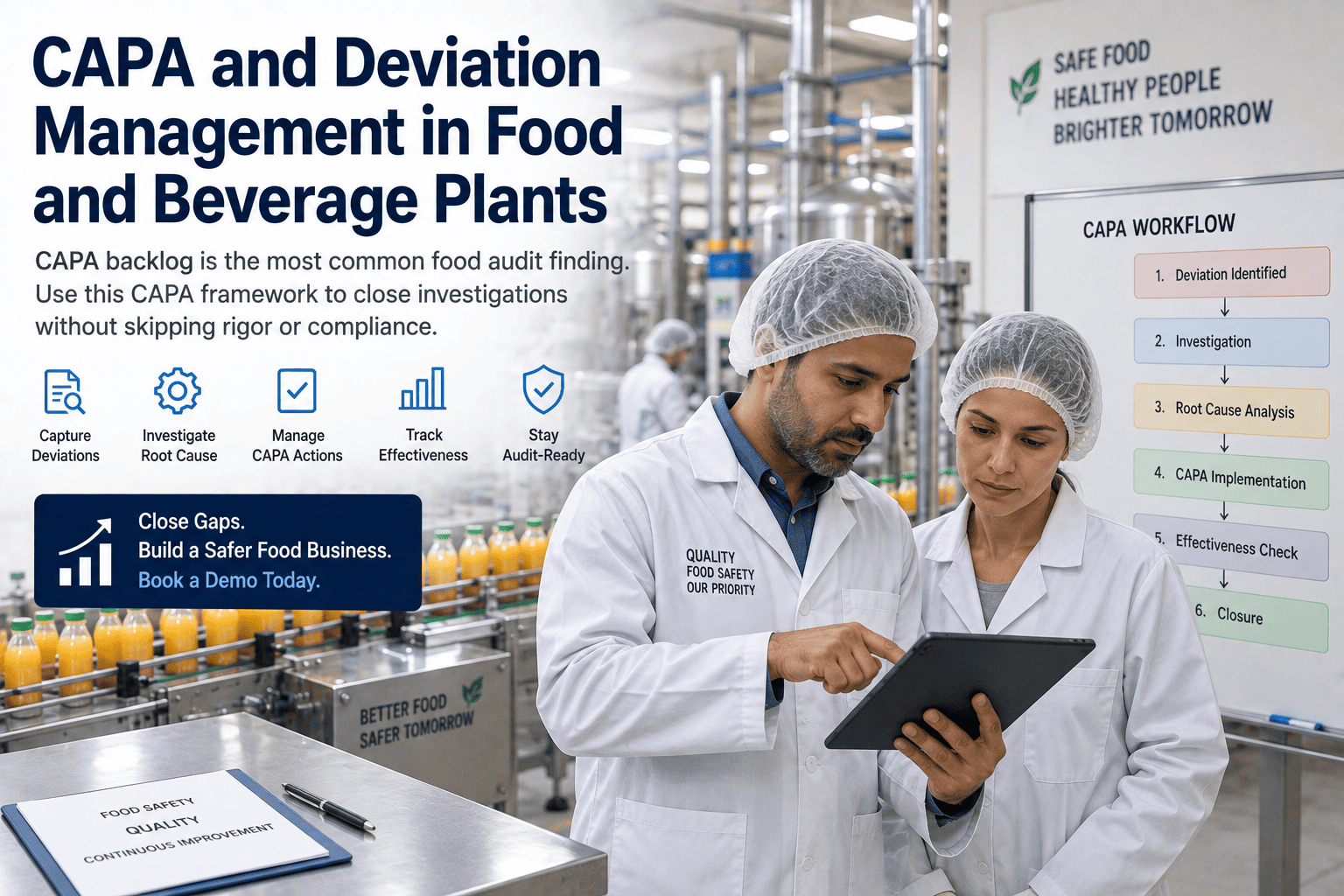
Six Stages That Take a Deviation All the Way to a Verified Close
A CAPA that survives an audit follows the same disciplined path every time, and the discipline is what prevents the backlog rather than causing it. Each stage has to complete before the next, so nothing gets marked done while a step is still open. This is the loop, built for a food plant.
Log the event the moment it's found — a critical-limit deviation, an out-of-spec lab result, a customer complaint, an environmental monitoring failure, an audit nonconformance — with the detail that starts the record clean.
Capture the immediate containment separately from the corrective action to come — quarantine, re-inspection, line stop — so the two are never conflated in the record an auditor reviews.
Grade the event by its food-safety and quality impact, so a critical-limit breach gets a full investigation while a minor issue gets a proportionate one — disciplined escalation by risk, not a flat rule.
Apply structured RCA — 5 Whys, fishbone — to the depth the risk demands, and where a complaint implicates several checks that all failed, pursue each failed control as its own root-cause thread.
Implement the corrective action that eliminates the root cause, then the preventive action that checks whether the same risk lives in similar lines or processes and closes it there too.
Confirm the action actually worked before the CAPA closes — a check back after a defined period against a metric like repeat-failure rate — so "closed" means resolved, not just actioned.
Give Every CAPA an Owner, a Deadline, and a Verified Close
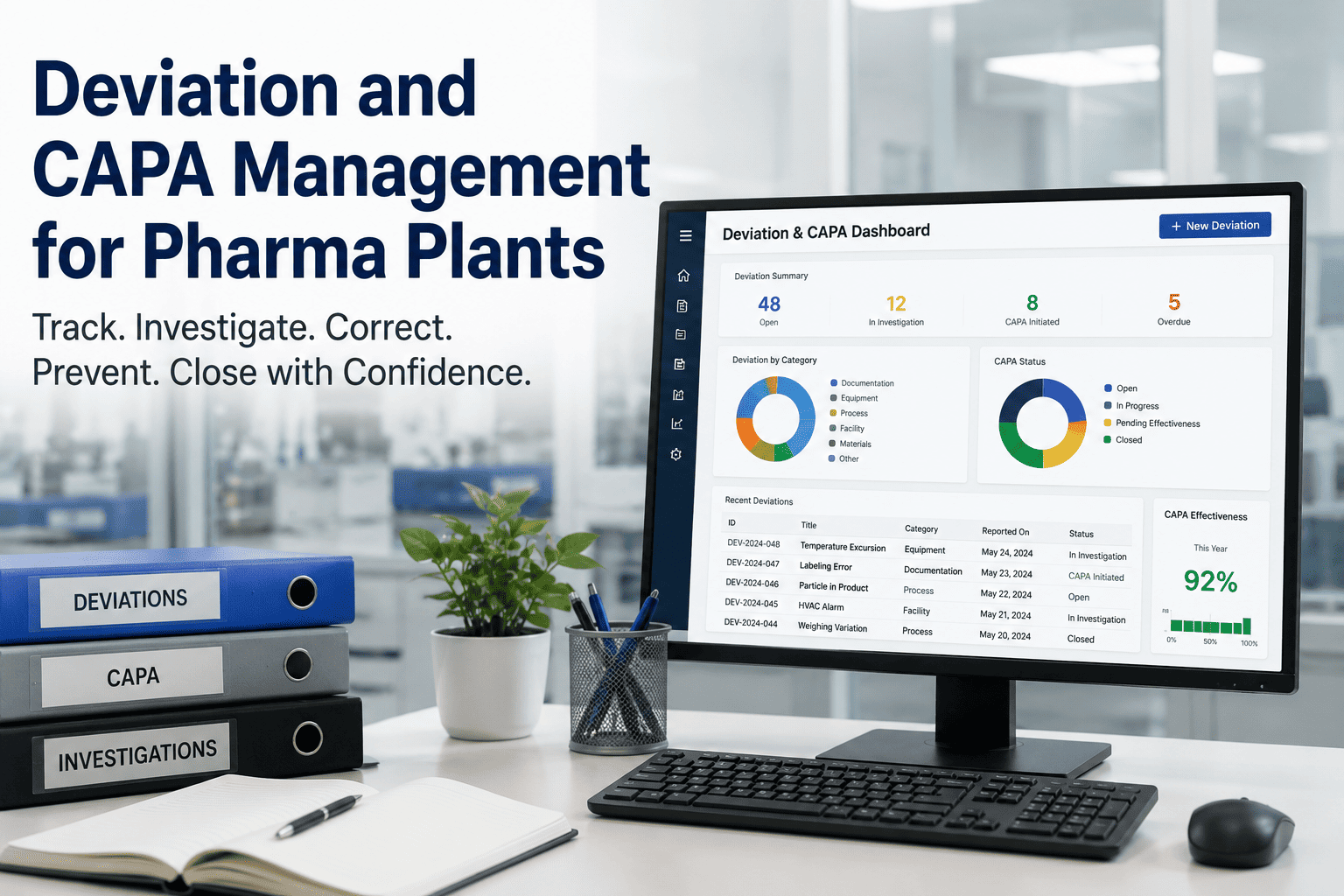
iFactory runs the full deviation-to-CAPA loop as one connected workflow, so investigations can't stall silently and the backlog stops building before the next audit.
The Events a Food Plant Can't Just Correct and Forget
Part of controlling the backlog is being clear about what actually warrants a full CAPA versus a simple correction. The GFSI schemes and FSMA name the triggers explicitly, and a good system routes each one down the right path from the start.
Any HACCP critical limit — time, temperature, pH, weight — going out of control demands a documented corrective action under 9 CFR 417, even if it was corrected on the line.
A failed micro, chemical, or physical test is an automatic CAPA trigger — quarantine the lot, repeat testing, and investigate whether it's equipment, contamination, or recipe.
Foreign material, illness, or any recall event triggers a CAPA that interrogates every check that should have caught it — often several failed-control threads at once.
An internal or external audit nonconformance, or a negative environmental monitoring trend, requires a formal investigation rather than a one-time fix.
SQF Edition 10 makes the point that a negative complaint trend, a recurring audit finding, or repeated process deviations aren't just separate events to correct one at a time — they're a signal that a deeper investigation is due. A CAPA system that trends deviations across lines and time turns that scattered noise into a visible pattern, so the facility-wide root cause gets addressed once instead of the same surface symptom getting corrected over and over.
Passing on the CAPA File, Not Just the Plant Floor
Modern GFSI and FSMA audits scrutinize the CAPA record as closely as the physical facility. Knowing what they look for is how you build a system that produces the evidence as a byproduct rather than a scramble. These are the things a food-safety auditor probes.
BRCGS specifically checks that the immediate fix and the systemic action are documented distinctly, not merged into one line that hides whether recurrence was ever addressed.
When a problem reached the customer, SQF auditors expect evidence that incoming inspection, in-process checks, and finished-product review were each examined as their own thread.
Documented proof the action worked — not just that it was taken — is increasingly the difference between a closed CAPA and an open finding.
SQF Edition 10 expects CAPA outputs to flow into management review, complaint trending, and food-safety-plan reassessment — proof the system learns, not just reacts.
The Same CAPA Program, Two Very Different Audit Days
The gap between a stalling paper CAPA process and a connected one shows up most sharply in the two moments that matter: when an investigation is running, and when an auditor asks to see the file.
- Corrections logged, investigations aging out of sight
- No owner or deadline visible on a stalled CAPA
- Root cause often defaults to "operator error"
- Effectiveness rarely verified after closure
- Audit prep is days of compiling scattered records
- Recurring deviations never trended into a pattern
- Every CAPA visible by stage, age, and owner
- Deadlines and escalation enforced by the system
- Structured RCA required before a cause is accepted
- Verification step gates the close of every CAPA
- Audit packages generated on demand, not assembled
- Deviations trended across lines to surface patterns
One Connected Loop From Deviation to Verified Close
The reason CAPAs stall on paper is that each stage lives somewhere different — the deviation on a form, the investigation in email, the action in a spreadsheet, the verification nowhere. iFactory runs the whole loop as one workflow, so a food-plant quality team closes with rigor and stays ahead of the backlog.
What Food Quality Teams Ask About CAPA and Deviations
Close Every Investigation With Rigor, and Walk Into the Audit Ready
iFactory runs food-plant CAPA and deviation management as one connected loop — correction and corrective action separated, root cause enforced, effectiveness verified — so the backlog stops building and the CAPA file is always audit-ready.