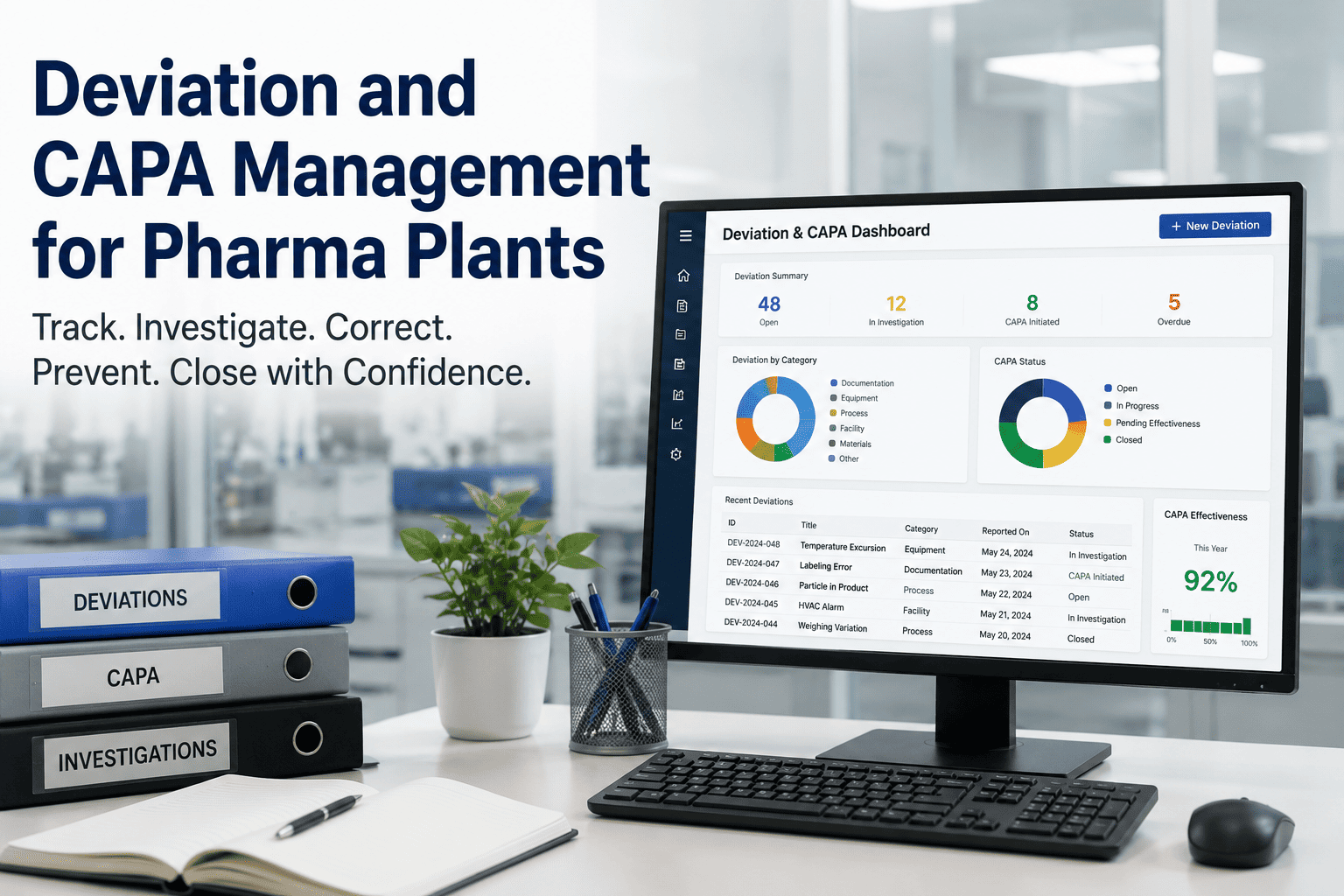
Every deviation on a pharma shop floor is a countdown timer. From the moment a batch record entry falls outside expected parameters, the clock is running against 21 CFR 211.192 — the regulation that demands a thorough, documented investigation with root cause identification and appropriate corrective action, extending to all other batches potentially affected. The plants that manage this well close investigations within their SOP-defined windows with defensible science behind every conclusion; the plants that do not end up with a CAPA backlog that grows quarter over quarter, and eventually with an FDA investigator standing in the QA office asking why. In FY 2025, that scenario played out 303 times in warning letters — a 59% jump from the year before — and CAPA effectiveness remains the single most-cited failure mode. If your deviation-to-CAPA workflow is running on spreadsheets, email chains, or a legacy system your team has stopped trusting, the fastest way to see a validated pharma-grade replacement is to book a demo.
PHARMA DEVIATION & CAPA MANAGEMENT · VALIDATED WORKFLOW
Close Investigations Fast. Without Skipping Rigor. Without the 483.
iFactory brings 21 CFR Part 11-compliant deviation intake, structured root cause investigation, effectiveness-checked CAPA, and immutable audit trails together in one validated platform — built for pharma quality teams that cannot afford another finding.
303
FDA drug warning letters issued in FY 2025 — a 59% increase from 190 the prior year
$50M–$600M
Estimated cost per warning letter in remediation, lost production, and shareholder impact
4
Top FDA 483 violation codes have stayed unchanged since 2021 — CAPA/investigation gaps dominate
15 days
FDA response window after a 483 is issued — the point where warning-letter risk is decided
The Regulation Behind the Pain
What 21 CFR 211.192 Actually Requires — and Where Programs Fail
The single most-cited pharma regulation in FDA 483 observations is not obscure. It is one paragraph, it has been on the books for decades, and it defines exactly what "investigating a deviation" means in regulatory terms. The plants that get findings are the plants that treat this as a paperwork exercise. The plants that stay clean treat it as the operating standard for every non-conformance on the floor.
21 CFR 211.192 — Production Record Review
"Written procedures shall be established and followed for investigating any unexplained discrepancy or failure of a batch or any of its components to meet any of its specifications. Such investigations shall extend to other batches of the same drug product and other drug products that may have been associated with the specific failure or discrepancy. The investigation and follow-up shall be documented."
FAIL 1
Shallow Root Cause
"Human error" used as the terminal cause with no systemic analysis. Cited in a large share of pharma warning letters — inspectors expect a documented 5-why or fishbone with evidence at each step, not a placeholder cause.
FAIL 2
Investigation Not Extended
The regulation explicitly requires extension to other batches and other products that may be affected. Failure to demonstrate that assessment — with impact analysis and dispositions — is a repeat 483 finding across facility types.
FAIL 3
CAPA That Did Not Stick
The corrective action exists on paper, but the same deviation recurs three or six months later. Absence of effectiveness verification is one of the most cited CAPA-specific failure modes — CAPA closure ≠ CAPA success.
FAIL 4
Backlog and Timeline Slippage
Deviations open past SOP-defined closure windows, CAPAs open past target dates, and no documented escalation trail. Inspectors read the backlog as evidence the quality unit lacks capacity or authority to run the QMS.
The End-to-End Flow
From Shop Floor Signal to Effectiveness-Verified Closure
A defensible deviation-to-CAPA program is not one workflow — it is seven distinct stages, each with its own owner, its own documentation requirement, and its own point of failure. What follows is the full end-to-end path that a validated pharma QMS supports, with the specific compliance evidence each stage must produce.
STAGE 1
Deviation Intake
Operator or supervisor logs the deviation within the SOP-defined window — typically minutes to hours from event. Immediate classification (planned vs unplanned, critical vs major vs minor) triggers the correct workflow branch and notification chain automatically.
Evidence produced: Timestamped intake record, classification decision, initial notifications
STAGE 2
Immediate Containment
Batch quarantine, line stop, or containment action documented and executed before investigation begins. This is the "stop the bleeding" step — decisions on whether affected material is held pending investigation, and whether upstream or downstream batches need similar containment.
Evidence produced: Containment decision log, material hold records, cross-batch impact scope
STAGE 3
Structured Root Cause Investigation
5-why, fishbone, or fault-tree analysis executed against a documented method — not free-form narrative. Evidence attached at each step: equipment logs, calibration records, batch data, prior deviation history for the same asset or product. "Human error" flagged automatically for systemic re-analysis.
Evidence produced: Method-structured RCA document, supporting evidence chain, verified root cause
STAGE 4
Impact Assessment and Batch Disposition
The 21 CFR 211.192 extension requirement — assessment of other batches of the same product and other products potentially affected. Explicit disposition decision on affected material (release, rework, reject, or reprocess) with the scientific rationale documented against SOP criteria.
Evidence produced: Impact scope, cross-batch assessment, disposition rationale with signatures
STAGE 5
Corrective Action + Preventive Action
Corrective action addresses the specific event; preventive action addresses the systemic root cause to prevent recurrence. Each action carries an owner, a target date, an SOP or system link, and a defined "how we will know it worked" measure. Multi-action CAPAs stay linked to the parent deviation.
Evidence produced: CAPA action plan, ownership assignment, target dates, success criteria
STAGE 6
Implementation and Verification
Each CAPA action executed against its plan, verified as complete by an independent reviewer, and documented with the objective evidence — SOP revision numbers, training completion records, equipment qualification documents, procedure updates. Nothing closes without evidence attached.
Evidence produced: Completion records, verification signatures, linked evidence documents
STAGE 7
Effectiveness Check
The step most programs skip — a scheduled review at 60, 90, or 180 days post-closure to confirm the corrective action actually prevented recurrence. Effectiveness is measured against the success criteria defined in Stage 5, not against a subjective "it seems better" judgment.
Evidence produced: Effectiveness verification record, trend data, decision to close or reopen
The Compliance Architecture
What Makes a Pharma QMS Actually Inspection-Ready
A validated pharma QMS is not just a workflow tool — it is an evidence-generation machine that produces the objective proof an FDA investigator will ask to see. The four architectural pillars below are what separate a general-purpose task tracker from a system that survives inspection.
P-11
21 CFR Part 11 Electronic Records
Immutable audit trails, controlled electronic signatures with printed name and date, unique user IDs, access-based permissions, and secure time-stamped records. Every field change, every approval, every attachment — captured and non-editable, meeting both FDA and EMA electronic record requirements.
IQ/OQ
Validated Deployment
Installation Qualification and Operational Qualification documentation delivered with deployment. GAMP 5 categorization, validation protocols, and traceability matrices provided as artifacts your validation team can execute against — not built from scratch by your team post-implementation.
RBAC
Role-Based Access and Segregation
Author, reviewer, and approver roles enforced by system — no user can approve their own work, no CAPA closes without the required signature chain. Segregation of duties built into the workflow rather than relying on procedural discipline.
TRACE
Cross-Module Linkage
Deviations link to batch records, batch records link to equipment history, equipment history links to calibration and PM records, complaint records link back to production batch. When an inspector asks "show me everything related to this incident," the trace is one click, not one week.
SEE YOUR OWN BACKLOG THROUGH AN INSPECTOR'S EYES
Run Your Open Deviation and CAPA List Through the Framework
Most quality teams discover the gaps that would surface in an inspection well before the inspector arrives — the question is only whether they have time to fix them first.
The Backlog Problem
Why CAPA Backlogs Grow — and What Breaks the Cycle
Backlog is not a scheduling problem. It is a workflow problem. Deviations accumulate faster than they close because the underlying process has too many manual handoffs, too much reliance on individual memory, and too little visibility into aging. The visualization below shows why — and what changes when the workflow is instrumented.
The CAPA Aging Curve — Manual vs Instrumented
Manual Tracking
0–30 days: 45%
31–60 days: 25%
61–90 days: 18%
>90 days: 12%
Instrumented Workflow
0–30 days: 78%
31–60 days: 16%
61–90 days: 4%
>90 days: 2%
The shift happens because automated aging escalation, ownership visibility, and blocked-by-what-signal tracking eliminate the two failure modes that create backlog: work sitting waiting for someone to notice, and work no one owns explicitly.
Deviation Classification
Critical vs Major vs Minor — the Classification That Sets the Clock
Not every deviation deserves the same investigation depth or the same timeline. The classification decision made in the first hour of intake determines the SOP-defined closure window, the required approval chain, and the level of impact assessment. Getting this wrong in either direction — over-classifying and burning quality resources, or under-classifying and shortcutting rigor — is itself a compliance risk.
| Classification | Definition | Typical Closure Window | Approval Chain |
|---|
| Critical | Direct impact on patient safety, product identity, strength, purity, or quality | 30 days | QA Director + Site Head + Regulatory |
| Major | Potential impact on GMP compliance, batch integrity, or process consistency | 60 days | QA Manager + Production Manager |
| Minor | Documented deviation from SOP without impact on product quality or safety | 90 days | QA Officer + Area Supervisor |
| Planned | Documented temporary departure approved before execution, with scientific justification | Per protocol | QA Manager + Technical Head |
The platform applies classification rules from the deviation intake questionnaire — impact area, product criticality, regulatory implication — and produces the classification as a system decision with the operator's confirmation, rather than leaving classification to individual judgment that inspectors will later question.
Root Cause Discipline
Why "Human Error" Is the Wrong Answer — and What to Write Instead
The single most common CAPA failure documented in FDA warning letters is "human error" used as the terminal root cause with no systemic follow-through. Inspectors read that as a program that has stopped asking why. The rewrite below is what a defensible root cause looks like — and it is the same regardless of what tool you use to reach it.
WHAT INSPECTORS SEE ON A 483
Root Cause:
Operator error — technician failed to follow SOP-1234.
Corrective Action:
Retrained technician on SOP-1234.
Preventive Action:
Not identified.
Inspector reads: quality unit did not investigate. Same deviation likely to recur.
WHAT AN INSPECTION-READY RECORD LOOKS LIKE
Root Cause:
SOP-1234 step 4.3.2 requires temperature verification before proceeding, but the reading location is 2 meters from the panel and the operator must physically walk over each cycle. Under time pressure during shift changeover, the step was skipped. Systemic cause: SOP designed without ergonomic verification of feasibility under production conditions.
Corrective Action:
Temperature reading remoted to control panel display — physical verification eliminated. Verified through SOP-1234 rev 08.
Preventive Action:
Ergonomic feasibility review added as mandatory step in SOP creation and revision workflow. Applied across all 87 SOPs with in-process verification steps.
Inspector reads: systemic thinking, verified fix, scope extended to prevent recurrence.
QA Director Perspective
Field Perspective
M
Meera S.
QA Director, Sterile Injectables Manufacturing Facility
We had a 240-open-deviation backlog when the FDA came in. The observation on Form 483 was not that we had deviations — every plant has deviations — it was that we could not show a working closure discipline. Six months later, with a validated workflow, the aging distribution had completely flipped. The next inspection asked the same question and got a clean answer with evidence attached. What changed was not our people. It was that the system stopped letting deviations disappear into someone's inbox.
Common Questions
Pharma Deviation and CAPA Management — Questions Quality Teams Ask
How long does validation take, and can we deploy without pausing operations?
Validated deployment for a pharma QMS typically takes 8 to 12 weeks from kickoff to go-live, using pre-configured pharma templates and IQ/OQ documentation delivered with the platform rather than authored from scratch on your side. The deployment runs in parallel with existing operations — your current deviation and CAPA system continues to function while the new platform is configured, validated, and user-tested, and the cutover happens as a single controlled event with historical open items migrated across. There is no operational pause required, and the validation package your team executes is designed to align with GAMP 5 categorization for a configurable commercial off-the-shelf system, keeping the validation scope proportionate to the risk profile rather than treating every field as a custom application.
Does the system actually meet 21 CFR Part 11 and EU Annex 11 requirements out of the box?
The platform is architected on immutable audit trail records, electronic signature controls that satisfy both the printed-name-and-date and the meaning-of-signature requirements, role-based access with unique user IDs, and time-stamped entries that cannot be edited retrospectively — the specific technical controls that Part 11 §11.10 and Annex 11 require of electronic record systems. What "out of the box" means in practice is that the controls are enabled by default rather than requiring configuration, and the deployment package includes the objective evidence — validation summary reports, audit trail specifications, and access control documentation — that your quality unit needs to support inspection questions on the electronic record system itself, not just on the deviations recorded in it.
What happens to our existing open deviations and CAPAs during the migration?
Existing open items are migrated across during a defined cutover window, with the full history — investigation notes, evidence documents, approvals, effectiveness check status — preserved and attached to the migrated record so the audit trail is continuous rather than reset. Migration follows a documented protocol that classifies items by status and applies the correct target-state workflow, so a deviation that was in root-cause investigation at cutover continues in root-cause investigation on the new platform rather than starting over. This continuity matters for two reasons: your open aging clock does not reset (which would look artificial in the next inspection), and no evidence is lost in the transition, which is itself a compliance requirement under the electronic record framework.
How does the effectiveness check step actually work — is it just a calendar reminder?
The effectiveness check is a structured evaluation against the success criteria defined at the time the CAPA action plan was written, not a subjective revisit. At the CAPA creation step, the system requires you to answer "how will we know this worked" — a specific measurable outcome, typically absence of recurrence over a defined observation window, a trend line moving in the specified direction, or a specific KPI reaching a target. At the effectiveness check date, the system pulls the actual data for that measure and presents it against the target, and the reviewer's decision is either "effective" (close), "partially effective" (extend observation), or "not effective" (reopen with a new investigation). This turns effectiveness check from a checkbox into a decision with evidence, which is exactly what inspectors expect to see. If you want to see how this would look configured against your specific CAPA types, the fastest path is to walk through it during a scheduled
demo.
Can we integrate this with our existing MES, LIMS, and eQMS systems?
Standard integrations are available for the major pharma MES platforms (POMSnet, Werum PAS-X, Rockwell), LIMS platforms (LabWare, LabVantage, STARLIMS), and enterprise eQMS ecosystems, using validated connectors that preserve the audit trail of data crossing system boundaries. Common integration patterns include batch record deviation triggers automatically opening a deviation in the QMS with the batch context pre-populated, laboratory OOS results creating linked investigations with the analytical evidence attached, and CAPA effectiveness data pulling from downstream trend systems automatically at the check date. Integration scope depends on your specific stack and is defined during scoping — for detailed integration architecture questions on your particular ecosystem, the implementation team can walk through it through
support.
21 CFR PART 11 · GAMP 5 · IQ/OQ · IMMUTABLE AUDIT TRAIL
Turn Your Deviation and CAPA Program Into the Evidence an Inspection Needs
iFactory brings validated, pharma-grade deviation and CAPA workflow together with the immutable audit trail, effectiveness verification, and cross-system traceability that separate an inspection-ready QMS from a paperwork liability.
7 StagesIntake to Effectiveness
Part 11Compliant Out of Box
8–12 wksTo Validated Go-Live
100%Immutable Audit Trail