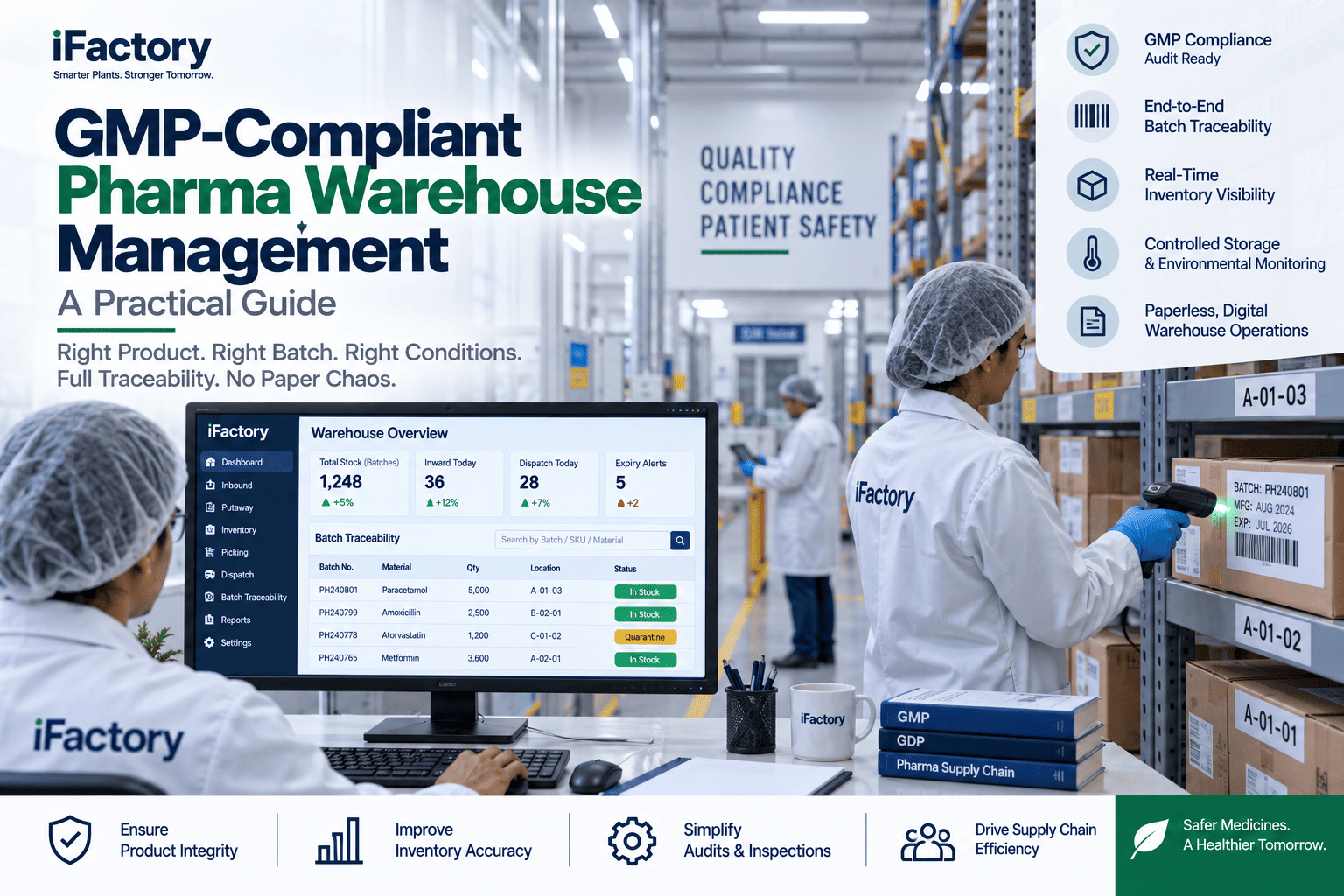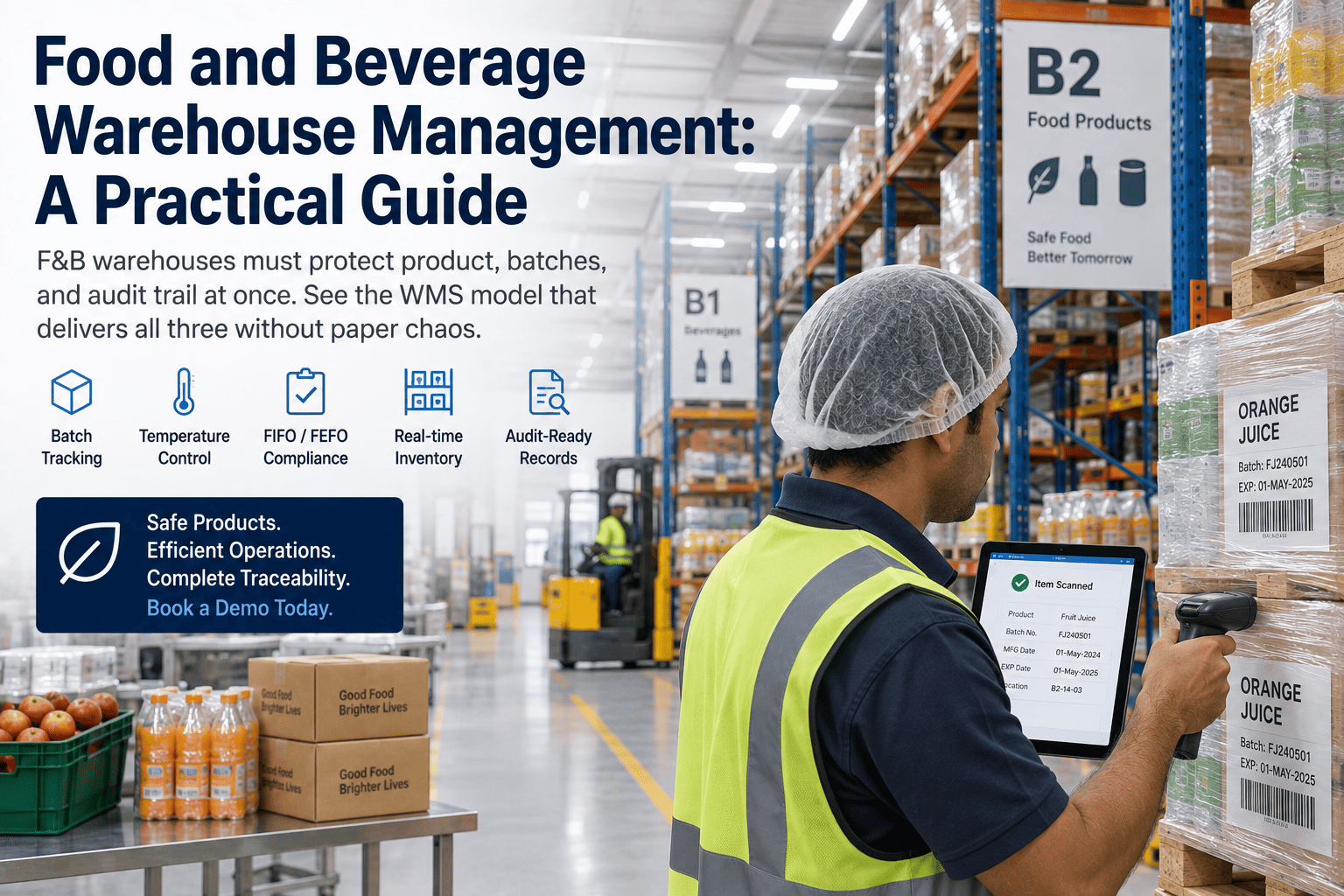
A food and beverage warehouse is asked to do something an ordinary warehouse never is: protect three things at once, on every pallet. It has to protect the product — the right temperature zone, away from allergens, moving fast enough to beat expiry. It has to protect the batch — which lot every case came from and where every case went. And it has to protect the audit trail — because when a recall asks "where is lot 4471 right now," the answer has to be a query, not a two-day hunt through paper. This guide walks through the operational model that delivers all three, written for the stores and supply-chain team who live it. You can book a demo to see it running.
Protect the Product, the Batch, and the Audit Trail — Without the Paper Chaos
An F&B warehouse has to get temperature, expiry, lot traceability, allergens, and compliance right on every movement. This guide covers the model that handles all of it as one connected workflow instead of five separate fights.
A General Warehouse Tracks Where Things Are. A Food Warehouse Tracks Whether They're Safe to Ship.
In a dry-goods warehouse, a pallet in the wrong slot is an inconvenience. In a food warehouse, a pallet in the wrong temperature zone, a lot picked out of expiry order, or an allergen stored above an open ingredient is a write-off, a rejected shipment, or a recall. The difference is that a food warehouse has to answer one question on every movement that a general warehouse never asks: not just "where is it," but "is it still safe and compliant to ship." That question has five moving parts, and managing them on paper or a generic system means fighting them one at a time.
This is why a generic WMS retrofitted onto a food operation tends to disappoint. It was built to optimize space and pick speed, and it treats every pallet as interchangeable inventory. A food warehouse can't afford that assumption for a second — two pallets of the same SKU with different expiry dates are not interchangeable, a chilled lot and an ambient lot are not interchangeable, and an allergen-containing case and an allergen-free one are actively dangerous to confuse. The specialized logic that keeps those distinctions straight on every movement is precisely what a general-purpose system lacks, and precisely what turns into risk when volume and pressure rise.
Every lot is aging from the moment it's received. Rotate by receipt date when you should rotate by expiry, and short-dated stock quietly ages out in a back rack while newer stock ships first.
Ambient, chilled, and frozen aren't just locations — they're conditions a product must never leave. A single excursion or a mis-slotted pallet can compromise a whole lot's safety.
Cross-contact is a safety event, not a housekeeping issue. Allergen-containing stock has to be segregated in storage and handled in the right pick sequence, every time, without relying on memory.
When a lot is implicated, the clock starts. Every hour spent reconstructing where that lot went from paper records is an hour the affected product sits in the supply chain.
FEFO vs. FIFO — and Why Using One Rule Everywhere Is the First Mistake
Rotation is the foundation of food warehouse discipline, and the single most common error is applying one rule across the whole facility. FIFO and FEFO are not interchangeable; the right one depends on the product, and a good system applies the correct rule at the SKU or lot level rather than plant-wide.
Ships by receipt order. Suitable for products with stable, long shelf lives — canned goods, rice, dry pasta, packaged snacks — where receipt date is a fair proxy for freshness.
Ships by expiry date, not receipt. Essential for perishables, because a later-received lot can expire sooner. Directs the pick to the shortest-dated stock regardless of when it arrived.
The answer isn't one or the other — it's both, configured per SKU. Dry goods on FIFO, perishables on FEFO, each enforced automatically at the pick so the operator never has to judge.
FEFO isn't only about waste. By consistently dispatching the shortest-dated stock first, it stops older lots from lingering and accumulating across distribution points. So when a recall does hit, the affected lot has been shipped to fewer locations over a shorter window — a smaller, faster, cheaper recall. Enforcing FEFO at the pick level, directing operators to the correct lot by durability date rather than leaving it to judgment, is what eliminates the rotation failures that manual systems can't prevent.
See Rotation Enforced at the Pick, Not Left to Judgment
iFactory applies FIFO or FEFO per SKU and directs every pick to the correct lot automatically — so rotation discipline stops depending on which operator is on shift.
Follow One Lot From the Receiving Dock to the Departing Truck
Everything traceability depends on comes down to one discipline: assigning a lot at receipt and never losing it. A food warehouse that tracks lots properly can answer, for any lot, where it came from, where it's stored, what's been picked, where it shipped, and what remains — the complete trail an audit, a customer query, or a recall demands. Here's the journey a lot should take.
Every incoming batch gets a lot number and its capture of expiry date, quantity, supplier, and any catch weight, scanned in at the dock so the record begins the moment product arrives.
The system directs the pallet to a location that matches its temperature zone and allergen status, so a lot is never stored somewhere that compromises it.
The lot sits in its correct zone with its expiry clock tracked, surfacing for rotation before it becomes short-dated rather than after.
When an order calls for the SKU, the operator is directed to the correct lot by the FIFO or FEFO rule, with allergen items sequenced to be handled last to prevent cross-contact.
A final scan at the dock confirms the right lots against the right order before the truck leaves, closing the trail with a verified link from lot to customer.
Four Rules the Warehouse Has to Enforce on Every Movement
Lot tracking is the spine, but a food warehouse layers several safety controls on top of it — each one a rule that has to hold on every put-away and every pick, not just when someone remembers. This is where a purpose-built approach separates from a generic one.
Put-away and picking are constrained to the product's required zone — ambient, chilled, or frozen — so a lot never lands in or moves through a condition it can't tolerate, with excursions logged against the record.
Allergen-containing stock is directed to segregated storage and picked in a sequence that keeps it away from allergen-free product, turning cross-contact prevention into an enforced rule rather than a trained habit.
A lot under investigation or awaiting release is flagged unpickable, so held stock physically cannot be selected into an order until quality clears it — the warehouse-floor half of batch disposition.
For variable-weight product, the actual weight of each unit is captured rather than assumed, so inventory, picking, and dispatch all reflect real quantities instead of nominal ones.
The Recall Test: From "How Many Days?" to "How Many Seconds?"
Everything above converges on the moment a food warehouse is really measured: a recall. The question is brutally simple — how many units of lot X are in the facility, where exactly are they, and where did the rest go — and the difference between a paper warehouse and a connected one is the difference between days and seconds.
- Reconstruct the lot's path from receiving logs and pick sheets
- Physically search racks to find remaining affected stock
- Cross-reference shipment paperwork to find where it went
- Hope no case was recorded wrong along the way
- Measure the response in days, while product sits in the field
- Query the lot to see every location instantly
- Held and affected stock flagged unpickable automatically
- Full movement history from receipt to each shipment on demand
- A complete, attributed trail with no gaps to hope through
- Containment measured in minutes, scope already minimized by FEFO
Why the Manual Warehouse Fails Quietly Until It Fails Loudly
Most food warehouses don't abandon paper because of one disaster — they do it because the small daily failures add up to a risk nobody can defend at audit. These are the cracks a manual or generic system leaves open.
When the operator decides which pallet to pick, the shortest-dated lot gets missed under pressure, and waste and near-expiry shipments follow.
A lot recorded at receiving but not at every move leaves holes in the trail — exactly the holes an auditor or a recall exposes.
Without an expiry clock surfacing stock before it's short-dated, write-offs are discovered at the pick face instead of prevented weeks earlier.
When the audit trail is a stack of forms, proving compliance means reconstructing it under deadline rather than pulling a record that already exists.
One System That Holds All Three at Once
The reason these controls are hard on paper is that they're treated as separate fights. iFactory's approach is to run them as one connected workflow, where lot, condition, rotation, and compliance travel together on every movement — so protecting the product, the batch, and the audit trail stops being three jobs and becomes one.
What Stores and Supply Chain Teams Ask
Protect Product, Batch, and Audit Trail as One Workflow
iFactory runs lot tracking, rotation, temperature, allergens, holds, and compliance as a single connected system from receiving to dispatch — so your food warehouse is recall-ready and audit-ready every day, not just when it's tested.