Legacy MES to AI-Native SPC: Future of Food & Beverage Quality Management
By James C on May 30, 2026
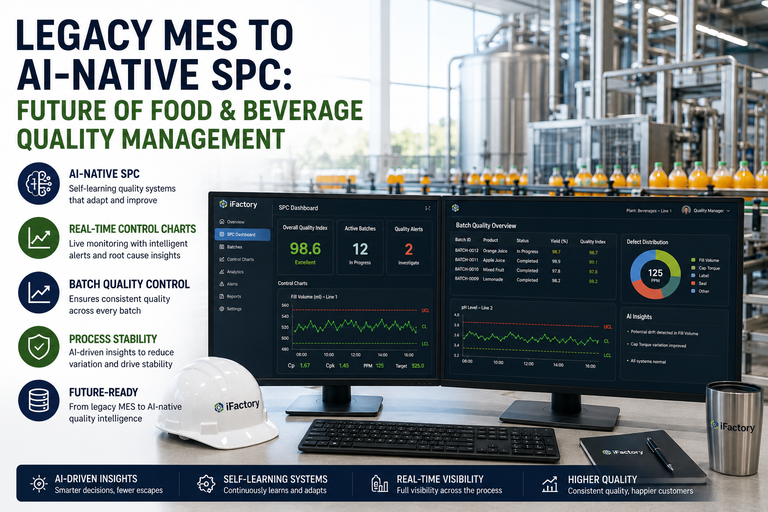
For a generation of food and beverage plants, SAP xMII was the digital glue of the shop floor — the layer that pulled tags off the line, calculated KPIs, and ran the SPC charts quality teams lived by. Then SAP set the clock: mainstream maintenance for SAP MII and ME ends in December 2027, with paid extended support to around 2030. No new roadmap, no new features, just an expiration date. That deadline is forcing a question bigger than "which platform replaces it." The SPC that legacy MES delivered was static — fixed control limits, rule-based alarms, charts that told you a process had drifted only after it already had. The migration moment is a chance to leap past a like-for-like rebuild to something fundamentally different: self-learning quality systems that adapt their own limits and catch drift before it happens. A move from legacy MES to AI-native SPC is less a migration than an upgrade in what quality control can do.
iFactory Quality Intelligence
Legacy MES to AI-Native SPC: The Future of Food & Beverage Quality Management
With SAP xMII reaching end of life, F&B plants can do more than rebuild old charts — self-learning quality systems and real-time control bring batch quality control into the AI era.
SAP has been direct: mainstream maintenance for SAP MII and ME ends December 2027, extended support runs to around 2030, and there is no new feature roadmap. For food and beverage plants that built years of OEE logic, KPIs, and SPC charts on the xMII workbench, that boxes up a lot of battle-tested work. The reflexive answer is a like-for-like migration to SAP's successor — but that path is neither cheap nor quick, and it preserves a model of SPC that was already a generation behind.
Stay on Legacy
Run MII to 2030 on extended support — rising cost, declining resources, no new capability, and a cliff at the end.
Like-for-Like Port
Rebuild on the SAP successor with clean-core, API-only architecture. BLS, xMII queries, and UIs can't be lifted — they must be redesigned, landing at 12-24 months.
Rationalize to AI-Native
Assess what's actually used, retire the 40-70% that isn't, and rebuild only what matters on an AI-native platform where SPC ships out of the box.
What "AI-Native SPC" Actually Means
The phrase is easy to dilute, so be precise. Legacy SPC was static: an engineer set fixed control limits once, the system alarmed when a point breached them, and capability was recalculated in scheduled studies. AI-native SPC is self-learning — it derives limits from the process itself, adapts them as conditions change, detects drift patterns before a limit is ever crossed, and gets sharper as it sees more production. It is the difference between a chart that reports the past and a system that anticipates it.
Legacy MES SPC
Static, Rule-Based, Reactive
Fixed control limits set manually and rarely revisited
Alarms fire only after a point breaches the limit — after drift
Capability recalculated in periodic studies, not continuously
One static ruleset across products that behave differently
AI-Native SPC
Self-Learning, Adaptive, Predictive
Limits derived from the process and adapted as conditions shift
Drift patterns flagged before any limit is crossed
Rolling capability computed continuously, sample by sample
Per-product, per-line models that learn each recipe's behavior
The Self-Learning Loop
What makes a quality system self-learning is a closed loop that improves itself. Instead of an engineer tuning thresholds and waiting for the next study, the system continuously learns the normal behavior of each process, watches live data against that learned baseline, flags meaningful deviations, and folds the outcome back into its model. Over time it knows your processes better than any static ruleset ever could.
How a Self-Learning Quality System Improves Itself
Learn & flag — the model sets each process's normal and catches deviation early
Watch & adapt — live data is scored, and every outcome sharpens the model
Why Food & Beverage Batch Quality Needs This
F&B is exactly the environment where static SPC struggles most. Recipes change, raw-material lots vary, seasons shift ingredient behavior, and lines run many products with different signatures. A single fixed ruleset cannot describe all of that — but a self-learning system that builds a model per product and per line can. This is where AI-native SPC earns its place in batch quality control.
Recipe & Product Variety
One line runs many SKUs with different normal behaviors. Per-product models learn each instead of forcing one static limit set across all.
Raw-Material Variation
Natural ingredients shift lot to lot and season to season. Adaptive limits distinguish that normal variation from a genuine special cause.
Batch & Continuous Mix
F&B blends batch and continuous steps; AI-native SPC handles both, tracking capability across dosing, cooking, filling, and packaging.
Giveaway & Compliance
Tighter, learned distributions cut overfill giveaway and give audit-ready capability evidence for FDA, HACCP, and GFSI in one system.
Want to see AI-native SPC run against your own batch data, not a rebuilt legacy chart? Book a 30-minute walkthrough and we'll model one of your products live.
The Migration Reality — and the Smarter Path
The honest truth about leaving xMII is that a full lift-and-rebuild is almost always the wrong economic decision. SAP's successor uses a clean-core, API-only architecture: BLS transactions, xMII queries, and SSCE pages cannot be reused — they must be redesigned, which is why full ports land at 12 to 24 months. But industry experience shows 40 to 70% of MII workbench artifacts in long-running deployments are unused, redundant, or replaceable by configuration. Rationalize first, and the project shrinks dramatically.
Logic that a modern platform ships out of the box — OEE, downtime, SPC — configured, not coded.
Transform
Custom logic that matters, ported to an event-driven workflow engine in modern form.
Keep
The genuinely unique, high-value logic worth carrying forward as-is.
Legacy as a Data Source, Not a Dependency
The architectural shift that makes all of this possible is treating the old platform as just another data source. In modern architectures — especially with a unified namespace — legacy MII becomes one feed among many rather than the system everything depends on. That decouples your future from the lifespan of any single tool: historian federation replaces the old query templates, SPC and OEE ship out of the box, and the custom logic that survives rationalization runs as event-driven services.
From xMII Deadline to AI-Native Quality
1
Assess
Inventory
Tag every MII artifact retire, replace, transform, or keep
2
Federate
Connect Data
Historian and line data feed the new platform; MII becomes one source
3
Deploy
AI-Native SPC
Self-learning charts and capability ship out of the box, per product
4
Operate
Self-Improve
The system learns each process and sharpens with every batch
What the Leap Delivers
Treating the xMII deadline as an upgrade rather than a chore changes the return. These figures reflect rationalized AI-native deployments versus full like-for-like ports across manufacturing.
~25%
Of full-port cost
rationalized AI-native path vs a complete SAP successor rebuild
~10 wk
To live, not 12-24 months
after retiring the artifacts that don't earn their place
Per-SKU
Learned models
instead of one static ruleset across every product
Predictive
Not reactive
drift caught before a limit is breached, not after
Every smart migration starts with knowing what to keep and what to leave behind. Want a rationalization assessment of your xMII estate? Talk to our migration engineers.
Frequently Asked Questions
When exactly does SAP xMII support end?
SAP has confirmed mainstream maintenance for SAP MII and ME ends in December 2027, with paid extended support available to around 2030. There is no new feature roadmap. Because complex migrations take 12 to 24 months, planning that starts in 2026 is already working against the clock — which is why the platform decision is pressing now, not in 2029.
Do we have to migrate to SAP's successor platform?
No — that's one option, not the only one. The practical choices are: run legacy to 2030 on extended support, do a like-for-like rebuild on the SAP successor, or rethink with a best-of-breed AI-native platform. The SAP successor uses clean-core, API-only architecture, so your existing BLS, queries, and UIs can't be reused regardless — meaning even the "stay with SAP" path is a rebuild, not a lift.
What makes AI-native SPC different from the SPC we ran in xMII?
Legacy SPC was static: an engineer set fixed limits, the system alarmed on a breach, and capability came from periodic studies. AI-native SPC is self-learning — it derives and adapts limits from the process, builds a model per product and line, flags drift before a limit is crossed, and computes capability continuously. It anticipates rather than reports, which matters enormously in F&B where products and lots vary constantly.
Won't we lose years of custom xMII logic?
Most of it you'll be glad to lose — industry experience shows 40 to 70% of MII artifacts in long-running deployments are unused, redundant, or replaceable by configuration. The right approach tags each artifact to retire, replace, transform, or keep, so dead logic is deleted, commodity logic like OEE and SPC is replaced by out-of-box capability, and only genuinely valuable custom logic is carried forward. You keep what matters and shed the rest.
How fast can a rationalized AI-native migration go live?
Far faster than a full port. Once you retire the artifacts that don't earn their place, the scope collapses — deployments have gone live in around 10 weeks at roughly 25% of a full SAP successor rebuild, with SPC, OEE, and downtime shipping out of the box and surviving custom logic ported as event-driven services. The legacy system can run as a data source during the transition, so there's no hard cutover cliff.
Don't Just Replace xMII. Outgrow It.
See AI-Native SPC on Your F&B Batch Data — in 30 Minutes
Bring a product line you run in volume. We'll show self-learning control charts adapting per SKU, rolling capability computed live, and drift flagged before a breach — then map the rationalized path from your xMII estate to AI-native quality, data source and all.