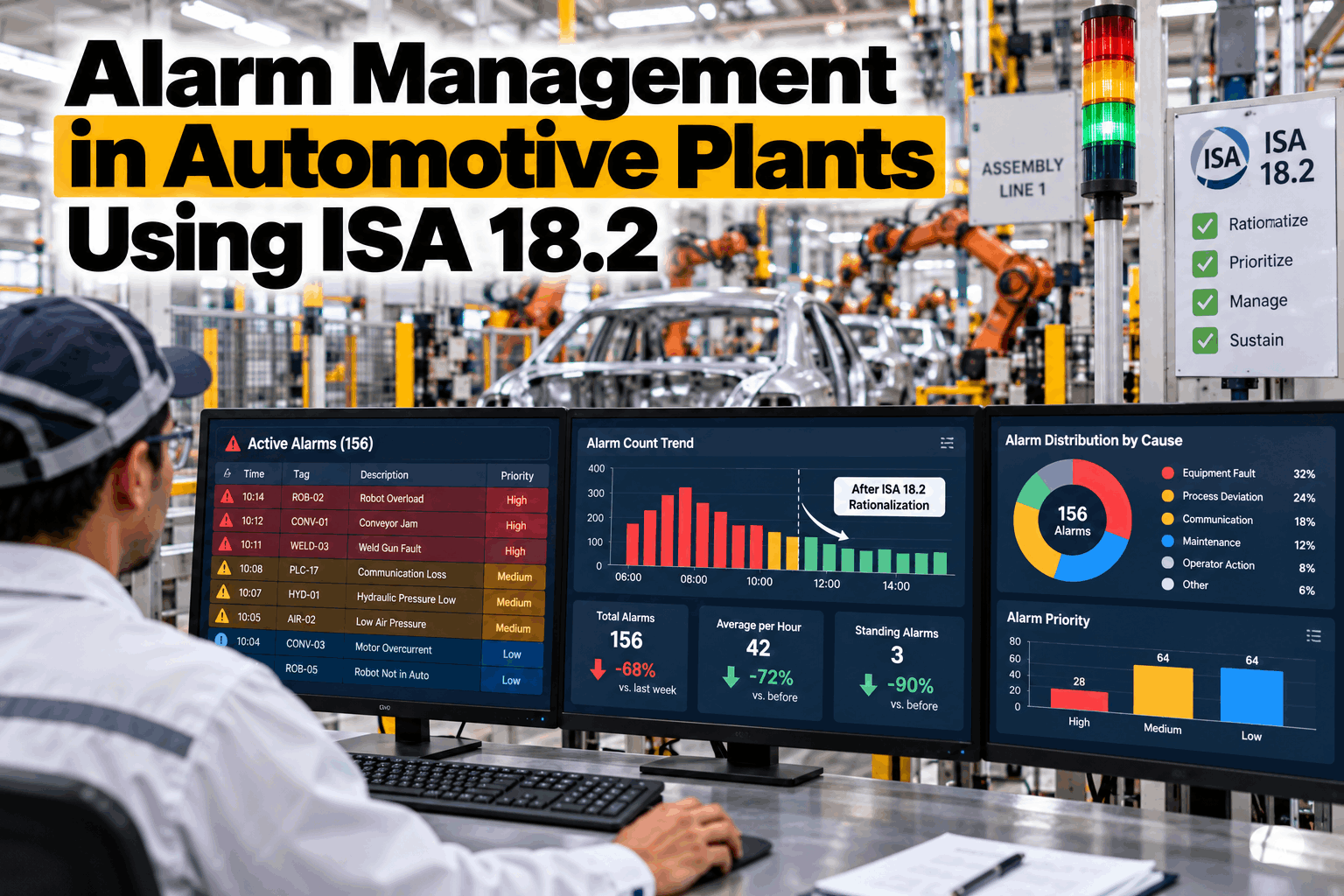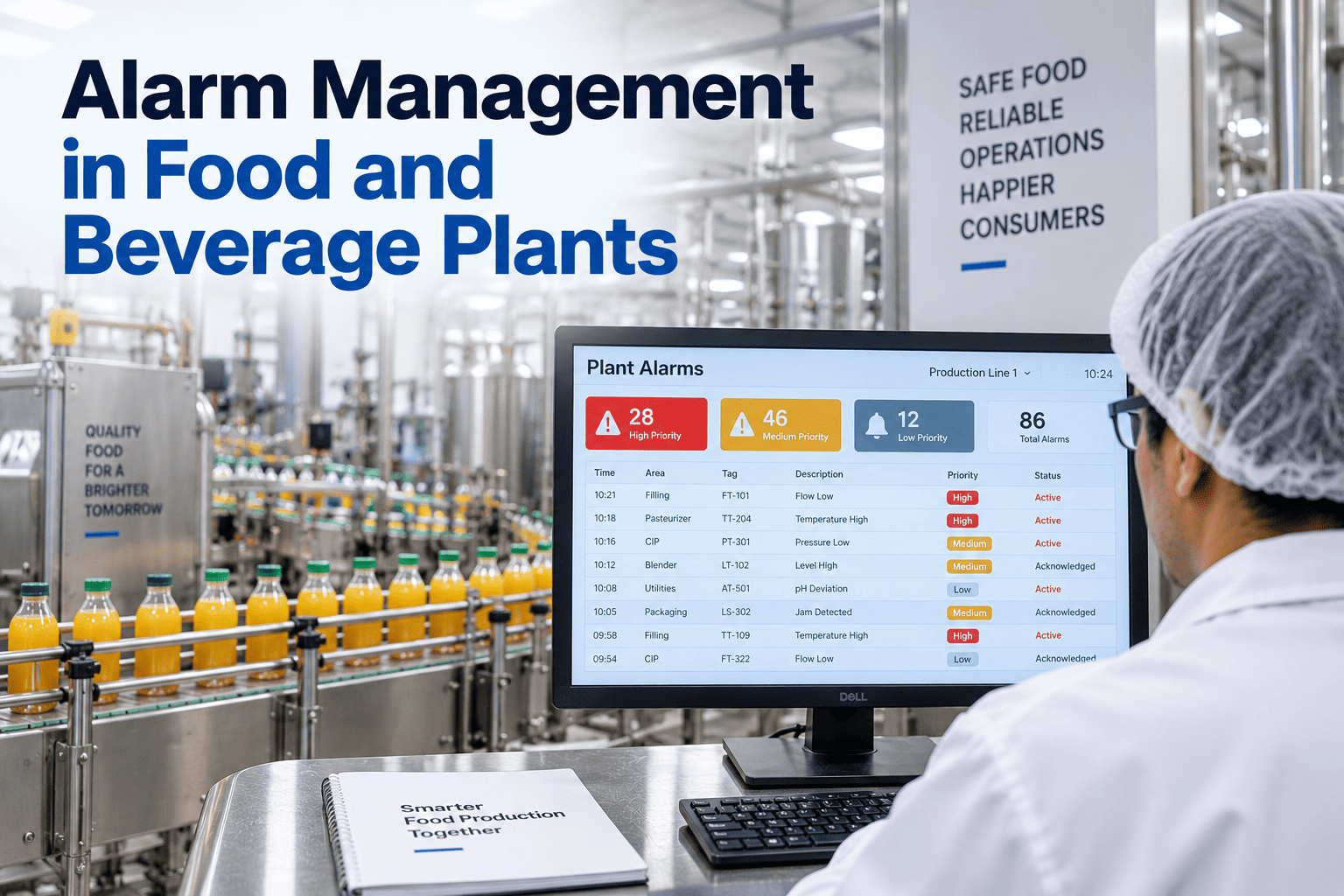
Ask a food plant operator how many alarms they saw last shift and the honest answer is: too many to count, and most of them didn't matter. A CIP cycle alone can throw dozens of temperature, flow, and conductivity alarms every wash; packaging lines chatter with photo-eye and jam alerts; refrigeration and batch phase changes add their own. By mid-shift the operator has learned to clear the annunciator without reading it — and that's the real danger, because buried in those hundreds of nuisance alarms is the one that's actually a food-safety event: a pasteurizer losing temperature, a CCP drifting out of limits. When every alarm looks the same, the critical one is invisible. ISA 18.2 rationalization cuts the noise — often by around 70% — so the alarm that matters is the one the operator sees. You can book a demo to see it against your own alarm data.
When Every Alarm Looks the Same, the Food-Safety One Is Invisible
Food operators see hundreds of alarms a shift and learn to ignore most of them. Applying ISA 18.2 rationalization to an F&B plant cuts the noise by around 70% — so the pasteurizer excursion isn't buried under CIP-cycle and packaging-jam alerts.
An Alarm System Only Works If the Operator Can Keep Up With It
The annunciator isn't broken when it throws hundreds of alarms a shift — it's doing exactly what it was configured to do. The failure is human: no operator can meaningfully process that volume, so they stop trying, clearing alarms reflexively rather than reading them. That learned dismissal is alarm fatigue, and in a food plant it's not just an efficiency problem — it's the mechanism by which a genuine food-safety alarm goes unseen. These are the ways an unmanaged food-plant alarm system generates the noise.
A clean-in-place sequence steps through temperature, flow, and conductivity setpoints, and an unrationalized system alarms on every transition — so a routine, expected wash generates a burst of alerts that mean nothing needs doing.
Photo-eyes, jam detectors, and micro-stops on a fast packaging line raise alarms constantly, most of which the line clears itself in seconds — high-frequency chatter that trains the operator to ignore the annunciator.
Many configured alarms require no operator response at all — a status change, an expected condition. ISA 18.2 is explicit that anything needing no response isn't an alarm; it's an indication, and leaving it as an alarm is pure nuisance load.
When priority isn't rationalized, alarms default to high, so nothing stands out — if almost everything is critical, then in practice nothing is, and the operator has no way to tell the pasteurizer trip from a full tote bin.
The Numbers That Separate a Usable Alarm System From a Flood
ISA 18.2, along with the closely related EEMUA 191 and IEC 62682, gives measurable targets for a single operator position. They're design and measurement benchmarks rather than pass-fail limits, but they're the numbers a rationalized system is built toward — and food plants measuring for the first time commonly run many times above them.
A compliant system averages under about six alarms an hour per operator during normal operation, and high-performing sites hold below two. EEMUA frames the same target as fewer than roughly twenty a day for a well-performing system — a world away from the hundreds a shift an unmanaged plant produces.
ISA 18.2 defines an alarm flood as more than ten alarms in any ten-minute period on one operator position — a rate high enough that the operator can no longer process each one, so the genuine fault is buried in the burst. In food plants, CIP starts and line faults are classic flood triggers.
A rationalized system reserves high priority for the small set of conditions that genuinely demand immediate action, targeting about 80% low, 15% medium, and 5% high. The priority distribution is the diagnostic most systems fail first — when everything is high, the split itself tells you the system isn't rationalized.
See Where Your Plant Sits Against the Benchmarks
iFactory measures your actual alarm rate, flood frequency, and priority split against ISA 18.2 and EEMUA 191 from your historian — so you can see the gap before you close it.
Every Alarm Earns Its Place, or It Isn't an Alarm
Rationalization is the heart of ISA 18.2: reviewing every configured alarm against a single test — does it require a specific operator action within a defined time? An alarm that survives gets a documented setpoint, priority, cause, consequence, and response; one that doesn't gets converted to an indication, re-tuned, or removed. The output is a master alarm database that becomes the plant's system of record, replacing tribal knowledge and scattered spreadsheets.
Each alarm is judged on whether it signals a real abnormal condition needing a specific operator response within a set time. If there's no action, it's not an alarm — it becomes an indication or event, which alone clears a large share of the nuisance load in a typical food plant.
Surviving alarms are scored against consequence severity and the time available to respond, using the plant's priority matrix — so a CCP temperature excursion sits above a routine level alert, and the high-priority tier is reserved for what genuinely demands immediate action.
Chattering alarms that oscillate around a setpoint are silenced with proper deadband — commonly a few percent of the process-variable span — so a tank level or temperature hovering near a limit stops generating a stream of repeat alarms that mean nothing.
Each rationalized alarm's setpoint, priority, cause, consequence, and expected response is documented in the master alarm database — the audit reference that makes the alarm system defensible and keeps it from drifting back to noise.
In a Food Plant, the Buried Alarm Is a Food-Safety Alarm
Every industry suffers from alarm floods, but the consequence in food and beverage is specific: the alarm most likely to be missed in the noise is often a food-safety-critical one. Rationalization in an F&B plant isn't only about operator efficiency — it's about making sure the alarm tied to a CCP or a hygiene-critical process is the one that stands out, not the one lost among CIP transitions.
A critical control point drifting out of limits — a pasteurizer under temperature, a metal detector fault — is a HACCP event. Rationalization puts it in the high-priority tier, distinct from the routine alerts it would otherwise hide among.
A CIP cycle's setpoint transitions are expected and need no response, so they're converted out of the alarm stream — which both cuts the noise and stops a genuine CIP fault from being lost among the routine steps.
Flow-diversion, batch-hold, and quality-hold conditions carry real consequence and are prioritized accordingly, so the operator reacts to a diversion event rather than acknowledging it reflexively with everything else.
Safety-instrumented alarms are never shelved or suppressed by the management layer — rationalization quiets the nuisance load around them precisely so the safety tier remains clear and always visible.
A Quiet Alarm System Drifts Loud Again Unless It's Monitored
The most common way alarm management fails is treating it as a one-off cleanup rather than a lifecycle. Setpoints get changed, new equipment adds alarms, and shelved alarms meant to be temporary quietly become permanent because nobody set an expiry. Without ongoing measurement, a system rationalized this year is back to noise within a couple of years. This is where software turns a binder into a living program.
Alarm rate, flood frequency, and the priority split are measured continuously against ISA 18.2 and EEMUA 191 benchmarks, so drift shows up as a trend rather than as a surprise at the next audit.
The tags generating the most alarms — the chattering and fleeting ones — are surfaced automatically, so the handful of bad actors responsible for most of the noise can be fixed rather than hunted for.
Temporary shelving gets a real expiry so a suppressed nuisance alarm doesn't silently become permanent — the specific drift that quietly erodes the gains from a rationalization effort.
Approved setpoints and priorities are pushed back to the DCS or SCADA with every change linked to its master-alarm-database entry, closing the management-of-change loop the standard requires.
The ISA 18.2 Lifecycle, Operationalized for a Food Plant
iFactory turns alarm management from a binder reviewed once a year into a living, monitored program: it builds and maintains the master alarm database, enforces prioritization, detects floods and chatter in real time, and reports performance against the benchmarks — all against your plant's own historian data.
What Food Plant Operations Teams Ask About Alarm Management
Make the Alarm That Matters the One Your Operators See
iFactory applies the full ISA 18.2 lifecycle to your food plant — benchmarking, rationalization into a master alarm database, and continuous monitoring — so nuisance noise drops around 70% and the food-safety-critical alarm always stands out.