Predictive maintenance in a food plant runs into a problem no other industry has quite the same way: the environment that keeps the food safe is actively hostile to the equipment that makes PdM work. High-pressure caustic washdowns, CIP cycles swinging from near-freezing to boiling, sanitary zones scrubbed daily — the same conditions that protect the product will destroy a standard vibration sensor in weeks. So F&B predictive maintenance is a hygiene problem before it's a reliability problem. Get the sensing, mounting, and CIP-noise filtering right and you can predict a filler, packer, conveyor, or CIP-pump failure weeks ahead — and fix it during a scheduled sanitation window instead of mid-run. Get them wrong and you've got blind spots where sensors keep dying, or a food-safety finding waiting to happen. You can book a demo to see it on your line.
PdM Where the Washdown Is as Dangerous to Your Sensors as to Bacteria
Fillers, packers, conveyors, and CIP systems run 24/7 under strict hygiene rules. Here's how predictive maintenance works on all of them — with washdown-survivable sensing, sanitary mounting, and AI that filters CIP noise — without breaking a single food-safety standard.
The Conditions That Keep Food Safe Are Lethal to Monitoring Equipment
In a dry factory, a condition-monitoring sensor lives an easy life. In a food plant, it's sprayed with pressurized water that can exceed a thousand PSI, doused in caustic and acid CIP chemistry, and cycled from cold to steam-hot every sanitation shift. That's why F&B predictive maintenance can't just borrow generic manufacturing hardware — the sensing has to survive the hygiene regime, and the way it's installed can't create a place for bacteria to hide. These are the constraints that make it different.
Sanitation sprayers routinely exceed 1,400 PSI, forcing water past the gaskets of anything not built for it. An IP67 sensor rated for gentle immersion fails in seconds under a washdown lance — the single most common F&B sensor mistake.
Clean-in-place cycles run pressurized caustic and acid solutions that corrode standard housings. Sensing hardware has to be chemically resistant stainless, not just water-sealed, or it degrades from the chemistry even when the seal holds.
CIP swings equipment surface temperature across a wide range every cycle, and repeated expansion and contraction is what eventually breaks a marginal seal. Sensors need a wide rated operating range to survive the cycling, not just a peak temperature.
A sensor bolted on with a standard bracket creates crevices where product and moisture collect and bacteria grow. Mounting has to follow sanitary design so the monitoring hardware never becomes the contamination risk it was added to help prevent.
Not Every Sensor Belongs in Every Part of the Plant
The practical starting point for F&B PdM is that hygiene requirements vary by where the asset sits, so the sensing spec follows the zone rather than a single plant-wide standard. Over-specifying everywhere wastes money; under-specifying in a wet zone guarantees dead sensors. Matching hardware to zone is what makes coverage both affordable and durable.
Product-contact and full-washdown areas demand the toughest spec: IP69K-rated, 316L stainless-steel housings, with sanitary 3-A-compliant mounting where hardware is near product-contact surfaces. This is the zone where nothing less than IP69K survives, and where mounting discipline matters most.
Splash zones near washdown but off the direct spray path can run IP67 or IP69K depending on exposure — still sealed and corrosion-resistant, but with more latitude than the direct-contact zone. Getting this judgment right is where zone-based specification saves cost without creating blind spots.
Dry-end and packaging areas away from washdown can use standard industrial sensors, since they never see the spray or the chemistry. Motor-current sensing in particular is best placed in the motor control center, entirely out of the wet environment, monitoring the asset without being exposed to it.
Get a Sensor Spec Matched to Your Plant's Zones
iFactory is sensor-agnostic and specifies the right hardware per asset and zone — IP69K where the washdown demands it, standard industrial where it doesn't — so coverage is durable and you're not overpaying.
What PdM Watches on Fillers, Packers, Conveyors, and CIP
Each of the core F&B asset classes fails in its own way and shows its own early signals, so PdM watches different things on each. The value is catching the specific degradation mode for each asset before it stops the line or compromises the product.
Fill-valve signatures, capper torque per head, and rotary-drive vibration reveal wear before it shows up as fill-accuracy drift or loose caps — quality problems that are also giveaway and rework. Monitoring catches the degrading head while the fill is still in spec.
Packaging lines see the highest downtime frequency in most F&B plants, and servo-motor, encoder, and drive faults are the usual cause. Motor-current and vibration signatures flag the servo or drive degrading so it's swapped on schedule, not mid-run.
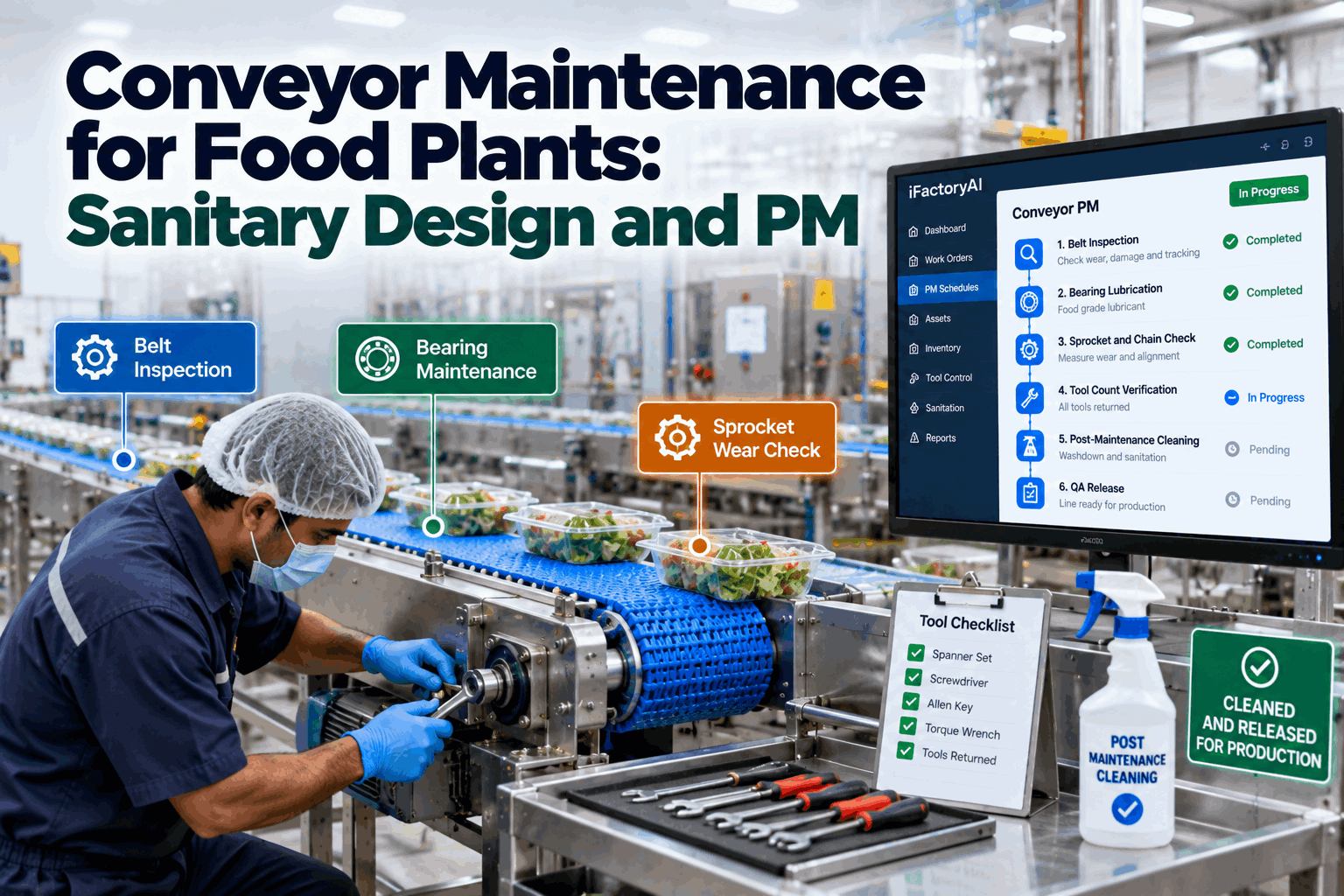
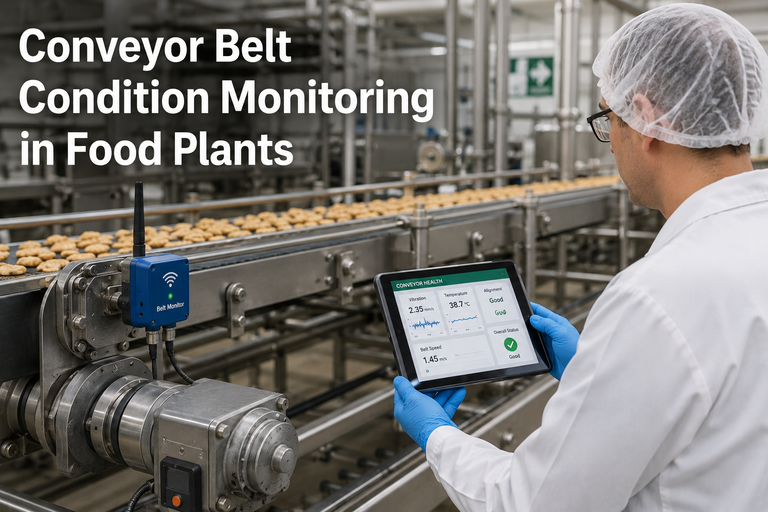
Conveyor drives and bearings — sometimes running through blast freezers or cookers — degrade from load and thermal stress. Vibration and temperature trends catch a failing bearing or misaligned drive, and the AI has to handle the extreme thermal shifts without crying wolf.
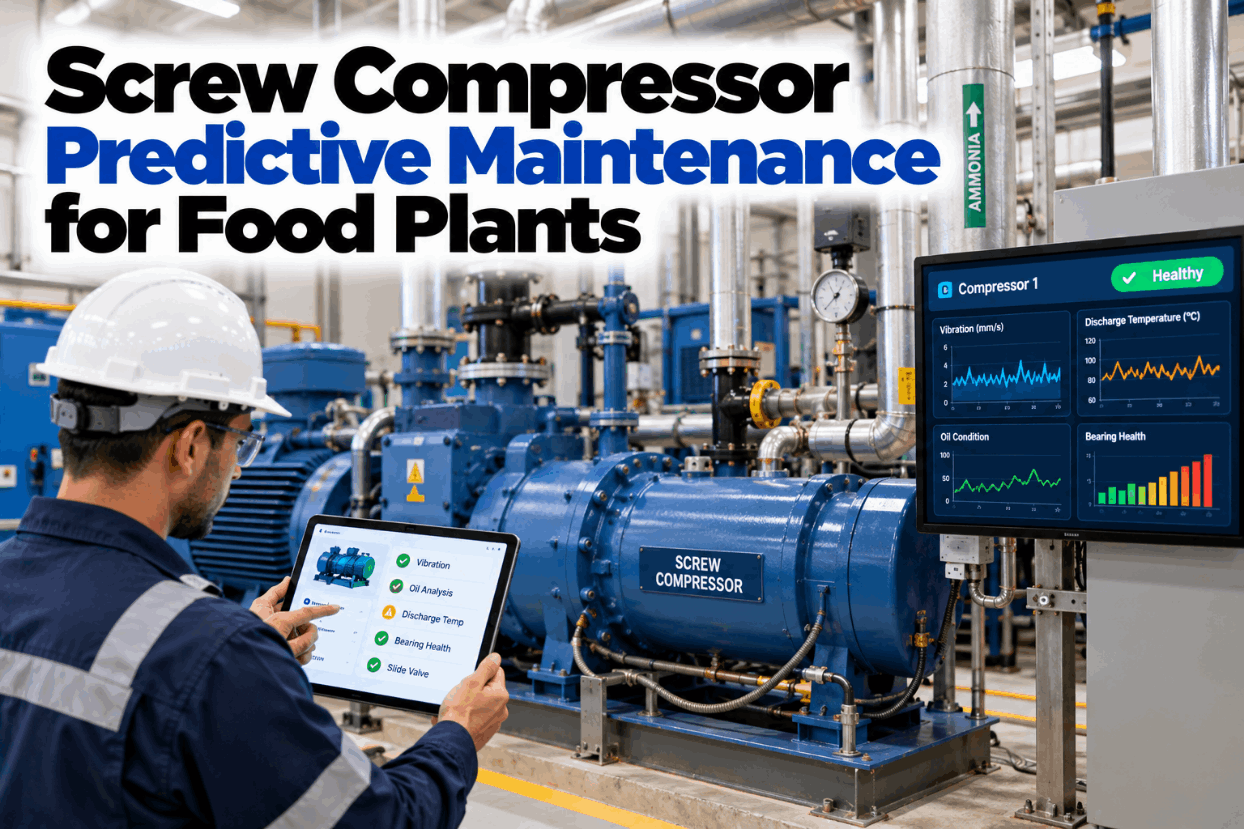
A failing CIP pump is not just a breakdown — if flow or pressure drops, the sanitation cycle itself is compromised, making it a food-safety event. Acoustic and vibration monitoring on CIP pumps protects the cleaning that protects the product.
In a Wet Plant, Moisture Ingress Is the Failure Chain to Watch
Beyond the general reliability signals, food plants have a signature failure chain that dry factories rarely see: moisture getting where it shouldn't. It's worth understanding on its own because it's both common and highly predictable, which makes it one of the highest-return things PdM catches in an F&B plant.
Repeated washdown and thermal cycling degrade a motor's shaft seal. Acoustic emission sensing can hear the seal condition change before moisture has meaningfully entered — the earliest point of intervention.
Once the seal is compromised, washdown water gets in — bearing grease washes out and winding insulation resistance begins to drop. Bearing vibration and online insulation-resistance trends both bend in this window, well before failure.
Left unchecked, falling insulation resistance ends in a ground-fault trip — a leading cause of unplanned line stoppages in wet processing areas, and one that hits without warning if nothing was watching the trend.
Because the chain unfolds over weeks, PdM turns it into a planned motor swap during a scheduled sanitation window rather than an emergency stoppage in the middle of production — which is the whole economic point.
The Hardest Part Isn't the Sensor — It's Ignoring the Wash Cycle
A washdown-proof sensor solves half the problem. The other half is that a CIP or SIP cycle looks, to a naive monitoring system, exactly like a violent abnormal event — huge swings in temperature, flow, and vibration that are completely normal. A PdM system that alarms on every wash cycle trains the maintenance team to ignore it, the same fatigue trap as a bad alarm system. The intelligence that separates the wash from the fault is what makes F&B PdM trustworthy.
The system learns what a CIP or SIP cycle looks like for each asset, so the enormous, regular signal of a sanitation cycle is recognized as normal rather than flagged as a fault every single time.
Fill-valve and capper signatures differ by container format — glass, PET, can — so baselines are learned per asset and per running format, and changeovers are detected so the model compares against the right normal.
With wash cycles and format changes accounted for, a genuine anomaly — a bearing signature drifting, a torque profile shifting — stands out against the correct baseline instead of being lost in expected variation.
Filtering the CIP noise is what keeps the alert stream credible, so when the system does raise a warning the team acts on it — the difference between PdM that gets used and PdM that gets muted.
Predictive Maintenance That Strengthens Food Safety Instead of Threatening It
Done right, PdM doesn't just avoid breaking food safety — it reinforces it. The same discipline that predicts a failure produces the records an auditor wants and protects the processes that keep product safe. This is how a reliability program fits inside a HACCP, FSMA, or ISO 22000 regime.
Sensors are installed and serviced during scheduled sanitation downtime, so adding condition monitoring never interrupts production or intrudes on a running food process.
By keeping CIP pumps, refrigeration, and pasteurizer-related equipment healthy, PdM directly protects the processes food safety depends on — reliability and hygiene pulling in the same direction.
Every prediction, work order, and intervention is logged, so the maintenance history stands up to HACCP, FSMA, and ISO 22000 audits as documented evidence rather than reconstructed notes.
Manual pre-op inspection, sanitation line-clearance, and CCP observations can be captured alongside the sensor data, so the human checks and the machine signals live in one reliability record.
Washdown-Ready Sensing, CIP-Aware AI, One Reliability Record
iFactory delivers F&B predictive maintenance as a complete loop: the right sensor for each asset and zone, AI trained to tell a wash cycle from a fault, and a maintenance record built for the audit — so you predict failures across fillers, packers, conveyors, and CIP without ever compromising hygiene.
What F&B Maintenance Teams Ask About Predictive Maintenance
Predict Failures Across Your Line Without Compromising Hygiene
iFactory brings washdown-ready sensing, CIP-aware AI, and an audit-ready record to fillers, packers, conveyors, and CIP systems — so you catch failures weeks ahead and fix them on schedule, all inside your food-safety regime.