Mixer and Blender Maintenance for Food Plants: PM Guide

By James C on October 22, 2026

mixer-blender-maintenance-food-plants-pm-guide

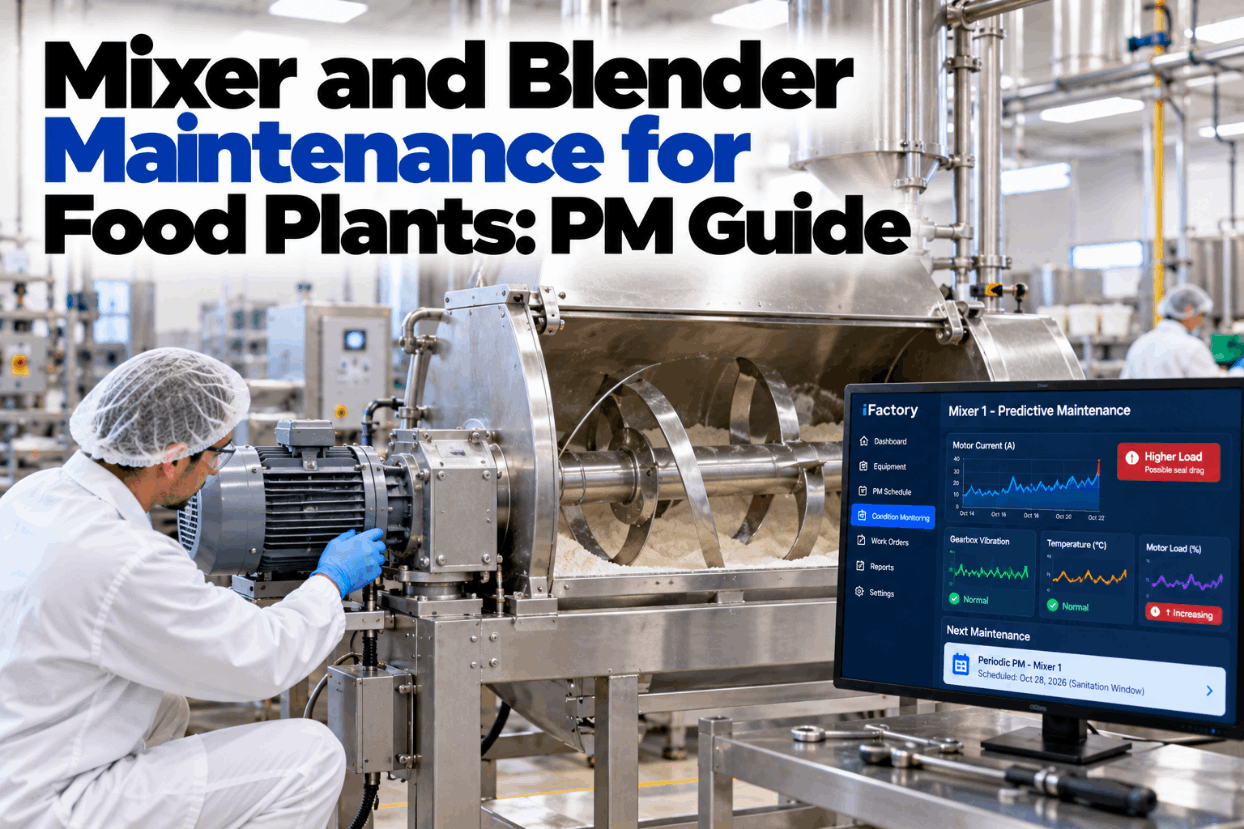
Mixers and blenders sit at the start of most food processes, so when one stops, everything downstream waits. Most failures give warning: a shaft seal that starts to drag, gearbox oil that darkens, a bowl lift that slows. The trouble is that those signs are easy to miss between batches, and PMs are hard to fit around production. This guide covers the wear points of the main mixer types, a PM template with starting frequencies and how motor load per batch shows wear early. See it on live mixer data in a short mixer maintenance demo.

PREDICTIVE AI + PM · MIXERS AND BLENDERS

Catch Seal Drag and Gearbox Wear in the Motor Load, Fix It in the Sanitation Window

iFactory reads motor amp signatures for every batch to detect seal drag and gearbox wear early. When a mixer needs work, the PM is scheduled into the next sanitation window automatically, so maintenance does not take production time.

Mixer 3 · Horizontal doughSeal drag likely
Peak amps per batch · recipe W-12 · same fill weight
Batch 1Batch 8
No-load ampsRising
vs recipe baseline+9%
Gearbox oilCheck due
PM booked · Tuesday sanitation window, 00:30
BATCH MIXER TYPES

Four Mixer Families, Four Different Weak Spots

Each mixer type wears in its own way. A ribbon blender moving dry powder grinds at its shaft seals, while a high-shear mixer running sauces wears its rotor and stator. Start your PM plan by listing each mixer by type, product and duty, then focus on the parts that type is known to wear. Sort your mixer fleet with our reliability team.

Ribbon blenderPowders, premixes, spices

Inner and outer helical ribbons in a U-shaped trough move product in opposite directions.

Shaft end sealsRibbon clearanceDischarge gateGearbox
Paddle mixerFragile or mixed particles, wet and dry

Paddles on one or two shafts lift and fold product with a gentler action.

Paddle tipsShaft sealsBearingsDischarge gate
Spiral and horizontal doughBread, bun and biscuit dough

Spiral mixers turn the bowl and hook separately. Horizontal mixers tilt the bowl to discharge.

Drive beltsBowl tilt hydraulicsAgitator end sealsCover interlock
High-shear mixerSauces, dressings, emulsions

A rotor spins close inside a stator at high speed to break up and disperse ingredients.

Mechanical sealsRotor-stator gapBearingsVibration
MIXER BLENDER MAINTENANCE FOOD

Seven Wear Points on a Horizontal Batch Mixer

The drawing shows a ribbon or paddle mixer, but most batch mixers share the same chain: motor, coupling, gearbox, bearings, seals, agitator and discharge. A failure anywhere in that chain shows up first as noise, heat, leakage or extra motor load. Map the wear points on your own mixers in a mixer walk-down session.

1234567
1Motor and couplingHeat, alignment, worn coupling elements
2GearboxOil level and colour, noise, case temperature
3BearingsNoise, heat, grease purge, vibration
4Shaft seals or packingProduct leaking out, drag, shaft scoring
5Agitator shaft and ribbonBent arms, cracks, clearance to the trough
6Discharge gateSeal wear, slow opening, product build-up
7Cover and interlockAgitator must stop when the cover opens
+Not shown: bowl liftHydraulic hoses, cylinder seals, drift on dough mixers
AGITATOR SEAL

Shaft Seals Are a Food Safety Part, Not Just a Wear Part

A leaking seal lets product escape into places sanitation can't reach, and a failing seal can let packing fibres or lubricant into the batch. Braided packing in a stuffing box needs regular adjustment, and over-tightening heats the packing and can score the shaft. Choose packing and lubricants suitable for food contact, using H1-registered lubricants wherever incidental contact is possible. Review your seal choices with our support team.

Braided packing
Wears byFriction on the shaft, powder working into the rings
Watch forLeakage, heat at the gland, constant re-tightening
PM taskCheck leakage and adjust gland evenly
Lip seal
Wears byAbrasive product under the lip, dry running
Watch forProduct weeping at the shaft, a grooved shaft
PM taskInspect lip and shaft surface, replace as set
Mechanical seal
Wears byFace wear, dry running, flush loss on double seals
Watch forFlush fluid loss, heat, product on the outboard side
PM taskCheck flush flow and level each shift
Air-purge seal
Wears byLittle contact wear, depends on the air supply
Watch forLow purge pressure, wet or oily air
PM taskCheck purge pressure and air filters
MOTOR AMP SIGNATURE

Four Load Patterns and What They Usually Mean

Motor current rises with the work the agitator does. Dough mixer makers have long used motor power to judge dough development, and the same signal shows mechanical wear. The trick is comparing like with like: same recipe, same fill weight and same mixing phase. A short no-load reading at the start of each run separates mechanical drag from product load, because a dragging seal adds load even when the trough is empty. See the patterns on your own mixers in an amp trend review.

No-load and batch amps both risingMechanical drag: seal, bearing or gearbox. Check the seal first.
Batch amps up for one recipe onlyProduct, not machine: viscosity, ingredient temperature, fill weight or formula.
Load swings once per turnMisalignment, a bent shaft or arm, a damaged gear tooth or coupling.
Batch amps fallingBelt slip, a worn coupling, under-fill or, on high-shear mixers, rotor-stator wear.

Every Batch Becomes a Health Check

iFactory records the amp signature of each batch against its recipe, flags drag and gearbox wear as the trend builds and books the PM into the next sanitation window, with the right parts and the LOTO steps attached.

Maintenance planner and iFactory · Monday
PlannerWhy is Mixer 3 on this week's list?
iFactoryNo-load amps have risen over 8 batches of W-12 at the same fill weight. Batch amps rose by the same amount, which points to drag at the seals rather than the dough.
PlannerWhen can we get at it?
iFactoryTuesday's sanitation window, 00:30 to 02:00, after dry clean and before wash. Packing set and gland tools reserved.
MIXER BLENDER MAINTENANCE FOOD TEMPLATE

A PM Template With Starting Frequencies

Use these frequencies as a starting point only. The OEM manual sets the baseline, and your own failure history and amp trends should move tasks earlier or later. Tasks tagged LOTO need full lockout, which is why they fit best inside a sanitation window. Get an editable version from our support team.

Each shift
Listen for new noise at bearings and gearboxLook for leaks at seals and discharge gateCheck flush level on double mechanical sealsConfirm cover interlock stops the agitator
Weekly
Check packing leakage, adjust gland evenlyCheck belt tension and wearCheck hydraulic oil level, hoses for weeping
Monthly
Gearbox oil level and colourGrease bearings with H1 grease, as the OEM setsInspect discharge gate sealCheck agitator for cracks and bent arms
Quarterly
Gearbox oil sample for wear metals and waterCheck agitator clearance to the troughCheck coupling and motor alignment
Yearly or by hours
Gearbox oil changeRepack or replace shaft sealsBowl lift cylinder seals and hoses
MIXER BLENDER MAINTENANCE FOOD FOR PLANT MANAGERS

Put the PM Inside the Sanitation Window

A mixer is already stopped, locked out and opened up during sanitation. Doing the PM in that window means no extra lost production. Order matters: maintenance after dry clean and before the wash lets sanitation clean up any grease, swarf or handling marks the work leaves. A PM done after the wash means re-cleaning the parts touched. Plan your windows in a schedule planning session.

22:0000:0002:0004:0006:00
LOTO, dry clean
PM slot
Wash and sanitize
Pre-op, start
Maintenance before washSanitation cleans up after the work, not the other way round.
Parts kitted the day beforeA window is too short to wait for stores.
Hand back in writingTools counted, guards on, LOTO removed by the people who applied it.
LOTO AND CONFINED SPACE

Isolate Every Energy Source, Then Decide on Entry

OSHA's lockout/tagout standard, 29 CFR 1910.147, applies whenever someone removes a guard or puts a body part into the danger zone, and its steps run from shutdown through isolation, stored energy release and verification. For bakery mixers, the bakery equipment standard, 1910.263, also requires a manual switch on each mixer that prevents starting during service and cleaning. A mixer usually has more than one energy source. Check your procedures with our safety specialists.

ElectricalAgitator motor, bowl drive, heaters
HydraulicBowl lift or tilt, with stored pressure
PneumaticDischarge gates, air-purge seals
GravityA raised bowl or a cover that can fall
ThermalSteam or glycol in the jacket
MechanicalAgitator that can turn by hand or by product weight
Is entry into a large mixer a confined space? OSHA 1910.146 asks three things
1Large enough for a worker to bodily enter and work
2Limited or restricted means of entry or exit
3Not designed for continuous occupancy
All three yes means a confined space. It needs a permit if it also holds a hazard such as engulfment by product, a hazardous atmosphere or another serious hazard, which an agitator can be.
MIXER BLENDER MAINTENANCE FOOD EXAMPLES

Three Illustrations From Batch Data

These are illustrations of how the patterns usually play out, not case studies. Real causes are confirmed on the machine. Walk through your own mixer history in a data review.

Ribbon blender · premix
No-load amps creep up after a repackThe gland was tightened unevenly. Adjusted in the next window, and no-load amps returned to the earlier level.
Spiral mixer · bread dough
Bowl motor amps fall mid-batchA slipping drive belt. Tension checked and the belt replaced before it failed during production.
High-shear · dressing
Amps rise on one recipe onlyA new oil supplier changed viscosity. No machine fault, and the recipe baseline was reset.
MIXER BLENDER MAINTENANCE FOOD COST AND ROI

Count the Production Hours PMs Take Today

The plainest saving is production time no longer lost to planned maintenance. Use your own figures. The worksheet below uses assumed inputs to show the arithmetic only. Our support team can help you build the case with your own PM records.

Mixers and blenders on site6, assumed
Planned PM hours per mixer per month taken from production3, assumed
Share that can move into sanitation windows2 of 3 hours, assumed
Production hours returned per month6 × 2 = 12 hours
TURNKEY AI DEPLOYMENT

Motor Analytics and PM Scheduling on a Ready-Built AI Server

iFactory delivers Predictive AI and PM as a turnkey package. A pre-configured NVIDIA AI server ships racked and ready, with the amp signature models and scheduling rules pre-loaded, so batch data is analysed on site. You rack it, plug in power and Ethernet, and the AI is live. Scope it for your mixers with a turnkey quote.

What's Included
  • Pre-configured NVIDIA AI server, racked and ready
  • Current sensors or drive data links for mixer motors
  • Recipe and batch links for like-for-like baselines
  • Amp signature models for drag and gearbox wear
  • PM templates by mixer type, with LOTO steps
  • Scheduling into sanitation windows
  • Training and 24×7 remote monitoring
Live in 6–12 weeks
Wk 1–4
Connect and Install

Server racked, motor current and batch data linked, mixers sorted by type.

Wk 5–8
Baseline and Load PMs

Recipe baselines learned while PM templates and windows are set up.

Wk 9–12
Go-Live and Tune

Alerts switched on, planners trained, thresholds tuned with your team.

HOW iFACTORY FITS

Mixer and Blender Maintenance Software That Listens to the Motor

iFactory joins batch data, motor load and the sanitation schedule, so wear is found early and fixed without lost production. Our support team can outline a pilot on two or three mixers.

1
Amp signatures per batch. Every batch is compared with its own recipe baseline at the same fill and phase.
2
Detects seal drag early. No-load and batch load trends separate seal drag from product changes.
3
Flags gearbox wear. Load swings and rising drag point to the gearbox before it fails.
4
PMs in sanitation windows. Work is booked automatically after dry clean and before the wash.
1000+
Industrial clients running iFactory
99.9%
Platform uptime for continuous processing
6-12 wks
From racked server to live mixer alerts
FREQUENTLY ASKED QUESTIONS

What Maintenance Leaders Ask About Mixer and Blender PM

How often should an industrial mixer have PM?
Start from the OEM manual, then adjust with your own history. Quick checks such as leaks, noise and interlocks suit every shift, belt and packing checks suit weekly, and gearbox oil, seals and alignment run monthly to yearly. Amp trends tell you when a task should come sooner.
How does motor current show seal drag?
A dragging seal adds load whether or not product is in the mixer. If the no-load reading at the start of each run rises, and batch amps rise by about the same amount at the same recipe and fill, the extra load is mechanical rather than a thicker product.
What lubricant should we use on a food mixer?
Use lubricants registered as H1 wherever incidental food contact is possible, such as bearings and seals near the product zone, and follow the OEM for grade and quantity. Keep food-grade and non-food-grade lubricants clearly separated in stores to avoid mix-ups.
Is a large mixer a confined space?
It can be. Under OSHA 1910.146, a space a worker can bodily enter, with limited entry or exit, not designed for continuous occupancy, is a confined space. It becomes permit-required if it also holds a serious hazard, such as engulfment by product or a moving agitator.
Why do PM before the wash, not after?
Maintenance leaves grease, swarf and handling marks. Doing it after dry clean and before the wash lets sanitation clean up afterwards. Work done after the wash means the touched parts must be cleaned and sanitized again before pre-op.
How do we start?
Pick two or three mixers with the most unplanned stops, connect their motor current and batch data, and load the PM template for their type. Let baselines build for a few weeks before switching on alerts. Our support team can plan that pilot with you.

Fix Mixers in the Window, Not in the Middle of a Run

Track amp signatures per batch, spot seal drag and gearbox wear early and let PMs land in sanitation windows automatically. The full system is delivered turnkey and goes live in 6 to 12 weeks.


Example weekly mixer summary
Mixers tracked6, every batch
FlaggedMixer 3, seal drag
PMs booked4, all in sanitation windows
Production time usedNone planned
Every PM linked to its batch evidence

Share This Story, Choose Your Platform!