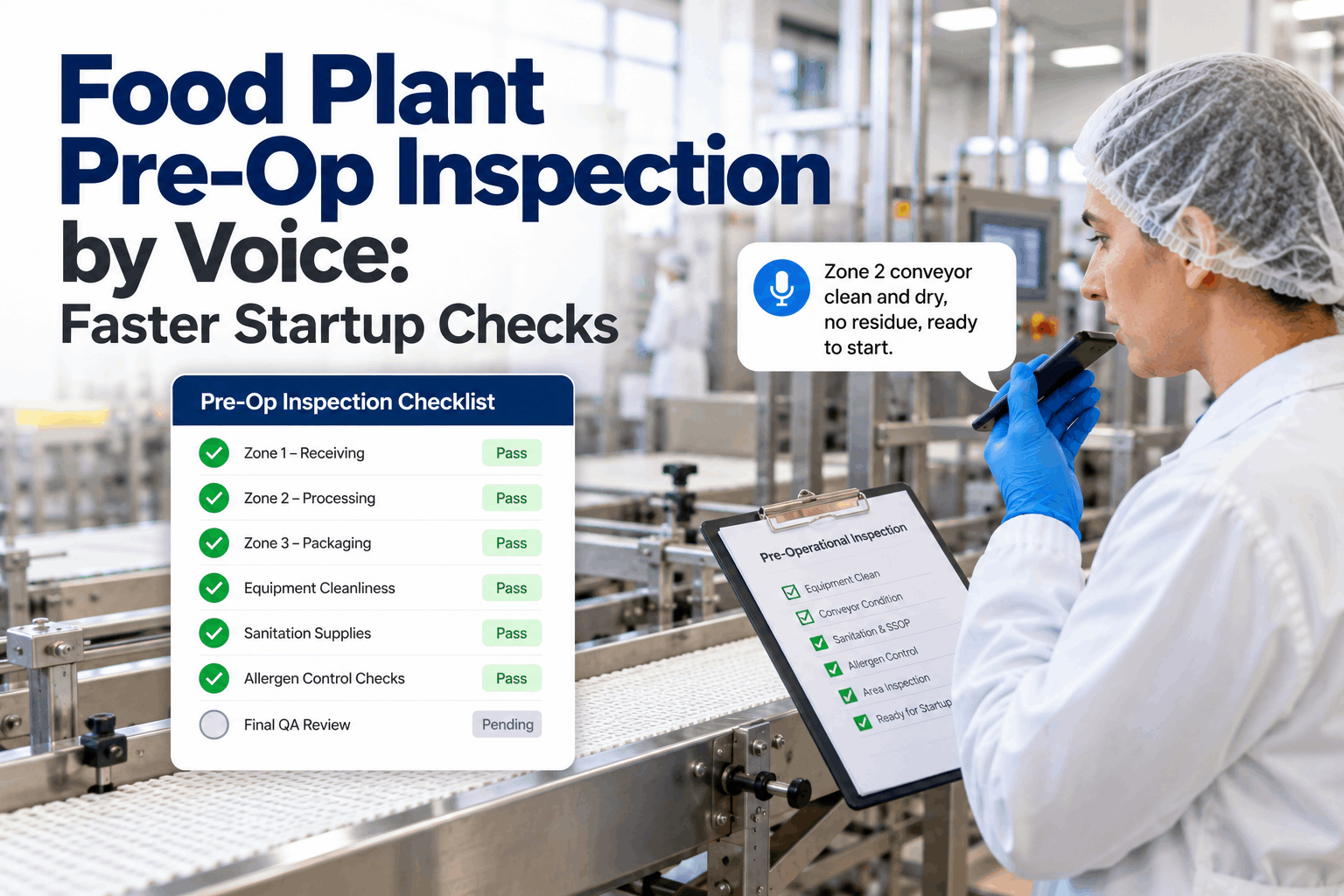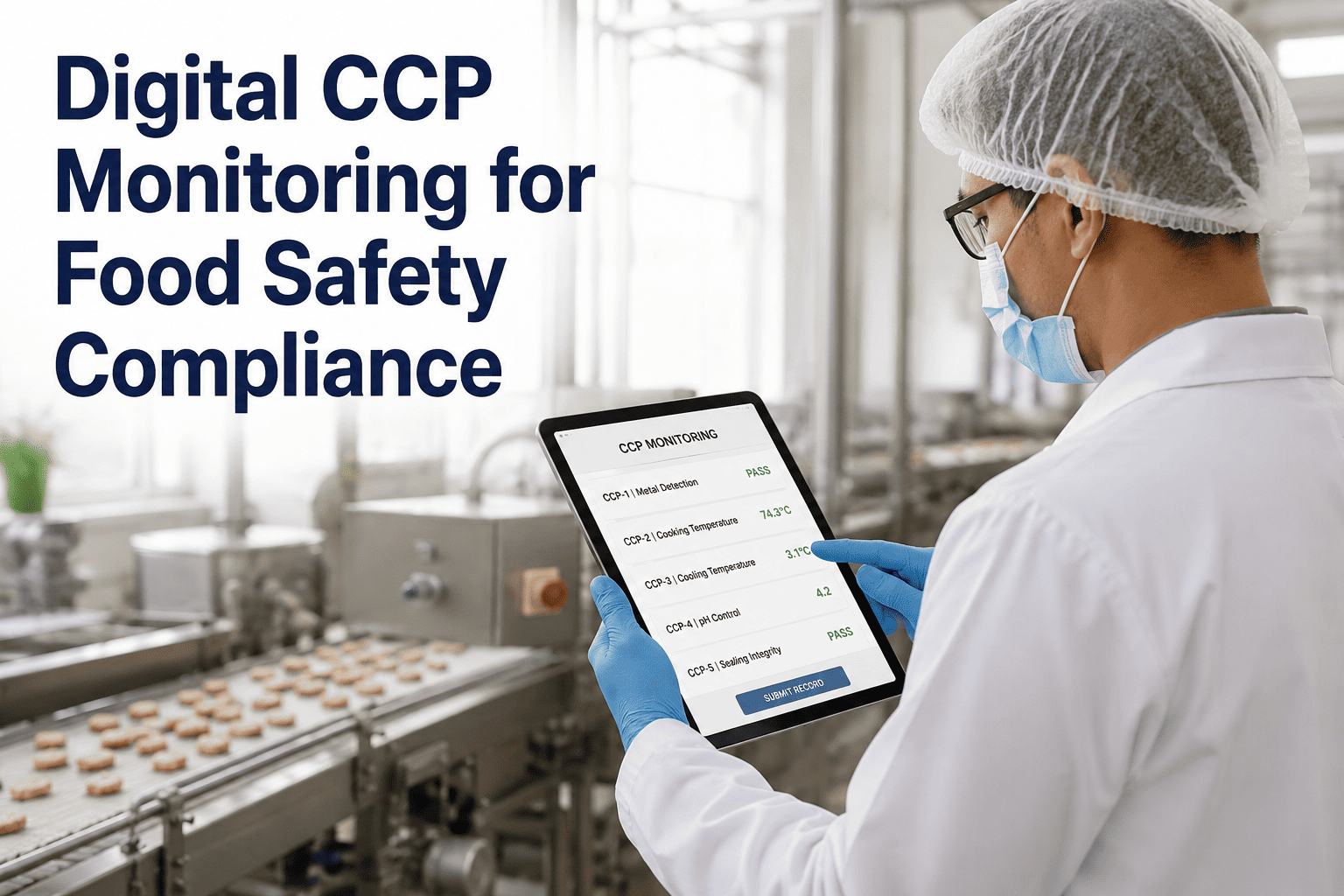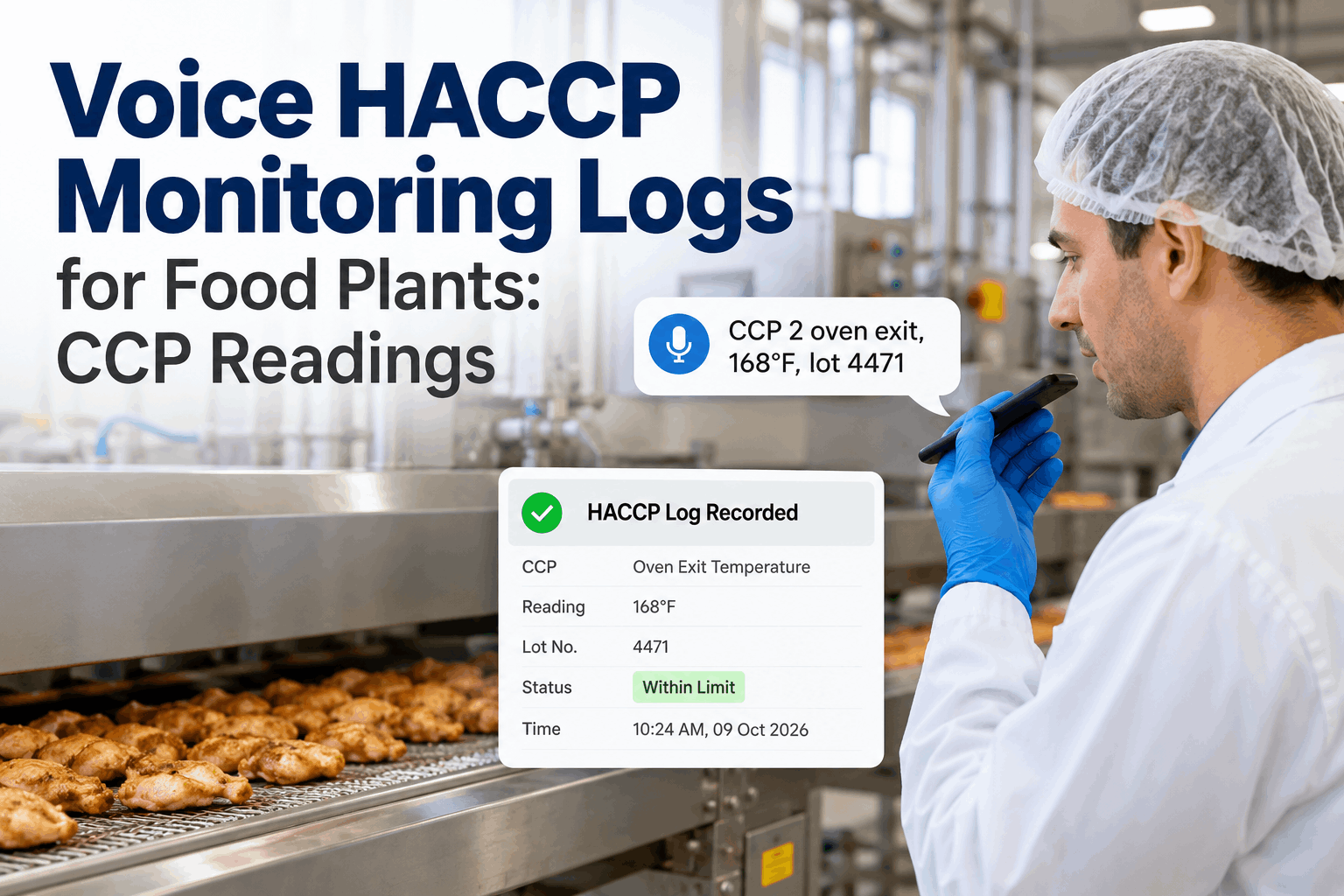
An operator checks the oven exit, reads 168°F and walks back to a clipboard with greasy gloves. By the time it is written, the time is a guess and the initials a scrawl. Across every CCP and shift, HACCP records become the weakest link. This guide shows how voice logs capture each reading as it happens. Start with a HACCP log review.
Voice HACCP Monitoring Logs for Food Plants: CCP Readings
Operators speak each CCP reading as they take it. AI checks the critical limit, stamps the time and operator, links the lot and, if a limit is missed, holds the product and opens a corrective action on the spot.
- What a HACCP monitoring record must contain
- How a spoken reading becomes a compliant record
- What happens the moment a critical limit is missed
"CCP 2 oven exit, 168°F, lot 4471."
Why Paper CCP Logs Fail
The reading is correct. The record is where it goes wrong.
Most HACCP problems found in audits are not unsafe product. They are records that cannot prove the product was safe: a missing time, a blank initial, a reading written up at the end of the shift or a value that sits just outside the limit with no corrective action beside it. Paper logs make these gaps easy, because writing is slow, gloves are dirty and the line keeps moving. Our food safety team can show where your logs are weakest.
Back-filled readings
Values written up after the event, with times that are guesses.
Missing initials
Entries that cannot be tied to the person who took the reading.
Silent deviations
A value outside the limit written down with no corrective action.
Slow review
Pre-shipment review held up while QA hunts through clipboards.
When recording a reading takes longer than taking it, people batch the writing. Make recording faster than the reading itself, and the habit of filling logs later fades on its own. The goal is a record made in the same few seconds as the measurement.
What a HACCP Monitoring Record Must Contain
Regulators ask for the same core facts on every entry.
USDA FSIS rules for meat and poultry under 9 CFR 417.5 spell out HACCP record requirements clearly, and FDA preventive control records follow similar principles. Each monitoring entry, for every CCP, must show the actual measured value, the date and time it was made and the initials or signature of the person who made it. Electronic records are allowed when controls protect the data and signatures. Check your records against these points in a record audit.
Actual reading
The measured temperature, time or check result, not just "OK".
Date and time
Recorded at the time of the event, not at the end of the shift.
Initials or signature
Each entry tied to the employee who made it.
Product identity
Lot, product and CCP, so the record links to what was made.
Corrective action
Any deviation recorded with cause, product disposition and prevention.
Pre-shipment review
Records checked for completeness before product leaves the plant.
9 CFR 417.5 accepts computer-kept records when controls protect the data and signatures. That means unique user identity, records that cannot be quietly edited and an audit trail of any correction. Voice logs should meet the same bar, with each operator signed in to their own headset or device at the start of the shift.
How Voice Monitoring Logs Work
Speak the reading, and the system does the paperwork.
The operator wears a headset or uses a rugged handheld, whichever suits the work area best. At each CCP, they say the point, the reading and the lot. The voice agent turns speech into a structured record, checks the value against the critical limit in your HACCP plan and saves it with time and identity. Out-of-limit readings trigger the corrective action path at once, while the operator is still standing at the CCP. Questions on the flow go to our support desk.
Speak
"CCP 2 oven exit, 168°F, lot 4471."
Understand
CCP, value, unit and lot pulled out of the phrase.
Check the limit
Value compared with the critical limit for that CCP.
Stamp and save
Time, operator and device added, record locked.
Confirm or act
Spoken confirmation, or hold and corrective action.
Critical limits shown are examples. Your validated HACCP plan sets the actual limits for each CCP.
What Voice Logging Saves Each Shift
Every reading spoken instead of written saves walking, writing and later checking. Across a plant with many CCPs, the time adds up fast, and the records get better at the same time.
When a Critical Limit Is Missed
The first minutes after a deviation decide how much product is at risk.
A HACCP plan must say what happens when a critical limit is not met: find the cause, make sure no unsafe product reaches customers and stop it happening again. On paper, the deviation is often noticed hours later, during review, after more product has passed the same point. With voice logging, the system knows at once and starts the response while the product is still in the plant. Plan your corrective action paths in a deviation workshop.
Hold the product
The lot is placed on hold in the system before it can move to packing or shipping.
Alert the right people
The line lead and QA get the reading, CCP and lot on their phones within seconds.
Correct the process
The operator is prompted with the corrective step from the plan.
Decide on the product
QA records disposition: re-process, evaluate or destroy.
Record and prevent
Cause and prevention captured, all linked to the original reading.
Making Voice Work on a Noisy Floor
Food plants are loud, wet and cold. The setup has to cope.
Voice logging only helps if it works first time in real conditions, on every shift and in every area. Ovens, compressors and conveyors are loud, and cold rooms and washdown areas are hard on devices. A few practical choices make the difference between a tool operators trust and one they avoid. Questions on hardware go to our deployment team.
Noise-cancelling headsets
Microphones close to the mouth, rated for the plant's noise level.
Washdown-rated devices
Handhelds and headsets that survive sanitation and cold rooms.
Read-back confirmation
The system repeats each value so mistakes are caught at once.
Plant vocabulary
CCP names, product codes and local terms taught to the model.
A spoken "168" can be heard as "160". Reading the value back and asking for a short confirmation catches those errors before the record is saved, and it gives operators confidence that the system heard them right.
A reading is only as good as the thermometer behind it. Let operators speak calibration checks too, such as "probe 7, ice point 32°F", and link each probe to the readings it took. If a probe later fails its check, the system shows exactly which records it touched.
Voice HACCP Mistakes to Avoid
Technology does not fix a weak HACCP plan.
Voice logging makes good records faster and bad habits harder, but it builds on the plan you already have. It cannot replace a validated plan, trained operators or calibrated thermometers. A short rollout plan session helps set the right order.
What works
- Critical limits loaded directly from the validated plan
- Read-back confirmation on every reading
- Thermometer calibration recorded alongside readings
- Pre-shipment review built from the voice records
What fails
- Keeping paper logs "just in case" alongside voice
- Limits typed in by hand and never checked
- Headsets that cannot cope with line noise
- Deviations noted with no corrective action path
For the first week or two, have QA compare voice records with a sample of manual checks on the same CCPs. Agreement builds trust with operators and auditors, and any gaps show where the vocabulary or headsets need tuning before paper is retired.
How iFactory Runs Voice HACCP Logs
Voice Agent plus HACCP Module, on your own network.
iFactory runs speech recognition and the HACCP rules on an on-prem AI server inside your plant, so voice data and records stay on your network. The Voice Agent captures each reading, the HACCP Module checks it against your plan and links it to lots, holds and corrective actions. Fit questions go to our solutions team.
Hands-free capture
Readings spoken through headsets, with read-back confirmation.
Instant limit checks
Every value compared with the critical limit for that CCP.
Automatic lot hold
Deviations place the lot on hold before it can move on.
Corrective actions
Cause, disposition and prevention captured and linked to the reading.
Pre-shipment review
Records for each lot gathered for QA sign-off in minutes.
Locked audit trail
User identity, timestamps and any corrections kept for inspectors.
Results depend on your HACCP plan, devices and how consistently operators use voice logging. We measure capture rate, record completeness and review time on your own data during the pilot, rather than promising a general figure.
Turnkey AI: Delivered, Connected and Live in 6–12 Weeks
You do not build this. It arrives ready.
iFactory ships as a pre-configured NVIDIA AI server with the software pre-loaded, racked and ready. Rack it, plug in power and Ethernet, and the AI is live on your network. Our team handles cabling, network setup, PLC, SCADA and MES integration, headset setup, operator training and 24×7 remote monitoring. Voice and record data stay on your network. For a scope matched to your plant, request a turnkey quote.
Ship, network and data
Server installed. HACCP plan, CCPs, limits and lot data loaded.
Model training and pilot
Voice model tuned to your CCP names and accents. Pilot on one line.
Go-live and training
Voice logs live across lines. Operators and QA trained. 24×7 monitoring begins.
Frequently Asked Questions
Are voice HACCP records accepted by regulators?
Electronic records are accepted when they contain the required information and are protected by controls on data and signatures, as 9 CFR 417.5 sets out for meat and poultry. Voice logs must capture the actual value, date, time and operator identity, and keep an audit trail.
What does an operator actually say?
A short phrase with the CCP, the reading and the lot, such as "CCP 2 oven exit, 168°F, lot 4471". The system reads the value back for confirmation before saving.
What happens if a reading is outside the critical limit?
The system places the lot on hold, alerts the line lead and QA, prompts the corrective step from the plan and opens a corrective action record linked to the reading.
Does voice logging work in loud areas?
Yes, with noise-cancelling headsets placed close to the mouth and a model trained on your plant's vocabulary. Read-back confirmation catches anything misheard.
How long must HACCP records be kept?
Under 9 CFR 417.5, at least one year for slaughter and refrigerated product, and at least two years for frozen, preserved or room-temperature storage products. Your own rules or customers may require longer.
Does this replace our HACCP plan?
No. Your validated plan still sets the CCPs, critical limits and corrective actions. Voice logging records and enforces that plan on the floor, and any change to the plan is loaded into the system before it takes effect.
Can operators use their own language?
Yes. The speech model can be trained on the languages and accents used on your floor, as long as the CCP names, units and lot numbers are recognised reliably. Read-back confirmation still applies in every language.
How do we start?
Start with one line and its main CCPs, usually cook and chill, where readings are most frequent. A 6-week pilot loads your plan, tunes the voice model and runs voice logs beside your current records. To plan it, contact our team.
Make Every CCP Reading Count
In thirty minutes we look at your HACCP plan, your CCP logs and how deviations are handled today. You keep the notes whether or not you go further with iFactory.
- 1Your HACCP plan with CCPs and limits
- 2A week of CCP monitoring logs
- 3Recent corrective action records
- 4Your last audit findings on records
- 5Noise levels on your busiest line