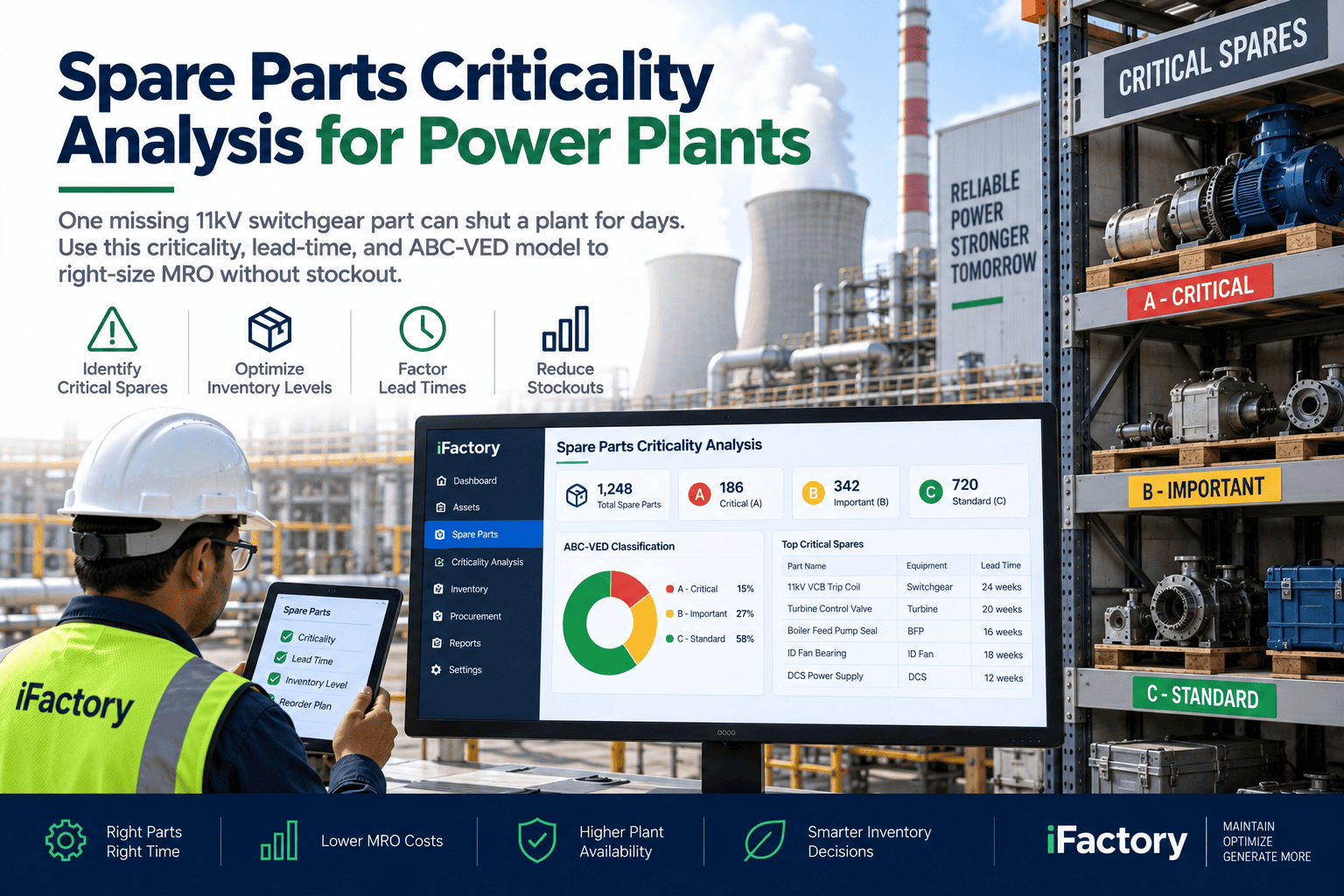
Walk through almost any food plant store and you will find a costly gearbox that has not moved in six years, two shelves from the empty bin where a forty-dollar filler seal should be. The store is overstocked and under-protected at the same moment. Criticality analysis fixes that by asking two plain questions of every part: what does it cost to hold, and what does it cost to be without? This guide shows how ABC-VED, criticality and lead time work together in a food and beverage plant, and how iFactory keeps the answer current. To try it on your own stock list, book a stock review.
Spare Parts Criticality Analysis for Food and Beverage Plants: ABC-VED Made Practical
Sort every part by what it costs and by what happens without it, then add lead time. The store shows you where it is overstocked and where it is exposed.
- Nine boxes, four simple stocking rules
- Food safety counted in what makes a part vital
- Stock levels worked out from class and lead time
Two Mistakes in the Same Store
Food plants overstock the wrong parts and run out of the critical ones — often on the same day.
The two mistakes have different causes, so one blanket rule cannot fix both. Cutting stock across the board makes the shortages worse. Raising stock across the board buries more cash. Our support team can help you find which mistake is costing you more.
The costly part nobody would miss
- Bought with the machine from the maker's recommended list.
- Never reviewed after the line was changed or slowed.
- Counted every year, used never.
- Ties up cash and shelf space at 15–25% a year.
The cheap part that stops the filler
- Too low in value to get anyone's attention.
- Taken from the bin without being booked out.
- Reordered only when the bin is found empty.
- Costs an hour of output worth far more than the part.
A stock count checks that what the system says is on the shelf really is there. It never asks whether it should be there. Criticality analysis is that missing second question, asked of every part.
Two Simple Sorts: ABC and VED
ABC asks what a part costs you. VED asks what its absence costs you.
Each sort alone is misleading. ABC on its own treats a cheap seal as unimportant. VED on its own ignores how much money sits on the shelf. Used together they give every part a clear place. To run both sorts on your own list, book a working session.
ABC: sort by money
- A. A few items that make up most of the yearly spend.
- B. The middle band, in both number and value.
- C. Most of the items, and very little of the money.
A common split is 10% of items for 70% of value, 20% for 20%, and 70% for the last 10%.
VED: sort by pain
- Vital. The line stops, or food safety is at risk, and there is no workaround.
- Essential. The line slows, or runs on a workaround for a shift or two.
- Desirable. Output and safety are not affected in the short term.
VED is a judgement, so it needs agreed questions. See below.
Four questions that decide V, E or D
The same bearing can be Vital on the filler and Desirable on a pallet wrapper. A part takes the highest class of any machine it serves, and its stock is sized for that machine.
Put Them Together: Nine Boxes, Four Rules
Cross the two sorts and every part lands in one of nine boxes. You only need four rules to manage them.
The example below is a plant store of 6,000 items worth $3.2 million. Look at where the items sit, then at where the money sits. They are not the same boxes. Ask our reliability specialists how the rules are tuned for a plant like yours.
Illustrative figures. Your own counts will differ; the pattern usually does not.
Real plants look much the same. In a published packaging-plant study, the top-priority group held 37% of the items and 82% of the spend, and the review found dead stock that could simply be removed.
Always hold
All Vital parts. 480 items, $0.62M. Never the place to save money.
Hold lean
All Essential parts. 1,800 items, $1.52M. Stock to real use, not to habit.
Question
Costly Desirable parts. 840 items, $0.86M. Hold only with a reason.
Simplify
Cheap Desirable parts. 2,880 items, $0.20M. Spend no planning time here.
Spend a Little More on Vital, a Lot Less on the Rest
Right-sizing is not a cut. Some shelves grow. In this example the store ends up 17% smaller and better protected than before.
Lead Time Turns a Class Into a Number
Knowing a part is Vital tells you to hold it. Lead time tells you how many.
Take a part used about twice a year with an eight-week lead time. While you wait for a replacement, there is a real chance another one fails. How many you hold decides how often that leaves you short. To size your own slow movers this way, book a sizing session.
Chance of not running out during the eight-week wait, assuming failures arrive at random.
Shorten the lead time, shrink the stock
Give the same part a two-week lead time and holding two covers 99.7%. A local supplier or a stocking agreement can do more for your store than any forecast.
Lengthen it, and the class moves up
An Essential part with a sixteen-week import lead time behaves like a Vital one. Lead time is checked every time a class is set, and again whenever a supplier changes.
What Counts as Vital in a Food Plant
In food, a part can be vital without stopping the line — because the line may not be allowed to run without it.
Heat treatment, metal detection and product-contact seals protect the consumer, not just output. That adds a question other industries do not ask. iFactory proposes a class for each part from your equipment list and downtime history, and your team confirms it. Our integration team can check what your systems already hold.
When the right part is not on the shelf, people improvise. Tape, wire and cable ties near product are a foreign-body hazard and an audit finding. One food regulator's maintenance guidance advises keeping gaskets, O-rings, bearings, seals and food-grade lubricants on hand for exactly this reason.
Keeping the classes current
It proposes
ABC from spend and use. VED from equipment criticality and past stoppages. People confirm.
It sizes
A stock level for each part from its class, its use and its lead time.
It flags change
A new machine, a longer lead time or a part now used on a second line.
Who sees what
- Stores. What to hold, how many, and what to question.
- Maintenance planner. Vital parts below their level, before the job needs them.
- Food safety lead. Stock cover for parts on safety-critical equipment.
- Finance. Stock value by box, and where it is heading.
iFactory proposes. Classes and orders are approved by your team.
Turnkey AI: Delivered, Connected and Live in 6–12 Weeks
You do not build this. It arrives ready.
iFactory ships as a pre-configured NVIDIA AI server, racked and ready, with the software pre-loaded. Rack it, plug in power and Ethernet, and the AI is live on your network.
Our team handles cabling, network setup, PLC and SCADA integration, operator training and 24×7 remote monitoring. The server sits inside your own network, and your stock and purchasing data stay on it. For a scope matched to your plant, request a turnkey quote.
Ship, network and data
Server installed. Stock list, usage history, equipment list and lead times loaded from your ERP and maintenance system.
Model training and pilot
ABC and VED classes proposed. Vital parts reviewed line by line with maintenance and food safety. Stock levels calculated.
Go-live and training
Live view of the nine boxes. Proposals sent for approval. Training for stores, planners and buyers. 24×7 remote monitoring begins.
Frequently Asked Questions
What is ABC-VED analysis?
It is two sorts used together. ABC ranks spare parts by yearly spend: A is high, C is low. VED ranks them by how badly the plant is hurt without them: Vital, Essential or Desirable. Crossing the two gives nine boxes, each with its own stocking rule.
How do I decide whether a part is Vital?
Ask four questions. Does production stop? Is food safety or a legal check affected? Is there a standby? How long does a replacement take? A part that stops the line or a safety control, with no standby and a long wait, is Vital.
Why not just use ABC?
Because ABC looks only at money. It would tell you to watch a costly gearbox closely and ignore a cheap seal, even if the seal stops the filler. VED adds the consequence, which is what a maintenance team cares about most.
How many of a Vital part should we hold?
Enough to cover the lead time with very little chance of running out. For a part used twice a year with an eight-week wait, that is three. With a two-week wait, two is enough. The number comes from use and lead time, not from a rule of thumb.
Does food safety change a part's criticality?
Yes. A part on heat treatment, metal detection or a product-contact seal can be Vital even if the line could physically run without it, because product made that way may not be fit to ship. Food safety is one of the four questions for that reason.
How often should the classes be reviewed?
Once a year for the whole list, and at once when something changes: a new line, a machine removed, a supplier with a longer lead time, or a stoppage caused by a missing part. Classes that are never reviewed are how stores drift out of shape.
How long does it take to go live?
Six to twelve weeks from delivery. We need a place for the server with power and Ethernet, read access to your ERP and maintenance system, and your equipment list. A pilot normally covers one store. To check your set-up first, contact our team.
Bring Your Stock List and Your Equipment List
In thirty minutes we run the two sorts on your data, show your own nine boxes and point to the cheap Vital parts with too little cover. You keep the result whether or not you go further with iFactory.
- 1Stock list with quantities and values
- 2Two or three years of parts usage
- 3Equipment list, with your most critical lines marked
- 4Supplier lead times for your main parts
- 5Stoppages caused by a missing part