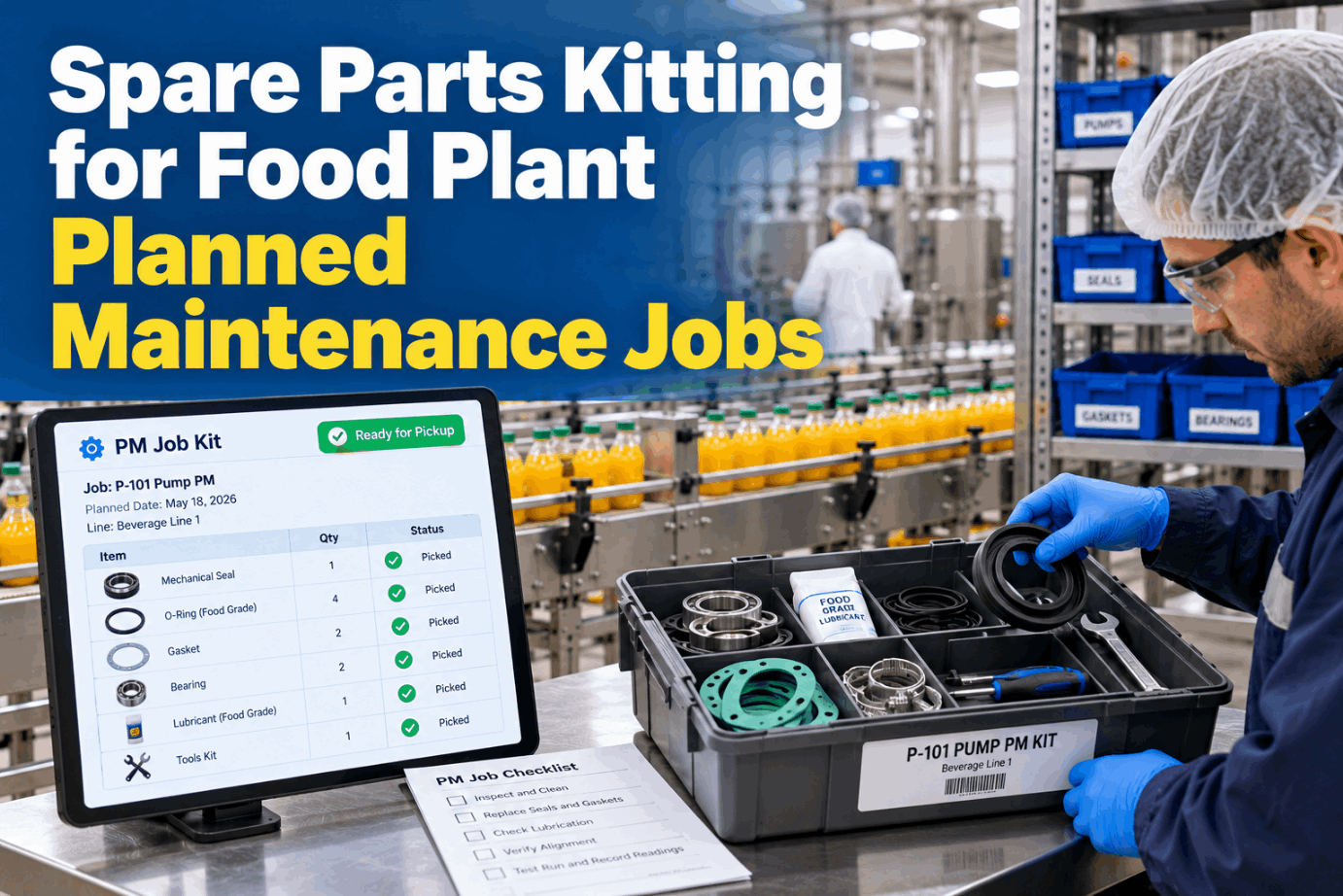
A planned job on a filler or a slicer gets a fixed sanitation-to-sanitation window, and every minute spent looking for a gasket, the right O-ring or a tube of food-grade grease comes out of that window. When the window closes, the job is half done or the line starts late. Spare parts kitting fixes this upstream: every part on the job plan is picked, checked against its food-grade spec and staged before the window opens. See how a kit gets built in a short kitting agent demo.
Every Seal, Gasket and Tool Staged Before the Maintenance Window Opens
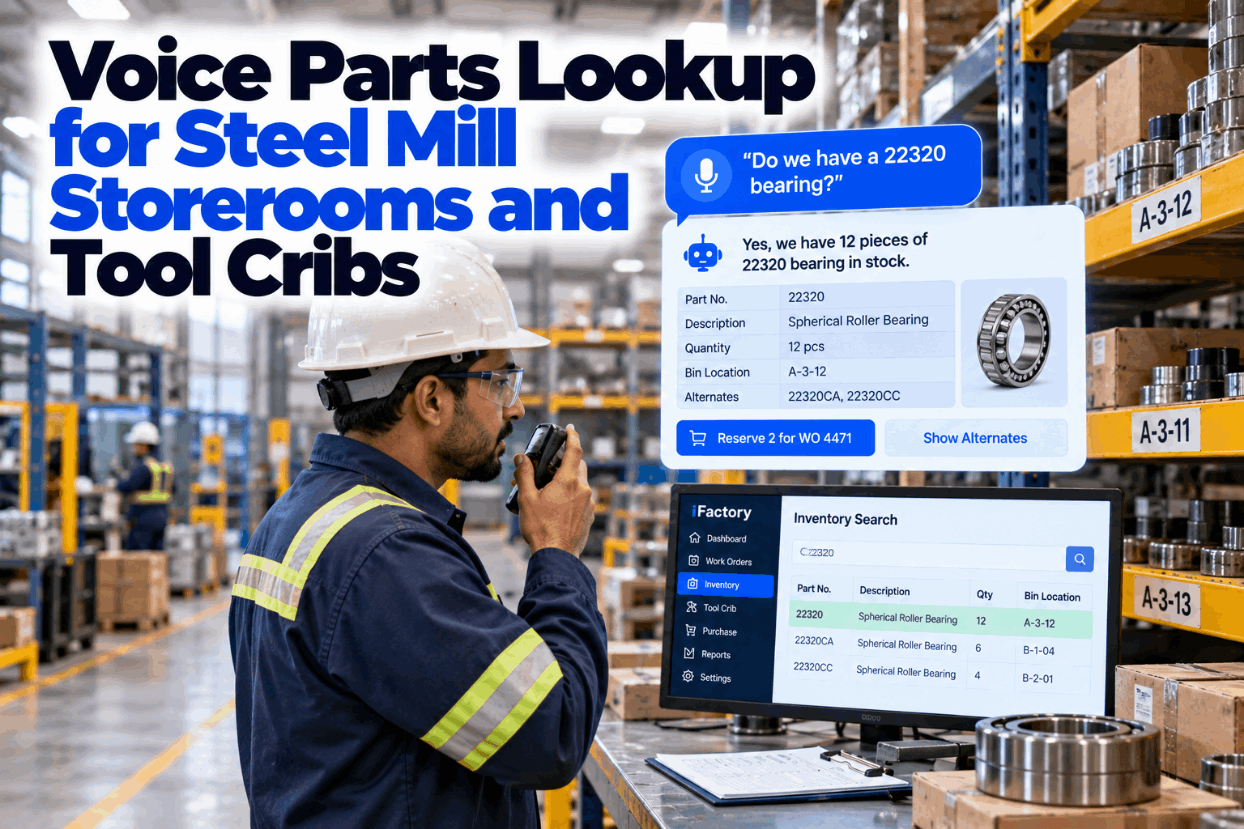
iFactory Kitting Agent builds kits from job plans 48 hours ahead, reserves the stock, confirms food-grade specs and notifies the storeroom. Technicians confirm pickup by voice, so the job starts with everything on the cart.
Where a Technician's Shift Goes Before Kitting
Wrench time is the share of a shift spent hands-on with the equipment. In a widely cited illustration, planning author Doc Palmer walks through one technician's 600-minute day at a power station: 30 minutes waiting at the storeroom for parts, 30 at the tool room, 45 travelling and 45 getting instructions. Only 210 minutes were hands-on work, a 35% wrench time. The bars below show his example, not iFactory data. Measure your own split with help from our maintenance planning team.
From Job Plan to Staged Kit: A 24 to 72 Hour Rhythm
A kit starts with a planned job: a job plan with a bill of materials (BOM) listing each part, quantity and stock number. Life Cycle Engineering's Al Emeneker recommends delivering kits for scheduled work the day before the job. Building earlier, 48 to 72 hours out, leaves time to chase a short or wrong part before the window. IDCON advises marking every box and loose item with the work order number. See the timeline on your own jobs in a kitting walkthrough.
The Spec Checks a Food Plant Kit Needs
In a food plant, the right size is not enough. A gasket that fits but is not food-grade is a food safety problem, not a maintenance one. US rubber food-contact parts are covered by 21 CFR 177.2600, and the 3-A standard for rubber materials adds tests for milk fat and cleaning chemicals, with classes set by exposure temperature. Many plants also specify metal-detectable plastics, often blue, so a broken fragment can be found. Check your own part specs with our parts data specialists.
Kits Built Two Days Out, Not Two Minutes Before
iFactory reads next week's job plans, builds each kit 48 hours ahead, reserves the stock and checks every part against its food-grade spec. The storeroom gets a pick list, and the planner sees which jobs are ready.
Kit Readiness as a Scheduling Gate
A job with a half-built kit is not a scheduled job, it is a future delay. A firm rule helps: no parts-dependent job enters the weekly schedule until its kit is complete and staged. IDCON suggests the CMMS should tell the planner when a kit is complete, so the work order can move to "ready to schedule". In a food plant, that gate also protects the sanitation plan: a job that overruns because a seal is missing can push back the pre-op inspection and the line start. Set up your own gate rules in a scheduling session.
What Every Kit Cart and Bin Label Should Show
A kit label should answer every question a technician or storeroom clerk might ask, without opening the bin. In a food plant it also needs to show that the parts were checked for food contact. Use these fields as a template, whether the label is printed or shown on a handheld. Ask our support team for a blank version.
Close the Loop After the Job
Kits rarely come back empty. Spare O-rings, an extra gasket or an unopened tube of grease left on a cart will be lost, used on the wrong job or counted twice. Opened food-contact parts also need care, because a seal that sat on a cart in a wet zone may no longer be fit to re-bin. IDCON recommends a designated returns area, with returned items checked before they go back in a bin, and pulling kits for cancelled or moved jobs after about two weeks. Plan your returns routine in a storeroom review.
- Leftover parts stay on carts or in toolboxes
- Stock shows zero while parts sit on the floor
- Opened seals go back in bins unchecked
- Kits for cancelled jobs tie up stock for weeks
- Technician says what was used when closing the job
- Unused items listed for the returns area
- Storeroom checks each item, then re-bins it
- Kits for moved jobs flagged and released
Five Measures That Show Kitting Is Working
Kitting is easy to start and easy to let slip. A few simple measures, reviewed weekly between maintenance and the storeroom, keep it honest. IDCON suggests a target of 85% of corrective, day-to-day work and 95% of shutdown items kitted. Set targets that suit your plant, and talk them through with our reliability team.
Best Practices for a First Kitting Rollout
Most kitting problems come from data, not effort. A kit is only as good as the job plan behind it, and a spec check is only as good as the item master. Start small, fix the data on one line, then widen it. Book a rollout plan in a planning call.
Size the Time Saved With Your Own Numbers
The clearest value is technician time no longer spent waiting for, or fetching, parts during a planned window. Every input below is assumed, to show the arithmetic only. Replace them with your own work sampling. Our team can help you build the case.
Recovered hours mean more work done inside each window, not fewer people. Add the value of fewer late line starts only if your own downtime data supports it.
Kitting Agent, Voice Pickup and AI Server in One Package
iFactory delivers the Kitting Agent turnkey. A pre-configured NVIDIA AI server ships racked and ready, with the agent and speech models running on site, close to your CMMS and stores data. You rack it, plug in power and Ethernet, and the AI is live. To scope it for your plant, request a turnkey quote.
- Pre-configured NVIDIA AI server, racked and ready
- Kitting Agent linked to job plans and stock
- Food-grade spec flags loaded on item records
- Pick lists and alerts sent to the storeroom
- Kit labels for carts and bins
- Voice pickup and parts-used confirmation
- 24×7 remote monitoring of models and hardware
Job BOMs and item specs cleaned, server installed and linked to CMMS and stores.
Kits built 48 hours ahead for one line's PMs, with voice pickup and returns.
Readiness gate added to scheduling, then rolled out to every line.
Kitting Built for Food Plant Maintenance Windows
iFactory is designed for short windows between sanitation runs, where a missing or wrong part costs the whole job. Plan a single-line pilot with our support team.
Spare Parts Kitting Questions From Food Plant Managers
Start Every Planned Job With a Full Cart
Build kits 48 hours ahead, reserve the stock, confirm food-grade specs and let technicians confirm pickup by voice. The full system is delivered turnkey and goes live in 6 to 12 weeks.