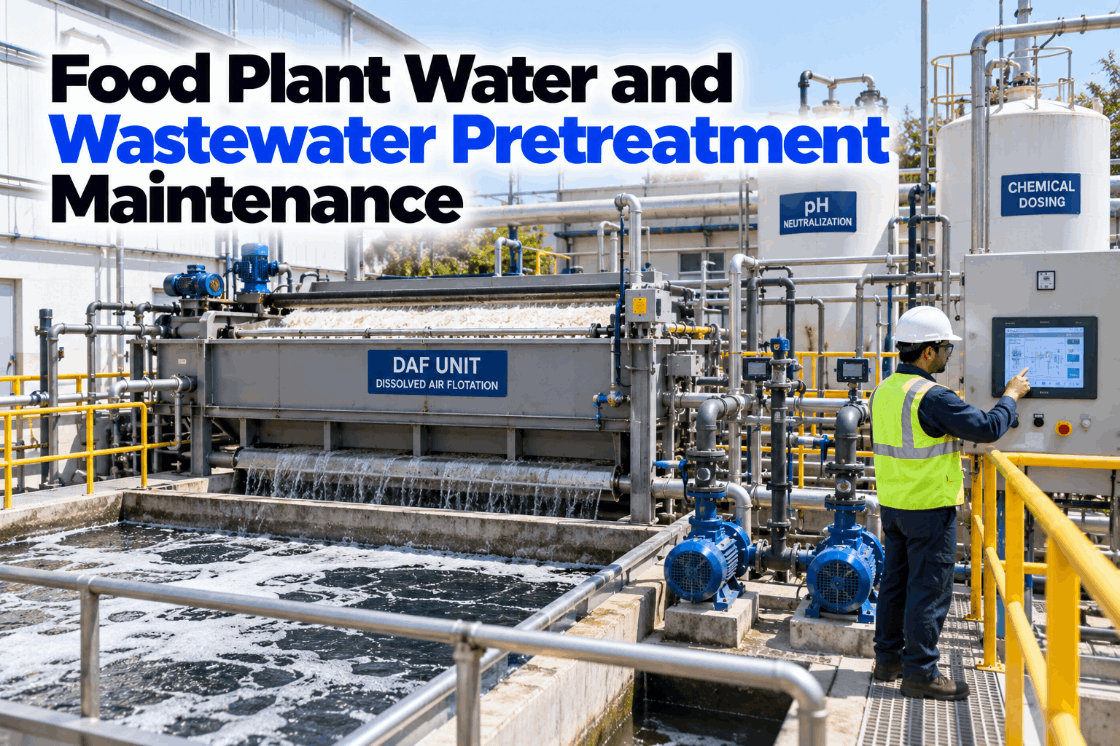
Wastewater pretreatment is the last process in a food plant, and often the least watched. A DAF unit that loses its air, a pH probe that drifts or an equalization tank that turns septic can push the discharge outside its permit within one shift, and the surcharge bill shows it a month later. Planned wastewater pretreatment maintenance keeps the equipment and the paperwork in step. See it on a working pretreatment train in a short wastewater demo.
Keep the DAF, Pumps and pH Control Inside Your Discharge Permit
iFactory trends DAF and pump performance, alerts the utilities tech by voice when pH or flow moves out of range, and compiles your permit records every month. Problems get fixed before the sampler finds them.
A Typical Food Plant Pretreatment Train
Most food plant pretreatment systems follow the same order: remove solids, even out flow and strength, correct pH, then float out fats and fine solids before the sewer. Each stage protects the next. A blinded screen sends solids on to the DAF, and a pH swing upsets its chemistry. That is why maintenance has to treat the train as one system. Map your own train in a pretreatment review.
What the Federal Pretreatment Rules Ask of Industrial Users
Food plants that discharge to a city sewer work under the General Pretreatment Regulations in 40 CFR 403, usually through an industrial user permit from the city or utility. The federal rules set the floor. Local limits for BOD, TSS, FOG and pH are set by your control authority and written into your permit. Maintenance owns many of the controls that keep those limits met. Walk through your permit with our compliance team.
Six DAF Parts That Decide Whether FOG Floats or Passes Through
A DAF unit dissolves air into a recycle stream under pressure, then releases it as fine bubbles that lift chemically formed floc to the surface. When the saturator, recycle pump or release nozzles weaken, bubbles get coarse and the float thins, often with no obvious alarm. Trending recycle flow and saturation pressure shows that slow decline early. See how DAF trends work in a short demo.
Reading the Health of a pH Probe
In wastewater, pH probes coat with fat, protein and scale far faster than in clean water, so some guidance calls for calibration daily or per shift. A two-point calibration with fresh buffers gives slope and offset, and those two numbers say more than the reading. One instrument vendor treats slope under 95% or offset beyond ±30 mV as drift, and slope under 90% as time to replace. Your probe maker's limits come first. Set up probe PMs with our support team.
pH and Flow Excursions Reach the Tech, Not Just a Screen
When pH, flow or DAF performance moves out of range, iFactory speaks the alert to the utilities tech on shift, names the asset and logs the response time for the permit file.
How a BOD Surcharge Is Usually Worked Out
Many cities charge industrial users extra for strength above a domestic threshold. A common form multiplies monthly flow by the concentration above the threshold, converts it to pounds and applies a unit rate. Thresholds, rates and the exact formula come from your local ordinance and permit, so the example uses assumed inputs only. Size it on your own bill in a cost review.
The 8.34 factor converts million gallons and mg/L into pounds. Run the same sum for TSS and, where your city charges for it, FOG. Then add fewer emergency hauls and less wasted chemical from calibrated feed pumps, using your own figures.
Pump Trends That Show Wear Before a Spill
Wastewater pumps handle grit, fats and rags, and when they fail the result is an overflow or a missed sample. Trending flow, current and run hours against each pump's normal duty shows a clogged impeller or worn wear ring before the pump stops. The week below is illustrative. Get a sample pump report from our utilities team.
What Goes Into the Monthly Permit Record File
Under 40 CFR 403.12(o), every sample record must show the date, exact place, method and time of sampling, who took it, when and by whom it was analysed, the method used and the result. iFactory compiles those each month with the maintenance evidence an inspector tends to ask about next. Use these fields as your template, and see a filled example in a records walkthrough.
Three Illustrations of Trouble Caught Early
FOG is usually measured as hexane extractable material under EPA Method 1664, and a weak DAF shows up there first. These examples are illustrations, not case studies, of how trend alerts change what happens next. Talk through your own recent results with our wastewater team.
Five Steps to Planned Pretreatment Maintenance
Most plants already have the equipment and the permit. What is missing is the link between them. These steps build that link without a large project. Plan the first month in a planning session.
Reactive Clean-Ups Against Planned Pretreatment for Plant Managers
The difference rarely shows in a single week. It shows over a year of surcharge bills, hauling invoices and permit reports. Compare your own routine with our support team.
- DAF problems found when the float looks wrong or a lab result comes back high
- pH probes calibrated when someone remembers
- Pumps run until they block or trip
- Permit records gathered from paper logs the week the report is due
- Surcharges treated as a fixed cost
- Recycle flow and saturation pressure trended, with alerts on slow decline
- Probe calibration PMs with slope and offset kept on record
- Pump flow and current trended against normal duty
- Permit records compiled monthly and ready to sign
- Surcharge pounds tracked, so savings from upkeep show up
Pretreatment Trends, Voice Alerts and NVIDIA Server in One Package
iFactory delivers Predictive AI and Compliance Logs as a turnkey bundle. pH, flow, pressure and pump signals are connected from your pretreatment train, and a pre-configured NVIDIA AI server ships racked and ready with DAF and pump models pre-loaded. You rack it, plug in power and Ethernet, and the AI is live. To scope it for your plant, request a turnkey quote.
- Pre-configured NVIDIA AI edge server, racked and ready
- Links to pH, flow, pressure and pump current signals
- DAF performance and pump wear models
- Voice alerts to utilities techs on pH and flow excursions
- pH probe, flow meter and sampler calibration PMs
- Monthly permit record packs ready for sign-off
- 24×7 remote monitoring of models and hardware
Signals linked, assets listed and permit limits loaded into the plan.
Normal DAF and pump behaviour learned, alerts run silently and checked.
Voice alerts, PMs and monthly records switched on, techs trained.
Pretreatment Upkeep and Permit Records in One Place
iFactory connects the equipment that treats your wastewater with the records that prove it. Our support team can walk you through a pilot plan.
What Plant Managers Ask About Wastewater Pretreatment Maintenance
Stay Inside Your Permit Every Month
Trend DAF and pump performance, get pH and flow excursions to the tech by voice and close every month with permit records ready to sign. The full system is delivered turnkey and goes live in 6 to 12 weeks.