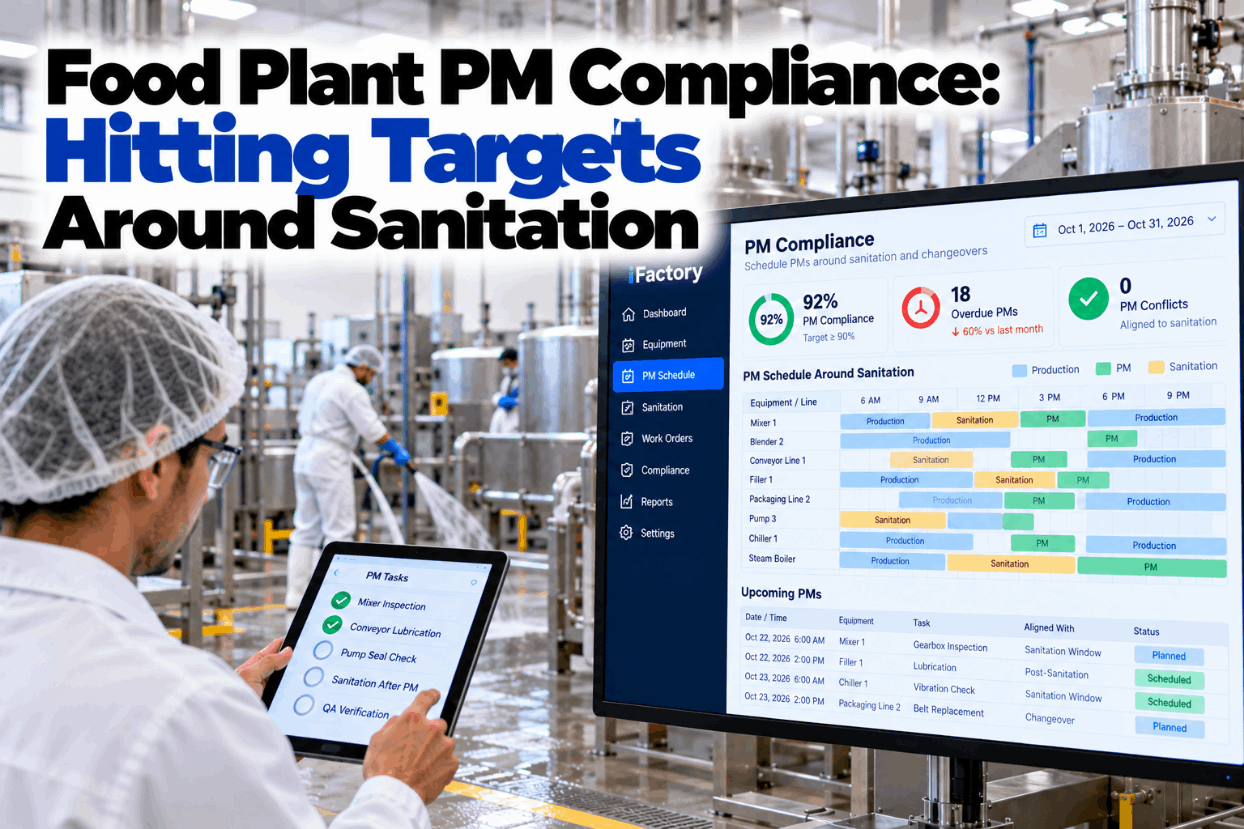
Food Plant PM Compliance: Hitting Targets Around Sanitation

By David Cook on October 22, 2026

food-plant-pm-compliance-hitting-targets-around-sanitation

Food plants rarely miss preventive maintenance because people don't care. They miss it because the hours the equipment is free belong to sanitation, changeovers and a production plan that changes every day. A PM bumped on Tuesday drifts to Friday, then past its window, and the compliance number falls without anyone choosing that. Food plant PM compliance improves when PMs are planned into sanitation shifts and open windows from the start, and moved early when the plan shifts. See how in a short PM scheduling demo.

AUTONOMOUS PM AGENT · FOOD PLANTS

Hit PM Targets by Planning Around Sanitation, Not Against It

iFactory Autonomous PM Agent aligns PMs to sanitation shifts, reschedules at-risk PMs when the production plan changes and reports compliance by line in a daily voice briefing. Planners approve the moves that need a person.

06:00 briefing · Last month2 at risk
PM compliance by line, done inside the window
Line 193.8%
Line 280.6%
Line 384.6%
Moved overnightLine 3 gearbox oil change → Saturday open window, still in its window
Tonight: 12 of 14 due PMs booked into the sanitation shift
PM COMPLETION RATE VS PM ADHERENCE

Agree What "On Time" Means Before You Measure It

PM completion rate counts PMs done at all. PM compliance, or adherence, counts PMs done inside a time window around the due date, which is what protects the interval. SMRP's own metric guidance has used more than one window: one metric counts a PM as compliant if done within 10% of its frequency, another allows the required date plus 20% of the frequency, up to 28 days, and notes that compliance can be measured different ways. Reliability trainer Jeff Shiver explains the 10% rule simply: a 30-day PM should be done within about three days of its due date. Choose one rule, write it down and apply it to every line. Our planning team can help you set it.

Weekly7-day PM
±0.7 day, about 17 hours
Monthly30-day PM
±3 days, day 27 to 33
Quarterly90-day PM
±9 days, day 81 to 99
Annual365-day PM
±36.5 days, about 5 weeks
Windows shown at 10% of frequency either side of the due date, as many plants apply the rule. Bars are not to the same time scale. Your written rule decides.
OVERDUE PM FOOD PLANTS

Why Food Plants Run Out of Maintenance Hours

Look at a typical week on one line and the problem is plain. Two shifts produce, the third is sanitation, and allergen changeovers and weekend deep cleans take more time. The hours left fully open for maintenance are few, and the ones inside sanitation are shared with crews who need the same equipment, locked out, at the same time. When production adds an extra run, the first thing to move is usually a PM. The grid below is an illustration, not a benchmark. Map your own week in a window mapping session.

MonTueWedThuFriSatSun
DayPPPPPCO
SwingPCPPCSO
NightSSSSSSP
PProductionCAllergen changeoverSSanitation, shared windowOOpen, full window
Sanitation owns the nightSame equipment, same lockout, different crew and goals
Changeovers run longAllergen cleans eat the slack a PM was counting on
Production plans moveAn extra run takes the slot, and the PM is the first thing bumped
Release takes timeEquipment must be cleaned and checked after work before it can run
SANITATION SHIFT MAINTENANCE

How a PM Fits Inside an Eight-Hour Sanitation Shift

Maintenance and sanitation can share a shift if the order is right. Do the maintenance first, so the wet clean that follows covers anything the work disturbed. Under OSHA 29 CFR 1910.147, servicing and maintenance includes cleaning, so both crews work under lockout and the handover between them must be planned. BRCGS Food Safety Issue 9, clause 4.7.4, requires maintenance work to be followed by a documented hygiene clearance procedure, with equipment inspected by an authorised person to confirm contamination hazards are removed. The plan below is an example for one line. Ask our support team to sequence your own shift.

22:0023:0000:0001:0002:0003:0004:0005:00
MaintenanceLockoutPMs on filler and seamerHygiene clearance
SanitationLockoutDry clean, other zonesWet clean and sanitise filler zone
QACheck clearancePre-op inspection
The rule of thumb

Book PMs that open product zones into the first part of the shift, before that zone's wet clean. Work that finishes after the clean needs that zone cleaned again before pre-op.

PM WINDOW SCHEDULING

Which PM Belongs in Which Window

Not every PM needs the same kind of window. Short checks fit a changeover, inspections that don't open the product zone can run on a moving line, and long rebuilds need a full open window. Sorting PMs by what they need, rather than by due date alone, is the most useful planning step a food plant can take. Sort your PM library in a library review.

PM type
Typical length
What it needs
Best window
Route checks, vibration, thermal scans
Minutes per asset
Access only, no lockout
Running line
Lubrication, belt and chain checks
Under 1 hour
Lockout, guards off
Changeover or sanitation, early
Seals, valves, wear parts on product zone
1 to 3 hours
Lockout, product zone opened, hygiene clearance
Sanitation shift, before wet clean
Gearbox oil, motor and drive work
1 to 4 hours
Lockout, outside product zone
Sanitation shift, any time
Rebuilds, calibrations needing a run-up
4 hours or more
Lockout, test run, QA release
Open window, weekend or planned stop

Ask Which PMs Are at Risk This Week

Planners shouldn't need a spreadsheet to know what will slip. Ask the PM Agent, and it answers by line, names the PMs whose windows are closing and tells you what it has already moved and what needs your call.

Line 2 · Planner and PM Agent
PlannerProduction added a run on Line 2 Thursday night. What does that hit?
PM AgentThursday's sanitation shift moves to Friday. Two PMs lose their slot: seamer chuck check and conveyor bearing lube.
PlannerCan they still make their windows?
PM AgentYes. Both moved to Friday's sanitation shift, before the filler wet clean. Lockout and sanitation crew lead notified.
AI RESCHEDULING

When the Plan Changes, the PMs Move With It

The PM Agent reads the production plan, the sanitation schedule and each PM's window and needs. When a slot disappears, it follows the same logic a good planner would, only faster and every time. Moves inside the rules happen automatically, and anything that would break a window goes to a person. Ask our support team how approval rules are set.

Production plan or sanitation schedule changes
Q1Does any PM lose its booked slot?
NoNothing to do. Keep the plan.
Yes ↓
Q2Is there a window that fits its needs before its compliance window closes?
YesMove it, book lockout and the sanitation slot, notify crews.
No ↓
Q3Can it be split, or part done on a running line safely?
YesPropose the split to the planner for approval.
No ↓
ElseEscalate in the morning briefing with the risk and the options
FOOD PLANT PM COMPLIANCE EXAMPLES

PM Compliance by Line, Worked Through

The month below uses assumed counts for three lines. It shows why completion rate alone is a misleading maintenance KPI for food plants: the plant finished 96.3% of its PMs, but only 86.8% were done inside their windows. It also shows that the plant figure must be worked from the totals, not by averaging the three line percentages, which would give 86.3%. Check your own numbers in a compliance review.

Line
PMs due
In window
Late
Missed
Completion
Compliance
Line 1
48
45
2
1
47 ÷ 48 = 97.9%
45 ÷ 48 = 93.8%
Line 2
36
29
5
2
34 ÷ 36 = 94.4%
29 ÷ 36 = 80.6%
Line 3
52
44
6
2
50 ÷ 52 = 96.2%
44 ÷ 52 = 84.6%
Plant
136
118
13
5
131 ÷ 136 = 96.3%
118 ÷ 136 = 86.8%
9.5 pointsGap between completion (96.3%) and compliance (86.8%) at plant level
Line 2Lowest compliance. 5 late and 2 missed out of 36. Start there.
18 PMsLate or missed this month, each one an interval stretched
DAILY VOICE BRIEFING

Two Minutes at 6 a.m. Instead of a Report Nobody Opens

The briefing is spoken to the maintenance manager's headset or phone, and to the morning meeting speaker if you want. It covers last period's compliance by line, what is due today, what was moved overnight and what needs a decision. Managers can interrupt with questions, such as "why is Line 2 low?" Hear a sample in a support call.

PM Agent · Morning briefing06:00 · 1 min 50 s
Compliance"Plant PM compliance last month was 86.8%. Line 2 is lowest at 80.6%, mostly seamer PMs done late."
Today"Fourteen PMs are due. Twelve are booked into tonight's sanitation shift, before the wet clean."
Moved"Line 3 gearbox oil change lost its slot to the extra allergen changeover. I moved it to Saturday's open window. It stays in its window."
Needs your call"Filler 2 valve kit needs three hours. Tonight's sanitation shift has two after lockout. Split it, or hold it for Saturday?"
FOOD PLANT PM COMPLIANCE COST AND ROI

A Worksheet You Can Fill With Your Own Numbers

The clearest gain is planner time spent re-juggling PMs by hand, plus the PMs that stop slipping out of their windows. Put your own figures into the worksheet. Everything below is an assumed input or plain arithmetic on those inputs, not a promised result. Walk through your figures in a value session.

PMs bumped by plan changes per week30, assumed
Planner minutes to rebook one by hand15, assumed
Planner time on rebooking per week30 × 15 = 450 min = 7.5 hours
PMs late or missed per month, from the example13 + 5 = 18
PMs due per month136
Compliance if 10 of those 18 are kept in window(118 + 10) ÷ 136 = 94.1%
What to leave out of the sum

Avoided breakdowns and audit findings are real but hard to price. Track them separately, and only add them to the business case when your own history supports a figure.

FOOD PLANT PM COMPLIANCE BEST PRACTICES AND IMPLEMENTATION GUIDE

Six Steps to PMs That Stay in Their Windows

Plants that hold high compliance through sanitation and changeovers tend to do the same few things in the same order. Get help with any step from our support team.

1
Write the compliance ruleOne window rule, one formula, every line. Report completion and compliance side by side.
2
Tag every PM by what it needsLength, lockout, product zone opened, hygiene clearance, test run.
3
Load sanitation and changeover plansReal shift times, by line and zone, so windows are known in advance.
4
Agree the order with sanitationShared lockout, maintenance before wet clean, hygiene clearance handover.
5
Run the agent in advisory modePlanners approve every move for a few weeks, then allow moves inside the rules.
6
Review by line every morningThe voice briefing makes the lowest line the first topic of the day.
TURNKEY AI DEPLOYMENT

PM Agent, CMMS Connector and AI Server in One Package

iFactory delivers the Autonomous PM Agent as a turnkey bundle. A pre-configured NVIDIA AI server ships racked and ready with the agent, the CMMS and production plan connectors and the voice briefing pre-loaded. You rack it, plug in power and Ethernet, and the AI is live. To scope it for your plant, request a turnkey quote.

What's Included
  • Pre-configured NVIDIA AI edge server, racked and ready
  • CMMS connector for PMs, windows and work orders
  • Production plan and sanitation schedule links
  • PM library tagging for window needs
  • Rescheduling and approval rules set with your planners
  • Daily voice briefing on headsets, phones or speakers
  • 24×7 remote monitoring of software and hardware
Live in 6–12 weeks
Wk 1–4
Connect and Tag

Server installed, CMMS and plans linked, PM library tagged by window needs.

Wk 5–8
Advisory Mode

Agent proposes moves, planners approve, sanitation order agreed per line.

Wk 9–12
Go-Live and Briefing

Moves inside the rules automated, daily voice briefing started, teams trained.

HOW iFACTORY FITS

Food Plant PM Compliance Software Built Around Sanitation

The PM Agent is designed for plants where sanitation and changeovers own most of the free equipment hours. Our support team can walk you through a pilot plan.

1
Aligned to sanitation shifts. PMs booked into the right part of the shift, before the wet clean.
2
At-risk PMs rescheduled. When the plan changes, PMs move to windows that still fit their rule.
3
Compliance by line. Completion and compliance worked from totals, the same way every time.
4
Daily voice briefing. What is due, what moved and what needs a decision, before the first meeting.
1000+
Industrial clients running iFactory
99.9%
Platform uptime for three-shift food plants
6-12 wks
From racked server to live PM agent
FREQUENTLY ASKED QUESTIONS

What Maintenance Managers Ask About Food Plant PM Compliance

What is the difference between PM completion rate and PM compliance?
Completion rate counts PMs finished in the period, whenever they were done. Compliance counts only PMs done inside the window around their due date. A plant can finish almost every PM and still have low compliance if many are done late, which stretches the real interval between services.
What window should we use for PM compliance?
Many plants use 10% of the PM frequency. SMRP's metric guidance has also used the required date plus 20% of the frequency, capped at 28 days, and notes compliance can be measured in different ways. What matters most is one written rule, applied the same way on every line and every month.
Can maintenance work during the sanitation shift?
Yes, with planning. Both crews work under lockout, so the lockout and handover must be agreed. Do product-zone work before that zone's wet clean, and follow every job with a hygiene clearance before the equipment is cleaned, inspected and released for production.
Will the agent move PMs without asking?
Only inside rules you set. Typically it moves a PM automatically when the new slot fits its needs and keeps it in its window. Anything that would break a window, split a job or touch a critical asset goes to a planner first, and appears in the morning briefing.
How is plant-level PM compliance worked out?
Add the PMs done in window across all lines and divide by all PMs due. Don't average the line percentages, because lines with more PMs should count for more. In the example on this page, the correct figure is 86.8%, while a plain average of line results gives 86.3%.
How do we start?
Write down your compliance rule, tag your PM library by what each job needs and load the sanitation schedule for one line. Run the agent in advisory mode for a few weeks before allowing automatic moves. Our support team can plan that pilot with you.

Keep Every PM Inside Its Window

Plan PMs into sanitation shifts, move them early when production changes and hear compliance by line every morning. The full system is delivered turnkey and goes live in 6 to 12 weeks.
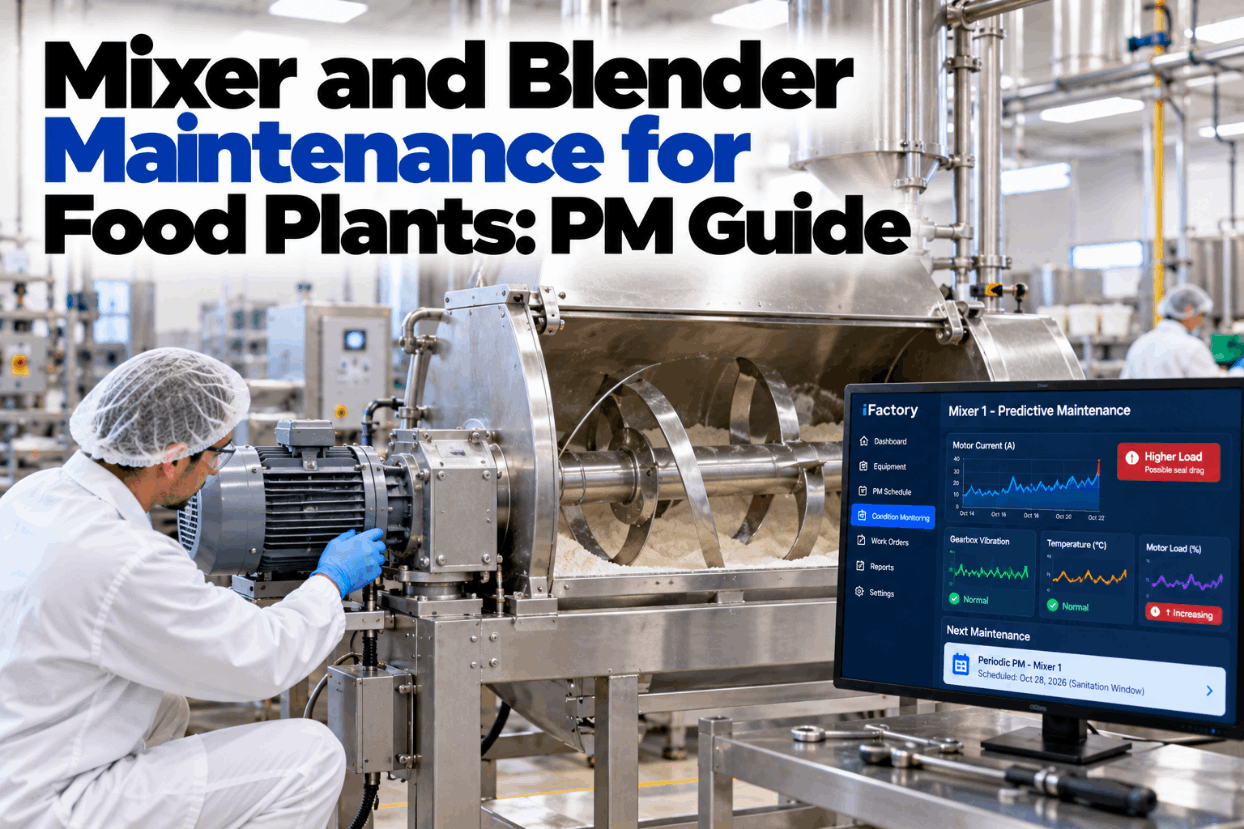

Example morning summary · Plant
PM compliance86.8%, Line 2 lowest
Due today14, 12 in sanitation shift
Moved overnight1, still in window
Needs a decisionFiller 2 valve kit
Every move logged with reason and approver

Share This Story, Choose Your Platform!