Hygienic Zoning and Maintenance Tool Control in Food Plants

By Jackson T on October 19, 2026

hygienic-zoning-maintenance-tool-control-food-plants

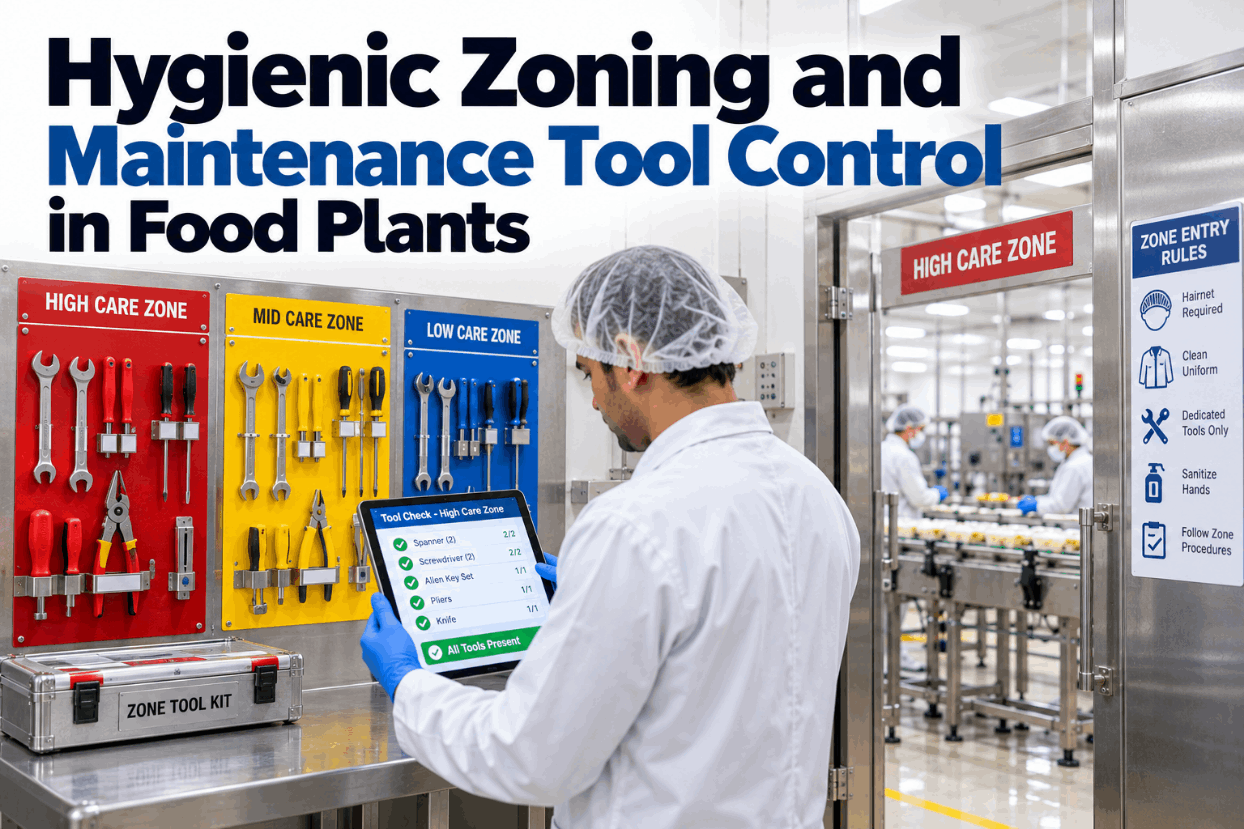
A maintenance job in a high care room is never just a repair. Every spanner, hex key and spare part that goes through the barrier is a possible foreign body, and every tool that has been in a low risk area can carry contamination with it. Hygienic zoning tool control turns that risk into a routine: the right colour-coded tools for the zone, a counted kit going in, the same count coming out, and a hygiene clearance before the line restarts. See how zone-aware work orders handle it in a short live demo.

ZONE-AWARE WORK ORDERS · FOOD HYGIENE

Every Tool Counted In, Every Tool Counted Out, Before the Line Restarts

iFactory work orders carry the hygienic zone rules for each asset. Technicians check tool kits out and back in by voice, and a missing tool raises a foreign material hold automatically, so nothing restarts until the count is right.

Kit HC-07 · Slicer, line 3High care
WO 4471 · Blade guard bearing · Blue-handled kit
Checked out12
Checked in11
Missing1
✓Torque wrench
✓Hex key set (7)
!10 mm spanner
✓Bearing puller
Technician"Check in kit HC-07, eleven tools."
iFactoryEleven of twelve. 10 mm spanner not returned. Line 3 on foreign material hold until it is found.
Hold FMH-219 raised · QA and shift lead notified
HIGH CARE ZONE BASICS

Low Risk, High Care, High Risk: What Changes for Maintenance

BRCGS sorts open product areas by how much a pathogen in the product would matter. High risk areas aim to prevent pathogen contamination of ready-to-eat products that have had a full kill step. High care areas aim to minimise it where the product has had a reduction step only. Ambient high care covers products where pathogens can survive but not grow. Low risk areas still need foreign body and allergen control. Each step up tightens the rules for people, parts and tools. Map your own zones with our support team.

Enclosed / non-product
Product fully packed or absentWorkshop tools allowed. Normal tool control and housekeeping.
Low risk
Open product, later kill stepForeign body focus. Counted kits on open product lines.
High care
Reduction step, chilled or frozenDedicated, colour-coded tools kept in the zone wherever possible.
High risk
Full kill step, ready to eatDedicated tools only. Anything entering is cleaned and accepted back on record.
COLOR CODED TOOLS

One Colour per Zone, Backed by Clear Rules

BRCGS asks that, wherever possible, tools and equipment used in high risk and high care areas are dedicated to that area and retained there. Colour coding is how most plants make that visible at a glance. A blue-handled spanner on a low risk bench is an obvious error. The colours themselves are a site choice, so the key below is an example only. What matters is that every technician reads it the same way. Set up your colour key during a zone setup session.

Zone
Example handle colour
Where the kit lives
Can it leave the zone?
Before it comes back
High risk
Blue
Shadow board inside the zone
No, except for repair off site
Clean, inspect, record acceptance
High care
Yellow
Shadow board inside the zone
Only under a work order
Clean, inspect, record acceptance
Low risk, open product
Green
Line-side kits by area
Yes, counted out and in
Count and condition check
Allergen area
Purple
Allergen room kit
No, to avoid allergen transfer
Allergen clean and record
Workshop and non-product
Uncoded
Main workshop
Never into open product zones
Not applicable
ZONE ENTRY RULES

Zone Entry Rules for Maintenance Technicians

Technicians move between zones far more than line operators, which makes them one of the easiest routes for contamination. BRCGS expects maintenance in high risk and high care areas to respect the segregation of the area. In practice that means the same changing, handwash and footwear routine as production, plus rules for what may cross the barrier. Ask our hygiene team how to load these rules into each work order.

1Before the barrier
Work order openedZone, kit and clearance steps shown on the handheld
Kit checked outZone kit issued and counted by voice
Spares baggedParts in clean, sealed bags, outer cartons left outside
2At the barrier
Change and washZone clothing, hairnet, boots, handwash as for production
Tools through a hatchAnything not kept in the zone is cleaned and passed through
No workshop toolsUncoded tools stay on the low risk side
3Inside the zone
Work area protectedProduct removed or covered, area screened if needed
Tools on a matNever on the belt, frame or product contact surface
Parts trackedRemoved nuts, washers and gaskets counted as well as tools
TOOL CHECK OUT AND CHECK IN

One Job, From Kit Issue to Line Release

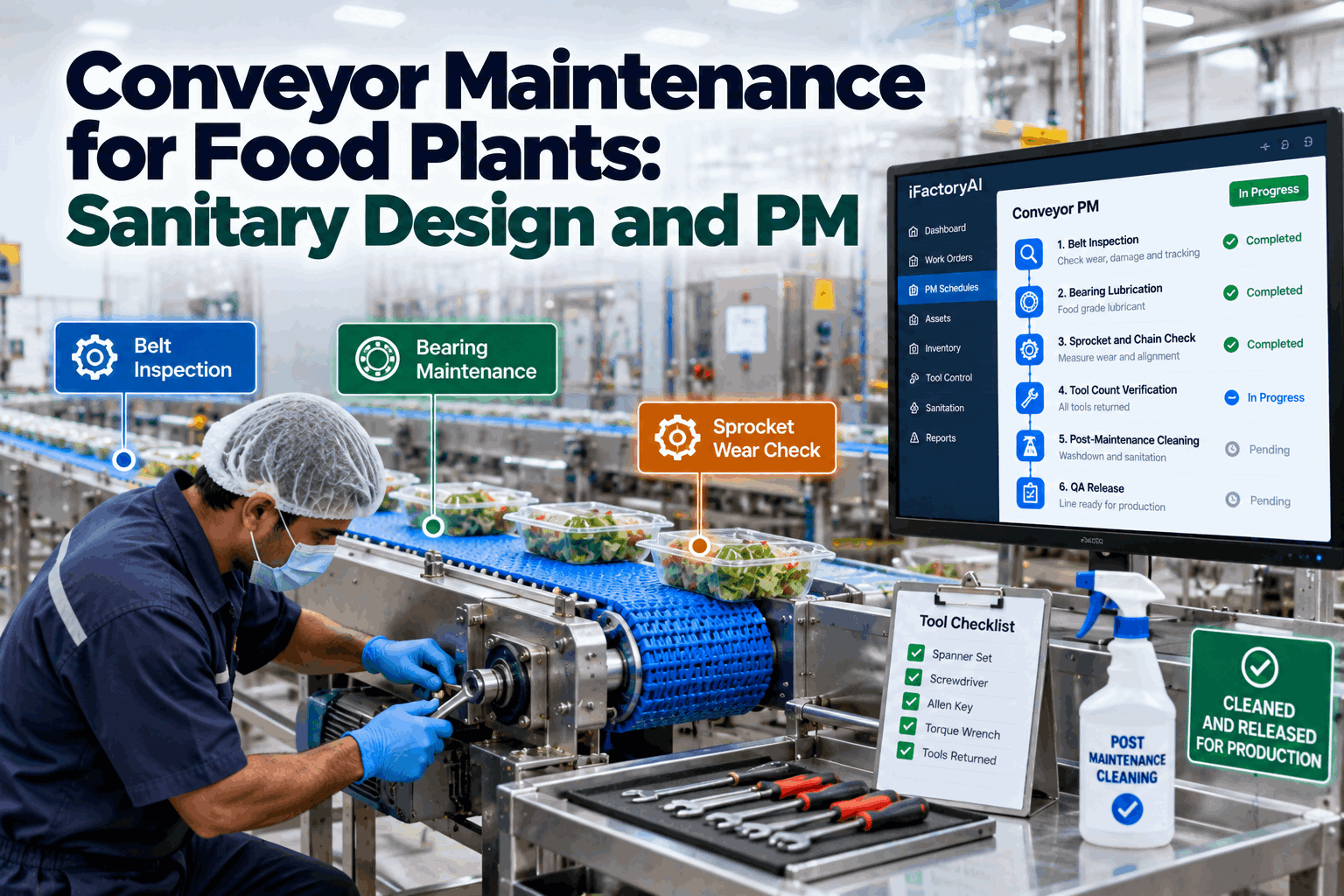
A good check-out record answers three questions later: what went in, what came out, and who confirmed it. Voice capture keeps those answers complete without slowing the job, because the technician never has to put tools down to write. The timeline below shows a typical high care repair with illustrative times. Walk through it on your own assets in a short demo.

07:42
Kit HC-07 checked out"Check out kit HC-07 for WO 4471." iFactory confirms twelve tools and the zone.
07:50
Entry through the high care barrierSpares pass the hatch in sealed bags. The bag count is noted.
08:05
Repair under wayTwo guard bolts and one washer removed, spoken as "three parts off".
09:10
Check-in countTools and removed parts counted back. Any gap raises a hold at once.
09:14
Hygiene clearanceArea cleaned, then inspected by an authorised person who is not the technician.
09:25
Line releasedRelease recorded against the work order with names and times.

The Count Happens by Voice, the Hold Happens by Itself

With iFactory, zone rules live inside the work order. Technicians speak the kit out and back in, and a short count raises a foreign material hold and alerts QA. Nobody has to remember to make the call.

High care · Technician and iFactory
TechnicianCheck in kit HC-07. Twelve tools, three parts refitted.
iFactoryTwelve of twelve tools, three of three parts. Count matches. Ready for hygiene clearance.
TechnicianWho is clearing it?
iFactoryShift QA has been asked to inspect line 3. The line stays held until clearance is signed.
HYGIENIC ZONING TOOL CONTROL TEMPLATE

Tool Reconciliation Checklist Before Line Release

Use this checklist as a starting point and adjust it to your own zoning risk assessment. Tick the boxes here, or speak each item on a voice round so the answers land in the work order. Count removed parts as carefully as tools. A missing washer is as much a foreign body as a missing spanner. For a version with your own kit IDs, ask our support team.

01Before work startsAt kit issue
02Before line releaseAt check-in
FOREIGN BODY PREVENTION

When the Count Does Not Match

A missing tool is a product safety question, not a stores question. FDA guidance on hard or sharp foreign objects treats objects of 7 mm to 25 mm in ready-to-eat food as grounds for regulatory action, and most hand tools and fixings are in that range or larger. That is why the response must be fast and the same every time, whoever is on shift. Build your hold rules with our food safety team.

Check-in count is shortLine stays stopped. Hold raised automatically on the work order.
Found, intact
Record where it was foundTool checked for damage and returned to the kit
Continue to hygiene clearanceHold closed with a note, line released as normal
Not found, or broken
Search the machine and areaIncluding guards, hoppers, drains and the belt path
Hold product at riskEverything made on the line since the last good count
QA decides on releaseUsing detector and x-ray records and the search findings
MAINTENANCE GMP

Post-Maintenance Hygiene Clearance

Under BRCGS clause 4.7.4, maintenance work must be followed by a documented hygiene clearance procedure, and equipment must be inspected by an authorised member of staff to confirm that contamination hazards have been removed before it goes back into use. Where equipment leaves a high risk or high care area, the site needs a procedure for accepting it back, with records. Review your clearance flow with our support team.

Hygiene clearance · WO 4471Slicer, line 3 · High care
Tool count12 out, 12 in
Parts count3 off, 3 refitted
Debris removedYes, swarf and ties
Area cleanedHigh care standard
Inspected byShift QA, not the technician
Released at09:25, recorded
HYGIENIC ZONING TOOL CONTROL EXAMPLES

Three Situations Maintenance Teams Meet Every Month

These are illustrations, not case studies. They show how zone-aware work orders respond in common cases. Your own procedures and risk assessment decide the right action. Try your own scenarios in a scenario walk-through.

Wrong kit
A low risk kit is checked out for a high care jobThe work order knows the asset is in high care, so voice check-out names the mismatch and asks for kit HC-07 instead.
Short count
One spanner missing at check-inA hold is raised on the line, QA is alerted and product since the last good count is held while the area is searched.
Tool leaves zone
A high care torque wrench goes for calibrationIt is logged out of the zone, and on return it is cleaned, inspected and accepted back with a record.
HYGIENIC ZONING TOOL CONTROL BEST PRACTICES

What Works on the Floor, and What Quietly Fails

Most tool control programmes fail through small habits, not missing rules. The comparison below shows the habits auditors and QA teams tend to flag, next to the ones that hold up. Get a review of your current routine from our hygiene specialists.

HABITS THAT FAIL
  • Personal toolboxes carried between zones
  • Counting tools but not removed parts
  • The technician clearing their own work
  • Paper sign-off filled in after the line restarts
  • Shadow boards with gaps nobody explains
HABITS THAT HOLD UP
  • Zone kits that stay in the zone wherever possible
  • Tools and parts counted out and back in
  • Clearance by a second, authorised person
  • Records made at the time, in the work order
  • Every gap on a board linked to an open job
HYGIENIC ZONING TOOL CONTROL IMPLEMENTATION GUIDE

Five Steps to a Working Tool Control Routine

Start with the zones that carry the most risk and the jobs that happen most often. A small, well-run routine on two lines teaches more than a plant-wide rollout on paper. Plan your first lines in a planning call.

1Confirm zonesFrom your zoning risk assessment
2Build kitsColour-coded kits per zone, with lists
3Tag assetsEvery asset tied to its zone and kit
4Go live by voiceCheck-out, check-in and holds on two lines
5Review monthlyShort counts, holds and clearance times
TURNKEY AI DEPLOYMENT

Zone-Aware Work Orders, Voice and AI Server in One Package

iFactory delivers zone-aware maintenance as a turnkey bundle. A pre-configured NVIDIA AI server ships racked and ready with voice and work order models pre-loaded, so speech is processed on site and works in noisy, wet areas. You rack it, plug in power and Ethernet, and the AI is live. Scope it for your plant with a turnkey quote.

What's Included
  • Pre-configured NVIDIA AI server, racked and ready
  • Voice agent for kit check-out and check-in
  • Zone rules loaded onto every asset and work order
  • Automatic foreign material holds on short counts
  • PLC links to keep held lines from restarting
  • Hygiene clearance and release records for audits
  • 24×7 remote monitoring and operator training
Live in 6–12 weeks
Wk 1–4
Ship and Map

Server installed, zones and kits mapped to assets, network and PLC links set up.

Wk 5–8
Train and Pilot

Voice tuned to your kit names, pilot on two high care lines with QA.

Wk 9–12
Go-Live and Training

All zones live, technicians and QA trained, monthly review started.

HOW iFACTORY FITS

Hygienic Zoning Tool Control Software Inside the Work Order

iFactory puts zone rules where technicians already work, so tool control is part of the job rather than an extra form. See it on a high care repair in a live session.

1
Zone rules on every work order. The asset's zone sets the kit, entry steps and clearance needed.
2
Kits counted by voice. Check-out and check-in are spoken and confirmed back, hands stay on the job.
3
Holds raised automatically. A short count opens a foreign material hold and alerts QA.
4
Clearance on record. Counts, inspector, times and release sit in one audit-ready record.
1000+
Industrial clients running iFactory
99.9%
Platform uptime for round-the-clock food plants
6-12 wks
From racked server to live zone-aware work orders
FREQUENTLY ASKED QUESTIONS

What Plant Managers Ask About Hygienic Zoning and Tool Control

What is hygienic zoning tool control?
It is the set of rules that keeps maintenance tools from becoming a contamination or foreign body risk. Tools are dedicated and colour-coded by zone, counted out before work and counted back in afterwards, and the line is only released after a documented hygiene clearance.
Does BRCGS require colour-coded tools?
BRCGS asks that tools and equipment for high risk and high care areas are dedicated to those areas and kept there wherever possible, and that portable items are visually distinctive or controlled by procedure. Colour coding is the most common way to meet that, but the colours are a site choice.
Should we count removed parts as well as tools?
Yes. Bolts, washers, clips and gaskets taken off a machine are just as likely to end up in product as a tool. Count them off and back on, or out of the zone, as part of the same check-in.
Who should sign the hygiene clearance?
BRCGS clause 4.7.4 asks for inspection by an authorised member of staff. Most sites use a trained QA or production lead rather than the technician who did the work, so the check is independent.
What happens if a tool is still missing after a search?
Product made since the last good count is held, detector and x-ray records are reviewed, and QA decides on release under your foreign material procedure. iFactory records each step on the hold so the decision is traceable.
How do we get started?
Pick two high care lines, build colour-coded kits for them and turn on voice check-out and check-in with automatic holds. Review short counts and clearance times after a month, then extend to other zones. Our support team can plan the pilot with you.

Restart Lines Only When Every Tool Is Home

Load zone rules into work orders, count kits by voice and let short counts raise holds on their own. The full system is delivered turnkey and goes live in 6 to 12 weeks.

Example shift summary · High care
Jobs in zone9 work orders
Kits counted18 check-outs, 18 check-ins
Short counts1, found and closed
Clearances9 signed before release
Every release traceable to a count and a name

Share This Story, Choose Your Platform!