
Steel Plant Inspection Checklist Templates: 15 Free Examples

By Josh Brook on October 26, 2026

steel-plant-inspection-checklist-templates-15-free-examples

A steel plant runs dozens of recurring inspections, from the hook check before the first lift of a shift to the yearly lockout audit. Most still live on paper forms that differ from shop to shop and slowly drift away from the rule behind them. This library sets out 15 steel plant inspection checklist templates, each with its purpose, frequency, key items and the standard it supports. See them run as voice checklists in a short checklist library demo.

CHECKLIST LIBRARY · STEEL PLANTS

Fifteen Steel Inspection Templates, Loaded on Day One

iFactory's Checklist Library ships with prebuilt steel templates for cranes, ladles, furnaces, conveyors, mill stands and more. Every field can be edited, crews complete them by voice, and every failed item opens a work order on its own.

Ladle L-07 · Turnaround checkVoice
Template 1 of 15 · Melt shop
Shell thermal scanNo spot over limit
Slag line liningAbove reline mark
Trunnions, visualNo cracks seen
Slide gate plateFail, eroded
Spoken at the ladle stand · 03:18"Ladle seven, slide gate plate eroded, fail."
WO raised for gate plate · L-07 held until closed
STEEL PLANT INSPECTION CHECKLIST TEMPLATES

Fifteen Templates, Sorted by How Often They Run

Frequency is the first thing to get right. Some checks run before every lift or every heat, others once a year. Sorting the library by rhythm shows which templates crews touch every shift and which ones planners must book into outages. Numbers match the templates further down. Plan your own cadence with our checklist team.

Every shift or use
5 Pot carriers · 6 Conveyor walk · 10 Crane frequent · 11 Slings · 13 LOTO verify
Every heat or cast
1 Ladle · 2 Tundish · 3 EAF panels · 4 BF tuyeres
Weekly to monthly
7 Hydraulic unit · 12 Gas line walk · 14 Extinguishers · 10 Crane hooks and ropes
Roll change or outage
8 Mill stand · 9 Roll shop
Every 1 to 12 months
10 Crane periodic · 11 Chain slings · 12 Valve tests · 13 LOTO audit · 15 MCC scan
EQUIPMENT INSPECTION FORMS

Templates 1 to 9: Melt Shop, Hot Metal and Mill

These nine templates follow the metal from furnace to finished roll. Few of them have a single legal rule behind them. Limits come from the furnace maker, the refractory supplier and the mill OEM, and your own molten metal procedures set the stop points. Where a standard applies, it is named. Walk through them in a template review.

1
Ladle refractory and trunnionStop a ladle carrying steel on a thin lining or a cracked lifting point.
WhenEvery turnaround, trunnion NDT on schedule
CheckShell hot spots, slag line wear, slide gate, trunnions, dry lining
SupportsRefractory supplier and ladle maker limits
2
Tundish preparationConfirm the tundish is sound, dry and hot before cast start.
WhenEvery tundish prep
CheckLining and dams, stopper or nozzle seating, preheat curve, shroud fit
SupportsRefractory preheat curve, caster start procedure
3
EAF water-cooled panelsFind damage or leaks before water reaches the bath.
WhenVisual between heats, flow watched continuously
CheckPanel faces, hoses and couplings, flow and return temperature per circuit
SupportsFurnace OEM and site water rules
4
BF tuyere and coolingCatch a burned tuyere or leaking cooler early.
WhenEvery shift round, flow balance continuous
CheckPeep sight view, supply versus return flow, water temperature rise, blowpipe joints, CO near the deck
SupportsSite BF procedures, OSHA 1910.1000 for CO
5
Hot metal and slag pot carriersMake sure the vehicle can stop, lift and shield its driver.
WhenEvery shift, before use
CheckBrakes, steering, lift arms and hoses, pot hooks, cab heat shield, fire suppression, horn and lights
SupportsOEM pre-use check, site traffic rules
6
ConveyorKeep raw material and coke belts guarded and running true.
WhenShift walk, weekly detailed check
CheckPull cords and stops tested, pulley guards, tracking, idlers, splices, spillage
SupportsASME B20.1 stop devices and guarding
7
Hydraulic power unitProtect mill and caster hydraulics from heat, leaks and dirty oil.
WhenDaily readings, monthly oil sample
CheckTank level and temperature, filter indicators, pump noise, hose leaks, accumulator precharge
SupportsISO 4406 cleanliness codes, OEM limits
8
Rolling mill standInspect the stand while it is open at roll change.
WhenEvery roll change
CheckChock liners, bearing seals, spindles, roll cooling nozzles, gap cylinder leaks, guides
SupportsMill OEM tolerances
9
Roll shopRelease only measured, sound rolls and chocks to the mill.
WhenEvery roll set before release
CheckDiameter and profile, surface cracks, chock bearings and grease, wheel ring test
SupportsOSHA 1910.215 for grinding wheels, roll maker specs
LADLE INSPECTION FORM

Template 1 in Full: Ladle Refractory and Trunnion Check

As a ladle lining wears, heat reaches the steel shell and shows up as hot spots. Thermal imaging suppliers describe these as an early sign, and warn that ignored wear can end in a molten metal breakout. Limits for lining thickness, shell temperature and trunnion wear come from your refractory supplier and ladle maker, so record the reading, not just a tick. For a version with your own ladle IDs and limits, contact our support team.

01Lining and gateEvery turnaround
02Shell and heatEvery turnaround
03Trunnions and liftingVisual each turn · NDT on schedule
04Services and releaseBefore first fill

Speak the Ladle Check, Keep Your Gloves On

At the ladle stand, the inspector says the item and the reading. iFactory reads it back, compares it with the limit and, on a fail, holds the ladle and raises the repair order before the next item.

Ladle stand 2 · Inspector and iFactory
InspectorLadle four, slag line at the reline mark on the east side.
iFactoryRead back: L-04, slag line at reline limit, east side. That fails the ladle template. Hold L-04 and raise a reline order?
InspectorYes, hold it.
iFactoryL-04 held and reline WO raised. Ladle tracking shows L-09 as next ready.
LIFTING, ENERGY AND SAFETY TEMPLATES

Templates 10 to 15: Where a Standard Sets the Interval

These six templates follow written standards, so the interval and the record are less a choice than a requirement. OSHA covers cranes, slings, lockout and extinguishers, and NFPA standards cover furnace fuel trains and electrical maintenance. Confirm which apply to your site and any state plan. Review them in a compliance walkthrough.

Template
What it protects
When
Check these
Standard
10Overhead crane, frequent and periodic
Lifts over people and molten metal
Frequent: daily to monthly. Periodic: 1 to 12 months. Hooks, chains, ropes: monthly, signed
Controls, limit switches, hooks, ropes, brakes, structure
OSHA 1910.179(j)
11Lifting gear and slings
Every rigged lift in the plant
Each day before use. Alloy chain slings: thorough check at least every 12 months, recorded
Chain links and stretch, rope broken wires, web cuts and burns, tags, shackles
OSHA 1910.184
12Gas line and valve
Fuel gas and oxygen trains to furnaces
Walk-down set by site. Interlocks and valve seat leakage: at least annually
Supports and corrosion, flange leaks, isolation valves labelled, detectors, interlocks
NFPA 86
13LOTO verification
People inside machines
Every job before work starts. Procedure audit at least annually
Every source isolated, a lock per person, try-start done, stored energy released
OSHA 1910.147
14Fire protection
Hydraulic rooms, cable tunnels, pulpits
Extinguishers: monthly visual, annual maintenance. Sprinklers: per NFPA 25
Unit in place, gauge, pin and seal, tag dated, access clear
OSHA 1910.157 · NFPA 25
15Electrical MCC thermography
Motor control centres and switchgear
At least every 12 months, every 6 months for poor-condition gear
Terminals, breakers, contactors and bus joints scanned under load, rise noted
NFPA 70B · 70E
Already covered in depth
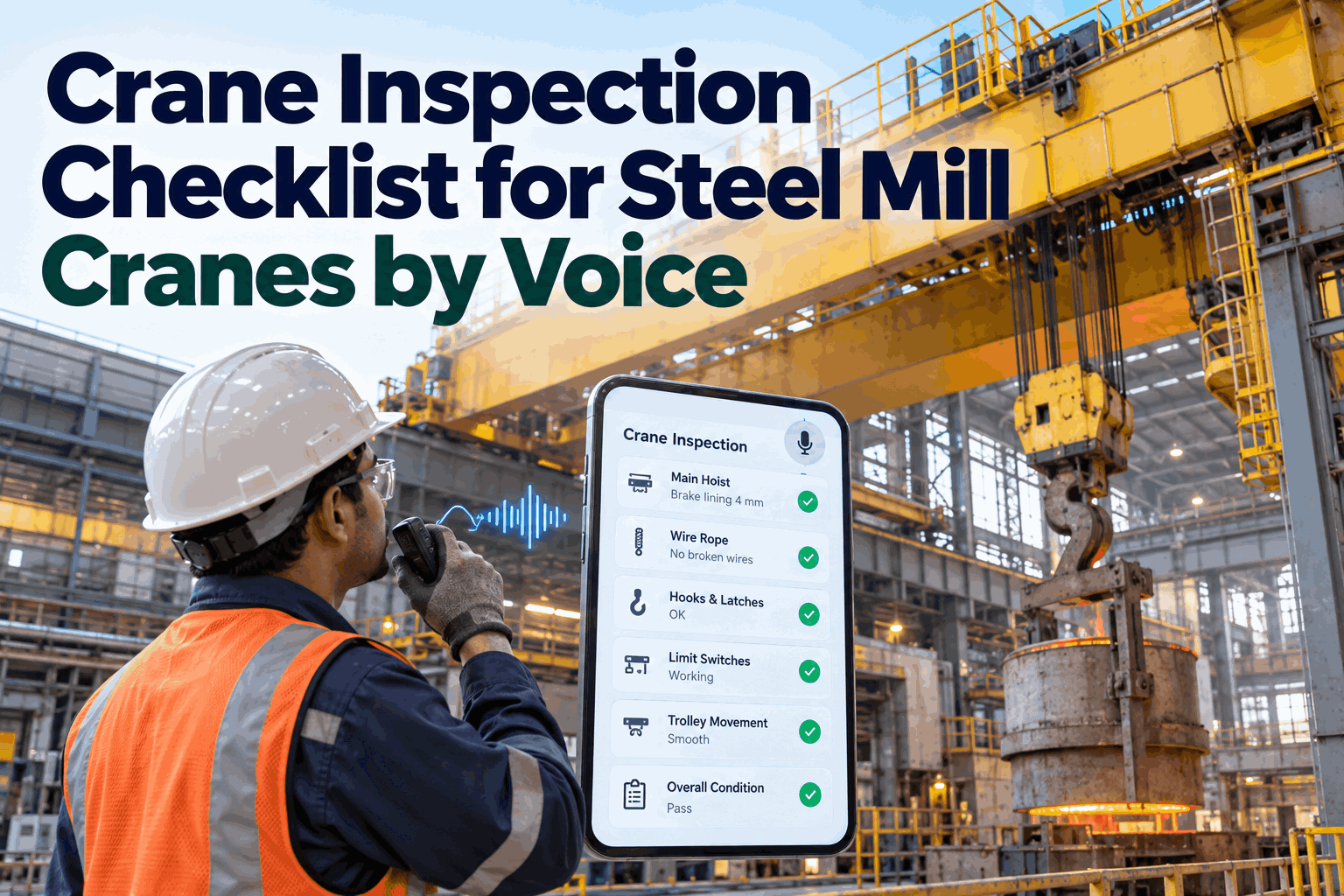
CranesOur steel mill crane inspection checklist goes item by item, with voice capture.
TundishOur voice tundish preparation checklist covers preheat and cast start holds.
LOTOOur voice LOTO verification guide covers the try-step and sign-off.
EAF panelsOur EAF panel leak detection guide covers flow balance and alarm tiers.
ConveyorsOur belt rip detection guide covers raw materials belts.
Daily safetyOur daily safety inspection guide covers area hazard rounds.
STEEL PLANT INSPECTION CHECKLIST TEMPLATES SOFTWARE

What Happens When an Item Fails

A failed item only counts if someone acts on it. In iFactory each template item carries a limit and a fail route, so the result is checked as it is spoken and a work order opens without anyone typing it up later. Set limits and routes for your templates with our support team.

1SpeakAsset, item and reading said aloud
2Read backEntry confirmed before it is saved
3CheckReading compared with the template limit
4Raise WOFail opens a work order with photo and asset
5CloseRepair and recheck logged against the item
STEEL PLANT INSPECTION CHECKLIST TEMPLATES BEST PRACTICES

Five Rules for Templates That Survive the Melt Shop

Long, vague forms get ticked from memory in the pulpit at the end of the shift. Short forms with clear limits get done at the equipment. Review your current forms in a form review.

01
Record the readingWrite the lining thickness or temperature, not a tick, so wear can be trended.
02
Count heats, not daysRefractory and gate checks follow heats and turnarounds, not the calendar.
03
Print the stop ruleSay on the form which fails take the asset out of service.
04
Use crew namesCall it "ladle seven" or "bay 2 ladle crane", the way crews say it on the radio.
05
Give every fail a routeFix now, work order, hold or tag-out, decided when the template is made.
STEEL PLANT INSPECTION CHECKLIST TEMPLATES FOR PLANT MANAGERS

Six Measures Worth a Weekly Look

Once templates are digital, the records show where the inspection program is strong and where it is slipping. Record a baseline in the first month, then review with maintenance and EHS together. Ask our support team for a sample weekly review.

On-time completionShare of due checklists done in their window, by area
Fail to work orderMinutes from a failed item to an open WO
Repeat failsSame item failing on the same asset within a month
Overdue regulated checksCrane, sling, LOTO and extinguisher records past due
Never-failed itemsItems that always pass, worth a review for value
Open holdsLadles, cranes or carriers held awaiting repair
COST AND ROI

Size the Paperwork Time With Your Own Numbers

The easiest value to count is the time spent writing up, keying in and filing forms. Faster repairs and cleaner audit trails matter more, but measure those after go-live. Every input below is assumed, to show the arithmetic only. Build the case with your figures in a value session.

Checklists completed per day, all shops90, assumed
Minutes per checklist to write up and key in3, assumed
Minutes per day90 × 3 = 270
Operating days per year360, assumed
Time per year270 × 360 = 97,200 min, or 1,620 hours

Multiply the hours by your own loaded labour rate. Leave avoided failures out of the sum until your own records show them.

TURNKEY AI DEPLOYMENT

Fifteen Steel Templates and an On-Site AI Server, Delivered Together

iFactory delivers the Checklist Library as a turnkey bundle. A pre-configured NVIDIA AI server ships racked and ready with the steel templates, the voice agent and the CMMS connector pre-loaded, so speech is processed inside the plant. You rack it, plug in power and Ethernet, and the AI is live. Scope it for your site with a turnkey quote.

What's Included
  • Pre-configured NVIDIA AI server, racked and ready
  • 15 steel inspection templates, every field open to edit
  • Voice completion with read-back on every item
  • Limits and stop rules loaded per asset
  • Automatic work orders on failed items
  • Rugged headsets or handhelds for inspectors
  • 24×7 remote monitoring of software and hardware
Live in 6–12 weeks
Wk 1–4
Install and Load

Server racked, templates matched to your forms, assets and limits loaded.

Wk 5–8
Pilot Two Shops

Voice checklists in the melt shop and crane bays, run beside paper.

Wk 9–12
Go-Live and Training

All shops live, crews trained on every shift, paper forms retired.

HOW iFACTORY FITS

A Checklist Library Built for Steel

One library for every steel inspection, completed hands-free and acted on at once. Our support team can walk you through a pilot plan.

1
Prebuilt steel templates. Cranes, ladles, furnaces, conveyors, mill stands and safety checks loaded on day one.
2
Fields you can edit. Add your asset IDs, OEM limits and stop rules without code.
3
Voice completion. Inspectors speak each result through gloves and noise, and every entry is read back.
4
Automatic work orders. Each failed item opens a WO with the asset, reading and photo attached.
1000+
Industrial clients running iFactory
99.9%
Platform uptime for round-the-clock mills
6-12 wks
From racked server to live voice checklists
FREQUENTLY ASKED QUESTIONS

What Plant Managers Ask About Steel Plant Inspection Checklist Templates

Which inspection checklists does a steel plant need?
Most need checks for cranes and rigging, ladles and tundishes, furnace cooling, hot metal vehicles, conveyors, hydraulics, mill stands, the roll shop, gas trains, lockout, fire protection and electrical gear. Your process route, risk assessments and the rules for your equipment decide the final list.
How often must overhead cranes be inspected?
OSHA 1910.179 sets frequent inspections at daily to monthly intervals and periodic inspections at 1 to 12 month intervals, depending on service. Hooks, hoist chains and ropes also need a monthly inspection with a certification record. Steel mill cranes usually sit at the short end of each range.
Are these free templates ready to use as they are?
Use them as a starting point. Copy the purpose, frequency, key items and standard onto your own forms, then add OEM limits, refractory supplier limits and your site stop rules before crews use them.
Is there a legal standard for ladle inspections?
There is no single OSHA rule that lists ladle lining checks. Limits come from the ladle maker and refractory supplier, and your molten metal procedures set the stop points. The cranes and rigging that lift the ladle do fall under OSHA 1910.179 and 1910.184.
Can voice records cover sling and lockout paperwork?
OSHA asks for a record of the most recent month each alloy chain sling was thoroughly inspected, and a certification of each periodic lockout inspection naming the equipment, date, employees and inspector. A voice entry stamped with time, user and asset can carry these details. Your safety team should confirm the format.
How do we start with the library?
Collect your current forms, match them to the 15 templates and pilot two areas, such as the ladle stand and crane bays, beside paper for two weeks. Our support team can help plan it.

Fifteen Steel Templates, No More Clipboards

Load the steel library, add your limits, complete checks by voice and let every failed item open its own work order. Delivered turnkey and live in 6 to 12 weeks.

Example shift · Steel checklist library
Checklists duePrompted by shop and shift
ReadingsSpoken, read back, checked
Failed itemsWork orders opened at once
Regulated recordsCrane, sling and LOTO kept
Every check traced to a person and a time

Share This Story, Choose Your Platform!