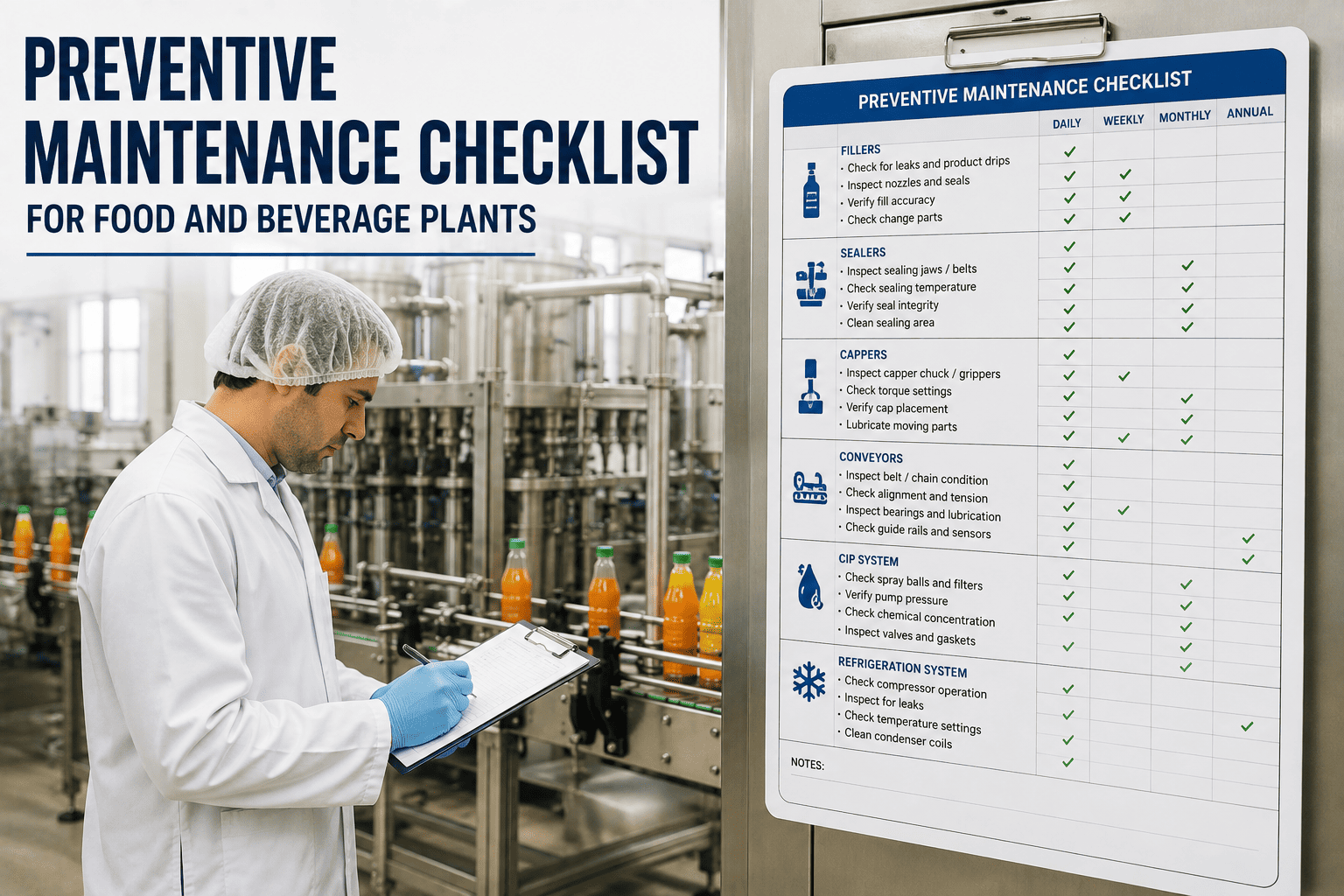
A food and beverage plant does not run on one machine — it runs on a filler, a capper or sealer, a line of conveyors, a CIP skid, and a refrigeration system all staying healthy at the same time, and each of them fails in its own way on its own timeline. A generic maintenance calendar treats them all the same and misses the specifics that actually cause downtime: a torque-drifting capper, a mistracking conveyor belt, a fouled condenser coil, a CIP cycle logging the wrong contact time. This checklist is built the way a maintenance team actually works — by equipment and by frequency, from daily operator checks through annual overhauls. Every task here can live as a scheduled, mobile work order in iFactory so nothing gets left on a clipboard between shifts. Start building your PM program — book a demo.
The Food-Specific PM Checklist Built by Equipment, Not by Guesswork
Fillers, sealers and cappers, conveyors, CIP, and refrigeration each fail differently and need their own schedule. This checklist maps every task to the machine it protects and the interval it belongs on — daily, weekly, monthly, and annual.
How Often Each Layer of Maintenance Should Run
Filling Machine PM Checklist
The filler sets your fill accuracy and, on high-throughput lines, your entire output ceiling. Fill drift wastes product on overfill and risks non-conforming underfill, so a documented sampling plan sits alongside the mechanical PM.
- Inspect and clean fill nozzles and nozzle seats for product buildup
- Check air and fluid lines for cracks, leaks, or blockages
- Verify fill volume against target on sample containers each hour
- Listen for grinding or rattling that signals worn bearings
- Tighten fasteners loosened by production vibration
- Inspect valve seals and gaskets for product leaks
- Check drive belts and chains for tension and wear
- Verify hopper level sensor calibration to prevent underfill
- Calibrate fill volume and flow instruments to setpoint
- Relubricate bearings with NSF H1 food-grade lubricant
- Inspect food-contact surfaces for pitting or corrosion
- Test fill-accuracy across the full container range
- Replace worn valve seats, seals, and wear components
- Full teardown and rebuild of filling heads
- Electrical thermography on drives and control panel
- Full-line fill-accuracy validation and documentation
Sealing and Capping Machine PM Checklist
Seal integrity is the single non-negotiable output of the sealing station — a failed seal leaks, contaminates adjacent product, and voids the shelf-life claim. Sealing jaws and capper bells are among the most frequently replaced components on the floor.
- Test crown or cap pickup with a steel test piece each run
- Inspect crown chute for bent or misshapen closures
- Verify closure orientation sensor rejects inverted caps
- Check applied torque on sample containers each hour
- Inspect sealing jaws for wear, pitting, and buildup
- Check capper head springs and clutch settings
- Clean and inspect closure feed track for misfeeds
- Verify torque tester calibration against reference
- Measure capper bell bore and crimp depth vs OEM limit
- Calibrate torque and seal-temperature controls
- Relubricate capper head with food-grade lubricant
- Inspect seal-jaw heaters and temperature uniformity
- Replace worn capper bells and sealing jaws
- Rebuild capping heads and torque clutches
- Full seal-integrity validation across the container range
- Replace closure feed-track wear components
Turn this checklist into scheduled work orders
iFactory takes every task on this page and puts it on the calendar, on your technicians' phones, with the parts, steps, and photo records attached.
Conveyor System PM Checklist
Conveyors run continuously in wet, cold, and washdown-heavy environments, which is exactly what wears belts, chains, and bearings fastest. A mistracking belt tips containers and starves the machines downstream of it.
- Inspect belt alignment and tracking for drift
- Clear debris from belt, chain, and transfer points
- Check visible lubrication points on chains and drives
- Listen for bearing noise or drive-motor strain
- Check belt tension and adjust tracking as needed
- Inspect chains and sprockets for wear and elongation
- Review drive-motor temperatures against baseline
- Inspect guide rails and transfer plates for wear
- Relubricate bearings and chains with food-grade grease
- Inspect and adjust gearbox and drive coupling
- Check belt splices and replace worn belt sections
- Verify emergency-stop and guard interlocks function
- Replace worn belts, chains, sprockets, and bearings
- Rebuild or replace drive gearboxes at wear limit
- Electrical thermography on all conveyor drive motors
- Full structural and guarding safety inspection
Clean-in-Place (CIP) PM Checklist
CIP is where maintenance and food safety meet — a spray ball, pump, or sensor out of spec can invalidate an entire cleaning cycle without anyone noticing until a swab fails. PM here protects both uptime and the sanitation record.
- Confirm cycle temperature, concentration, and time logging
- Check CIP supply and return pump operation
- Verify chemical tank levels and dosing operation
- Inspect hoses, fittings, and connections for leaks
- Inspect spray balls and nozzles for blockage or wear
- Check flow rate meets minimum turbulent velocity
- Verify conductivity and temperature sensor response
- Inspect valves and actuators for correct sequencing
- Calibrate conductivity, temperature, and flow sensors
- Verify return-line temperature matches supply-side
- Inspect and service CIP pump seals and impellers
- Confirm spray-ball coverage with a wetting test
- Full CIP validation against microbial swab results
- Replace worn spray balls, seals, and valve components
- Rebuild CIP supply and return pumps at wear limit
- Requalify sensors against certified reference standards
Refrigeration System PM Checklist
Refrigeration runs 24 hours a day and fails expensively — a dirty condenser is the number one cause of elevated head pressure and compressor overload, and grease and flour dust foul coils fast in a food environment.
- Verify cold-storage and setpoint temperatures each shift
- Visual compressor check for noise, vibration, or oil loss
- Record glycol supply and return loop temperatures
- Check for frost, ice buildup, or airflow blockage
- Clean condenser coils of grease, dust, and debris
- Audit defrost cycle operation and timing
- Record suction and discharge pressures vs baseline
- Inspect door seals and gaskets on cold rooms
- Analyze refrigerant charge and check for leaks
- Inspect electrical panels for heat and loose terminals
- Test compressor performance against rated capacity
- Verify temperature-monitoring and alarm systems
- Comprehensive compressor overhaul at service interval
- Electrical thermography on all refrigeration circuits
- Replace worn expansion valves and controls
- Full refrigerant-system compliance documentation
Get every asset on a schedule that runs itself
Stop rebuilding this checklist by hand for each line. iFactory auto-schedules PM by calendar, runtime, or cycle count and tracks completion to 90%+.
Common Questions About Food Plant PM Programs
Put Your Whole Food Plant PM Program in One Place
Fillers, cappers, conveyors, CIP, and refrigeration each have their own rhythm. iFactory keeps every one of them on schedule, on your technicians' phones, and audit-ready.