A reliability director doesn't want "AI for maintenance" in the abstract. They want to know whether it addresses the failure modes of their specific asset classes, whether it fits the RCM and FMEA framework they already run, and whether it moves the KPIs they're measured on — MTBF and MTTR. Most PdM pitches fail with this audience because they treat all rotating equipment as one undifferentiated thing, when each chemical-plant asset class fails its own way: a pump at the mechanical seal, a compressor at the valves or on surge, an agitator through torque drift, a heat exchanger through fouling and tube corrosion. A real platform isn't one model — it's a model per failure mode per asset class, which is what delivers 88 to 97 percent accuracy and a 78 percent cut in unplanned downtime. And it runs on-premise, at the edge, because chemical process data is sovereign and detection has to happen in milliseconds. You can book a demo to see it on your asset list.
A Predictive-Maintenance Platform That Speaks Failure Modes, Not Just "AI"
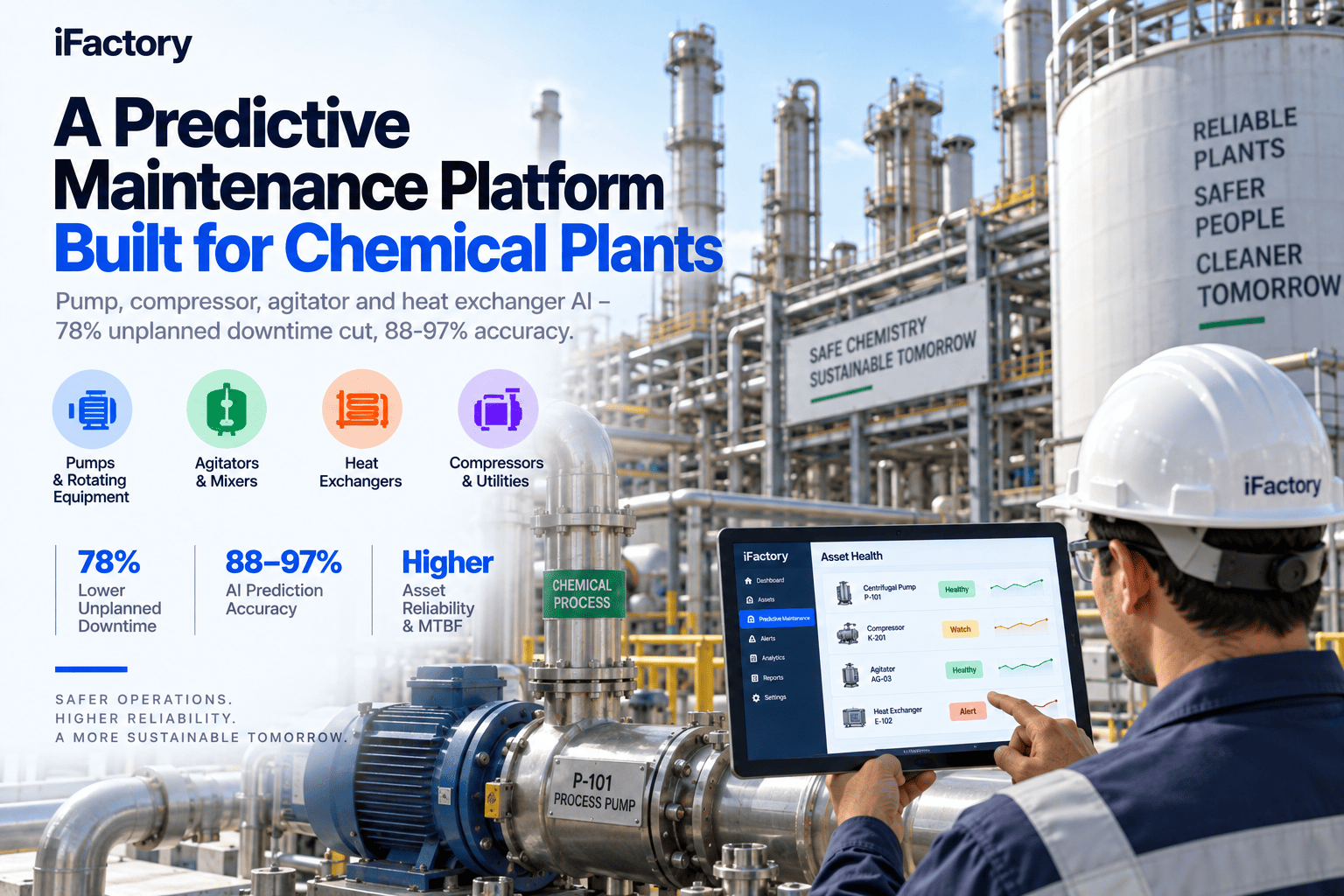
Pump, compressor, agitator, and heat-exchanger AI — a model per failure mode per asset class, fitted to your RCM and FMEA framework, delivering 88 to 97 percent accuracy and a 78 percent cut in unplanned downtime, all on-premise.
All Rotating Equipment Is Not One Problem
The reason so many PdM deployments disappoint reliability leaders is that they're built as one anomaly detector pointed at everything, when the discipline of reliability engineering is precisely about distinguishing failure modes. A platform that doesn't model the difference between a seal failure and a bearing failure can't earn a reliability director's trust — or reach the accuracy that makes its alerts actionable. These are the distinctions a real platform has to respect.
A centrifugal pump's failure signature, a reciprocating compressor's, and an agitator's have almost nothing in common. One model averaged across all of them is accurate for none — the per-asset-class modeling is what makes the prediction trustworthy.
Even within one pump, a seal failure, a bearing failure, and cavitation each announce themselves through different signatures. A model tied to the named failure mode — not a generic "something's wrong" — is what turns an alert into a specific, actionable diagnosis.
A model that cries wolf gets ignored, and reliability teams learn fast to tune out a noisy system. The 88-to-97-percent accuracy that failure-mode-specific modeling delivers is what keeps every alert credible enough to act on.
A reliability director already runs RCM and FMEA. A platform that ignores that framework and demands its own is dead on arrival — the right one executes the CBM decisions your RCM analysis already made, at a scale manual monitoring never could.
Where 50 to 60 Percent of Pump Repairs Actually Start
Centrifugal and positive-displacement process pumps are the workhorses and the biggest single maintenance line in most chemical plants, and their failures cluster on a small number of well-understood modes. Targeting those modes directly is what pushes pump MTBF from around 18 months toward 36-plus. This is what the platform watches on a pump.
Seals account for roughly 50 to 60 percent of pump repairs — the single largest mode. The platform tracks the leakage, temperature, and vibration precursors so a degrading seal is caught as a trend rather than as the leak that stops the line and releases process fluid.
Bearings are another 20 to 25 percent of repairs, and they're the textbook case for vibration analysis — the BPFO, BPFI, and harmonic signatures develop over weeks. This is where predictive detection has the longest, clearest runway.
Cavitation damage from suction or process-condition problems shows in the vibration spectrum and acoustic signature before it erodes the impeller. Catching it also surfaces the process condition causing it, not just the mechanical damage.
The remaining modes — coupling misalignment, impeller wear — round out the failure picture, each with its own detectable signature, so the pump's whole failure envelope is covered rather than just the obvious modes.
The Highest-Consequence Rotating Asset in the Plant
Reciprocating and centrifugal compressors are often the most critical and most expensive rotating equipment in a chemical plant, and an unplanned compressor trip can take a whole process unit down. Their failure modes are distinct from pumps and demand their own models. This is the compressor coverage.
Valve failures are the leading maintenance issue on reciprocating compressors, and they show in the pressure-time and vibration signatures per cylinder. The platform models each valve's signature so a failing one is isolated before it cascades.
Surge is the failure mode unique and catastrophic to centrifugal compressors — a flow reversal that can wreck the machine in seconds. Monitoring the approach to the surge line against real conditions is a distinct, high-value predictive job.
Journal and thrust bearings and rotor dynamics carry the same vibration-based predictability as other rotating equipment, but at a consequence level that makes early detection worth far more per event.
A compressor drawing a few percent more current over baseline, or losing efficiency, is often the earliest sign of a developing problem — a signal the platform catches in milliseconds against the machine's learned healthy signature.
See the Model Behind Every Asset Class
iFactory runs a failure-mode-specific model on each pump, compressor, agitator, and heat exchanger, so alerts name the mode and the fix — the accuracy and specificity a reliability program can actually build on.
The Asset Whose Failure Ruins the Batch Inside It
Reactor agitators are distinctive because their failure is entangled with the process they're driving — a torque drift or seal problem doesn't just threaten the equipment, it can ruin the batch in the vessel and create a containment concern. Their signatures live partly in the mechanical drive and partly in the process. This is what the platform monitors.
An agitator's torque signature drifting inside a reactor jacket is a leading indicator of both a mechanical problem and a process change — the platform tracks it as one of the most telling signals a reactor gives.
The agitator seal is a containment boundary on a vessel that may hold hazardous or high-value contents, so its degradation is both a reliability and a safety signal, monitored for the leakage and temperature precursors that precede failure.
The drive gearbox and bearings carry standard rotating-equipment vibration signatures, caught weeks ahead — but on an asset where an unplanned stop mid-batch is far more costly than the repair itself.
Misalignment and shaft issues on a long agitator shaft show in vibration and are worth catching early, because the consequences of a failure propagate into the reactor rather than staying with the machine.
The Static Asset That Fails Slowly and Predictably
Heat exchangers are the one non-rotating asset class in the set, and their value in a PdM program is that they degrade in slow, highly predictable ways — fouling and corrosion — that are ideal for trending. Catching them is as much a process-efficiency win as a reliability one. This is the heat-exchanger coverage.
A heat exchanger's differential pressure climbing above its fouling threshold is a clean, trendable signal that it needs cleaning — and modeling it lets cleaning be scheduled at the economic optimum rather than a fixed calendar date or a performance crisis.
Tracking the exchanger's actual heat-transfer effectiveness against its design reveals fouling and degradation as an efficiency loss, so the energy cost of a dirty exchanger is visible and priced, not just the eventual failure.
Ultrasonic thickness data and corrosion-rate trending feed the platform, so tube wall loss in corrosive service is tracked toward its limit — the mechanical-integrity data that also feeds the PSM audit.
Cross-contamination and leak indicators are caught early, which matters most where a tube leak mixes process streams that must not meet — a safety and quality event, not just a maintenance one.
Every Prediction Feeds the MTBF, FMEA, and PSM Record
What separates a PdM platform from a bolt-on sensor system, for a reliability director, is whether it feeds the reliability program rather than sitting beside it. Every prediction and every failure has to become structured data that improves the FMEA and proves mechanical integrity. This is how the platform closes the loop your program depends on.
Every alert auto-generates a work order coded to the named failure mode, so the intervention is captured as structured reliability data — building the MTBF, MTTR, and bad-actor history your program runs on rather than a pile of unstructured repairs.
When a failure occurs that the analysis said shouldn't, or a mode appears that wasn't captured, the data flows back so the FMEA is updated on real evidence — the feedback loop that separates plants with improving reliability from those that stagnate.
Because chemical plants run under OSHA PSM and mechanical-integrity standards, the failure-coded history and the thickness and condition trends are exactly the evidence a PSM audit demands — audit-ready as a byproduct of running the program.
The reliability engineer sees asset health as a trend across the whole fleet, so the program is managed on data rather than on who remembers which pump has been trouble — the shift from reactive to genuinely predictive.
On-Premise, Sovereign, and Fitted to Hazardous-Area Reality
A chemical plant imposes constraints a generic cloud PdM tool ignores — data sovereignty, latency, hazardous-area instrumentation, and existing sensors. The platform is built around them rather than asking the plant to work around it. These are the deployment realities it respects.
Sensor data is processed locally on-premise with no cloud round-trip, so detection happens in milliseconds and process data never leaves the plant — the sovereignty and latency a chemical operation requires, not a cloud service it has to trust.
The platform connects to the vibration, temperature, pressure, current, and acoustic sensors you already run over OPC-UA, Modbus, MQTT, and PROFINET — no rip-and-replace, with non-invasive clamp-on sensors added to legacy assets in hours.
Class I Division 1/2 area classifications restrict instrumentation to intrinsically safe or explosion-proof equipment, and the monitoring approach is designed around those limits rather than assuming a sensor can go anywhere.
Not every asset needs a sensor — RCM's own logic decides which assets and failure modes warrant CBM, and the platform is deployed against that tiering, so engineering effort lands on the critical assets, not spread thin across the trivial ones.
Failure-Mode Models, KPI Impact, One On-Premise Platform
iFactory delivers PdM for a chemical plant the way a reliability director needs it: failure-mode-specific models across pumps, compressors, agitators, and heat exchangers, fitted to your RCM and FMEA framework, closing the loop into MTBF and PSM evidence, and running on-premise at the edge — a 78 percent downtime cut backed by 88-to-97-percent accuracy.
What Reliability Directors Ask About the PdM Platform
Give Your Reliability Program Failure-Mode Intelligence at Scale
iFactory runs failure-mode-specific PdM across your pumps, compressors, agitators, and heat exchangers, fits your RCM and FMEA framework, feeds MTBF and PSM evidence, and runs on-premise at the edge — a 78 percent downtime cut backed by 88-to-97-percent accuracy.