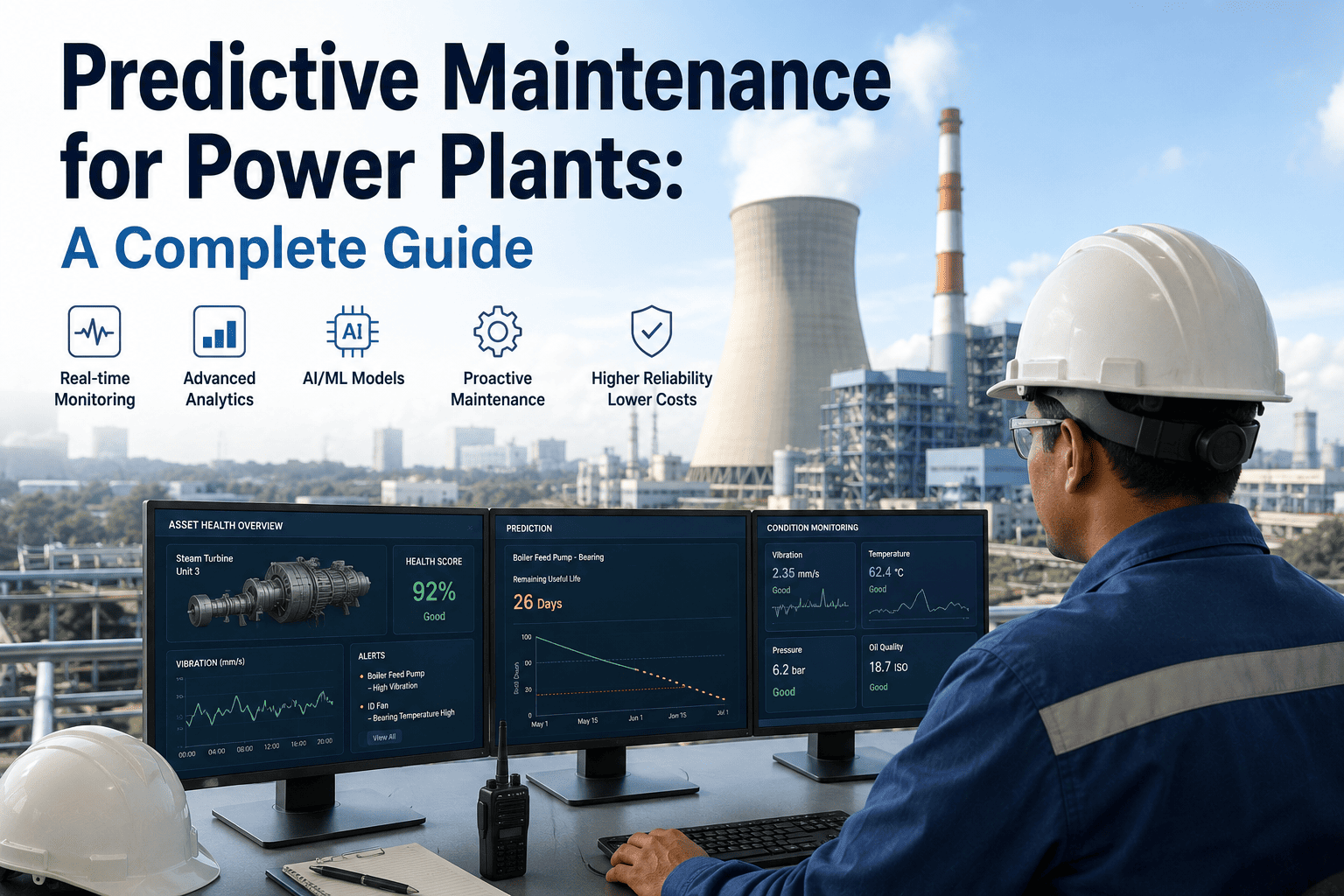
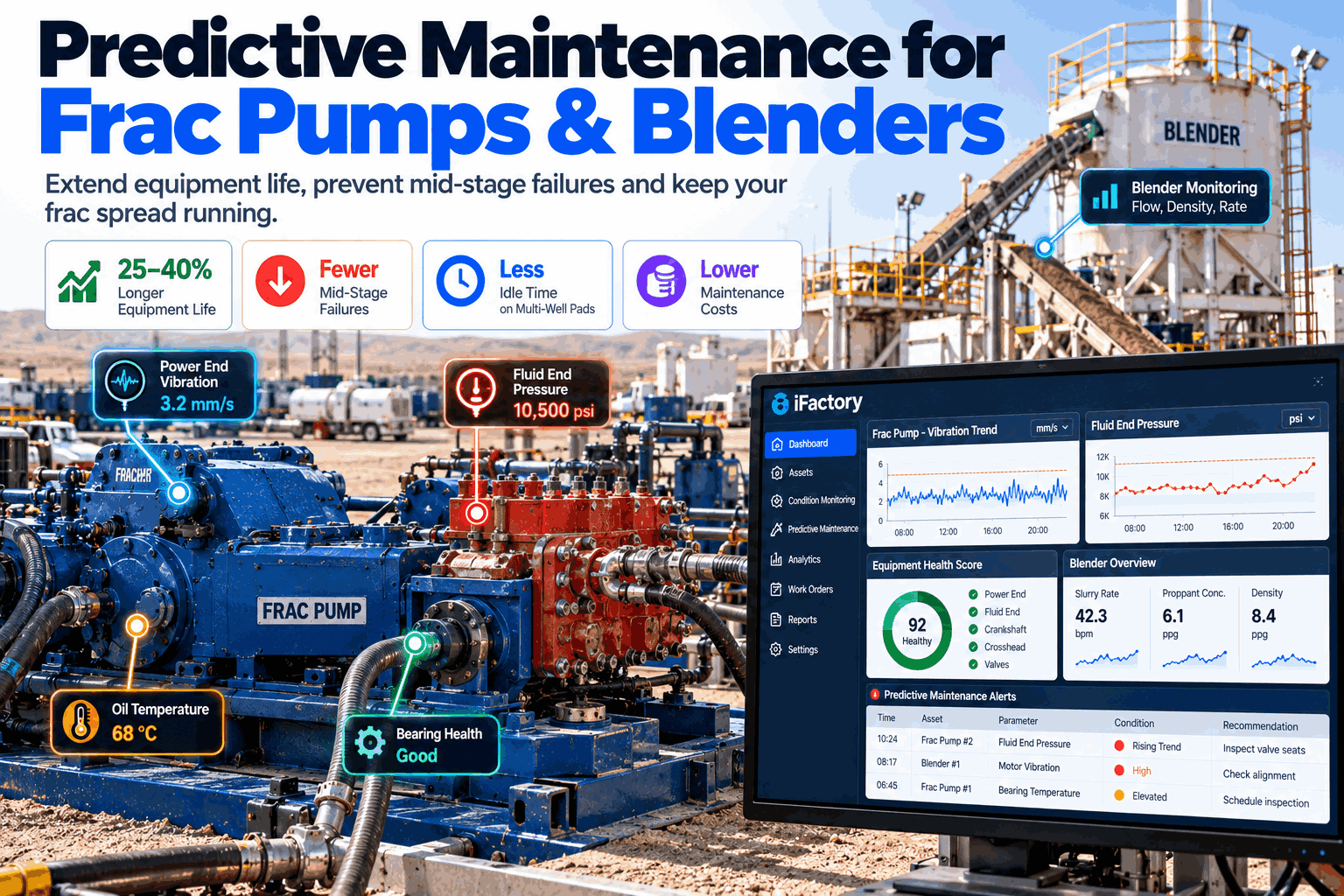
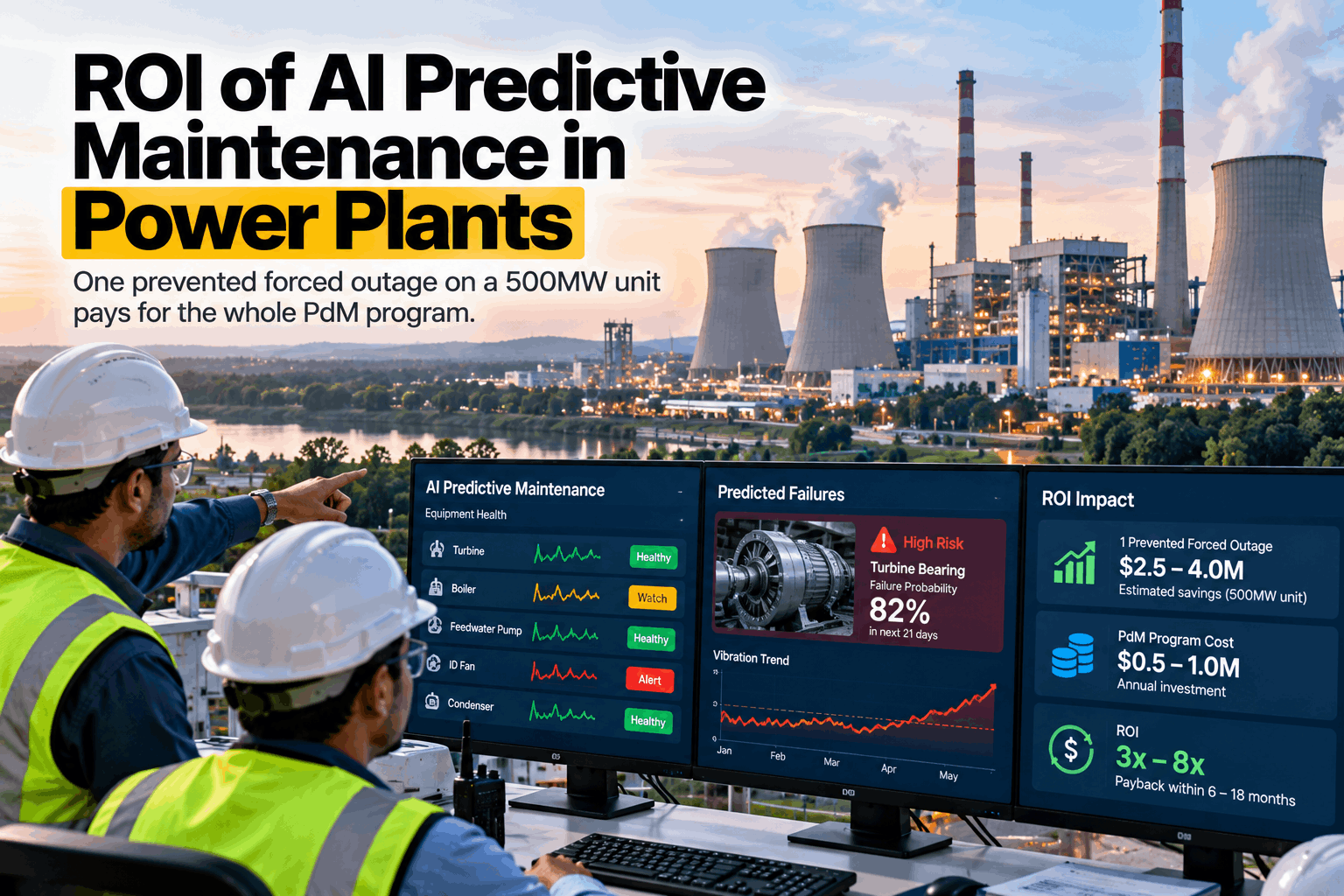
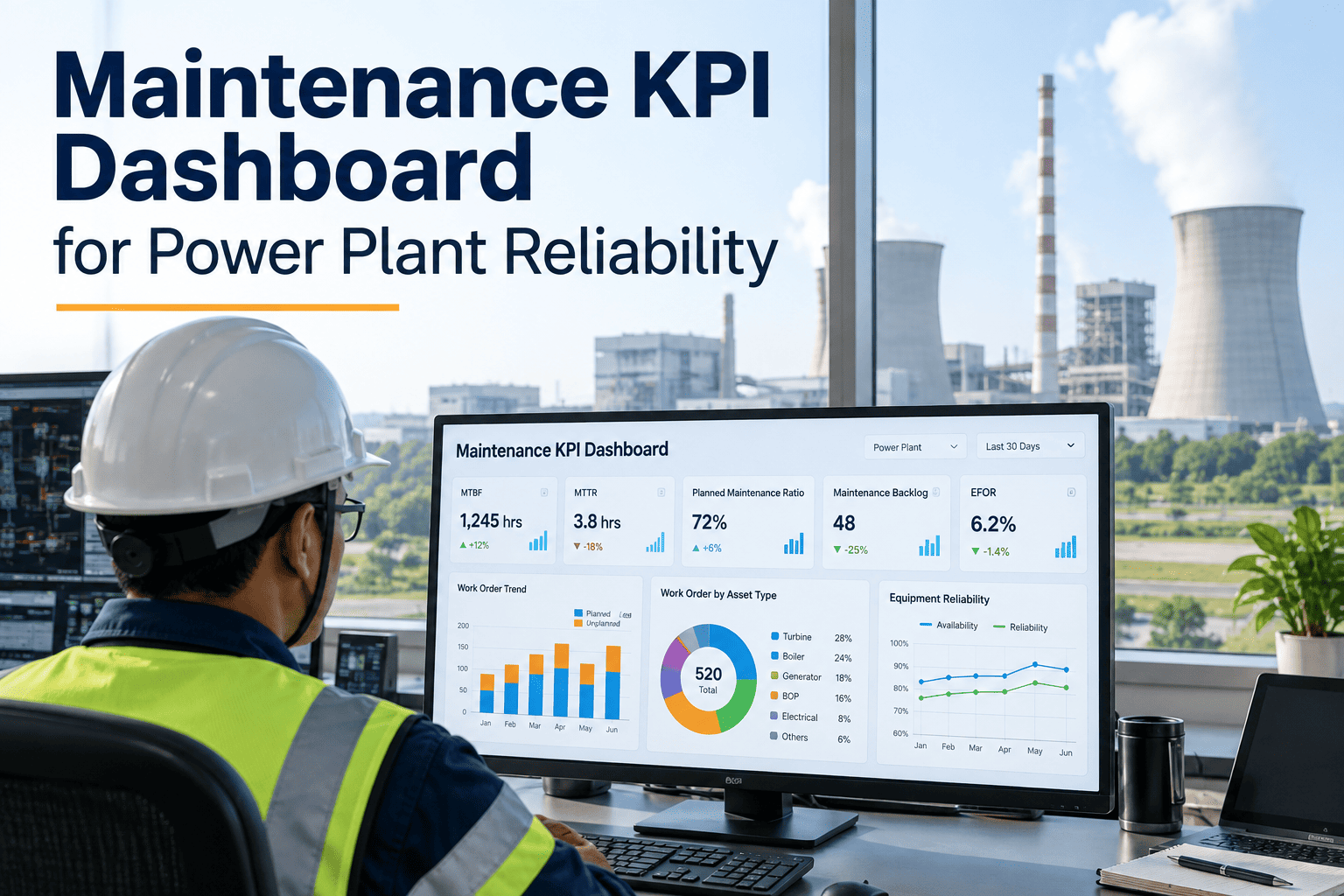
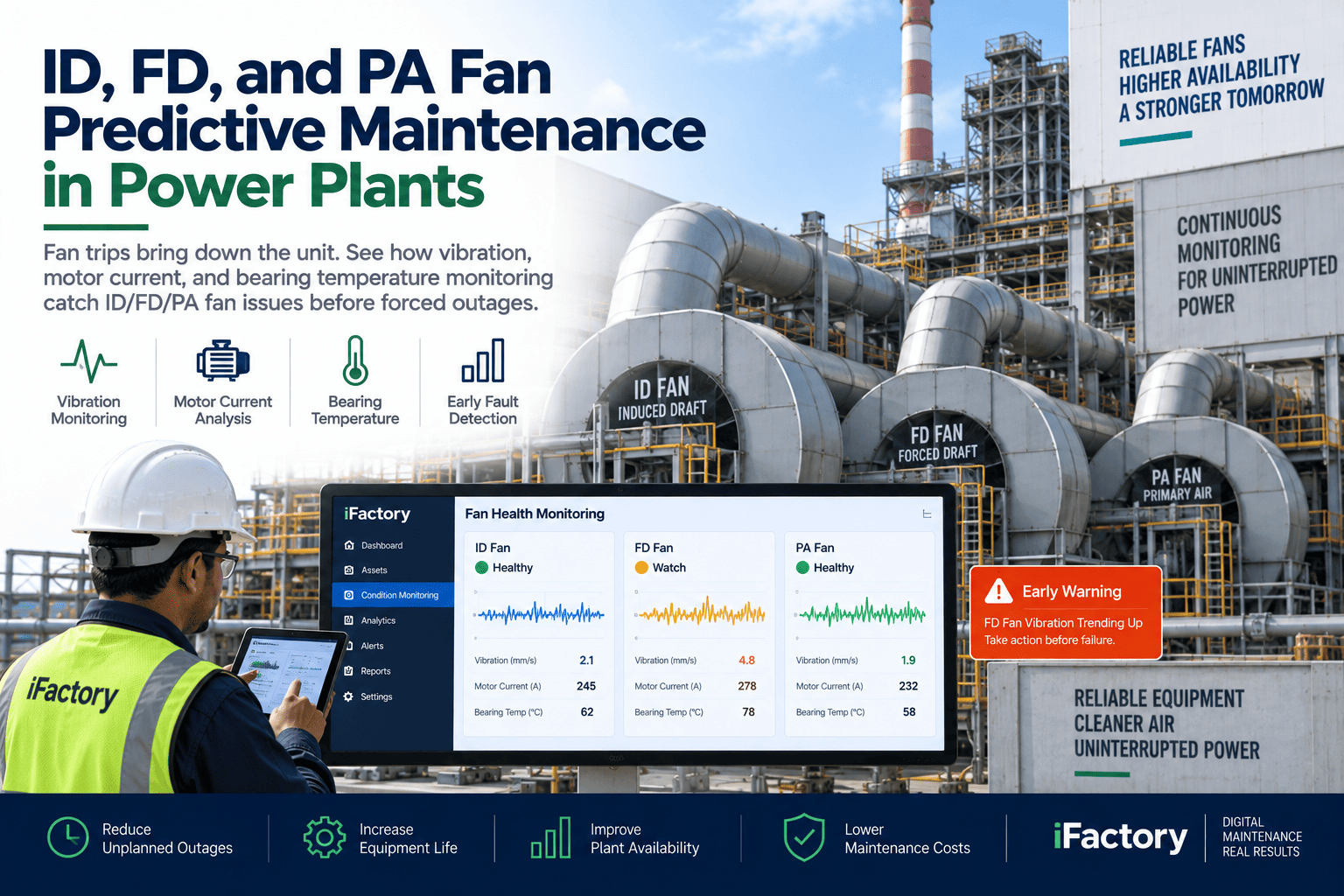
Power plants lose an estimated $50 billion a year to unplanned equipment failures — and most facilities are still on calendar-based maintenance that treats a turbine bearing showing early spalling exactly like one running perfectly. The gap between those two is where the money leaks. Predictive maintenance closes it, but only when three things line up: the right sensors capturing the signals that precede failure, machine-learning models that turn those signals into a forecast, and a rollout that actually gets acted on rather than generating alerts nobody owns. A single prevented gas-turbine failure is worth $500,000 to $2 million in avoided repair and lost generation, which is why this is one of the highest-ROI applications of industrial AI in generation. This guide covers the sensors, the models, and the rollout. To see it on your fleet, book a demo.
MAINTENANCE RELIABILITY · POWER GENERATION · PREDICTIVE MAINTENANCE
Real Predictive Maintenance on Power Generation Assets
Sensors, models, and a rollout that gets acted on — the three things that separate working PdM from an alert stream nobody trusts. See what to monitor, which models forecast failure, and how to deploy without stalling on a full-facility sensor project.
WHAT'S AT STAKE
The Numbers That Make the Case
$50B
Lost each year across power generation to unplanned equipment failures
$500K–2M
Cost of a single catastrophic turbine failure in repair and lost generation
35–50%
Downtime reduction reported by plants that adopt predictive maintenance
95%
Of predictive-maintenance adopters report positive ROI, 27% inside the first year
Time-based maintenance cannot address the variable conditions — load cycling, fuel-quality shifts, ambient swings, steam-chemistry variation — that actually accelerate degradation. That is why condition-based prediction, not a fixed calendar, is where the reliability gains come from.
PART ONE · THE SENSORS
What to Monitor, and What Each Signal Catches
Predictive maintenance starts with the right measurement. Each technique below detects a different failure mode, and the highest-value programs layer several across their critical assets rather than betting on one.
Vibration Analysis
The highest-ROI technique for rotating equipment — bearing pedestals and casing accelerometers capture spectral signatures that flag bearing wear, imbalance, and misalignment on the turbine train 3 to 6 months ahead of failure.
Infrared Thermography
Thermal imaging finds hot spots in electrical connections, switchgear, and transformer bushings, and rising exhaust or bearing temperatures — a 12°C exhaust rise is a classic degradation signal — before they become failures.
Oil & Lube Analysis
Particle counts and wear-metal trends in lube-oil samples reveal bearing and gear degradation from inside the machine, catching wear that surface measurements miss on turbines, pumps, and gearboxes.
Motor Current Signature
MCSA reads the motor's own current draw to detect rotor-bar, winding, and load faults without added sensors — a cost-effective way to cover balance-of-plant motors and pumps at scale.
Dissolved Gas Analysis
DGA tracks gases dissolved in transformer oil to catch insulation breakdown and partial discharge, giving weeks-to-months warning on high-value transformer and generator-stator faults.
Ultrasonic & Acoustic
Ultrasonic detection finds early bearing defects, steam-trap leaks, and valve passing, and pairs well with MCSA as low-cost coverage across the balance of plant where full vibration monitoring isn't justified.
Start with the data you already have
Your SCADA and DCS historians already hold months of asset-health data. iFactory ingests that history to build baselines and start detecting anomalies before a single new sensor is purchased.
PART TWO · THE MODELS
Turning Sensor Streams Into a Failure Forecast
Raw sensor data is not prediction. A working model is built in four layers, and skipping any one is why so many programs stall with data they can't act on. Good features matter more than the choice of algorithm.
1
Historical Data Ingestion
Pull 12 to 24 months of SCADA tags, vibration spectra, oil-lab results, trip logs, and maintenance history, then label the failure events by mode — bearing wear, blade fouling, combustion instability — so a supervised model can learn each pattern.
2
Feature Engineering
Transform raw signals into model-ready features — RMS vibration trend, spectral kurtosis, bearing-defect frequencies, exhaust-spread deviation, ramp-rate stress counters, temperature rate-of-change. This is where most of the accuracy is won or lost.
3
Fault Classification
Train a Random Forest or gradient-boosted model to classify the fault type, so an alert says not just "something is wrong" but which failure mode is developing — the difference between an actionable work order and a vague warning.
4
Remaining-Useful-Life Regression
Train an LSTM or survival model to estimate remaining useful life, converting a detected fault into a failure window the team can schedule against — the output that lets a repair land in a planned outage instead of a forced one.
Plants that complete all four layers typically cut unplanned turbine downtime 30 to 50 percent within the first operating cycle. Models trained on SCADA and condition-monitoring history detect bearing, blade, and combustion anomalies with 85 to 95 percent accuracy, giving reliability teams a 5 to 20 day advance warning window.
BY ASSET CLASS
What Fails, What It Costs, and How Far Ahead You See It
Different generation assets fail differently and carry different consequences. This maps the major asset classes to the signals that predict their failures and the warning window a model realistically provides.
| Asset Class |
Primary Failure Modes |
Key Signals |
Warning Window |
| Gas / Steam Turbine |
Bearing wear, blade fouling, combustion instability |
Vibration spectra, thrust-bearing temp, lube-oil particles |
3–6 weeks |
| Boiler / HRSG |
Tube leaks, creep, fatigue cracking |
Thickness trending, temperature, chemistry |
Weeks |
| Generator |
Stator degradation, rotor faults, excitation issues |
Partial-discharge signatures, temperature, shift-log anomalies |
Weeks |
| Transformer |
Insulation breakdown, partial discharge |
Dissolved gas analysis, oil condition |
Weeks–months |
| Balance of Plant |
Pump-bearing failure, fan degradation, tube fouling |
MCSA, ultrasonic, vibration |
Days–weeks |
Build the model on your plant, not a generic template
iFactory trains asset-specific models on your historian, maintenance logs, and failure records — so the failure signatures it learns are your equipment's, at your load profile and fuel mix.
PART THREE · THE ROLLOUT
Deploying PdM Without Stalling on a Full-Sensor Project
The programs that fail try to instrument the whole plant before proving anything. The ones that work start with existing data, prove ROI on the critical few, and expand from documented wins. Here is that sequence.
1
Load Historian Data Before Buying Sensors
Your SCADA and DCS historians already contain months or years of asset-health data. Load it first — it establishes the baselines that make anomaly detection accurate from day one, before any capital sensor purchase.
2
Start on the Highest-Consequence Assets
Put continuous vibration monitoring on the gas-turbine bearing train first — the single highest-ROI application, where one prevented failure is worth $500K to $2M. Prove the approach where the stakes justify it, not across every motor at once.
3
Define the Response Protocol Before the First Alert
Decide who receives alerts, what the response window is, and who authorizes an intervention window — before the first alert fires. Programs without defined response protocols see 60 percent of early alerts go unacted on, which turns prediction into noise.
4
Route Predictions Into Work Orders Automatically
A prediction only prevents a failure if it becomes a scheduled job. Feed the model's alerts straight into the maintenance system as prioritized work orders timed to the window between early detection and functional failure, so nothing depends on someone watching a dashboard.
5
Expand From Documented ROI
Once your first prevented failure generates documented savings, use that evidence to fund expansion to balance-of-plant motors, pumps, and cooling systems, where MCSA and ultrasonic give cost-effective coverage at scale.
FREQUENTLY ASKED QUESTIONS
Common Questions About Power Plant Predictive Maintenance
Do we have to install a full sensor network before we see any value?
No — the fastest path starts with the data you already have. SCADA and DCS historians typically hold months or years of asset-health data, and loading that history establishes the baselines that make anomaly detection accurate from day one, before any new sensor is purchased. From there, continuous monitoring is added to the highest-consequence assets first, usually the turbine bearing train, and expanded from documented ROI. Trying to instrument the entire plant before proving anything is the most common way these programs stall.
How much advance warning does a model realistically give?
It depends on the asset and the failure mode, but models trained on SCADA and condition-monitoring history commonly detect bearing, blade, and combustion anomalies with 85 to 95 percent accuracy and a 5 to 20 day advance window, with continuous vibration monitoring on turbine bearings extending that to 3 to 6 months for slow-developing wear. The point of the window is to move a repair out of a forced outage and into a planned one — even a few weeks is usually enough to schedule parts, labor, and an intervention window rather than scramble.
Which sensor technique should we start with?
For most plants, continuous vibration monitoring on the gas-turbine bearing train delivers the highest ROI, because a single prevented turbine failure is worth $500K to $2M and the warning window is long. Beyond that, the strongest programs layer techniques by asset — infrared thermography on electrical assets, dissolved gas analysis on transformers, oil analysis on lubricated machines, and MCSA or ultrasonic for cost-effective balance-of-plant coverage. The right mix is driven by which assets carry the highest failure consequence at your plant.
Why do so many predictive programs generate alerts nobody acts on?
Because the response protocol was never defined before the alerts started. Programs without a clear answer to who receives an alert, what the response window is, and who authorizes an intervention see roughly 60 percent of early alerts go unacted on — the prediction was correct, but nothing happened. The fix is deciding those roles before the first alert fires and routing predictions straight into the maintenance system as prioritized work orders, so acting on them is the default rather than a judgment call someone has to remember to make.
Where does iFactory fit in a predictive maintenance program?
iFactory is the predictive analytics and AI layer that ingests your plant's historian streams, maintenance logs, and failure records to build asset-specific models — identifying degradation signatures, forecasting failure windows, and generating prioritized work orders automatically, without manual threshold-tuning. It works from the sensor and historian data you already collect and feeds its predictions into your maintenance workflow, so the model's output becomes scheduled work rather than another dashboard to watch.
Contact our support team to scope a program around your specific asset mix.
SENSE IT, PREDICT IT, SCHEDULE IT
Turn Your Plant's Sensor Data Into Failures Caught Weeks Early
The right sensors, models trained on your own assets, and a rollout that turns predictions into scheduled work. iFactory builds asset-specific predictive models from the historian data you already have — catching turbine, boiler, and generator failures 1 to 6 weeks before they happen.