Unplanned downtime costs manufacturing plants $50,000 to over $1 million per hour depending on industry — and the average facility experiences 800 hours of unplanned downtime annually. The predictive maintenance market reached $14.29 billion in 2025 and is projected to grow at 27.9% CAGR to $98.16 billion by 2033, driven by manufacturers who have proven that AI-driven predictive maintenance delivers 10:1 to 30:1 ROI within 12-18 months. The data is overwhelming: organizations implementing AI predictive maintenance achieve 30-50% reduction in unplanned downtime, 18-25% lower maintenance costs, 20-40% extension in equipment lifespan, and 73% fewer infrastructure failures. Modern AI systems predict equipment failures 30-90 days in advance with 80-97% accuracy — giving maintenance teams ample time to plan interventions during scheduled downtime instead of reacting to catastrophic breakdowns. A poorly maintained motor alone consumes 10-15% more energy; multiply that across hundreds of assets and the waste is staggering. iFactory deploys AI-powered predictive maintenance across motors, bearings, pumps, compressors, gearboxes, conveyors, and electrical systems — analyzing vibration, temperature, current, pressure, and acoustic data in real time to predict failures weeks before they happen and auto-generate prioritized work orders.
Reactive vs Preventive vs Predictive: The Maintenance Evolution
Most manufacturers still operate on a mix of reactive ("fix it when it breaks") and preventive ("service it on a schedule regardless of condition") maintenance. Both approaches have fundamental flaws that AI predictive maintenance eliminates.
Fix When It Breaks
Downtime is always a surprise. Emergency labor rates, expedited parts, cascading damage to adjacent equipment. A $2,000 bearing replacement becomes a $25,000 emergency when the bearing seizes and damages the shaft, housing, and coupling.
Cost: 4-6x planned maintenanceService on Schedule
Over-services healthy equipment. Under-services equipment that's quietly degrading between intervals. Replaces bearings at 10,000 hours even if they have 15,000 hours of life remaining — wasting parts and labor on assets that don't need attention.
Cost: 18-25% more than neededFix When Data Demands It
Service equipment when sensor data and AI analysis indicate actual degradation — not before, not after. Interventions planned during scheduled downtime. Equipment runs to 85-95% of rated service life instead of being replaced prematurely.
Saves: 30-50% vs reactive, 18-25% vs preventiveHow AI Predictive Maintenance Works
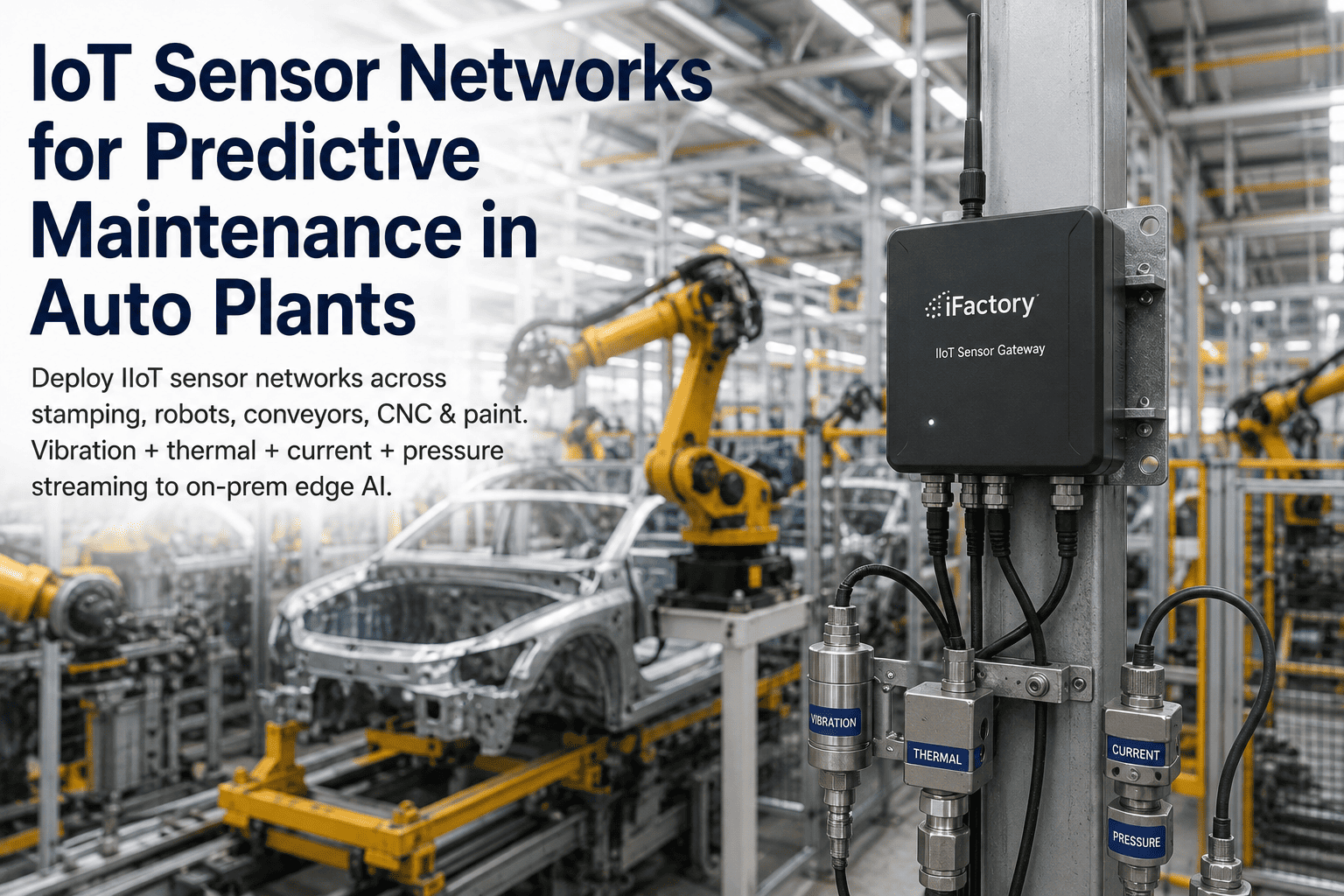
IoT sensors continuously stream vibration, temperature, current, pressure, and acoustic data from your equipment. AI models learn what "normal" looks like for each asset under every operating condition — then detect subtle anomalies that precede failure weeks or months before breakdown occurs.
Sensor Data Collection
Vibration, temperature, current draw, pressure, and acoustic sensors stream data continuously from motors, bearings, pumps, compressors, and gearboxes. Works with existing sensors or new wireless IoT retrofits.
AI Pattern Recognition
Machine learning models trained on your equipment's operating data learn normal baselines — then detect anomalies: subtle vibration frequency shifts, temperature drift, current signature changes that precede specific failure modes.
Failure Prediction
AI predicts failures 30-90 days in advance with 80-97% accuracy. Remaining Useful Life (RUL) calculated for each monitored component — enabling precise scheduling of interventions during planned downtime windows.
Auto Work Order
When AI detects degradation, iFactory automatically generates a prioritized work order with failure mode, severity, RUL, recommended action, and optimal repair window — pushed to SAP PM, Maximo, or iFactory CMMS.
Equipment Types: What AI Monitors and How It Predicts Failure
Each equipment type has distinct failure signatures that AI models learn to detect. iFactory trains equipment-specific models that understand the vibration, thermal, and electrical patterns unique to each asset class.
Bearing Wear, Winding Insulation, Misalignment
AI detects bearing defect frequencies in vibration spectra 30-60 days before failure. Winding insulation degradation tracked via current signature and thermal monitoring. Misalignment detected through asymmetric vibration patterns.
Advance warning: 2-8 weeksCavitation, Seal Leakage, Impeller Wear
Cavitation produces distinctive high-frequency vibration detectable by AI before pump damage begins. Seal degradation tracked through pressure differential and vibration. Impeller wear detected via flow rate deviation against power consumption.
Advance warning: 3-6 weeksValve Degradation, Lubrication, Capacity Loss
Valve flutter and seat wear produce acoustic signatures AI identifies weeks before efficiency drops below threshold. Oil degradation tracked through particle counting and viscosity analysis. Capacity loss correlated with suction/discharge pressure trends.
Advance warning: 4-10 weeksTooth Wear, Bearing Defects, Lubrication
Gear mesh frequency analysis detects tooth pitting, scoring, and breakage patterns weeks before catastrophic failure. Oil analysis integration correlates particle counts with specific gear stage degradation. Bearing envelope analysis pinpoints failing components.
Advance warning: 3-8 weeksBelt Wear, Idler Failure, Drive Issues
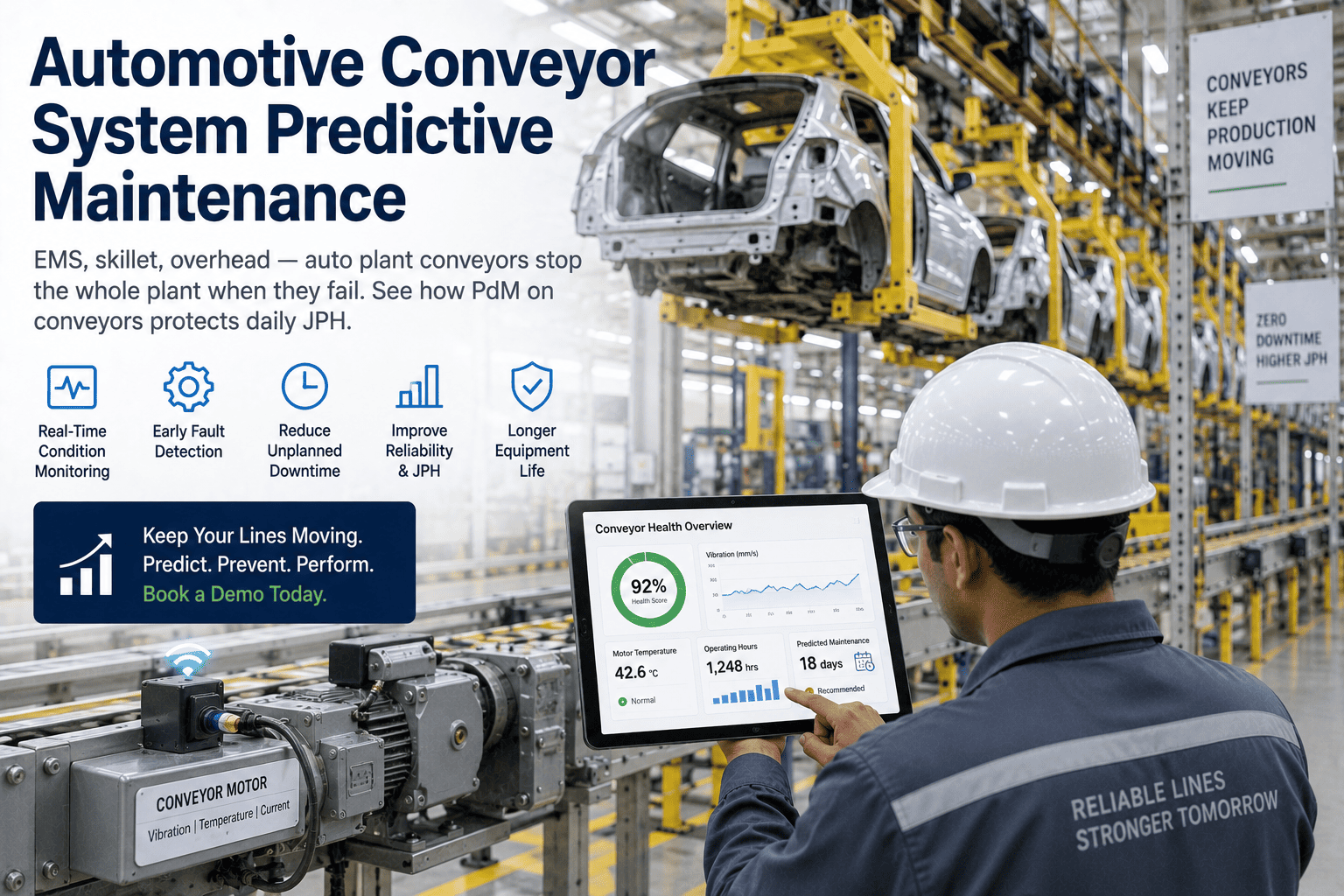
Belt tension and tracking monitored through vibration and acoustic sensors. Idler bearing failures detected via localized vibration spikes. Drive motor current signature analysis identifies chain/sprocket wear and coupling degradation.
Advance warning: 2-6 weeksConnections, Switchgear, Transformers
Thermal imaging detects overheating connections (85-90% of electrical faults caught). Partial discharge monitoring for switchgear insulation. Transformer oil analysis via dissolved gas analysis (DGA) for winding health assessment.
Advance warning: 30-90 daysProven ROI: What Manufacturers Actually Achieve
The financial case for AI predictive maintenance is not theoretical. Documented deployments across automotive, aerospace, energy, and general manufacturing consistently deliver returns that exceed initial projections.
Downtime Reduction
Unplanned downtime cut by 30-50% in year one. For a plant with $50K/hr downtime cost and 800 hrs annual unplanned downtime, a 35% reduction saves $14M annually.
Maintenance Cost Cut
Targeted condition-based interventions replace blanket time-based PM schedules. Equipment serviced only when data demands it — eliminating unnecessary parts and labor spend.
Equipment Life Extension
Components run to 85-95% of rated service life instead of premature replacement. For a $250K compressor, a 40% life extension represents $100K in deferred CapEx.
PwC Documented ROI
IoT-based predictive maintenance delivers $7 return for every $1 invested (PwC research). Automotive manufacturer saved $4.2M in year one from a single servo motor monitoring application.
Servo motor failures in high-speed stamping presses caused 12-hour line stoppages costing $500,000+ per event in lost production.
AI models trained on vibration and current signature data identified specific patterns preceding motor winding failure — predicting failures 21 days in advance with 98% accuracy.
$4.2M saved in year one. Zero unplanned downtime from servo motor failure. Maintenance scheduled during planned line stops. Paid for the entire IoT deployment in the first year.
Deploy in 3 Phases: Pilot to Full-Scale
The recommended approach: start with 5-10 critical assets where failure costs are highest, prove ROI within one quarter, then scale. No enterprise-wide transformation required upfront. Most organizations achieve 60-70% of projected savings within the first quarter post-implementation.
Assess & Pilot
Identify Tier 1 critical assets (highest downtime cost, longest replacement lead time). Deploy sensors on 5-10 machines. AI baseline learning requires 2-4 weeks of normal operating data. First anomaly alerts within 30 days.
Validate & Expand
Refine prediction models based on real maintenance outcomes. Expand to 50-100 assets across production lines. Integrate with CMMS for auto work orders. Train maintenance teams on AI alerts and dashboards.
Scale & Optimize
Full deployment across all critical and semi-critical assets. Advanced analytics: failure mode correlation, spare parts optimization, energy efficiency monitoring. Continuous model improvement as prediction accuracy reaches 95%+.
Frequently Asked Questions
Your Equipment Is Telling You It's About to Fail. Start Listening.
iFactory deploys AI predictive maintenance across your critical assets — motors, pumps, compressors, gearboxes, conveyors, and electrical systems — predicting failures 30-90 days in advance and auto-generating work orders before breakdowns happen.