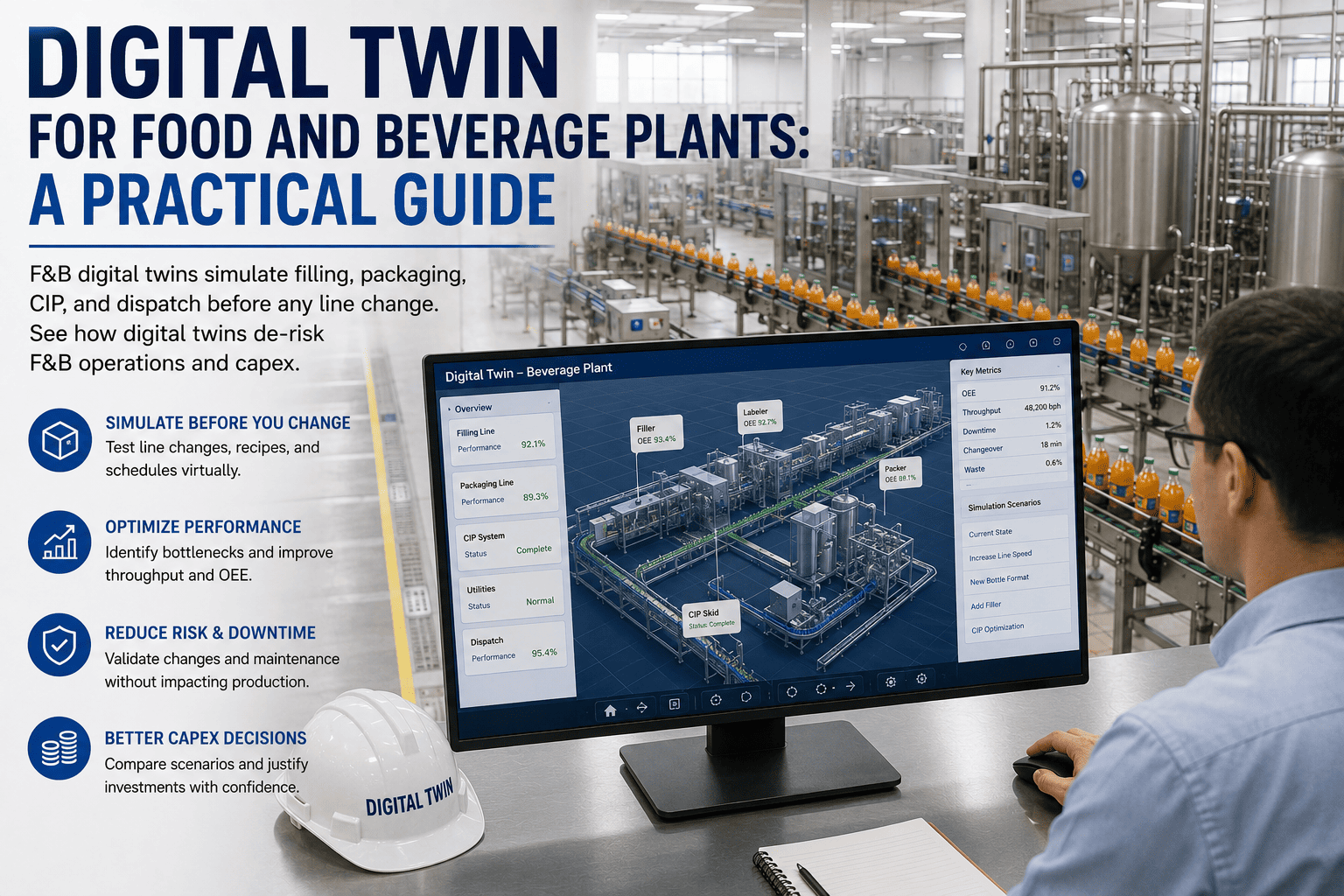
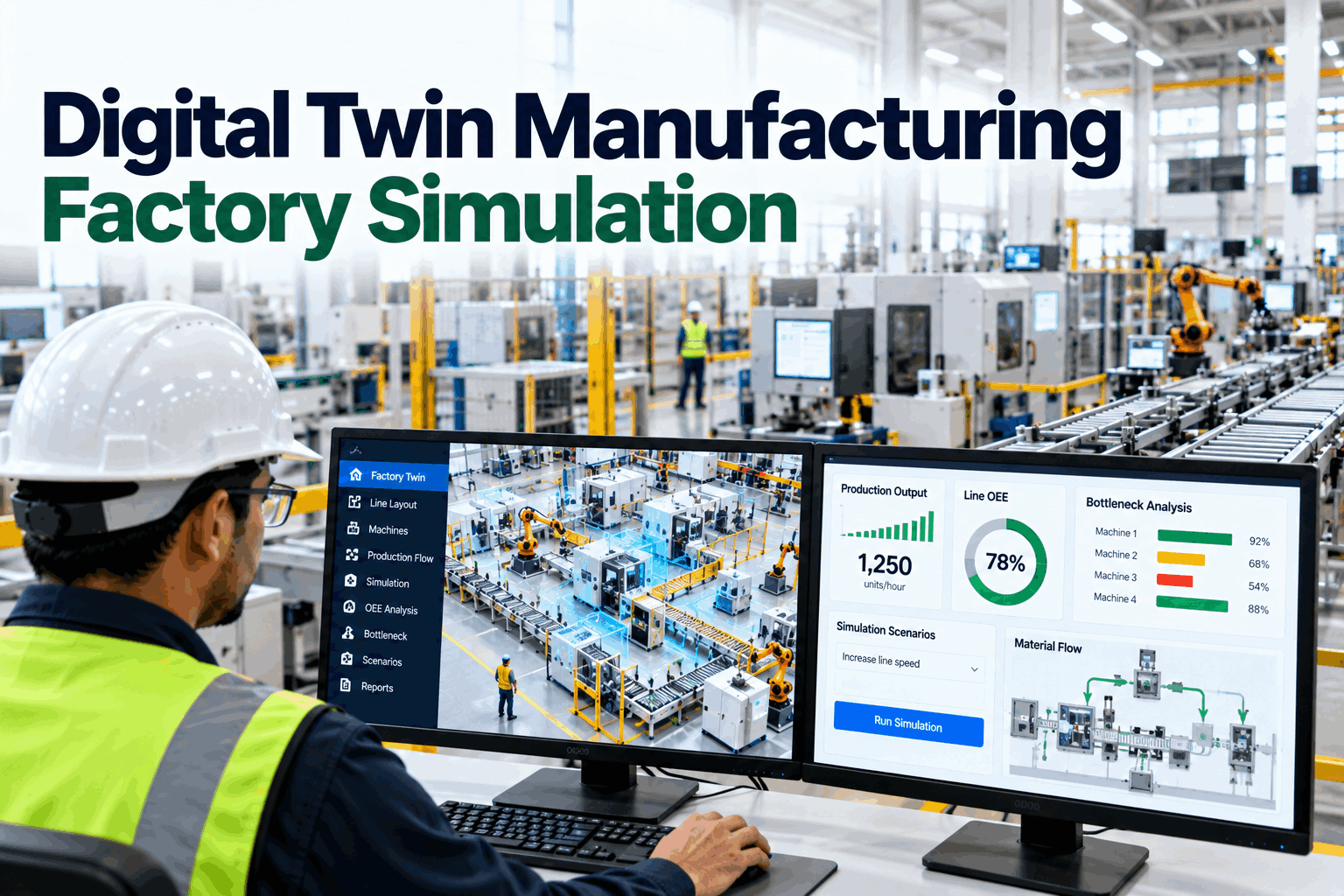
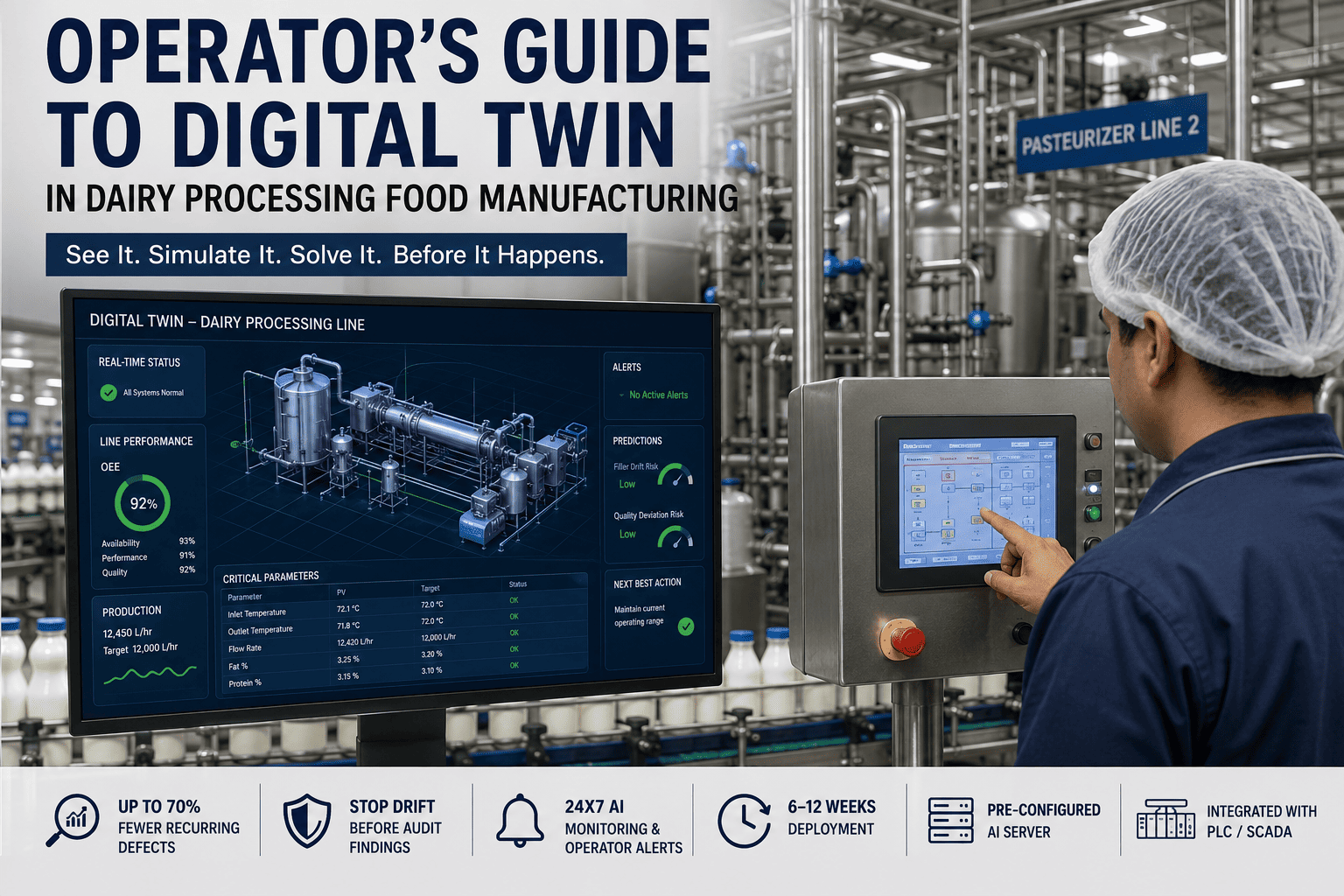
Every meaningful change on a food or beverage line carries the same risk: you cannot know exactly how a new SKU, a faster filler, a re-sequenced CIP window, or an added shift will behave until you have already committed the equipment, the material, and the production time to find out. A digital twin removes that gamble. It is a live, physics-accurate virtual replica of your plant, synced to real sensor data, that lets you run the changeover, the line-speed increase, or the new cleaning schedule virtually first — and see the throughput, scrap, and downtime impact before you touch a single machine on the real floor. This guide explains how a food and beverage digital twin actually works, the domains where it pays, and how to start without boiling the ocean. To see it modeled on your own line, book a demo.
PROCESS & ENGINEERING · FOOD & BEVERAGE · DIGITAL TWIN
Test Every Line Change Virtually Before It Costs You on the Floor
A food and beverage digital twin is a live, sensor-synced replica of your plant that simulates filling, packaging, CIP, and dispatch. Run the changeover, the speed increase, or the capex decision in the model first — and commit only what the data proves out.
FIRST, THE DISTINCTION THAT DECIDES ROI
A Digital Twin Is Not a Simulation — and Confusing Them Is Expensive
Most people use the terms interchangeably, and that is one of the costlier mistakes in manufacturing technology. The difference is not academic; it decides whether the investment keeps paying back or goes stale the week after it is built.
Traditional Simulation
A static model built once from historical data to answer a single design question — how big a buffer, how many lanes. Once the question is answered, the model is done and starts drifting from reality immediately.
Digital Twin
A continuously updated virtual replica connected to live sensor data. It evolves with your actual equipment, learning your specific wear patterns, product mix, and failure history — so it stays accurate as the plant changes and answers new questions on demand.
THE FOUR DOMAINS WHERE AN F&B TWIN PAYS
Filling, Packaging, CIP, and Dispatch — Modeled End to End
A food and beverage twin is not one model but a connected set covering the four zones where line decisions carry the most risk and the most recoverable value. Each answers a different "what happens if" question before the change is committed.
Model fill accuracy, valve behavior, and micro-stoppages that are too brief to trigger a downtime log but frequent enough to bleed real output. The twin quantifies the gap between a line's theoretical throughput and its actual runrate, then isolates the causal chain — changeover friction, seal-wear hesitation, or upstream flow restriction.
Fill-accuracy modeling
Micro-stoppage detection
Throughput-gap analysis
A discrete-event model of every station — filler, capper, labeller, packer, palletizer — running lock-step with the live PLCs and encoders. It shows which station is the true bottleneck, where OEE is bleeding, and how the next changeover will hit throughput, so an accumulator size or a line-speed change can be tested across hundreds of virtual configurations before one bolt is moved.
Bottleneck identification
Changeover simulation
Accumulator sizing
Simulate CIP sequencing, timing, and chemical parameters against both your regulatory requirements and your production schedule. By predicting fouling from actual product runs, temperatures, and flow rather than a fixed calendar, the twin finds the cleaning window that neither over-cleans (wasting time and chemicals) nor under-cleans (risking contamination).
Fouling prediction
CIP window tuning
Sanitation compliance
Model how upstream line decisions ripple into finished-goods flow, cold-storage load, and dispatch timing. Compressor degradation, refrigerant charge, and condenser fouling are tracked to flag cold-chain risk before it compromises product, and schedule changes can be stress-tested for their effect on downstream capacity and on-time dispatch.
Cold-chain risk modeling
Finished-goods flow
Dispatch scheduling
See which domain would pay back first on your line
iFactory scopes a twin around your highest-value zone — usually a filling or packaging bottleneck — and proves the ROI before you scale it plant-wide.
THE DECISIONS A TWIN LETS YOU TEST FIRST
Every "What Happens If" You'd Rather Not Learn on the Real Line
The point of a twin is not the model — it is the decisions it de-risks. These are the changes food and beverage plants most often commit blind, and that a twin lets you run virtually before spending time, material, or capex.
"What if we add a third shift?"
See the effect on asset utilization and failure risk before the shift ever starts, rather than discovering the stress on a compressor or filler after it fails.
"What if we run this new SKU?"
Model the changeover time, the OEE hit, and the slowest sub-step before scheduling it, so a new bottle size or fill recipe is a planned cost, not a surprise.
"What if we speed up the filler 5%?"
Test whether the downstream capper, labeller, and accumulator can absorb the increase, or whether you would simply move the bottleneck somewhere more expensive.
"What if we re-sequence CIP?"
Try a new cleaning window against sanitation rules and the production schedule in the model, before a real change risks a failed swab or a missed run.
"What if we buy the bigger accumulator?"
Quantify the availability gain from a capex item before you sign the PO, so the spend is justified by simulated output, not a vendor's estimate.
"What if this asset fails next month?"
Model the downstream batch, CIP, and throughput impact of an at-risk asset flagged weeks early, so maintenance and production can plan one coordinated response.
Stop learning these answers on the live line
iFactory runs your next changeover, speed change, or capex decision virtually first — so you commit the version the model proves, not the one you hoped would work.
CHANGING BLIND VS. CHANGING WITH A TWIN
What De-Risking a Line Change Actually Looks Like
The change still happens either way — the twin does not replace the engineering decision, it informs it. What changes is whether the first time you see the outcome is in a model you can iterate for free, or on a line where every wrong guess costs material and runtime.
| Decision Factor |
Committing the Change Blind |
Testing It in the Twin First |
| Where you first see the result |
On the live line, after committing resources |
In the model, before touching the floor |
| Cost of a wrong guess |
Lost material, runtime, and possibly a run |
A re-run of the simulation, at no floor cost |
| Changeover planning |
Historical playbook, one fixed sequence |
Hundreds of sequences compared for the fastest |
| Capex justification |
Vendor estimate and best judgment |
Simulated availability and throughput gain |
| Failure response |
Reacting once the breakdown happens |
Planned 2–4 weeks ahead from an early flag |
| Model accuracy over time |
Static — drifts from reality immediately |
Live — stays synced to real sensor data |
HOW TO START WITHOUT BOILING THE OCEAN
The Practical Path From Asset Record to Live Twin
A full plant twin is the destination, not the starting point. The pragmatic route builds value at each step, so the data foundation a twin needs is laid while earlier stages already pay for themselves.
1
Build a Connected Asset Record
Start with a complete, connected register of your assets and their available sensor data — the foundation every later stage depends on, which already delivers condition-based maintenance value on its own.
2
Pick One High-Value Bottleneck
Model a single zone where the payback is clearest — usually a filling or packaging line where micro-stoppages or changeover losses are visibly bleeding output — rather than the whole plant at once.
3
Sync the Model to Live Data
Connect the model to the line's PLCs, encoders, and sensors so it runs lock-step with reality and its recommendations reflect the plant as it is today, not as it was at commissioning.
4
Prove ROI in One Quarter
Use that first twin to test real decisions — a changeover, a speed change, a CIP window — and measure the result against the previous baseline before committing to wider rollout.
5
Scale Across the Plant
Extend the twin from the proven zone to adjacent lines and the four domains, connecting filling, packaging, CIP, and dispatch into one model of how a change in one ripples through the rest.
FREQUENTLY ASKED QUESTIONS
What Process and Engineering Teams Ask About F&B Digital Twins
How is a digital twin different from the simulation software we already use?
Traditional simulation is a static model built once from historical data to answer a single design question, then it stops updating and drifts from reality. A digital twin stays connected to live sensor data and evolves with your actual equipment, learning your specific wear patterns, product mix, and failure history. That live connection is what lets it answer new questions accurately months after it was first built, rather than becoming a snapshot that is out of date the week after commissioning.
Do we need to instrument the whole plant before we get any value?
No — the practical path starts with a connected asset record and one high-value bottleneck, not full plant instrumentation. Establishing that register and connecting available sensor data delivers condition-based maintenance value immediately while building the foundation a fuller twin needs later. Most plants prove ROI on a single filling or packaging zone in about a quarter before extending the model to adjacent lines and the other domains.
Can a twin actually help with CIP without risking sanitation compliance?
Yes, because the twin simulates CIP sequencing, timing, and chemistry against your regulatory requirements first, rather than shortening cycles blindly. By predicting fouling from actual product runs, temperatures, and flow instead of a fixed calendar, it targets the window that avoids both over-cleaning and under-cleaning. The change is validated in the model against compliance rules before anything is altered on the real cleaning cycle, so sanitation standards remain the constraint the optimization works within.
Where does our data live, and does the twin depend on the cloud?
iFactory runs the twin on-premise, so your plant data stays in the plant rather than being sent off-site. The deterministic discrete-event simulation and the machine-learning residual run on an on-site compute stack, with power and a network drop the only things you provide. It is structured as a one-time capital purchase in which you own the line model, the ML weights, the OEE archive, and the underlying data, rather than renting continuous access to your own operational history.
What kind of decisions give the clearest payback first?
The fastest returns usually come from changeover sequencing, line-speed changes, and capex sizing decisions on a bottleneck line, because those are the changes most often committed blind today. Testing hundreds of configurations virtually to find the fastest changeover, or quantifying an accumulator's availability gain before signing the PO, converts guesses into measured decisions. CIP window tuning and early failure modeling typically follow once the first zone has proven the approach on your own numbers.
COMMIT WHAT THE MODEL PROVES, NOT WHAT YOU GUESS
Put Your Next Line Change Through the Twin First
Filling, packaging, CIP, and dispatch — every high-stakes change tested virtually before it costs time, material, or output. iFactory builds the twin around your highest-value line and proves the return before you scale.